

fig9
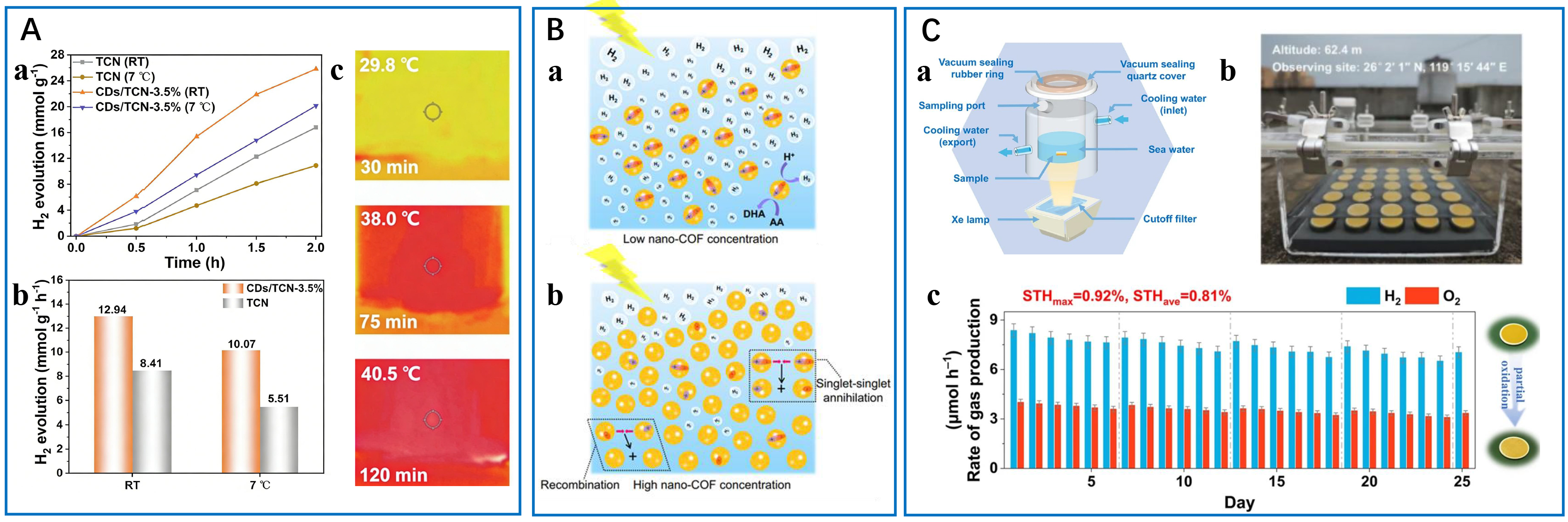
Figure 9. Additional optimization during photocatalytic reaction. (A) Photothermal-assisted photocatalytic water splitting into hydrogen: (a) photocatalytic H2 generation from water splitting and (b) H2 evolution rates of TCN and CDs/TCN-3.5% at different temperatures; (c) photothermal mapping images of CDs/TCN-3.5% under full-spectrum irradiation in the photocatalytic water splitting process. This figure is quoted with permission from Lu et al. Copyright (2022) Elsevier B.V[50]; (B) Free charge carriers produced in nano-COFs at (a) low concentration and (b) high concentration (ascorbic acid: AA; dehydroascorbic acid: DHA). This figure is quoted with permission from Zhao et al. Copyright (2025) Springer Nature[101]; (C) Porous microreactor chip for photocatalytic seawater splitting: (a) schematic illustration of the reaction system, (b) the optical image of an outdoor setup, and (c) stability test of as-prepared Ag3PO4/CdS chip photocatalysts. Each cycle is 12 h. This figure is quoted with permission from Zhu et al. Copyright (2025) Springer[51]. CDs/TCN: Carbon dot-modified tubular carbon nitride; COFs: covalent organic frameworks; STH: solar-to-hydrogen.