
fig4
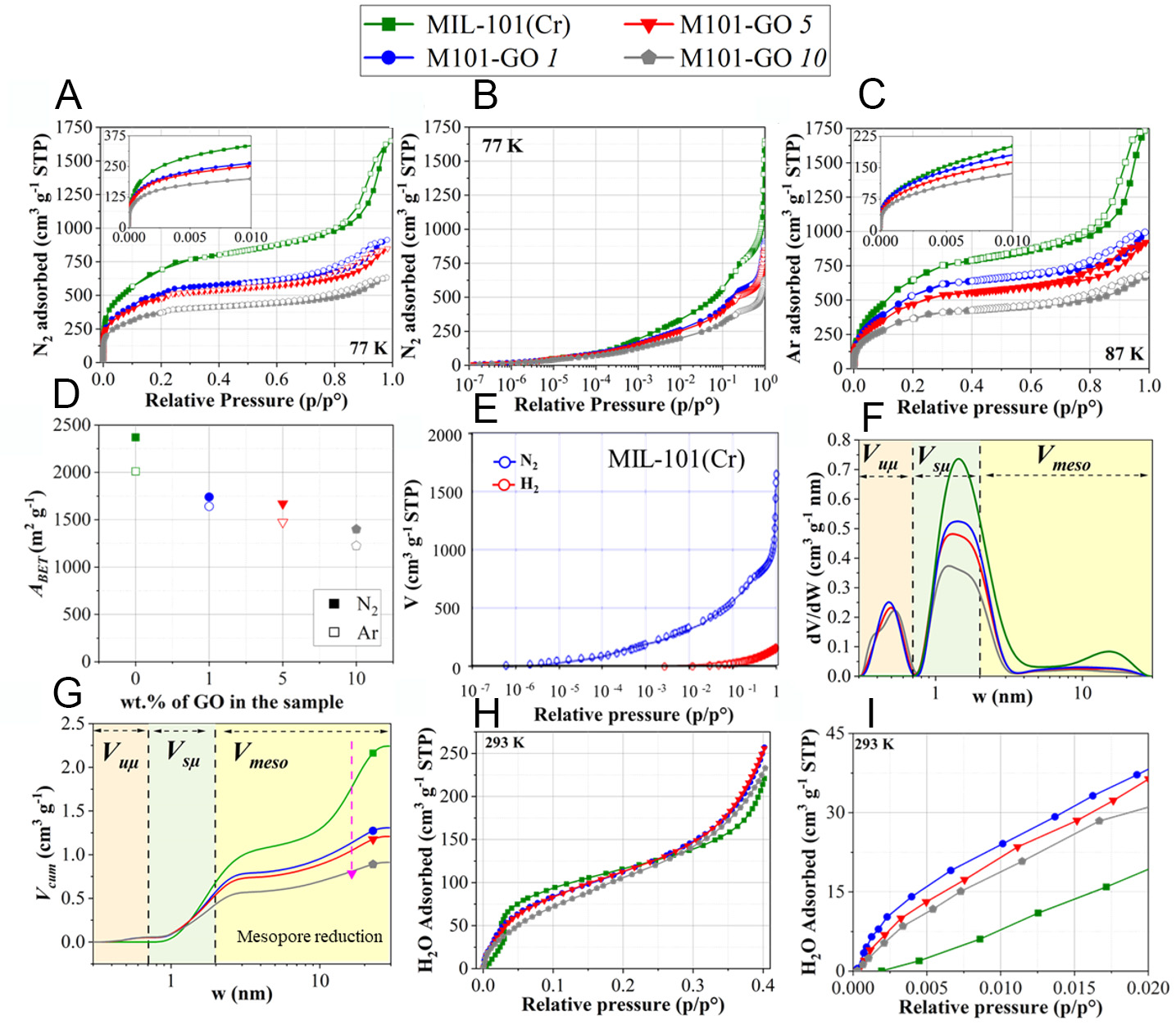
Figure 4. Textural characteristics of pure MIL-101(Cr) and its GO-based hybrids: (A) N2 adsorption-desorption isotherms at 77 K (the inset shows a zoom at p/p < 0.01); (B) N2 adsorption-desorption isotherms at 77 K in semi-logarithmic scale; (C) Ar adsorption-desorption isotherms at 87 K (the inset shows a zoom tat p/p < 0.01); (D) ABET obtained from N2 and Ar isotherms; (E) 2D-NLDFT fitting for heterogeneous surfaces using N2 and H2 isotherms for bare MIL-101(Cr); (F) Pore size distribution and (G) cumulative pore volume as a function of pore width; (H) Water adsorption isotherms at 293 K for pure MIL-101(Cr) and its hybrids with various GO contents; (I) Zoomed-in view of (H) highlighting the water affinity region.