


Recent developments in electro/photo chemical reduction of CO2 by ligand-protected Cu nanoclusters with precise crystal structures
 0
0 Abstract
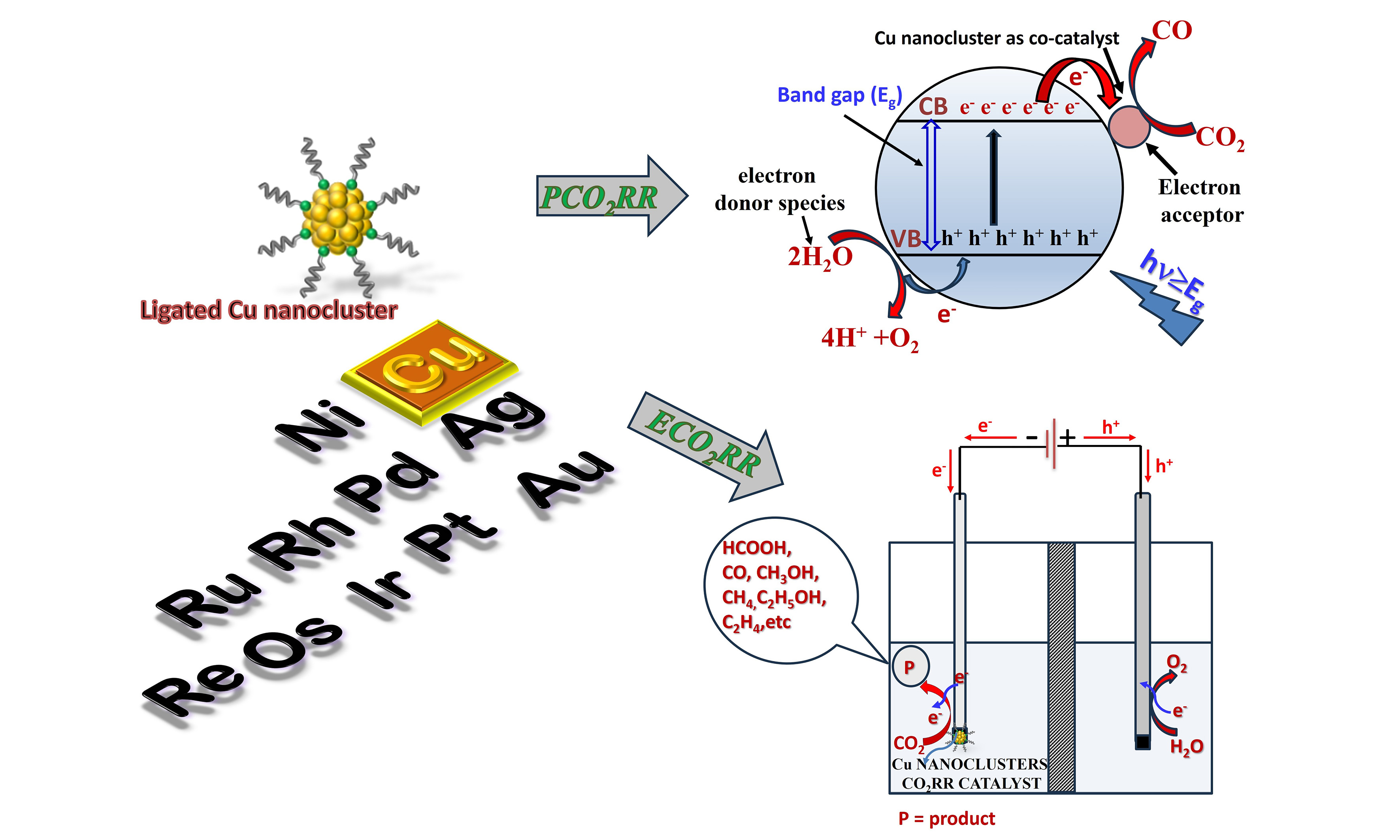
CO2 is a thermodynamically and kinetically stable molecule with its standard Gibbs free energy of formation (ΔGfo) of -394.4 kJ·mol-1 at 298 K and a highly negative first-electron reduction potential (Eo) of -1.90 V vs. standard hydrogen electrode (SHE) in aqueous solution. Therefore, its thermal reduction requires high temperatures to overcome the unfavorable thermodynamics and kinetics. Even so, electrochemical CO2 reduction reactions (ECO2RR) and photochemical CO2 reduction reactions (PCO2RR) have been demonstrated to be highly effective in terms of ambient operative conditions, conversion efficiency, and capacity to generate a wide range of value-added carbon-based fuels. However, to drive the ECO2RR/PCO2RR, highly efficient and atomically well-defined catalysts with customized optimizations are required. Thanks to the specific and uniform catalytic active sites located on the metal nanocluster surface/interface defined by their precise atomic structure, the ligand-protected atomically precise Cu nanoclusters have been shown to drive the CO2 reduction reaction (CO2RR) to various valuable C1, C2, and C2+ products. The current status of the synthesis and the ECO2RR and PCO2RR catalyzed by ligand-protected Cu nanoclusters with precise crystal structures is reviewed in this article.
Keywords
INTRODUCTION
The increased emission of greenhouse gases due to anthropogenic activities will have a substantial impact on long-term climate change. In 2015, the Paris Agreement was adopted to achieve “carbon neutrality” by 2050. Carbon neutrality, i.e., reducing greenhouse gas emissions, including “CO2 to net-zero,” is now a long-term goal shared worldwide. To achieve this, various scientific strategies are being developed. In particular, the adsorption-based capture and conversion of CO2 into a wide range of carbon-based fuels and value-added organic products, e.g., carbon monoxide, methane, methanol, ethanol, formic acid, ethylene, acetaldehyde, etc., are being investigated, which may help reduce CO2 emissions while supporting sustainable fuel production[1-6]. However, CO2 is primarily a thermodynamically and kinetically stable molecule (ΔGfo = -394.38 kJ·mol-1) with a nonpolar linear structure with a high C=O bond energy (750 kJ·mol-1), making its activation and reduction an extremely challenging process[4]. Hence, a highly efficient catalyst is required to drive its reduction under ambient conditions, which in turn also regulates reaction selectivity, activity, and stability of reaction intermediates for their deep reduction[1-6].
To this end, the early landmark investigations of constant-current electrolysis of CO2-saturated
However, despite the excellent catalytic properties of these polycrystalline Cu-based nanomaterials (> 2 nm) for ECO2RR, their surface structure/morphology is often ill-defined and non-uniform, in addition to their inherent particle-size distribution. This results in mixed types of catalytic active sites, leading to significant variations in their catalytic activities, ultimately resulting in the limited selectivity of desired products[2,19]. Moreover, these mixed types of active sites are the major obstacles to understanding the precise mechanism of the CO2 reduction reaction (CO2RR) on Cu nanoparticles or Cu-based bulk materials. In contrast to this, the ligand-protected Cu nanoclusters with well-resolved crystal structures at atomic-level precision (i.e., core metal arrangements such as icosahedra, body-centered cubic, face-centered cubic, octahedron, etc. surrounded by ligand shells/motifs in specific patterns) in conjunction with their high molecular uniformity (i.e., uniform catalytic active sites) afford higher tunable selectivity of desired products than conventional Cu nanoparticles or other Cu-based bulk materials for electro/photochemical CO2 reduction[4,20-24]. On top of that, the well-resolved single crystal structures of ligand-protected Cu nanoclusters make them the ideal materials to investigate the structure-property relationships accurately, and hence, the precise details of the ECO2RR mechanism can be obtained, which are otherwise ambiguous in the case of Cu nanoparticles. Furthermore, with the advanced knowledge of the precise single-crystal structure of ligand-protected Cu nanoclusters, theoretical studies can further assist the researchers in tailoring the Cu nanocluster-based catalysts for more efficient ECO2RR and PCO2RR.
Although significant success has been achieved in CO2 reduction to CO over atomically precise Au and Ag nanoclusters[2,25-27], the optimized design of these catalysts ensuring high efficiency and selectivity remains challenging. Here, Cu nanoclusters have emerged as promising catalysts for ECO2RR/PCO2RR. As discussed, Cu binds CO with moderate interactions, i.e., not strong enough to desorb from the catalyst surface yet strong enough to stabilize reaction intermediates, thereby enabling its further reduction to diverse value-added products beyond CO[3,6-13]. A second distinct feature of Cu is its ability to exist in various oxidation states (0/+1/+2), which significantly impacts the products of multielectron CO2 reduction. Notably, Cu in 0 and +1 oxidation states has been observed in ligand-protected Cu nanoclusters[21]. However, the main disadvantage of ligand-protected atomically precise Cu nanoclusters compared to Au and Ag nanoclusters is their instability, plausibly owing to their lower standard reduction potential (Cu+/Cu = +0.52 V and Cu2+/Cu = +0.34 V) than Ag (Ag+/Ag = +0.80 V) and Au (Au+/Au = +1.83 V and Au3+/Au = +1.50 V)[28]. By addressing these challenges and using innovative synthesis strategies, the full potential of atomically precise Cu metal nanoclusters as next-generation CO2 reduction catalysts can be achieved. Thus far, a relatively small number of ligand-protected Cu nanoclusters have been identified as catalysts for electro/photochemical reduction of CO2. This article reviews these reported systems as next-generation CO₂ reduction catalysts.
SYNTHESIS
Monoatomic ligand-protected Cu nanoclusters
Basically, three types of ligand-protected homoatomic Cu nanoclusters have been reported[28]: (i) Cu(I) hydride nanoclusters; (ii) hydride-free Cu(I) nanoclusters; and (iii) Cu nanoclusters with partial Cu(0) character. Dhayal et al. started off the synthesis of Cu(I) hydride nanoclusters using a nonaqueous solution of a reducing agent, Cu(I) precursor, and dichalcogen ligands[29]. They also generated analogous hydride-free Cu(I) nanoclusters without [BH4]. Following this, Cu(I) nanoclusters with and without hydrides were synthesized by other research groups through the reduction with a nonaqueous [BH4]- solution and without [BH4]-, respectively, using a single or a mix of protecting ligands[28]. However, Nematulloev et al. reported a hydride-free thiolate- and phosphine-protected Cu(I) nanocluster with the formula [Cu15(PPh3)6(PET)13]2+ (PET: 2-phenylethanethiol) through the reduction with a nonaqueous [BH4]- solution[30]. Notably, the hydride- and hydride-free thiolate-protected Cu(I) nanoclusters have been produced using an aqueous [BH4]- solution. For example, Li et al. synthesized [Cu11(TBBT)9(PPh3)6]2+ (TBBT: 4-tert-butylbenzenethiolate)[31], and another example of a hydride-free Cu(I) cluster, [Cu8(SPh)8(Ph3P)4], using the ice-cold aqueous solution of NaBH4, was reported by Ke et al.[32]. Tang et al. introduced a novel two-step addition of aqueous NaBH4 at two different temperatures to obtain a high-nuclearity thiolated [Cu75(S-adm)32]2+ nanocluster (adm: adamantane)[33]. Interestingly, Cu(I)-thiolate nanoclusters with hydride having compositions: [Cu14(S-tert-Bu)3(PPh3)7H10], [Cu18H(PET)14(PPh3)6(SCN)3], [Cu25H10(SPhCl2)18]3- were also obtained using aqueous NaBH4[34-36]. So, there is no general protocol to use an aqueous/non-aqueous solution of NaBH4 to produce the desired hydride or hydride-free Cu nanoclusters. Notably, the synthesis of Cu nanoclusters with Cu(0) character has been challenging owing to the intrinsic high reactivity of Cu(0). A gradient reduction strategy has recently been applied by Han et al. to synthesize [Cu23(tert-BuC≡C)13(CF3COO)6] having partial Cu(0)[37]. Nguyen et al. also reported [Cu25H22(PPh3)12]Cl nanoclusters with the presence of partial Cu(0)[38]. Additionally, [Cu18H3(S-Adm)12(PPh3)4Cl2][39], [Cu14(C2B10H10S2)6(CH3CN)8][40], [Cu31(4-MeO-PhC≡C)21(dppe)3](ClO)4[41], and [Cu23(SR)18(TPP)6](SbF6) with a Cu@Cu8 body-centred cubic core[42], each having partial Cu(0) character, and [Cu23H4(SC7H7)18(PPh3)6][43] with a central Cu(0) atom are also reported.
Copper-based alloy nanoclusters
The co-reduction and galvanic/anti-galvanic reduction methods are potential routes to synthesize heteroatom-doped Cu-M (M: Au/Ag/Pd/Pt) alloy nanoclusters with enhanced stability[44]. Significant progress has been made on metal alloy nanoclusters involving group 11 metals based on d10-d10 metalophilicity. Examples with reference to CO2RR catalysis include [Ag15Cu6(C≡CR)18(DPPE)2]- [HC≡CR: 3,5-bis(trifluoromethyl)phenylacetylene; DPPE: 1,2-bis(diphenylphosphino)ethane][45], and [Cu14Ag6(TC4A)2(PhC≡C)12(MeOH)] (TC4A: thiacalixarene[4]arene; PhC≡C: phenyl acetylene)[46]. However, the synthesis of alloy nanoclusters of Cu with groups 9 and 10 metals is challenging due to large differences in atomic radii and standard reduction potentials. Examples include [Pt2Cu34(PET)2Cl4]2-, and [Cu16Pd1L10(PPh3)2(PZ)6] [PZ: 3,5-(CF3)2Pyrazolate and L: 4-CH3OPhCC-][47,48].
ELECTROCHEMICAL CO2 REDUCTION REACTIONS (ECO2RR)
Fundamental principle
The first step of ECO2RR is the CO2 activation, i.e., the diffusion of linear CO2 to a metal surface followed by its adsorption to form radical anion CO2·- (with bent geometry) through direct one-electron reduction. However, this step requires very high energy to overcome the activation barrier indicated by a high negative standard reduction potential Eo = -1.90 V vs. standard hydrogen electrode (SHE) in water (pH = 7) and Eo = -1.97 V vs. SHE in an aprotic solvent such as N,N-dimethyl formamide (DMF) on a non-catalytic or poorly catalytic electrode surface[49-51]. To avoid this high-energy intermediate, the electrocatalysts offer a less negative and more favorable overpotential using an alternative proton-coupled electron transfer pathway (PCET) [Figure 1][21,51,52]. CO2 can bind to the catalyst surface either through carbon coordination, forming the *COOH intermediate, or through oxygen coordination, forming the HCOO* intermediate. The *COOH further undergoes PCET to produce a *CO intermediate, which either desorbs from the catalyst surface as CO or can undergo further PCET to generate CH4 and CH3OH through the *COH and *CHO intermediates. However, the HCOO* intermediate generates HCOOH as a final product via PCET. Furthermore, Cu has the potential to facilitate the C-C coupling reaction owing to its moderate binding to *CO, thereby allowing it to remain on Cu long enough to interact with another molecule. Basically, C2 product pathways are more complex, in which the *COCO, *COCHO, and *COCOH are common C2 intermediates [Figure 1][21]. The *COCO is formed by coupling between two *CO intermediates, while *COCHO and *COCOH are formed either by protonation of *COCO or reaction of *CO either with *COH or *CHO intermediates. Recently, considerable progress has been made in understanding the synergistic effects in ECO2RR to promote the multi-carbon product formation[53].
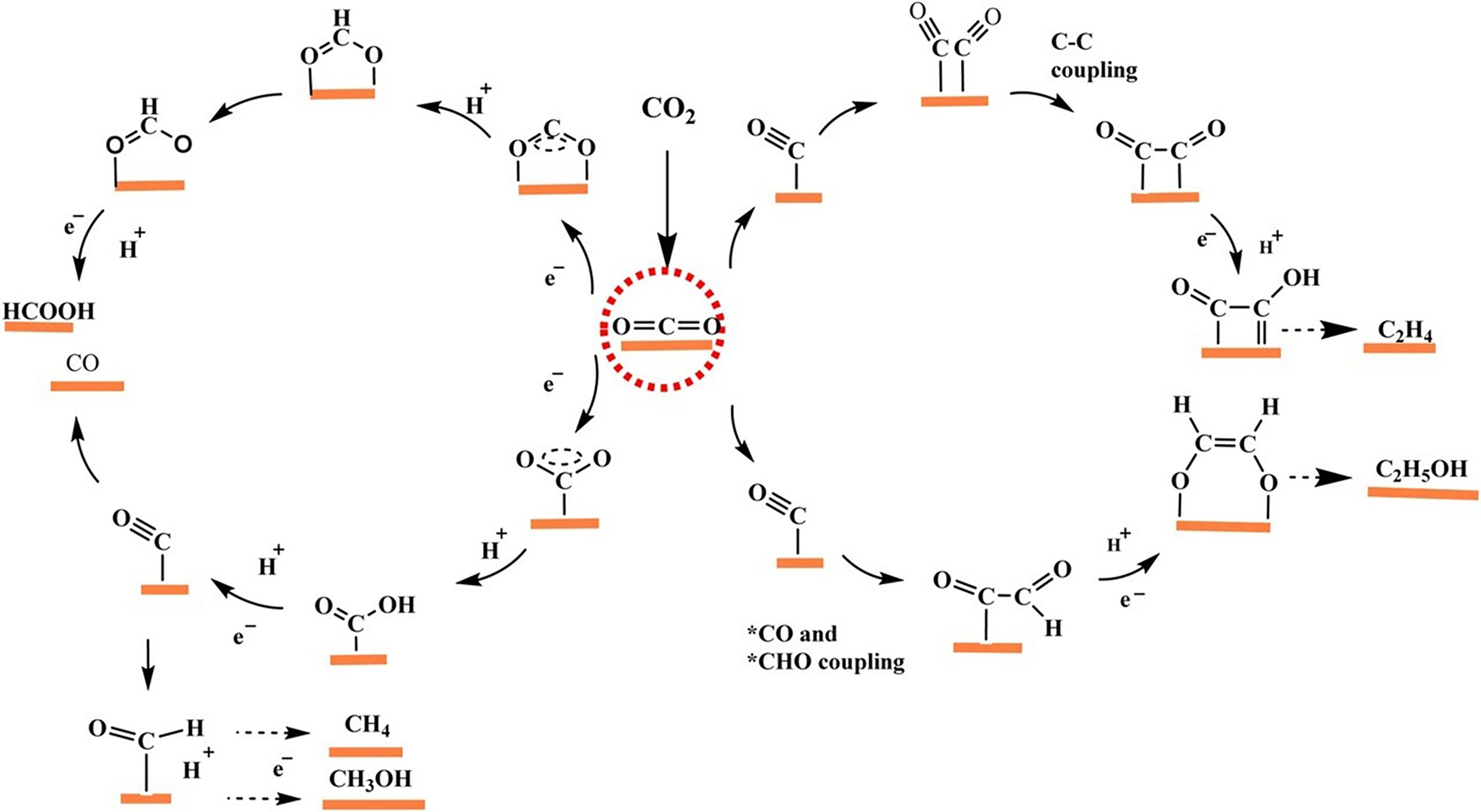
Figure 1. Reaction mechanistic pathways of ECO2RR. This figure is reproduced with permission from Ref.[21]. © The Royal Society of Chemistry 2025.
Ligand-protected Cu nanocluster for ECO2RR
HCOOH selective ECO2RR: role of lattice hydrides
In their pioneering work, Tang et al. presented the “lattice hydride mechanism” in 2017[54] to explain the ECO2RR over [Cu32(H)20{S2P(OiPr)2}12] (Cu32) nanoclusters at low overpotentials. Cu32 features a hexacapped pseudo-rhombohedral metal core of 14 Cu atoms packed between two triangular cupola fragments of Cu atoms, and overall Cu32 is stabilized by 1,2-dithiophosphate (S2P(OiPr)2) ligands and 20 hydride ligands with three kinds of bridging coordination patterns [Figure 2A]: 12μ3-H (lattice hydrides), 6μ4-H (interstitial hydrides), and 2μ5-H (interstitial hydrides). The 12μ3-H lattice hydrides are further sorted into three μ3-H1, two μ3-H2, four μ3-H3, and two μ3-H4. As per DFT calculations, CO2 adsorbed at the most favored site at μ3-H1, followed by reduction by hydride addition (μ3-H1) to C of CO2 to form adsorbed HCOO* (ΔG0 = 0.32 eV), owing to attraction between negatively charged hydride and positively charged C of CO2 to form Cu32H19L12-HCOO*. It is further succeeded by the addition of another hydride (μ4-H1) to finally form the HCOOH product (G = 0.07 eV) with FE of 90%. These two hydride vacancies of Cu32H18L12 are regenerated by two back-to-back electrochemical proton reductions to resume the catalytic cycle [Figure 2B]. Furthermore, the first hydride transfer revealed that higher overpotentials of +0.81 V and +0.6 to +1 eV, respectively, are needed for competing CO formation and the hydrogen evolution reaction (HER) relative to HCOOH formation occurring at low overpotentials (+0.32 V) and thus cannot compete with HCOOH formation. The controlled potential electrocatalysis experiments using Cu32 in 0.1 M KHCO3 and 0.4 M KCl (pH = 6.8) on the Cu32/C/GDL electrode supported the theoretical results. Cu32 mainly produced HCOOH at low overpotentials (89% at +0.3 V and 83% at +0.4 V) with a small amount of CO and H2 [Figure 2C]. At overpotentials above +0.5 V, H2 was generated predominantly (85% at 0.5 V and 94% at +0.6 V).
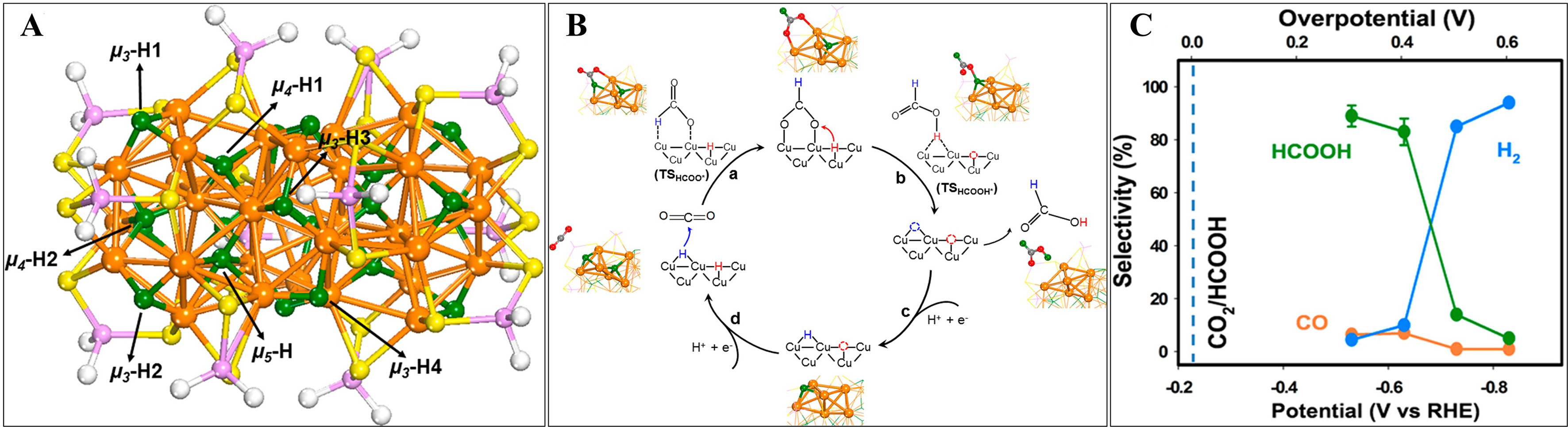
Figure 2. (A) Structure of Cu32; (B) Lattice hydride mechanism of HCOOH generation during CO2 reduction on Cu32; (C) Product selectivity for H2, HCOOH, and CO at different overpotentials. Color code: Cu, orange; hydride, green; oxygen, red; carbon, gray. This figure is reproduced with permission from Ref.[54]. Copyright © 2017 American Chemical Society. RHE: Reversible hydrogen electrode.
HCOOH selective ECO2RR: ligand effect
To investigate the effect of ligands on ECO2RR, Shingyouchi et al. prepared Cu14 nanoclusters with compositions [Cu14(CHT)3(PPh3)8H10]+ (Cu14-CHT) and [Cu14(PET)3(PPh3)8H10]+ (Cu14-PET) protected by cyclohexane thiolate (CHT) and 2-phenylethane thiolate (PET)[55]. Structure-wise, both nanoclusters have distorted fcc (face-centered cubic) structures equipped with an inner Cu6 octahedral core and outer Cu8 cube. These overall distorted structures are stabilized due to various intracluster interactions, e.g., C-H---π interactions in Cu14-CHT and C-H---π interactions and T-shaped π-π interactions in Cu14-PET [Figure 3A]. The smaller Cu-Cu and Cu-S average distances in Cu14-PET resulted in a reduction in its size and inner cuprophilic interactions, enhancing its stability, which influenced the stability of reaction intermediates during ECO2RR and determined the selectivity of the product.
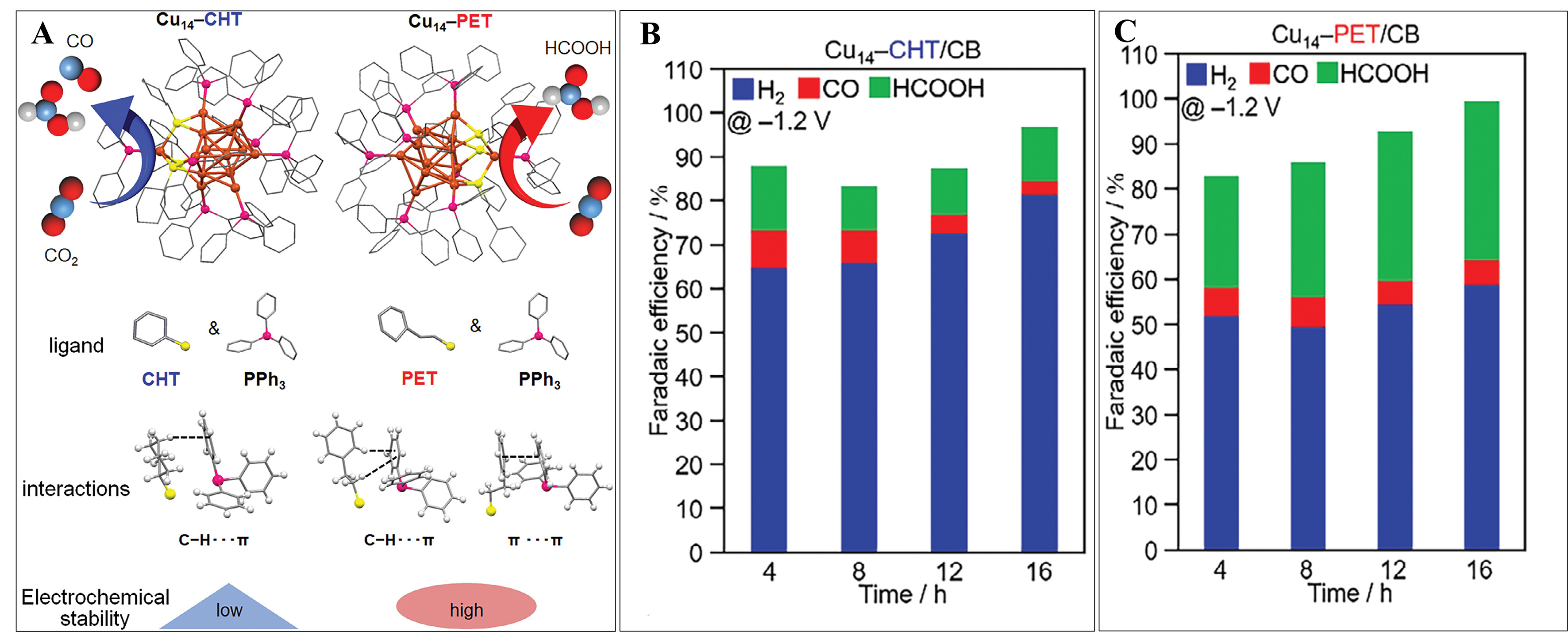
Figure 3. (A) Structures of Cu14-CHT and Cu14-PET exhibiting different interactions; time-dependent FE for ECO2RR products on (B) Cu14-CHT/CB, and (C) Cu14-PET/CB. This figure is reproduced with permission from Ref.[55]. Licensed under CC BY 4.0. FE: Faradaic efficiency.
HCOOH was the main product using both Cu14 clusters in the potential range of -0.8 V to -1.4 V (vs. RHE). Briefly, for Cu14-CHT/CB, FEHCOOH and FECO were ≈31% and ≈8% and for Cu14-PET/CB, FEHCCOH and FECO were ≈39% and ≈2% at -1.2 V [Figure 3B and C], respectively, supported by higher current densities (JCOOH) displayed by latter. The higher stability of reaction intermediate HCOO* than *COOH in Cu14-PET prefers production of highly selective HCOOH over CO. Cu14-CHT clusters showed an increase in HER, whereas Cu14-PET maintained HER and CO production while enhancing the HCOOH production over extended time[55]. The increase in HER during prolonged electrochemical exposure is attributed to the aggregation of Cu14-CHT.
HCOOH selective ECO2RR: effect of metal core structure
To investigate effect of isomers for ECO2RR, Liu et al. synthesized Cu nanoclusters with compositions Cu8(H)(L1)6PF6 (Cu8-1), Cu8(tBuS)4(L1)4 (Cu8-2), and Cu8(tBuS)4(L2)4 (Cu8-3) (L1: 9H-carbazole-9-carbodithiol; L2: o-ethyl carbonodithiol)[56]. Cu8-1 possesses a cubic kernel protected by L1-type ligands [Figure 4A], and upon partial replacement of L1 or L2 by tBuS-, Cu8-2 and Cu8-3, possessing ditetrahedron kernels, were prepared, respectively [Figure 4B and C]. According to the space-filling model, all Cu8 clusters with a low number of ligands covering Cu atoms act as active sites[56].
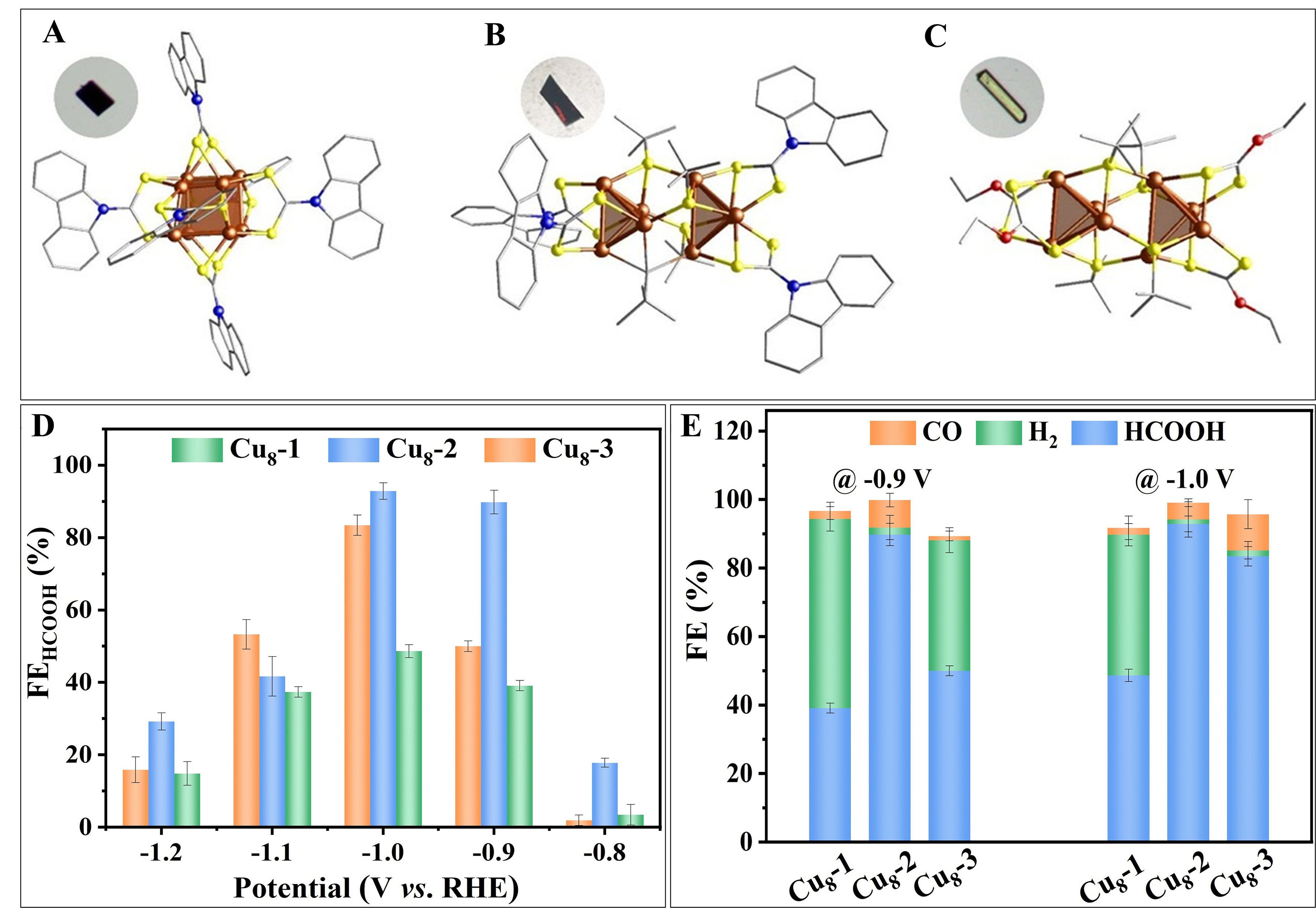
Figure 4. Total structures of (A) Cu8-1, (B) Cu8-2, and (C) Cu8-3; (D) FEHCOOH of Cu8-1, Cu8-2, and Cu8-3 at various applied potentials; (E) FEHCOOH, FECO, and FEH2 at -0.9 and -1.0 V on Cu8-1, Cu8-2, and Cu8-3 clusters. This figure is reproduced with permission from Ref.[56], © 2022 Wiley-VCH GmbH.
Linear sweep voltammetry (LSV) curves of all Cu8 clusters in CO2-saturated solution exhibited high current density, indicating their activity for ECO2RR. The lower onset potentials for Cu8-2 and Cu8-3 (-0.6 V and -0.48 V, vs. RHE, respectively) than Cu8-1 (-0.71 V vs. RHE) suggested the lower energy barrier of ECO2RR for ditetrahedron kernels[56]. The electrochemical performance in the range of -0.8 to -1.2 V vs. RHE yielded H2, CO, and HCOOH with total FE > 90%. The ditetrahedron Cu8 clusters exhibited higher FEHCOOH and selectivity than cubic Cu8 in this potential range as shown in Figure 4D. In more detail, as potential tuned from -0.8 to -1.0 V, HCOOH selectivity for all Cu8 clusters increased, accompanied by a notable decrease beyond -1.0 V, where H2 became the primary product. The FEHCOOH values for ditetrahedron Cu8-2, shown in Figure 4E, were evaluated to be 90% and 92% at -0.9 and -1.0 V, respectively, which were 2 times higher than Cu8-1 clusters (39.1% and 48.6% at -0.9 and -1.0 V, respectively), supported by higher JCOOH values for Cu8-2 and Cu8-3. Of note, the slight difference in activities between the ditetrahedron Cu8-2 and Cu8-3 owes to the ligand effect. The chronoamperometric measurements revealed the relatively high electrochemical stability of Cu8-2 and Cu8-3 under the operating conditions for 8 h[56].
As per DFT calculations, the difference in CO2RR activity for Cu8-1 and Cu8-2 is ascribed to distortion caused by the corner site in the latter [Figure 5A and B], supported by the potential energy diagram showing suppression of HER for Cu8-2 [Figure 5C]. These results were consistent with the experimental findings shown in Figure 4E. The CO2RR process shown in Figure 5D, where the conversion of *CO2 to HCOO* occurs with a lower free energy for Cu8-2 than Cu8-1, further proves the former’s higher reactivity and selectivity.
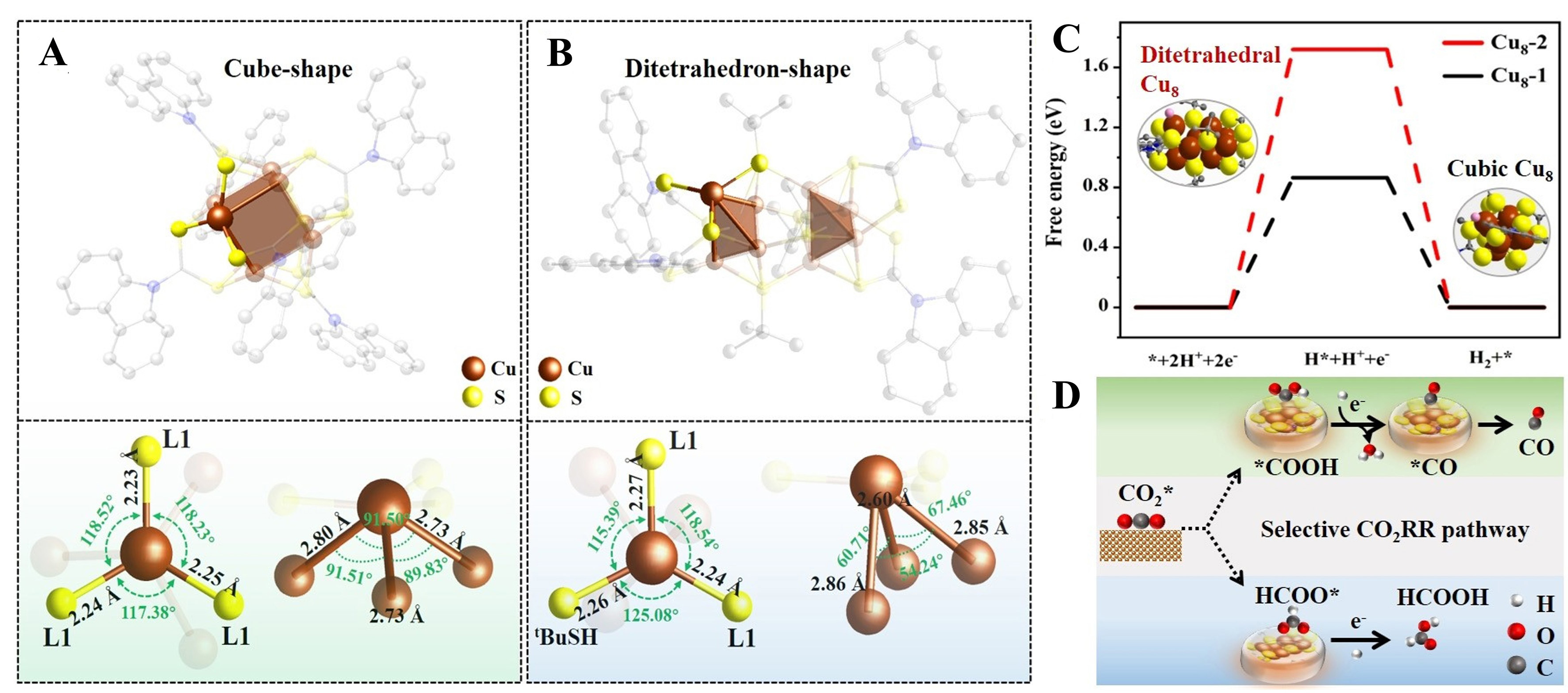
Figure 5. Corner site structures for Cu8 nanoclusters with (A) cubic and (B) ditetrahedron kernels along with coordination environment; (C) Potential barrier diagram for Cu8-2 and Cu8-1 for HER; (D) CO2RR process over Cu8 nanoclusters for CO and HCOOH products. This figure is reproduced with permission from Ref.[56], © 2022 Wiley-VCH GmbH. HER: Hydrogen evolution reaction.
HCOOH selective ECO2RR: role of structural arrangements
Biswas et al. recently fabricated a highly stable [Cu23H4(SC7H7)18(PPh3)6] (Cu23) (SC7H7: p-toulenethiolate) nanocluster via fusion of two [Cu12H2(SC7H7)7(PPh3)3] subunits sharing a Cu(0) atom [Figure 6A][43]. The remarkable stability of Cu23 motivated the authors to investigate Cu23/CB for ECO2RR. FE data in Figure 6B indicated a maximum FEHCOOH ~26% at -1.2 V along with FEH2 ~42% and minor CO for Cu23. While 30 nm Cu particles prepared with the same precursor via calcination displayed FEH2 ~80% at -1.0 V, indicating uncontrolled competitive HER along with FEHCOOH ~8% and FECO ~6%, underlining the superior HCOOH selectivity of Cu23. DFT revealed antenna-like Cu3 units on both sides of the overall geometry, forming the more favorable hollow triangular prism-like sites for H2 adsorption in line with high HER at low overpotential [Figure 6C]. Additionally, these sites also act as potential active sites for CO2RR [Figure 6C], and among their two investigated pathways, the *HCOOH (via HCOO* intermediate) pathway is preferred over the *COOH pathway as per their energy profiles [Figure 6D], in agreement with selective production of HCOOH on Cu23.
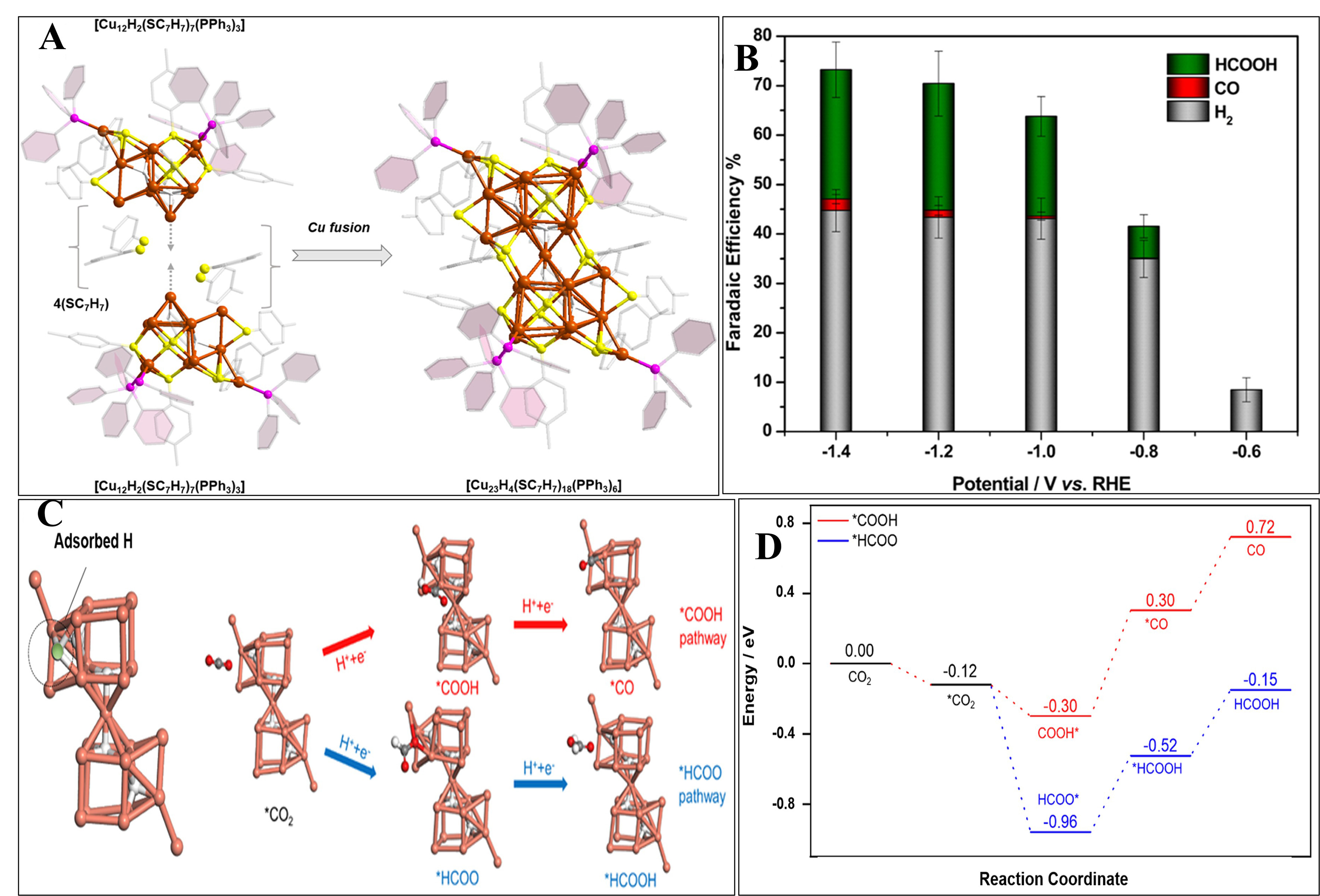
Figure 6. (A) Structure of Cu23 nanocluster formed upon fusion of two identical Cu subunits; (B) FEs of ECO2RR products on Cu23/CB at different applied potentials; (C) Scheme of H adsorption on active site; (D) DFT computed energy values of plausible pathways. Color code: Cu, brown; S, yellow; P, violet; H, white; C, gray. This figure is reproduced with permission from Ref.[43], Copyright © 2025 The Authors. FE: Faradaic efficiency; DFT: density functional theory.
Ethylene selective ECO2RR catalysis: ligand effect
Han et al. synthesized two Cu nanoclusters with the compositions [Cu17H6(NHCH)4(dppm)4](PF6)3(MeCN)3(CH2Cl2)(Et2O) (Cu17a) [NHCH: 1,3-diprop-2-ynyl-1H-imidazol-3-ium hexafluorophosphate; dppm: Bis(diphenylposphino)methane] with its crystal structure [Figure 7A] and Cu17H6(NHCph)4(dppm)4](PF6)3(MeCN)(CH3OH) (Cu17b) [NHCPh: 1,3-bis(2-propyn-1-yl)-1H-benzoimidazol-3-ium hexafluorophosphate]. Both Cu17a and Cu17b feature a Cu17H6 square orthobicupola as a common core, shown in Figure 7B[57]. The σ and π bonding between Cu and N-heterocyclic carbene (NHC) ligands [Figure 7C] provides high stability to both these Cu17 clusters, and moreover, the distinctive coordination pattern (μ7-ησ1:ησ1:ησ1:ησ1:ησ1:ηπ2:ηπ2) of the NHC ligand exposes the neighboring Cu atoms as active sites for CO2RR.
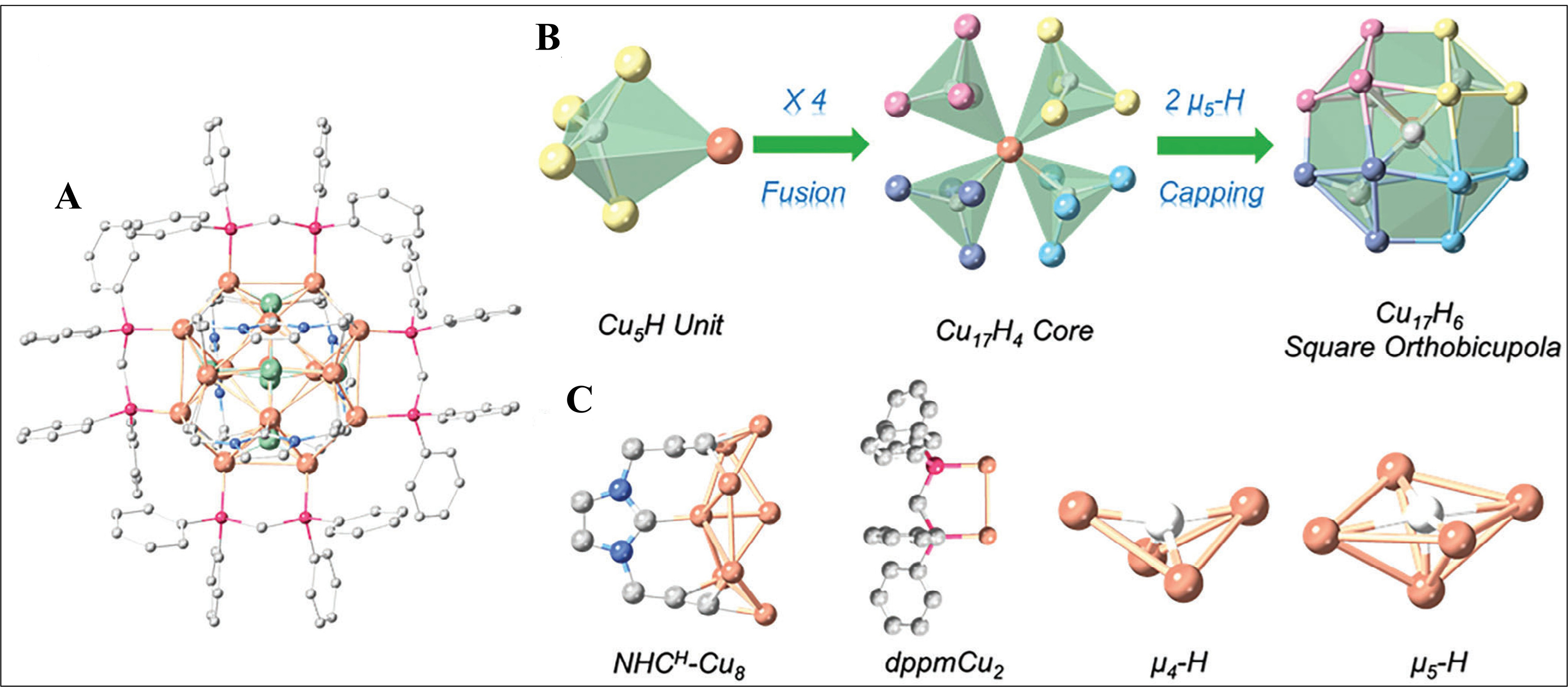
Figure 7. (A) Total structure of Cu17a; (B) Formation of Cu17H6 square orthobicupola by vertex sharing of four Cu5H triangular bipyramids; (C) Ligand coordination pattern in Cu17a. Color code: Cu, orange/yellow/pastel cyan/pastel blue/pastel magenta; N, blue; C, gray; P, rose red; H, green/white. This figure is reproduced with permission from Ref.[57], © 2025 Wiley-VCH GmbH.
Comparing the structures of Cu17a [Figure 7A] and Cu17b[57], a ligand effect was noticed on ECO2RR activity due to minimal steric hindrance for CO2 adsorption on Cu17a compared to Cu17b. The more positive onset potential and higher cathodic current density observed for Cu17a indicate their higher activity towards CO2RR than Cu17b[57]. For Cu17a, FECO reached approximately 91% at -0.37 V [Figure 8A], exceeding the values reported for the Cu nanocluster-based electrocatalysts[58]. In contrast, Cu17b displayed poor catalytic activity, with CO being the main product across the potential range from -0.37 to -1.07 V, with maximum
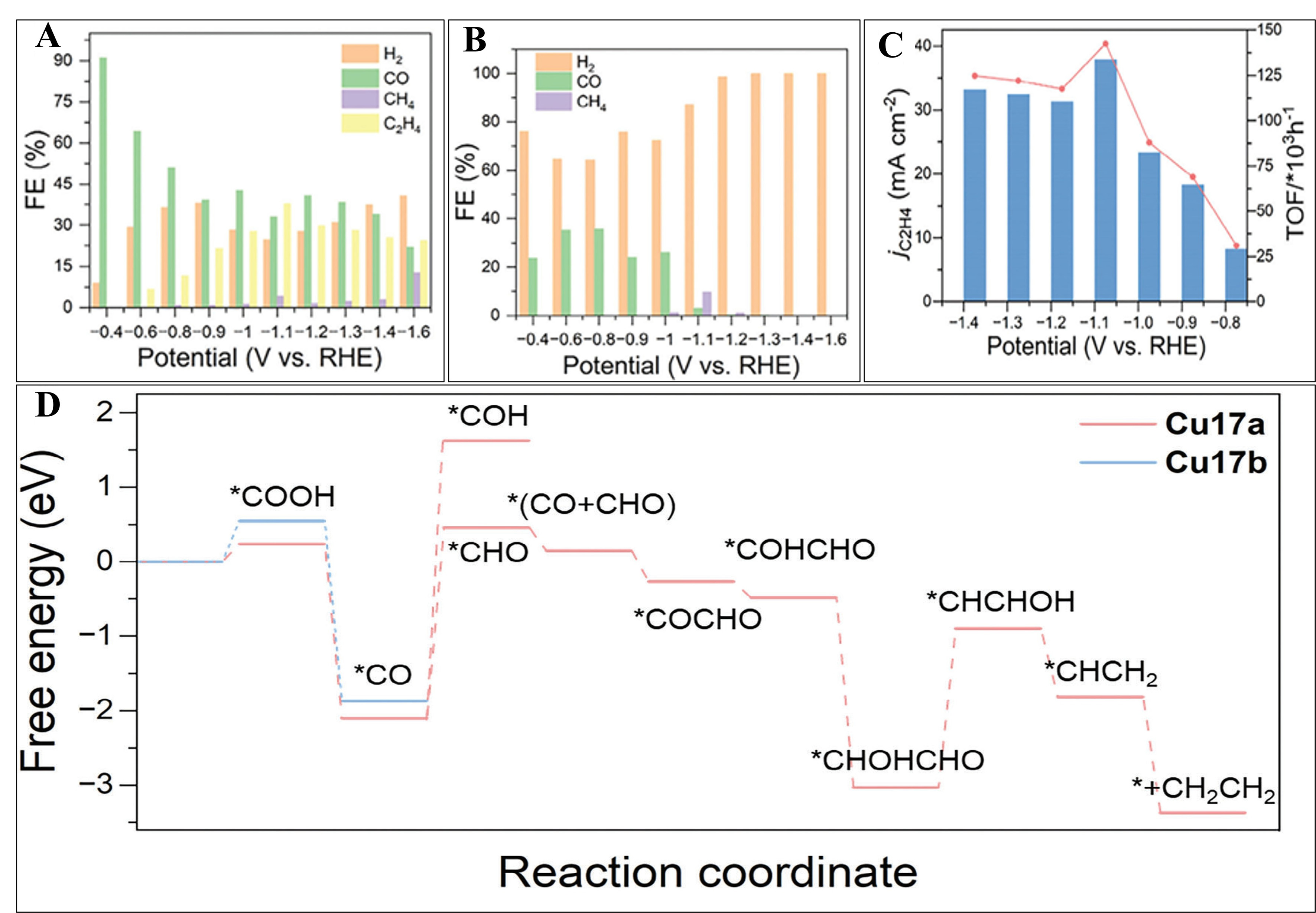
Figure 8. FE of ECO2RR products over (A) Cu17a and (B) Cu17b; (C) Potential-dependent JC2H4 and TOF of Cu17a; (D) Free energy diagrams of ECO2RR pathways for Cu17a and Cu17b. The asterisk (*) is standard notation for adsorbed species on catalyst surface. This figure is reproduced with permission from Ref.[57], © 2025 Wiley-VCH GmbH. RHE: Reversible hydrogen electrode; FE: Faradaic efficiency; TOF: turnover frequency.
Due to the competitive HER, H2 was the main product at high potentials [Figure 8A and B]. The attenuated total reflectance surface-enhanced infrared absorption spectroscopy (ATR-SEIRAS) showed the broad peak of adsorbed water molecules at 1,670 cm-1, which was used to perform proton-coupled electron transfer. The peak at 1,366 cm-1, owing to *COOH, suggested CO2 hydrogenation followed by adsorption of *CO. Further, peaks of *OCCHO at 1,498 cm-1 and 1,316 cm-1 confirm its significance as an intermediate in the C-C coupling process. Thus, the formation of the C2H4 product is facilitated by Cu17a. The optimized space-filling model of these clusters revealed the cavity between two parallel NHC ligands, resulting in exposing two adjacent Cu atoms as potential active sites. The free energy diagram [Figure 8D] explains the thermodynamic favorability of CO2 reduction by suggesting that surface ligands with less steric hindrance assisted the substrate adsorption. Hence, Cu17a displays more effective CO2 adsorption with a free energy of -0.56 eV, which is less than -0.23 eV of Cu17b.
Methanol selective ECO2RR catalysis: defect induced effects
Biswas et al. reported ECO2RR driven selective synthesis of methanol over defect-induced nanocluster [Cu58H20(SPr)36(PPh3)7]2+ (Cu58-I) (Pr: CH2CH2CH3; PPh3: triphenylphosphine)[59]. Cu58-I, lacking one PPh3 ligand, was synthesized using the protocol reported for the synthesis of regular
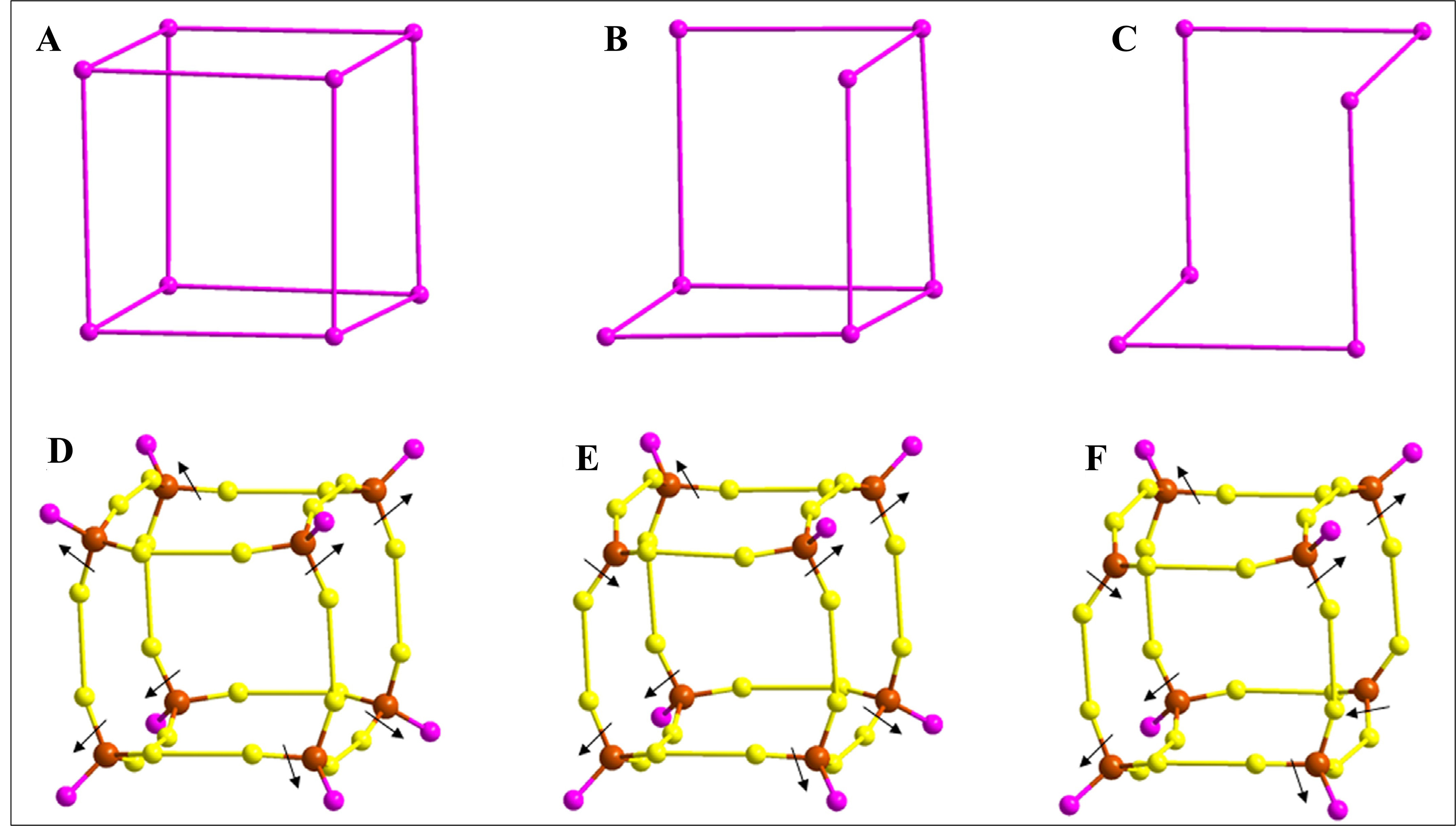
Figure 9. (A) Complete cubic P8 shell of Cu58; (B) Partial cubic P7 shell of Cu58-I; (C) Partial P6 shell of Cu58-II; Typical outward and inward directional arrangement of the cubic shell associated with attached ligands in (D) Cu58, (E) Cu58-I, and (F) Cu58-II, respectively. Color code: Cu, brown; S, yellow; P, violet. This figure is reproduced with permission from Ref.[59], licensed under CC BY 4.0.
Cu58-II with more defects showed the highest reduction current, followed by less defect-induced Cu58-I, followed by regular Cu58 at -0.9 V. However, all Cu58 nanoclusters yielded different selective products during ECO2R. For instance, H2, CO, and CH3OH are key products for Cu58-I [Figure 10A], while H2, CO, and HCOOH for Cu58-II [Figure 10B]. FE analysis revealed that HER was dominant (FEH2 > 50%) for Cu58-II, with a higher number of defects resulting in more exposed Cu vertices and edges. The Cu58-I, with relatively fewer distortions and exposed Cu sites, selectively yielded CH3OH with FECH3OH ≈54% at -0.7 V [Figure 10A]. On the other hand, regular Cu58 produced only CO due to few active sites [Figure 10C].
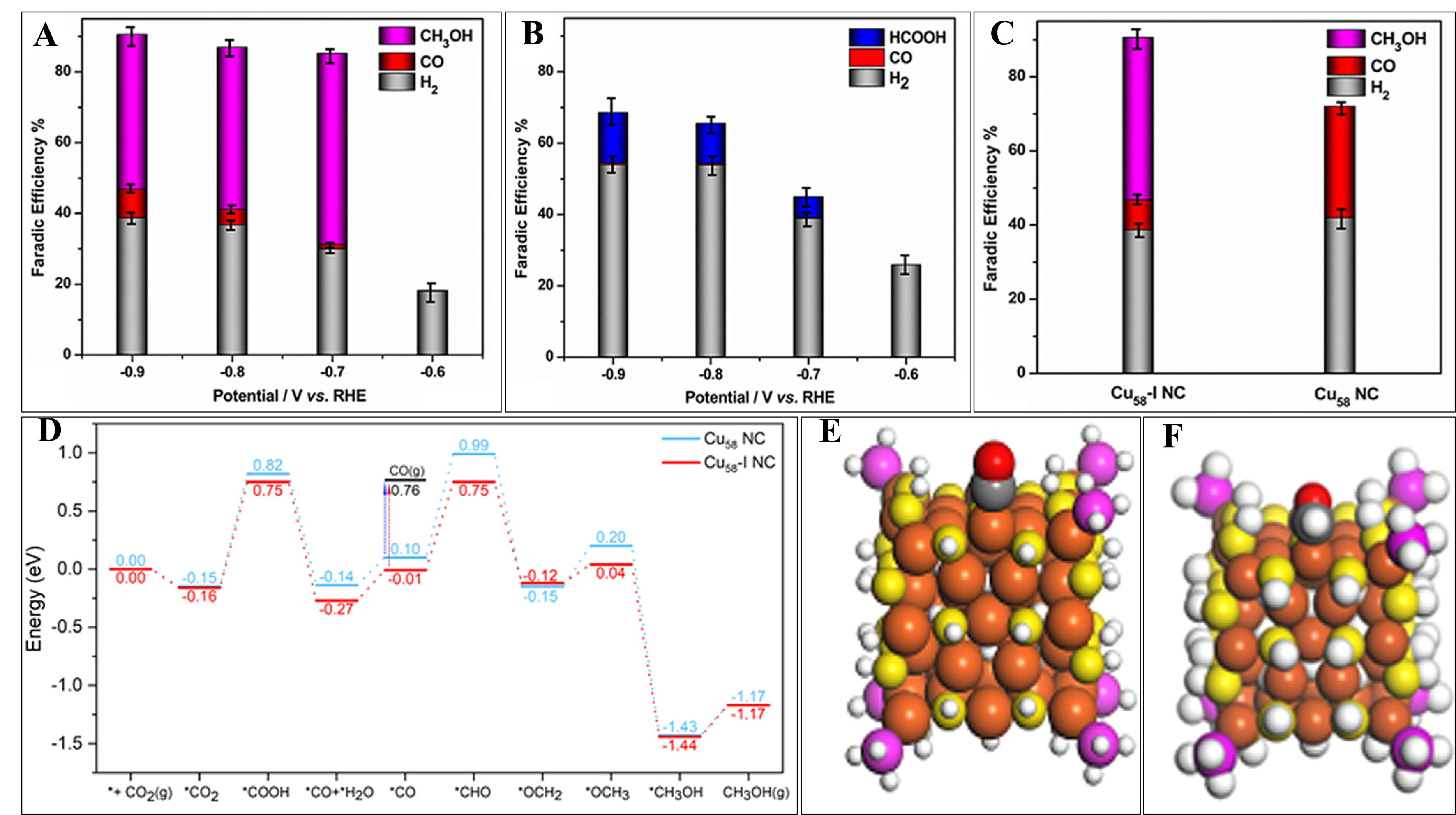
Figure 10. FE of ECO2RR products for (A) Cu58-I, and (B) Cu58-II; (C) Comparisons of FE for Cu58-1 and Cu58 at -0.9 V vs. RHE; (D) DFT-based free energy diagram for ECO2RR on Cu58-I and Cu58; (E) *CO adsorbed on Cu58-1 edge site; (F) *CHO adsorbed on Cu58-1 edge site. Color code: Cu, brown; S, yellow; P, violet; H, white. This figure is reproduced with permission from Ref.[59], Licensed under CC BY 4.0. FE: Faradaic efficiency; RHE: reversible hydrogen electrode; DFT: density functional theory.
The computational hydrogen electrode method revealed that the formation of *COOH is more favorable than *HCOO since it is less uphill for Cu58-1 than Cu58 in the energy level diagram [Figure 10D]. Subsequently, the formation of *CO from *COOH occurs, and after H2O desorption, *CO converts into methanol on Cu58-1. In contrast, *CO desorption is easier in the case of regular Cu58 nanoclusters. Furthermore, the enhanced binding of *CO and *CHO intermediates at the edge Cu site i.e. next to the vertex site with a ligand vacancy in Cu58-I [Figure 10E and F], is attributed to the upshift of d-states of the edge Cu site[59].
Ethanol selective ECO2RR catalysis: effect of structural transformation
Chen et al. synthesized a metastable thiacalix[4]arene-protected {NaCu35(TC4A)4(PhC≡C)20} (Cu35) cluster shown in Figure 11A[46]. It has a semiring architecture composed of two angularly offset {Cu17(TC4A)2L9} (L: alkynyl ligand) subunits [Figure 11B], connected by a linear CuL2 bridging unit [Figure 11C][46]. Each {Cu17(TC4A)2L9} subunit is composed of two {Cu4-TC4A} units linked to {Cu9L9} core [Figure 11D]. Owing to the structural adaptability of TC4A, Cu35 possesses plasticity, resulting in its two distinct occupancy states: one where it coordinates with Na+ and a second where it encapsulates a CH2Cl2 molecule, as shown in Figure 11A. Thus, the central void acts as a potential site for further metal incorporation. Cu35 at elevated temperature can undergo fragmentation to form the thermodynamically stable [Cu14(TC4A)4(PhC≡C)6] (Cu14) cluster [Figure 11E]. Further, due to flexibility, a thermal etching of Cu35 by Ag+ can also form bimetallic [Cu14Ag6(TC4A)2(PhC≡C)12(MeOH)] (Cu14Ag6) nanoclusters [Figure 11E]. Cu14Ag6 [Figure 11F] exhibits a dimer composed of two terminal shuttlecock-like {Cu6(TC4A)L4} units [Figure 11G] and a central {Ag6Cu2L4} core [Figure 11H].
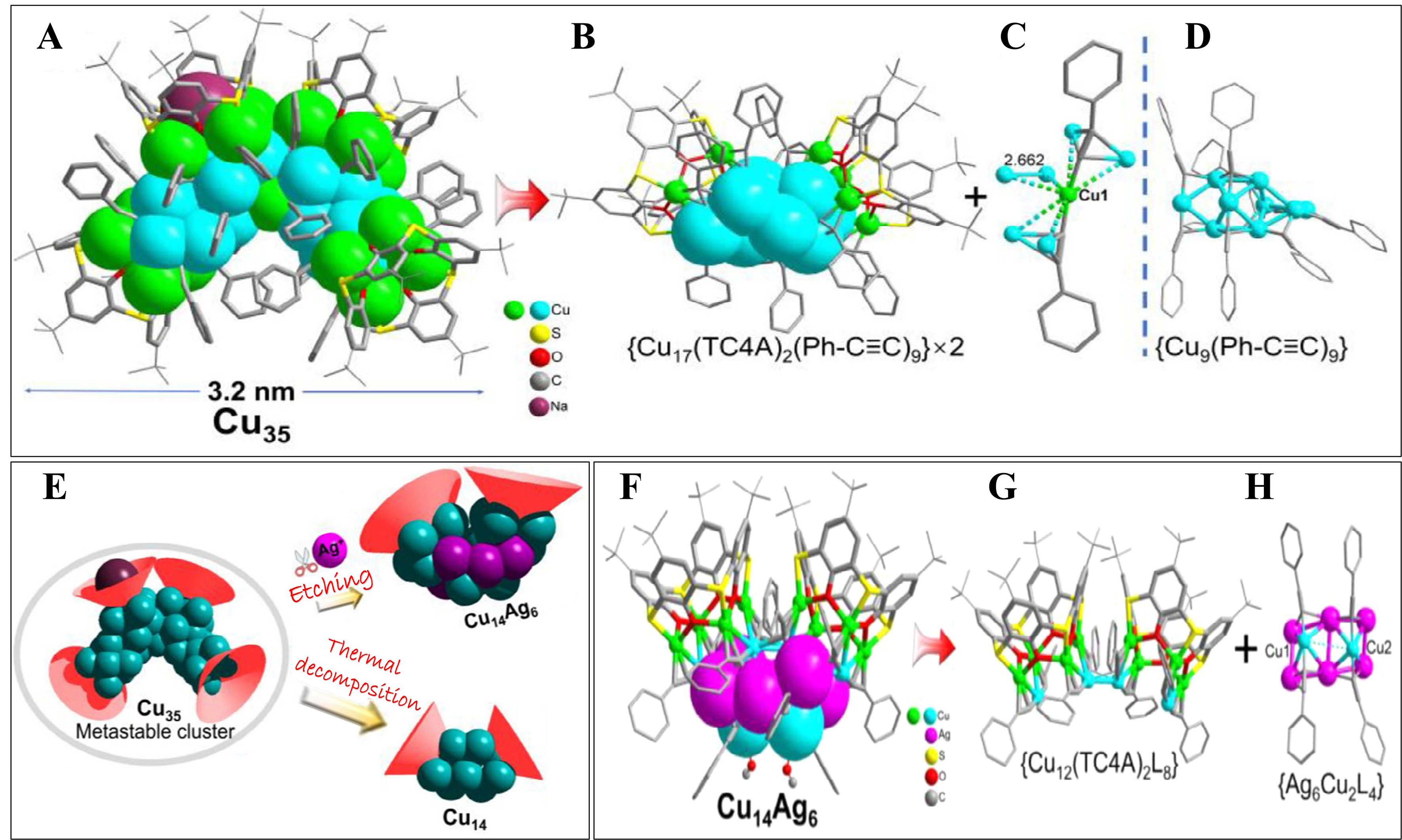
Figure 11. (A) Total crystal structure of Cu35; (B) {Cu17(TC4A)2L9} subunit; (C) Linear CuL2 bridging unit; (D) {Cu9L9} core within Cu17 subunit; (E) Two different structural pathways based on metastable Cu35; (F) Structure of Cu14Ag6[46]; (G) The dimer {Cu12(TC4A)2L8} substructure; (H) The central {Ag6Cu2L4} core. This figure is reproduced with permission from Ref.[46], © 2025 Wiley-VCH GmbH.
All three clusters displayed lower onset overpotentials and enhanced cathodic current densities under CO2 than under N2, but their different product distributions represent a clear structural dependence. The monometallic clusters Cu14 and Cu35 mainly yielded CH4 and C2H4 gas-phase products [Figure 12A and B]. For instance, Cu14 showed a FECH4 ~17.94% and FEC2H4 ~27.50% at -1.1 V [Figure 12A]. Similarly, Cu35 displays FECH4 ~34.01% and FEC2H4 ~13.95% at -1.3 V [Figure 12B]. Notably, monoatomic Cu35 and Cu14 displayed a limited ethanol selectivity (FEC2H5OH < 7%) across the full potential range. While across the potential range of -0.9 to -1.6 V, Cu14Ag6 exhibits FEC2H5OH > 20% with a maximum FEC2H5OH ~49.27% at -1.3 V [Figure 12C]. Thus, the incorporation of Ag+ guides the Cu cluster catalysis via stabilizing the key intermediates in the ethanol production pathway. Interestingly, both C2H5OH and C2H4 routes in ECO2RR have the same *CO-*COH intermediate. Conventionally, this favors the formation of ethane if it coordinates with two Cu sites through its two carbon atoms. Whereas to obtain ethanol as a selective product, its coordination to a Cu site must be through its oxygen atom rather than its carbon atom [Figure 1].
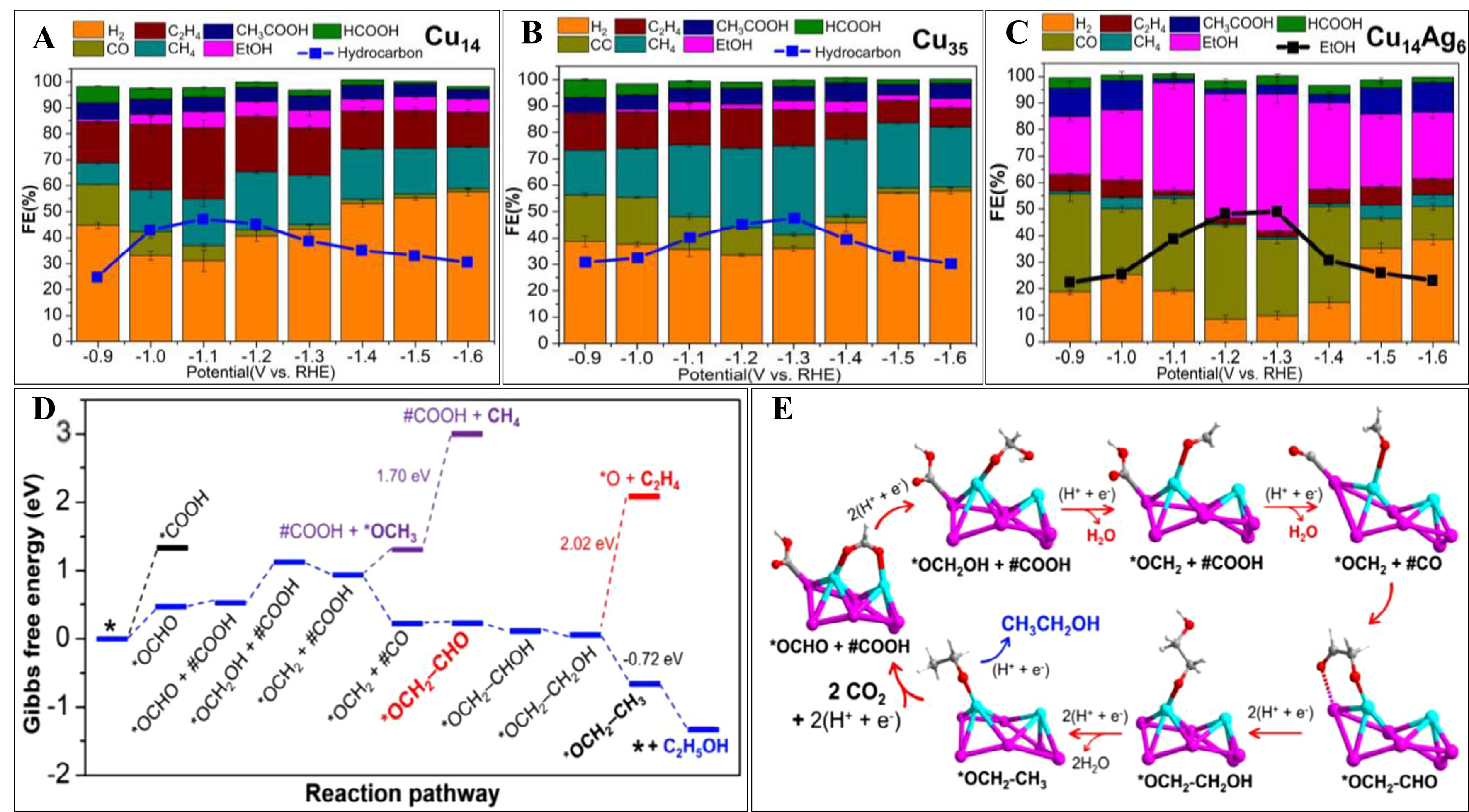
Figure 12. FEs of ECO2RR products at different applied potentials for (A) Cu14, (B) Cu35, and (C) Cu14Ag6; (D) Free energy profile of ECO2RR on Cu14Ag6 for ethanol generation; (E) Mechanism for ethanol production by Cu14Ag6 via ECO2RR. Color code: Cu, cyan; Ag, pink; C, gray; O, red; H, white. This figure is reproduced with permission from Ref.[46], © 2025 Wiley-VCH GmbH. FE: Faradaic efficiency.
In Cu14Ag6, the two surface-exposed Cu sites of the Ag6Cu2 subunit are the two active sites for ECO2RR, which have oxyphilic properties that coordinate with CO2 through the dual-O-bridged adsorption configuration of CO2, supported by DFT calculations [Figure 12D]. This dual-O-bridged configuration at the two exposed Cu sites undergoes PCET to form bidentate *OCHO, which is further hydrogenated to produce *OCH2 (* represents a Cu site). Simultaneously, at an adjacent Ag site, CO2 follows conventional C-terminal adsorption and is reduced to #CHO via #COOH (# denotes an Ag site). The intermediates *OCH2 and #CHO formed simultaneously undergo asymmetric coupling to generate *OCH2-CHO, which is further hydrogenated to form CH3CH2O* before reduction to ethanol [Figure 12E]. Conversely, Cu---Cu dual sites in Cu35 and Cu14 favor C2H4 formation.
CO selective ECO2RR catalysts: effect of ligand shells
To discover the effect of complicated multiple surface shells on ECO2RR, Li et al. synthesized [Cu26(DPPE)3(CF3CO2)8(CH3O)2(tBuC≡C)4H11]+ (Cu26) nanocluster, which consists of 26 Cu atoms and five different kinds of ligands such as 1,2-bis(diphenylphosphino)-ethane (DPPE), trifluoroacetate (CF3COO-), 3,3-dimethyl-1-butyne (tBuC≡C-), methoxide (CH3O-), and hydride ligands[61]. For comparison, other Cu nanoclusters such as Cu25H22((p-FPh)3P)12 (Cu25)[62], [Cu53(CF3COO)10(tBuCC)20Cl2H18]+ (Cu53)[63], and [Cu61(StBu)26S6Cl6H14]+ (Cu61)[64] with distinct interfaces were also prepared.
LSV curves suggested that the catalytic activity of CO2R over different clusters varies substantially [Figure 13A]. The Cu26 clusters showed FECO ~81% at -0.8 V [Figures 13B and C]. But Cu53, in spite of having similar ligands, exhibited much lower FECO than Cu26 at the same potential, indicating the complex surface structure of Cu26 created by five ligands favors the formation of CO [Figure 13C]. The plausible reason for the high catalytic efficiency of the Cu26 cluster is its strong capability to suppress the competitive HER. Moreover, FEH2 for the Cu26 was much lower than other clusters under investigation at -0.7 and -0.8 V [Figure 13D]. This suggests that under these potentials, a higher rate of CO2 adsorption and CO desorption makes CO2 to CO conversion more prominent on Cu26.
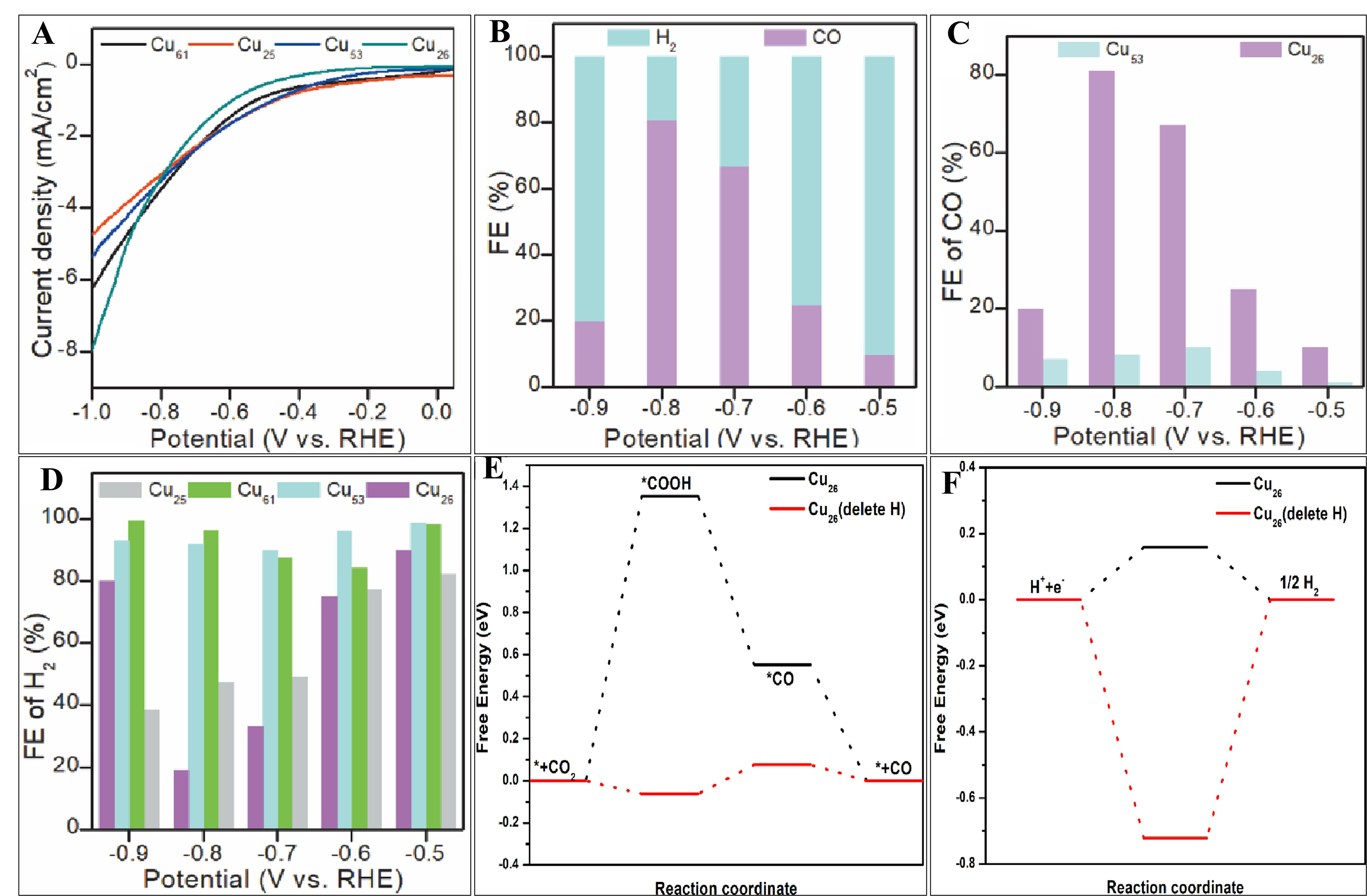
Figure 13. (A) LSV curves of Cu26, Cu25, Cu61, and Cu53; (B) FEs of ECO2RR products over Cu26; (C) FECO for Cu53 and Cu26; (D) FEH2 for Cu25, Cu61, Cu53, and Cu26; (E and F) Free energy diagrams of ECO2RR and HER pathways on Cu26 with and without hydrides (shown by black and red line respectively). This figure is reproduced with permission from Ref.[61], Copyright © 2023 American Chemical Society. LSV: Linear sweep voltammetry; FE: Faradaic efficiency; RHE: reversible hydrogen electrode.
DFT calculations compared the energy barrier for the formation of intermediates for two types of modeled Cu26 clusters: Cu26 having hydrides and Cu26-H- (i.e., Cu26 without hydrides) [Figure 13E]. Here, the hydrides present in Cu26 play an important role in the stabilization of the cluster as well as exposing active sites for selective reduction of CO2 to CO. However, DFT-based free energy diagrams [Figure 13E and F] revealed that in the absence of hydrides, Cu26 clusters can suppress even HER to a great extent and can significantly increase the yield of CO by decreasing the energy barrier for CO* formation.
CO selective ECO2RR catalysts: role of size and structure
Deng et al. synthesized bimetallic nanocluster with composition [Ag15Cu6(C≡CR)18(DPPE)2]- (Ag15Cu6) [HC≡CR: 3,5-bis(trifluoromethyl)phenylacetylene; DPPE: 1,2-bis(diphenylphosphino)ethane]. Ag15Cu6 exhibits an Ag11Cu4 metal core with a bcc (body-centred cubic) structure capped by two Cu atoms, two Ag2DPPE motifs, and eighteen alkynyl ligands. Such an unusual bcc metal core and accessible surface make it suitable for investigating ECO2RR[45]. For comparison, the [Ag9Cu6(tBuC≡C)12]+ (Ag9Cu6) cluster possessing a bcc metal core was synthesized. Both these clusters were supported on carbon black (Ag15Cu6/C and Ag9Cu6/C) to prevent conductivity problems and enhance dispersion[45]. High current densities in LSV curves were noticed for both the samples in CO2-saturated solution, indicating their catalytic activity for ECO2RR[45].
Interestingly, Ag15Cu6/C showed higher current density and lower onset potential than Ag9Cu6/C, suggesting the former’s higher catalytic activity. The data shown in Figure 14A revealed that Ag15Cu6/C exhibited high selectivity for CO (FECO > 85%) in the potential range of -0.72 to -0.87 V, with a maximum FECO ~91.3% at -0.81 V, whereas Ag9Cu6/C showed a maximum FECO ~48.5% at -0.89 V. In a membrane electrode assembly (MEA) electrochemical cell [Figure 14B], Ag15Cu6/C exhibited high selectivity towards CO, with FECO > 83% at all tested potentials with highest FECO ~91.3% at -3.50 V and a high partial JCO ~-154 mA·cm-2 at -4.00 V. Additionally, Ag15Cu6/C also demonstrated durability as FECO ~90% and partial current density of ~60 mA·cm-2 maintained during 145 h [Figure 14C].
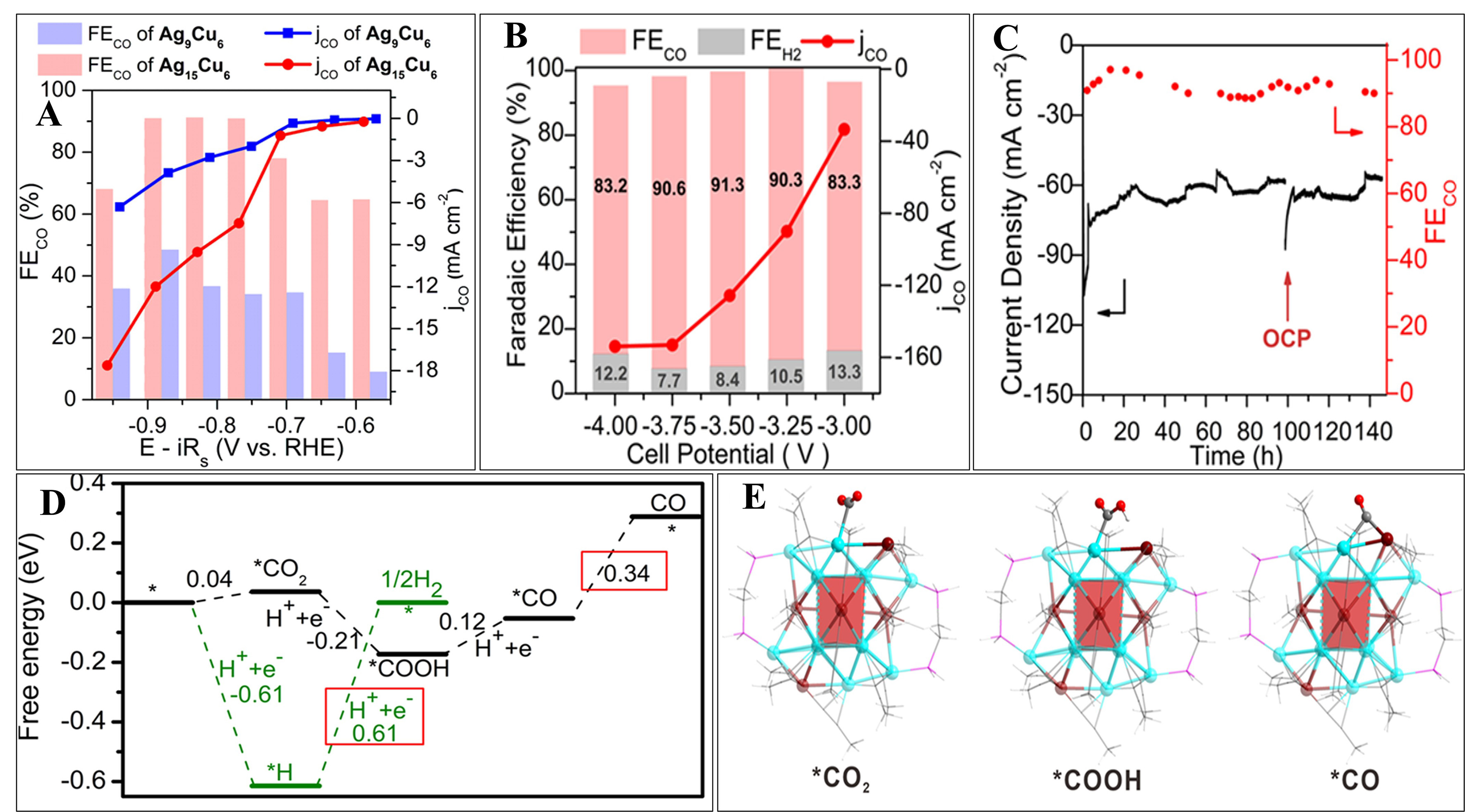
Figure 14. (A) FECO and jCO for Ag15Cu6/C, and Ag9Cu6/C during ECO2RR; (B) FECO, FEH2, and jCO of Ag15Cu6/C at various applied potentials in an MEA cell; (C) Long-duration operation of Ag15Cu6/C at -3.25 V in an MEA cell; (D) Free energy diagrams of ECO2RR and HER on Ag15Cu6 at 0 V (vs. RHE) after the removal of a single alkynyl ligand; (E) DFT-based structures of intermediates of *CO2, *COOH, and *CO. Color code: Ag, turquoise; Cu, dark red; P, pink; O, red; C, gray; H, white. This figure is reproduced with permission from Ref.[45], Copyright © 2022 American Chemical Society. MEA: Membrane electrode assembly; HER: hydrogen evolution reaction; RHE: reversible hydrogen electrode; DFT: density functional theory.
DFT simulations revealed two pairs of AgCu dual metals in Ag15Cu6/C as the most favorable active sites for ECO2RR owing to the stripping of alkynyl ligands during catalyst preparation without any structural changes, resulting in more available space. Theoretical calculations shown in Figure 14D and E suggested that de-ligated Ag15Cu6 can reduce the exothermic energy barrier of CO2 to *COOH by 0.21 eV, and the desorption of *CO to CO requires overcoming an endothermic energy barrier of 0.34 eV. However, in the competitive reaction pathway of HER, H+ desorption to form H2 is a potential-determining step that needs to overcome a large energy barrier of 0.61 V. Thus, it suggested the increase of activity and selectivity of Ag15Cu6 towards CO formation.
Methane selective ECO2RR catalysis: size effect
Xie et al. recently presented tailored Cu nanoclusters to suppress HER while enhancing CO2 to CH4 transformation under acidic media[65]. They deposited [Cu8(H)(9H-carbazole-9-carbodithiolate)6]PF6 (Cu8), [Cu36H10(PET)24(PPh3)6Cl2] (Cu36), and [Cu61(StBu)26S6Cl6H14]PF6 (Cu61) clusters onto carbon paper to make gas diffusion electrodes to test them in a bipolar membrane CO2RR electrolyzer with an acidic cathode
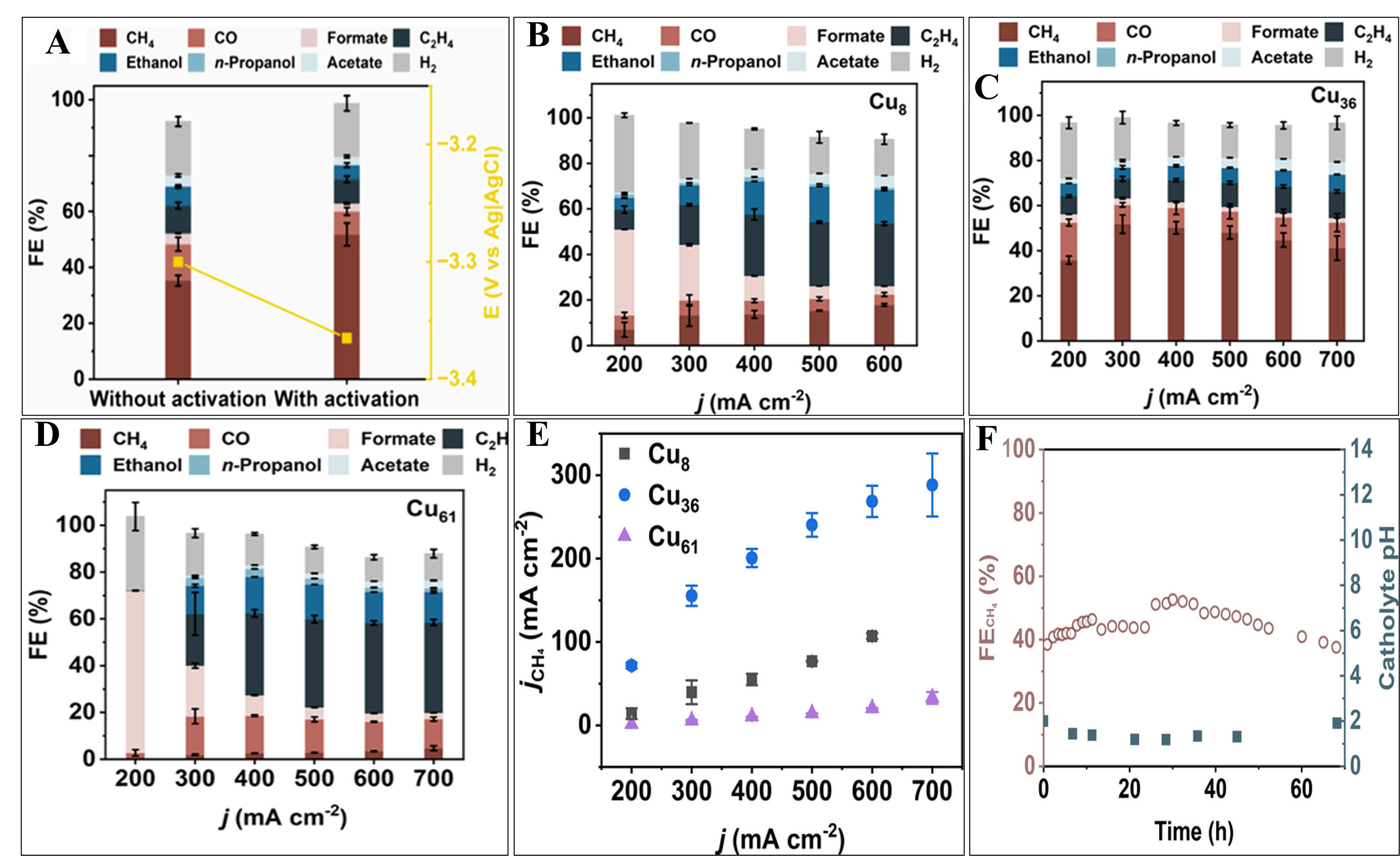
Figure 15. (A) FE of ECO2RR products at -300 mA·cm-2 for Cu36; FE distribution of CO2RR for (B) Cu8, (C) Cu36, and (D) Cu61 at various current densities; (E) Current density of methane (JCH4) for Cu8, Cu36, and Cu61; (F) Stability test of Cu36 at 300 mA·cm-2 in 1 M KCl (pH = 2). This figure is reproduced with permission from Ref.[65], Copyright © 2025 American Chemical Society. FE: Faradaic efficiency.
Cu61 generated formate (FEHCOOH = 69.4% ± 0.2%) and the lowest CH4 (FECH4 < 1%) along with H2 evolution [Figure 15D].
The stable Cu36 maintained the methane selectivity (FE > 40%) across the current density from 300 mA·cm-2 to 700 mA·cm-2 [Figure 15E]. These results were supported by partial current density (JCH4) curves of Cu8, Cu36, and Cu61 nanoclusters. In contrast to Cu36, an explicit transition in product distribution was observed from C1 to C2+ for Cu8 and Cu61 across the 200 mA·cm-2 to 700 mA·cm-2 [Figure 15B-D][65]. Here, C-C coupling reactions responsible for C2H4 and C2H5OH formation were due to nanocluster aggregation owing to instability of thiolate ligands on Cu8 and Cu61 at high current densities, resulting in the formation of crystalline Cu2-xS nanoparticles creating more favorable active sites to generate C2 products. However, in case of Cu36, the thiolate ligands prevented such agglomeration. The Cu36 also maintained constant activity and selectivity for 70 h at -300 mA·cm-2 [Figure 15F].
In another report, Han et al. demonstrated size effects on ECO2RR for [Cu13(SC6H3F2)3(P(PhF)3)7H10] (Cu13) and [Cu14(SC6H3F2)3(P(PhF)3)8H10]+ (Cu14) nanoclusters with precise structures shown in Figure 16A and B, where even one atom alteration results in switching of catalytic reactivity[66]. Here, Cu14 has a Cu(PR3) vertex at its defect site [Figure 16C], and this additional Cu atom at the top of Cu14 allows the H atom bound to three core Cu atoms to move into the center of the same Cu3 plane. As a result, the electronic structure of surrounding atoms is tuned to facilitate the CO2 adsorption and H2O dissociation simultaneously on Cu14.
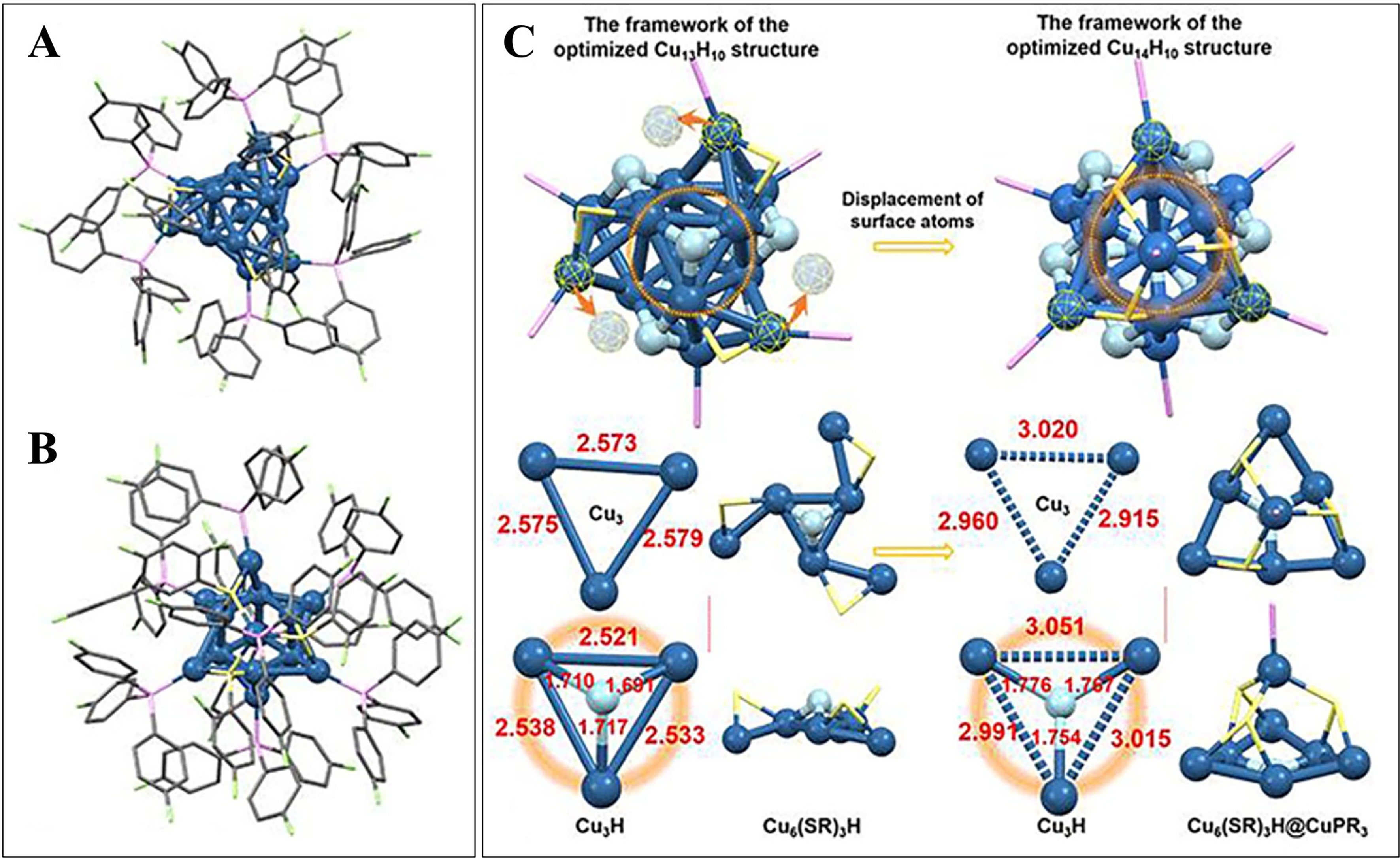
Figure 16. Total structures of (A) Cu13 and (B) Cu14; (C) Structural comparisons between Cu13 and Cu14. Color code: Cu, blue; H, cyan. This figure is reproduced with permission from Ref.[66], © 2025 Wiley-VCH GmbH.
For Cu13, H2 was the main product with little CO across the whole potential range of -0.8 to -1.3 V [Figure 17A]. Notably, for Cu14, with an increase of applied voltage from -0.8 to -1.2 V, FECO gradually decreases from 43% to 10.3%, while FECH4+C2H4 was found to be ~54.3% at -1.2 V with a corresponding current density of carbon-containing products (Jcarbon containing products) of 60 mA·cm-2 [Figure 17B]. Upon a further increase of potential to -1.3 V, H2 evolution becomes extreme, resulting in a significant decrease in CO2RR activity of Cu14. It is worth noting here that the decreasing trend of FECO and increasing trend of FE of carbon-containing hydrocarbons in the potential range of -0.8 to -1.2 V indicate that CO2 to CH4 and C2H4 conversion occurs via a *CO intermediate. Interestingly, an increase in the rate of formation of carbon-containing products with an increase in pH indicates that Cu14 speeds up H2O activation even at higher pH[66].
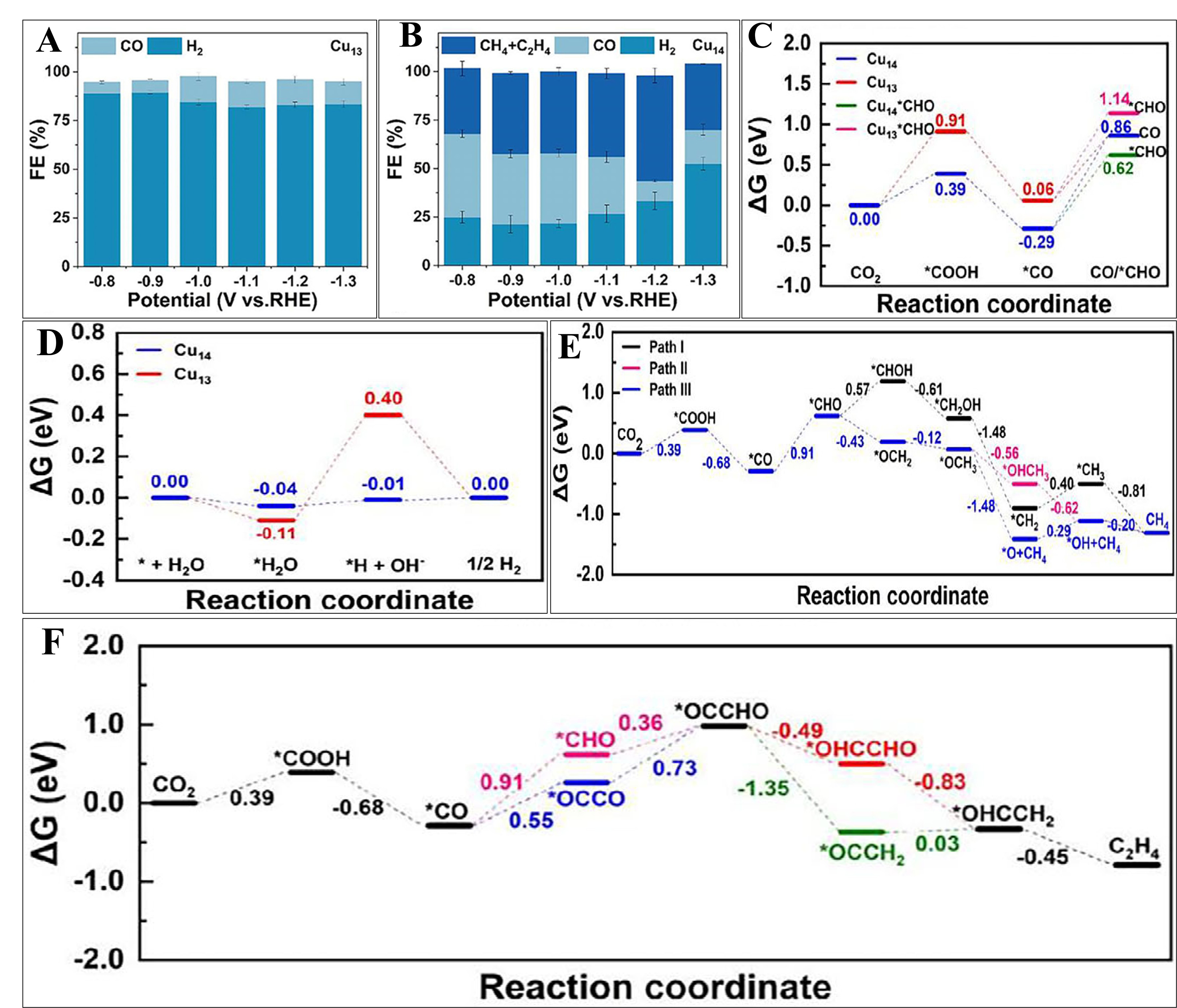
Figure 17. FE of products in ECO2RR over (A) Cu13 and (B) Cu14; ΔG curves for (C) reduction of CO2 to CO/*CHO, (D) H2O dissociation, (E) CH4 formation, and (F) C2H4 formation on Cu14 and Cu13. This figure is reproduced with permission from Ref.[66], © 2025 Wiley-VCH GmbH. FE: Faradaic efficiency.
Furthermore, in situ FTIR (Fourier transform infrared spectroscopy) monitoring revealed that the *CO peak in Cu14 becomes more intense with time, suggesting accumulation of *CO on Cu14 leading to further deep hydrogenation[66]. Next, Gibbs free energy calculations showed that the formation of the *COOH intermediate was more favorable in the case of Cu14 (ΔG = 0.39 eV) than in Cu13 (ΔG = 0.91 eV) [Figure 17C]. ΔG curves further indicate that H2O dissociation is also more feasible on Cu14 than on Cu13 [Figure 17D]. But the *CO desorption on Cu14 was found more difficult (ΔG = 1.15 eV), which promoted its deep hydrogenation to produce hydrocarbons [Figure 17E and F].
Methane and ethylene selective ECO2RR catalysis: effect of coordination symmetry of metal active site
The coordination symmetry breaking of the metal center results in an increase in active sites. Wu et al. demonstrated this kind of breaking of coordination symmetry in thiolate-protected Cu6(MBD)6 (MBD: 2-mercaptobenzimidazole) nanoclusters having symmetry-broken CuS2N1 active sites and its impact on ECO2RR[58]. The Cu6(MBD)6 displayed a maximum current density of ~364 mA·cm-2 at -1.5 V in saturated CO2 [Figure 18A]. The product distribution analysis shown in Figure 18B revealed that at an applied potential of +0.7 V, CO was the main product (FECO > 31.8%) along with CH4 (FECH4 ~2.1%) and C2H4 (FEC2H4 ~3.5%). However, with an increase in applied potential, FECO gradually decreased, while FECH4 and FEC2H4 continuously increased till FECH4 reached 42.5% at -1.4 V (JCH4 = -119 mA·cm-2), along with FEC2H4 reaching 23% (JC2H4 = -64.4 mA·cm-2) [Figure 18C].
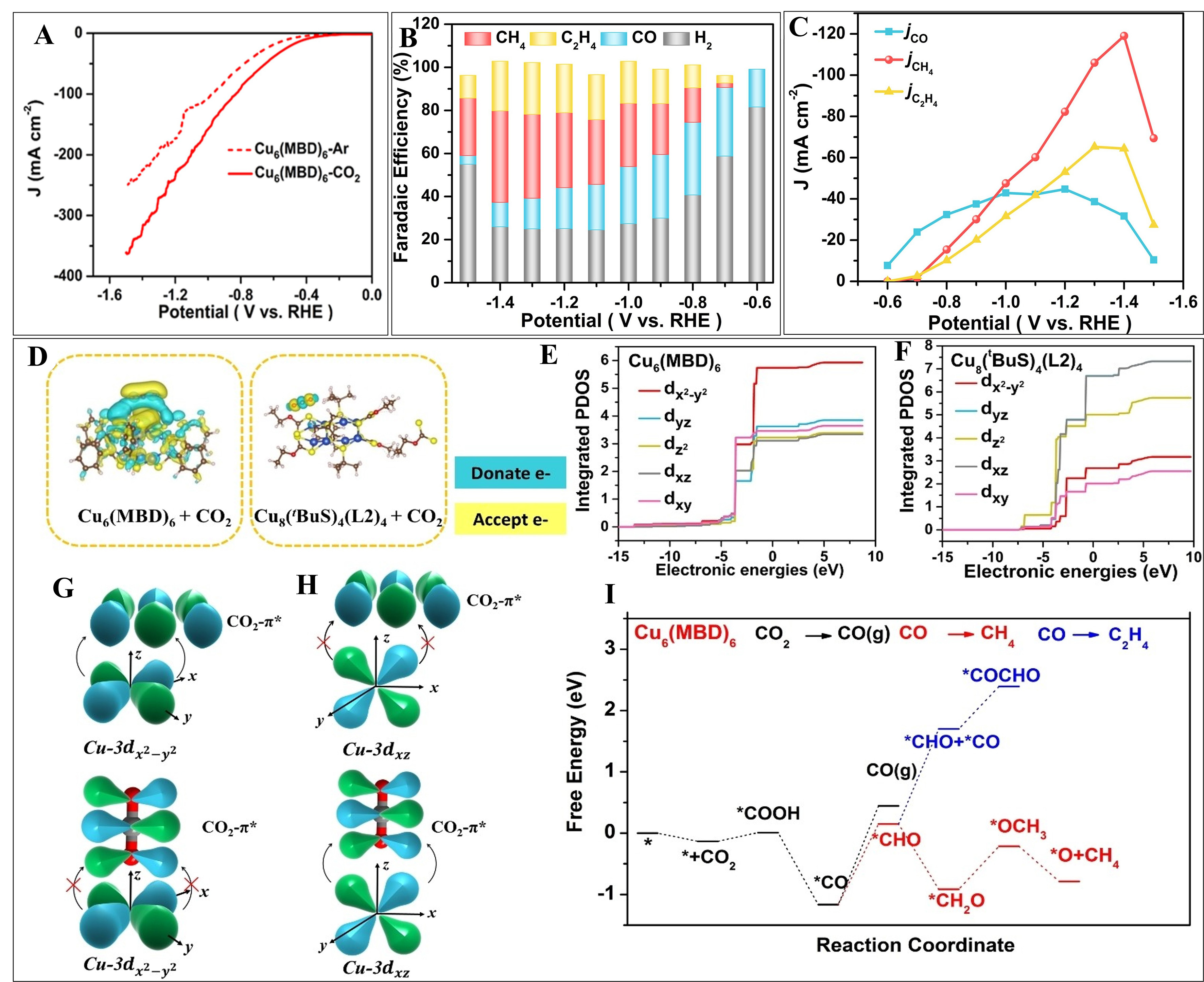
Figure 18. (A) LSV curves of Cu6(MBD)6 under saturated CO and Ar; (B) FEs of ECO2RR products (CH4, C2H4, and CO) at different applied potentials for Cu6(MBD)6; (C) Current densities of ECO2RR products on Cu6(MBD)6; (D) Charge density contrast plots at Cu6(MBD)6/CO2 and Cu8(tBuS)4(L2)4/CO2 interface; Density of states relative to Fermi level on Cu atom in (E) Cu6(MBD)6 and (F) Cu8(tBuS)4(L2)4; Different modes of CO2 binding with Cu sites considering dx2-y2 and dxz as highest occupied d orbitals in (G) Cu6(MBD)6 and (H) Cu8(tBuS)4(L2)4, respectively; (I) Free energy diagram of CO2RR on Cu6(MBD)6 at -1.4 V. This figure is reproduced with permission from Ref.[58], © 2023 Wiley-VCH GmbH. RHE: Reversible hydrogen electrode.
Further, DFT calculations were performed using optimized geometric models of Cu6(MBD)6 with CuS2N1 active sites and Cu8(tBuS)4(L2)4 (L2: o-ethyl carbonodithiolate) with Cu-S3 sites. Unlike in Cu8(tBuS)4(L2)4, electron transfer from Cu6(MBD)6 to CO2 was noticed owing to the higher polarity of the Cu-S2N1 site relative to the Cu-S3 site [Figure 18D], and the higher binding energy (0.19 eV) between Cu6(MBD)6 and CO2 than between CO2 and Cu8(tBuS)4(L2)4 (0.18 eV). Integrated projected density of states (IPDOS) revealed that for Cu6(MBD)6, the dx2-y2 orbital of the CuS2N1 site is the highest occupied d-orbital [Figure 18E], and for Cu8(tBuS)4(L2)4, the dxz of the CuS3 site is the highest occupied d-orbital [Figure 18F]. Further, for Cu6(MBD)6, the symmetry and energy match of its highest occupied dx2-y2 orbital with the lowest occupied π* orbital of CO2 to form a π-complex via π-back bonding plays a role in binding the reactant and intermediate [Figure 18G]. In contrast, the highest occupied dxz orbital of Cu8(tBuS)4(L2)4 would couple with the lowest occupied π* orbital of CO2 to form a π-complex only when the adsorption of CO2 occurs through the O atom [Figure 18H]. The key intermediate in the case of Cu6(MBD)6, was *COOH instead of *OCHO. On the basis of adsorption free energies of key intermediates at an applied potential of -1.4 V shown in Figure 18I, the CuS2N1 adsorbs the CO2 with a free energy of -0.13 eV, leading to their strong interaction followed by hydrogenation through adding a proton and electron from the electrode to form the *COOH intermediate. This is followed by generation of *CO, which can either undergo desorption or hydrogenation to form CH4 and/or C2H4 as products.
Methane selective ECO2RR catalysis: synergic effect of dual sites
Li et al. illustrated the impact of the synergistic effect of dual sites, such as Cu+ and adjacent S sites, on ECO2RR. To this end, they synthesised Cu4(MMI)4 (Cu4) and Cu8(MMI)4(tBuS)4 (Cu8) (MMI: 2-mercapto-1-methylimidazole) nanoclusters with well-resolved structures as shown in Figure 19A and B, respectively[67]. LSV curves of both Cu4 and Cu8 exhibited high current densities in saturated CO2, confirming their high activities for ECO2RR. Cu4 exhibited FE of carbon products > 85.8% across the potential from -0.9 to -1.6 V with a maximum FE ~94.0% at -1.2 V [Figure 19C]. The carbonaceous hydrocarbons formed on Cu4 via ECO2RR were CH4 (FECH4 ~53.7%), C2+ products (FEC2+ ~37.3%), and CO and HCOOH (FECO + HCOOH < 8.2%) at -1.2 V. This indicates that the Cu(I) site in Cu4 effectively stabilizes the *CO, which is further reduced into high-value carbonaceous products. In contrast, FE of deep-reduced carbonaceous products for Cu8 was found to be ~72.8% at -1.2 V [Figure 19D], along with FE of 2e-reduction products ~15.8% and FEH2 ~11.4%. Notably, Cu4 showed a high preference for CH4 with FECH4 ~53.7% and JCH4 ~89.1 mA·cm-2 at -1.2 V (vs. RHE), whereas Cu8 exhibits a preference for C2+ products with FE ~58.5% and JC2+ of 152.1 mA·cm-2 at -1.3 V (vs. RHE)[67]. Interestingly, the continuous electrolysis revealed higher electrochemical stability of Cu4.
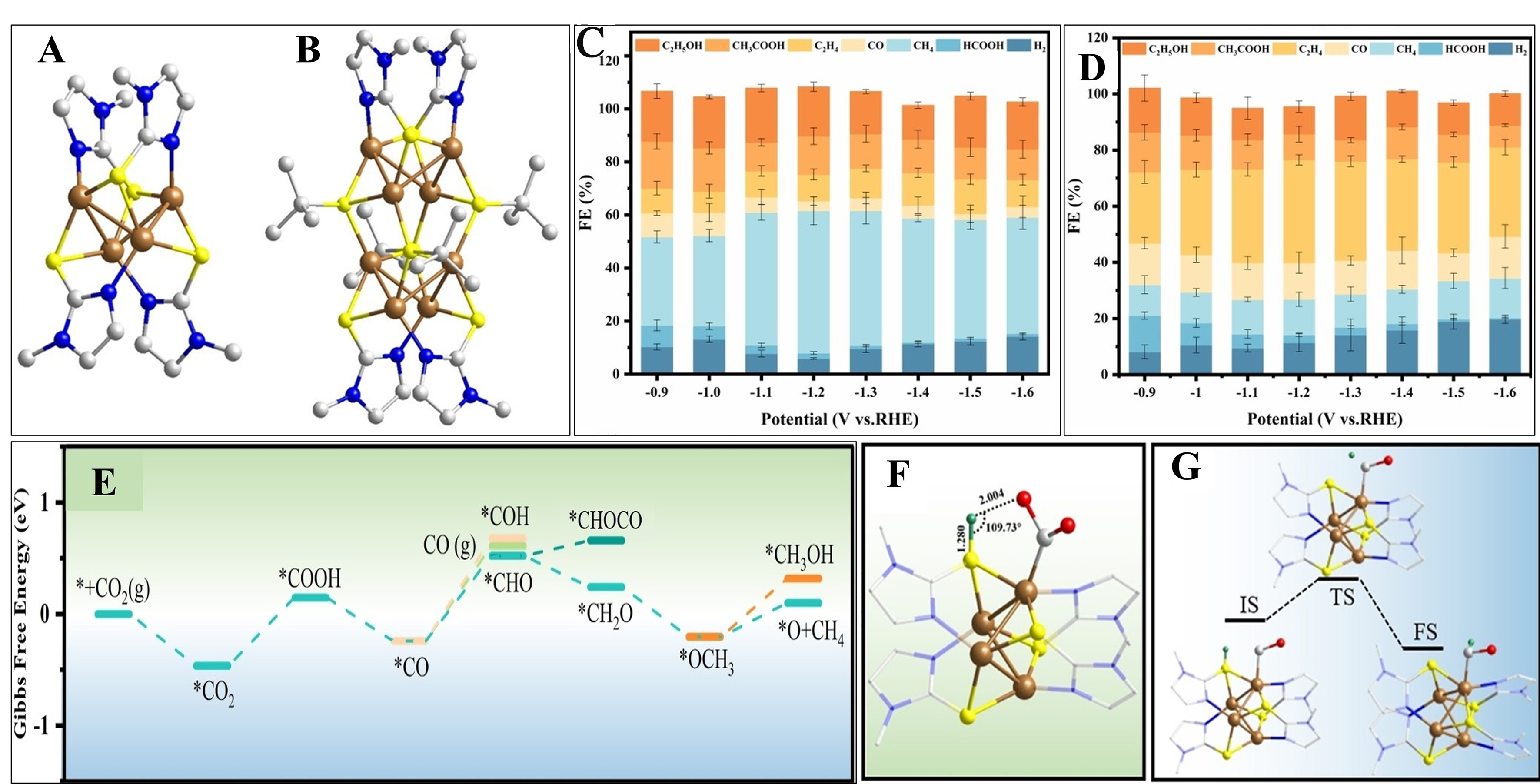
Figure 19. Total structure of (A) Cu4 and (B) Cu8; FE of CO2RR products on (C) Cu4 and (D) Cu8; (E) Free energy diagram of CO2RR on Cu4.; (F) Mechanism of hydrogen bond interaction between *H and reaction intermediates; (G) Relative free energies of initial configuration (IS), transition states (TS), and final configuration (FS) for *CO protonation to *CHO. This figure is reproduced with permission from Ref.[67], © 2024 Wiley-VCH GmbH. RHE: Reversible hydrogen electrode; FE: Faradaic efficiency.
Further, ATR-SEIRAS analysis displayed the peaks corresponding to the OH deformation and symmetric stretch of *COOH, which is key intermediate to form CO and CH4 products in case of Cu4[67]. Furthermore, the peaks of *CH2O and *OCH3, which are crucial intermediates to form CH4, were also noticed. Although most of the reaction intermediates on Cu4 are similar to Cu8, the appearance of peaks corresponding to the *COCHO intermediate indicates the formation of C2+ products in Cu8. The Gibbs free energy diagram for Cu4, shown in Figure 19E, revealed that the C-C coupling step of *CHOCO is uphill, with a barrier of 0.19 eV inhibiting the production of multicarbon products. Furthermore, the Gibbs formation energy of *CH3OH from the *OCH3 intermediate is 0.22 eV higher than that of CH4 for Cu4. The proposed mechanism of hydrogen bond interaction between H* and reaction intermediate is presented in Figure 19F along with relative free energies of initial configuration, transition state, and final configuration for protonation of *CO to *CHO [Figure 19G]. On the other hand, taking into account experimental findings that one tert-butyl group is removed, the energy barrier for *COCHO formation is lower than *CHO protonation on both CuS2N and Cu-S3 sites, indicating a stronger tendency of Cu8 to form C2+ products.
The Faradaic efficiencies of products formed during ECO2RR over various ligand-protected Cu nanoclusters mentioned in this review are summarized in Table 1.
Summary of Cu nanocluster-based ECO2RR catalysis along with FE of products
| Cu nanocluster-based electrocatalysts | Potential | Faradaic efficiency (FE) of products | Reactor | Ref. |
| [Cu32(H)20{S2P(OiPr)2}12] (Cu32) W.E.: Cu32/CB/GDL (1 cm2) Electrolyte: 0.1 M KHCO3 + 0.4 M KCl, pH ~6.8 | 0.3 V overpotential | FEHCOOH ≈89%; minor products: CO and H2; TON ~1740 for 90 min | H-cell | [54] |
| [Cu14(CHT)3(PPh3)H10]+ (Cu14-CHT) W.E.: Cu14-CHT/CB/carbon paper Electrolyte: 0.1 M KHCO3, pH~7 | -1.2 V | FEHCOOH ≈31%; FECO ≈8%; For 12 h, consistent FEHCOOH ≈12 %; other product = H2 | Flow-cell | [55] |
| [Cu14(PET)3(PPh3)8H10]+ (Cu14-PET) W.E.: Cu14-PET/CB/carbon paper Electrolyte: 0.1 M KHCO3, pH ~7 | -1.2 V | FEHCOOH ≈39%; FECO ≈2%; For 12 h, consistent FEHCOOH ≈35%; other product = H2 | Flow-cell | [55] |
| Cu8(H)(L1)6PF6 (Cu8-1), (cubic kernel) W.E.: Cu8-1/C/carbon fiber cloth Electrolyte: 0.5 M KHCO3 | -1.0 V | FEHCOOH ≈48.6%; FECO < 5%; FEH2 ~40%) | H-cell | [56] |
| Cu8(tBuS)4(L1)4 (Cu8-2), (ditetrahedral kernel) W.E.: Cu8-2/C/ carbon fiber cloth Electrolyte: 0.5 M KHCO3 | -1.0 V | FEHCOOH ≈92%; FECO ~10%; FEH2 < 5% | H-cell | [56] |
| [Cu23H4(SC7H7)18(PPh3)6] (Cu23) W.E.: Cu23/CB/carbon paper Electrolyte: 0.5 M KHCO3 | -1.2 V | FEHCOOH ≈26%; FEH2 ≈43%; other minor product: CO; TOF for HCOOH~113.4 h-1 | H-cell | [43] |
| [Cu17H6(NHCH)4(dppm)4]3+ (Cu17a) W.E.: Cu17a/CNT/GDC Electrolyte: 1 M KOH | -0.37 V | FECO ≈91%; FEH2 < 10% | Flow-cell | [57] |
| -1.07 V | FEC2H4 ≈37.5%; FECO < 35%; FEH2 < 30% | |||
| [Cu17H6(NHCph)4(dppm)4]3+ (Cu17b) W.E.: Cu17b/CNT/GDC Electrolyte: 1 M KOH | -0.6 - 0.8 V | FECO ≈36%; other product = H2 | Flow-cell | [57] |
| [Cu58H20(SPr)36(PPh3)7]2+ (Cu58-1) W.E.: Cu58-1/CB/carbon paper Electrolyte: 0.1 M KHCO3 | -0.7 V | FECH3OH ≈54%; FEH2 < 30%; minor product: CO | H-cell | [59] |
| [Cu58H20(SEt)36(PPh3)6]2+ (Cu58-II) W.E.: Cu58-II/CB/carbon paper Electrolyte: 0.1 M KHCO3 | -0.9 V | FEH2 > 50%; FEHCOOH ~15%; minor product: CO | H-cell | [59] |
| [Cu58H20(SPr)36(PPh3)7]2+ (Cu58) W.E. : Cu58/CB/carbon paper Electrolyte: 0.1 M KHCO3 | -0.9 V | FECO ≈30%; FEH2 ~40% | H-cell | [59] |
| {NaCu35(TC4A)4(PhCC)20} (Cu35) W.E: Cu35/CNT/carbon paper Electrolyte: 1 M KOH | -1.3 V | FECH4 ≈34.01%; FEC2H4 ≈13.95%; FECO ~5%; FEH2 ~37%; FEC2H5OH < 5% | Flow-cell | [46] |
| [Cu14(TC4A)4(PhCC)6] (Cu14) W.E: Cu14/CNT/carbon paper Electrolyte: 1 M KOH | -1.1 V | FECH4 ≈17.94%; FEC2H4 ≈27.50%; FEH2 ~30%; FECO ~5%; FEC2H5OH < 7% | Flow-cell | [46] |
| [Cu14Ag6(TC4A)2(PhC≡C)12(MeOH)] (Cu14Ag6) W.E.: Cu14Ag6/CNT/carbon paper) Electrolyte: 1 M KOH | -1.3 V | FEEtOH ~49.27%; FECO ~30%; FEC2H4 ~1.87%; FEH2 < 10% | Flow-cell | [46] |
| [Cu26(DPPE)3(CF3CO2)8(CH3O)2(tBuC≡C)4H11]+ (Cu26) W.E: Cu26/CB/carbon paper Electrolyte: 0.1 M KHCO3 + 0.4 M KCl | -0.8 V | FECO ≈81%; other products = H2 | H-cell | [61] |
| [Ag15Cu6(C≡CR)18(DPPE)2]- (Ag15Cu6) W.E.: Ag15Cu6/C/carbon paper Electrolyte: 0.1 M KHCO3 | -0.81 V | FECO ≈91.3%; FEH2 ≈7% | H-cell | [45] |
| [Ag9Cu6(tBuC≡C)12]+ (Ag9Cu6) W.E.: Ag9Cu6/C/carbon paper Electrolyte: 0.1M KHCO3 | -0.89 V | FECO ≈48.5%; other product: H2 | H-cell | [45] |
| [Cu8(H)(9H-carbazole-9-carbodithiolate)6]PF6 (Cu8) W.E: Cu8/carbon substrate) Electrolyte: catholyte 1 M KCl, pH = 2 and anolyte 1 M KOH | @ 200 mA·cm-2 | FEHCOOH ~37.7%; FEC2+ ≈16.2% 2%; FEH2 ≈33.9% 1.0%; FECH4 ≈7.0%) | Flow-cell | [65] |
| [Cu36H10(PET)24(PPh3)6Cl2] (Cu36) W.E.: Cu36/carbon substrate Electrolyte: catholyte 1M KCl, pH = 2 and anolyte 1 M KOH | @ 200 mA·cm-2 | FECH4=35.9 1.8%; other products: CO, C2H4, C2H5OH, HCOOH, CH3COOH, and H2 | Flow-cell | [65] |
| [Cu61(StBu)26S6Cl6H14]PF6 (Cu61) W.E.: Cu61/carbon substrate Electrolyte: catholyte 1 M KCl, pH = 2 and anolyte 1 M KOH | @ 200 mA·cm-2 | FEHCOOH ≈69.4% ± 0.2%; FECH4 < 1%; FEH2 ~33% | Flow-cell | [65] |
| [Cu13(SC6H3F2)3(P(PhF)3)7H10]0 (Cu13) W.E.: Cu13/caron fiber paper Electrolyte: 0.5 M KHCO3 | -1.1 V | FECO ≈13%; FEH2 ≈85% | H-cell | [66] |
| [Cu14(SC6H3F2)3(P(PhF)3)8H10]+ (Cu14) W.E.: Cu14/caron fiber paper Electrolyte: 0.5 M KHCO3 | -1.2 V | FECH4+C2H4 ≈54.3% ; FECO ≈10.3% ; other product: H2 | H-cell | [66] |
| [Cu6(MBD)6] (Cu6(MBD)6) W.E.: Cu6(MBD)6/carbon paper Electrolyte: 1 M KOH | -0.7 V | FECO ≈31.8%; minor products: CH4 and C2H4 | Flow cell | [58] |
| -1.4 V | FECH4 ≈42.5%; FEC2H4 ≈23; minor product: CO | |||
| Cu4(MMI)4 (Cu4) W.E.: Cu4/carbon paper Electrolyte: 1 M KOH | -1.2 V | FECH4 ≈53.7%; FEC2+ ≈37.3%; other minor products: CO, H2. HCOOH, CH3COOH | Flow cell | [67] |
| Cu8(MMI)4(tBuS)4 (Cu8) W.E.: Cu8/carbon paper Electrolyte: 1 M KOH | -1.3 V | FEC2+ ≈58.5%; FEC1≈15.8%; FEH2 ≈11.4% | Flow cell | [67] |
PHOTOCATALYTIC CO2 REDUCTION REACTIONS (PCO2RR)
Fundamental principle
The photocatalytic CO2 reduction under a continuous solar spectrum performs like artificial photosynthesis, which involves three typical processes: (i) charge carrier (electron-hole pair) formation upon light absorption; (ii) charge carrier separation and transport; and (iii) surface redox reactions. For efficient surface reactions, the charge recombination rate must be slower than the rate of charge transfer to chemical species. Thermodynamically, the conduction band position of the photocatalyst should be more negative than the reduction potential of CO2 (~-0.48 V vs. RHE, pH = 7), while the valence band should be at a more positive potential than the oxidation potential of water (+0.81 to +0.82 V vs. RHE, pH = 7). Artificial photocatalytic systems are mainly of three kinds [Figure 20A-C][68]: (1) single excitation system with a wide band gap photocatalyst; (2) multiple excitation system with a pair of narrow band gap materials coupled with each other via a physical contact (heterojunction); (3) multiple excitation systems connected by a redox mediator to form a Z scheme.
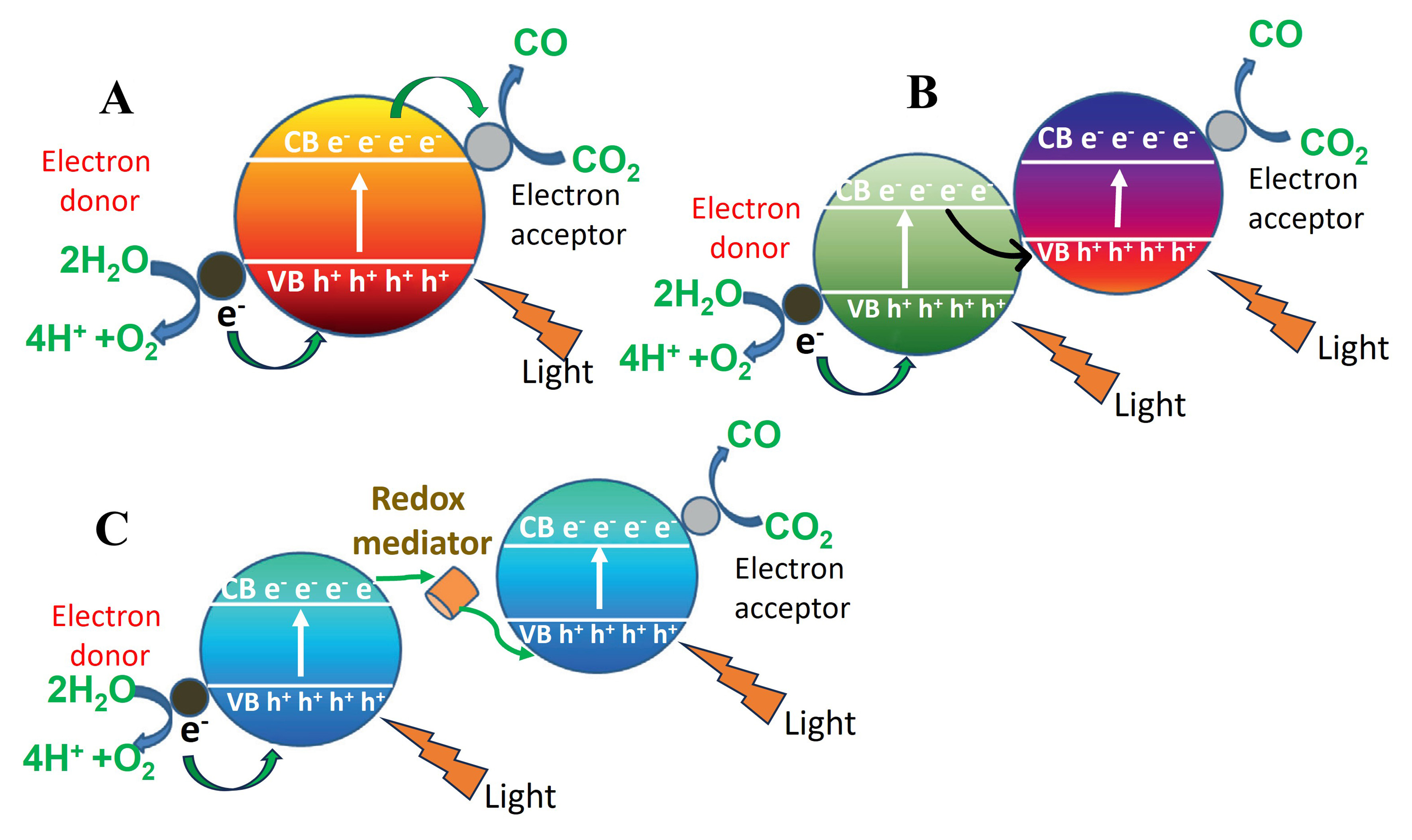
Figure 20. Photocatalytic systems: (A) Single excitation photosystem with a wide band gap; (B) Multiple excitation system with a pair of narrow band gap photocatalysts connected with a heterojunction; (C) Multiple excitation system connected with an electron mediator to form a Z scheme. This figure is reproduced with permission from Ref.[68], © 2021 Elsevier B.V. All rights reserved.
The reported examples of Cu nanoclusters as photocatalysts are relatively few and are illustrated in the following section.
Ligand-protected Cu nanocluster for PCO2RR
CO selective PCO2RR: ligand effect
The S, N atom-based coordination compounds are in more negative p-orbitals (lower in energy) relative to O atoms and can be coupled to produce more desirable band structures. With this understanding,
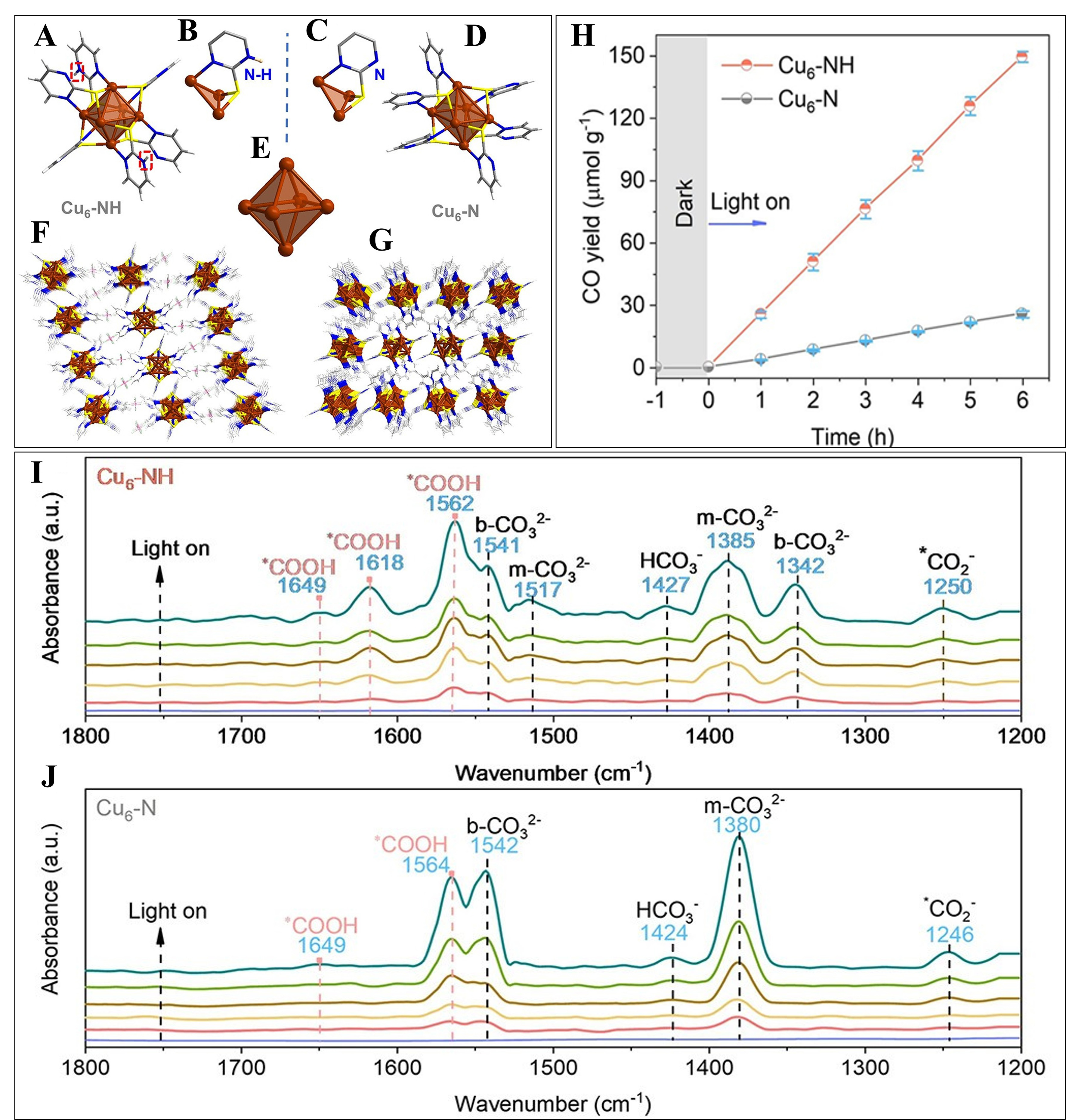
Figure 21. (A) Structure of Cu6-NH ; (B) Coordination modes of ligand in Cu6-NH ; (C) Coordination modes of ligand in Cu6-N; (D) Structure of Cu6-N; (E) Common octahedral Cu6 metal core in Cu6-NH and Cu6-N; Molecule packing diagrams of (F) Cu6-NH and (G) Cu6-N; (H) Time-dependent CO2 photoreduction performances of Cu6-NH and Cu6-N; In-situ DRIFTS spectra during CO2 photoreduction over (I) Cu6-NH and (J) Cu6-N. Color code: Cu, brown; S, yellow; C, gray; H, white; N, blue. This figure is reproduced with permission from Ref.[69], © 2023 Wiley-VCH GmbH.
UV-Vis (ultraviolet-visible) spectra indicated that Cu6-NH and Cu6-N have absorption in 400-550 nm. The conduction bands of both clusters were more negative (-1.08 and -1.11 V, respectively) than the redox potential of CO/CO2 (-0.48 V, pH = 7), and the valence bands of both clusters are more positive than the redox potential of O/H2O (+0.82 V, pH = 7), indicating both can catalyze CO2 reduction and H2O oxidation. DFT calculations revealed that both nanoclusters are direct band gap semiconductors with p-n heterostructures for efficient charge separation[69]. After 6 h of visible light irradiation, the average rate of CO evolution was 24.8 μmol·g-1·h-1 for Cu6-NH [Figure 21H], comparable with reported catalysts[70-72]. Whereas Cu6-N showed a low CO evolution rate of 4.3 μmol·g-1·h-1. Additionally, a minor amount of H2 was detected, and O2 was also generated with a molar ratio of 2:1 of CO and O2. The sole difference between Cu6-NH and Cu6-N is the two protonated N atoms of the PymSH ligand in the former, as shown in Figure 21B, which play a key role as proton relay stations in improving its photocatalytic performance.
To gain further insights, in situ diffuse reflectance infrared Fourier transform spectroscopy (DRIFTS) experiments were conducted, revealing relatively extra absorption bands of *COOH, mCO32-, and b-CO32- at 1,618, 1,517, and 1,342 cm-1, respectively, for Cu6-NH, ascribed to H-bonding between protonated N-H and different intermediates [Figure 21I and J]. This observation further validated the role of protonated N-H groups as proton relay stations in Cu6-NH, beneficial for the formation of the *COOH intermediate, which was finally reduced to CO.
CO selective PCO2RR: effect of structural transformation
The efficiency of photocatalytic CO2 reduction has still not reached its full potential due to inadequate utilization of the solar spectrum. Recently, Dong et al. presented an unprecedented near-infrared light-responsive [Cu8(StBu)4(PymS)4] (Cu8SN) nanocluster for effective photoreduction of CO2[73]. Notably, owing to C-H…π and C-H…N interactions between PymS and tBuS-ligands shown in Figure 22A, a 3D supramolecular network is formed in Cu8SN [Figure 22B]. Further, thermal treatment of Cu8SN at 240 oC under N2 resulted in its transformation into a novel and structurally stable [Cu8(S)2(PymS)4] (Cu8SN-T) nanocluster [Figure 22C]. Comparison of the structures of Cu8SN and Cu8SN-T revealed that after heat treatment at 240 oC, the tert-butyl mercaptan uniting two Cu4 sub-cores in Cu8SN is replaced with S2- in Cu8SN-T, resulting in a novel Cu8 Core in the latter [Figure 22A and C].
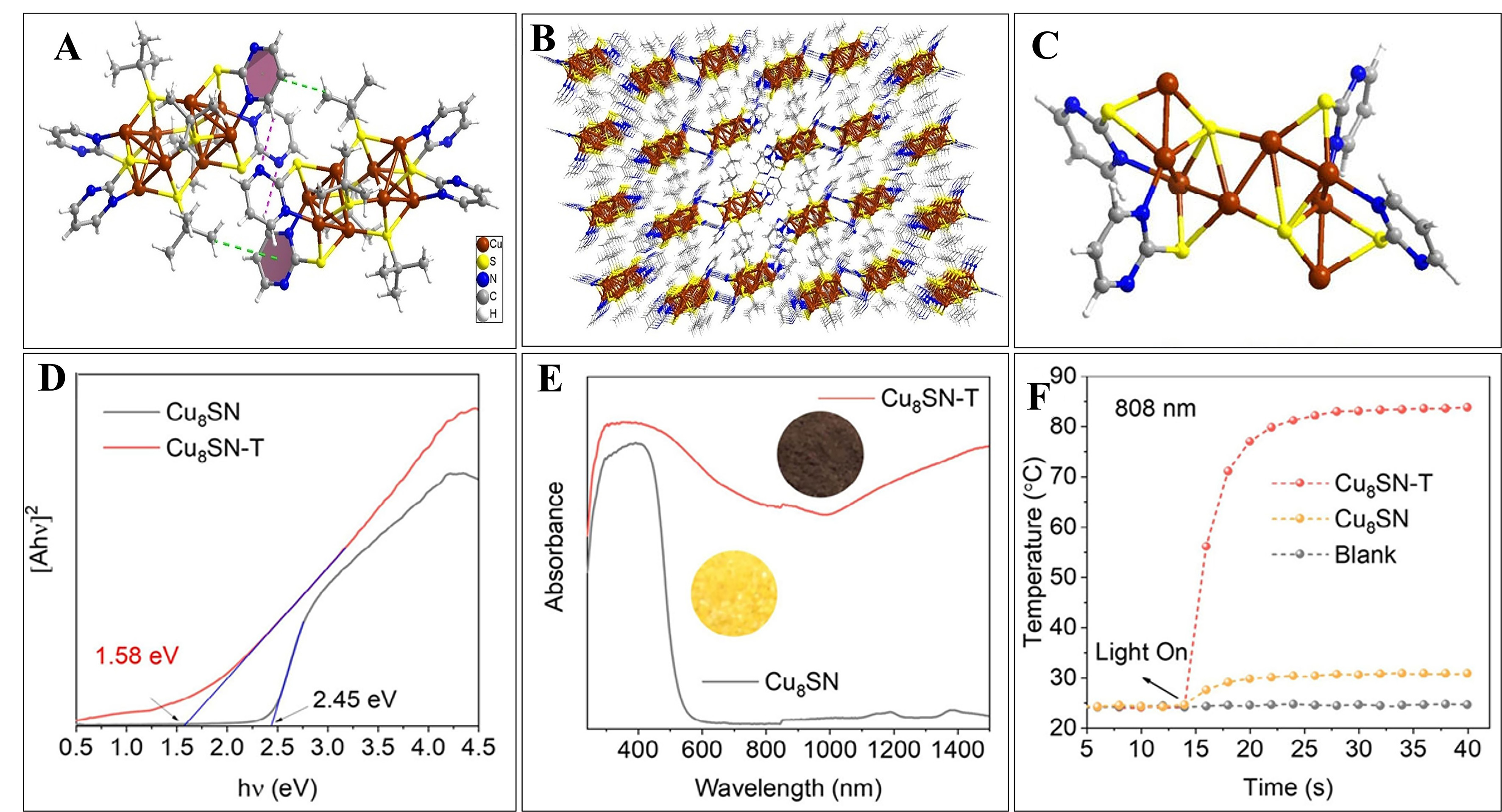
Figure 22. (A) C-H---π and C-H---N interactions in Cu8SN; (B) Stacking structure of Cu8SN; (C) Simulated structure of Cu8SN-T; (D) Tauc plots of Cu8SN and Cu8SN-T showing their distinct band gaps; (E) Solid-state UV-Vis-NIR DRS of Cu8SN and Cu8SN-T (F) Photothermal temperature study of Cu8SN and Cu8SN-T. This figure is reproduced with permission from Ref.[73], © 2025 Wiley-VCH GmbH.
The estimated band gaps of 2.45 eV and 1.58 eV from Tauc plots for Cu8SN and Cu8SN-T, respectively [Figure 22D], confirmed their different band structures. Ultraviolet-visible-near infrared (UV-Vis-NIR) diffuse reflectance spectra (DRS) in Figure 22E revealed that Cu8SN-T exhibited absorption bands across the UV-Vis-NIR region. Upon illumination with near-infrared (NIR) light (808 nm, 100 mW·cm-2) [Figure 22F], the temperature of Cu8SN-T increased from 24.2 to 87.2 oC within 25 s, which is much faster than for Cu8SN (final temperature = 31.3 oC). Thus, Cu8SN-T enables direct use of sunlight for high-temperature photocatalysis. Being a direct band gap semiconductor, the valence band of Cu8SN-T at +0.90 V [vs. normal hydrogen electrode (NHE)] and the conduction band at -0.68 V (vs. NHE) make it possible to catalyze both CO2 reduction and H2O oxidation. Further, the quenching of PL intensity of Cu8SN-T also confirmed its better charge separation ability.
The CO evolution rate of Cu8SN-T was calculated to be 20.2, 17.92, and
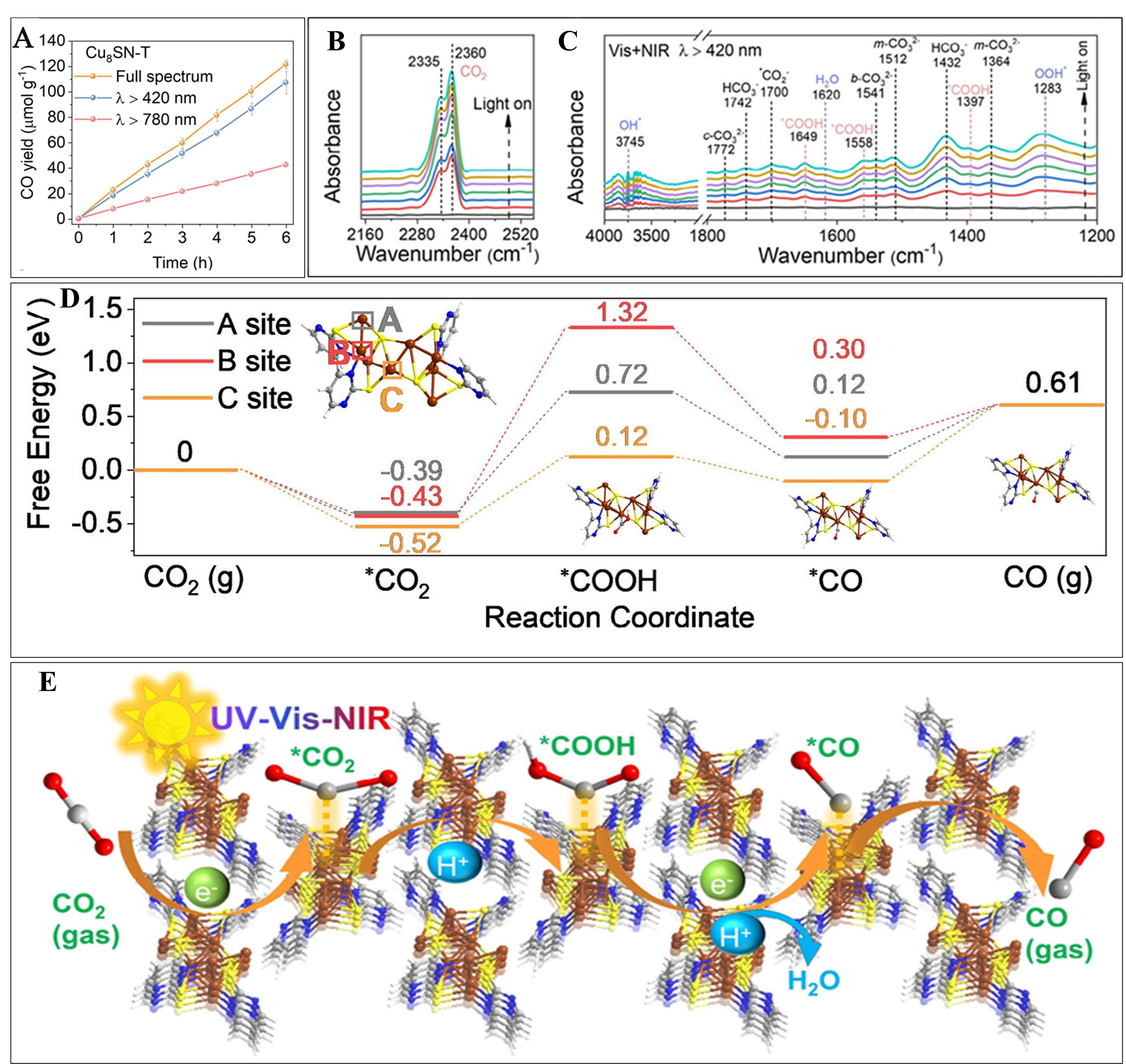
Figure 23. (A) CO2RR performance of Cu8SN-T; (B and C) In situ DRIFTS spectra during CO2 photoreduction over Cu8SN-T; (D) Free-energy diagrams for CO2 reduction over A, B, and C sites of Cu8SN-T; (E) CO2RR mechanism. The asterisk (*) is standard notation for adsorbed species. This figure is reproduced with permission from Ref.[73], © 2025 Wiley-VCH GmbH. DRIFTS: Diffuse reflectance infrared Fourier transform spectroscopy.
In situ DRIFTS spectra shown in Figure 23B and C revealed that apart from the peaks owing to CO2 adsorption on Cu8SN-T at 2,335 and 2,360 cm-1, additional peaks at 1,397, 1,558, and 1,649 cm-1 were assigned to the *COOH intermediate responsible for CO2 reduction to CO. The bands at 1,432 and 1,742 cm-1 correspond to symmetric stretching of *HCO3-, highlighting that CO2 and H2O are co-adsorbed on Cu8SN-T.
DFT calculations identified three types of Cu sites for CO2 adsorption in Cu8SN-T as shown in the inset of Figure 23D: A site (Cu-S2), B site (Cu-N1S2), and C site (Cu-S3) with adsorption energies of -0.31, -0.60, and -0.99 eV, respectively, indicating that any of them can act as a site for CO2 reduction. However, CO2 reduction was found more likely to occur at the C site (i.e., Cu-S3) in the thermally treated Cu8SN-T cluster as per their energy profiles [Figure 23D]. On the basis of DRIFTS results, authors proposed a plausible reaction mechanism of PCO2RR over Cu8SN-T shown in Figure 23E.
CONCLUSIONS AND OUTLOOKS
In summary, the reported examples of electrochemical and photochemical reduction of CO2 catalyzed by ligand-protected Cu metal nanoclusters with well-resolved structures are thoroughly reviewed in this article. Owing to the specific and well-defined catalytic active sites on the surface/interface of Cu metal nanoclusters and the optimal interaction of Cu with CO2, deep mechanistic insights into ECO2RR/PCO2RR for the selective valuable products have been gained.
However, the following gaps need to be addressed. (a) The progress in the synthesis of Cu nanoclusters with well-resolved structures has not yet reached the level vis-à-vis their Au/Ag counterparts. The unexplored composition of Cu nanoclusters, particularly with partial Cu(0) character and even higher magic number clusters of Cu, are still to be discovered; (b) The stability of Cu nanoclusters is another area of concern for their applications in ECO2RR/PCO2RR that is required to be addressed; (c) Given the limited number of reports, the photocatalytic CO2 reduction over Cu nanoclusters must be a major research priority; (d) Considering the challenges to stabilize the Cu nanoclusters, more advancement is required in resolving their crystal structures and tailored optimization using theoretical research tools to unleash their full potential in CO2RR catalysis; (e) The competitive reactions, particularly HER, occurring during CO2RR over Cu nanoclusters should be suppressed efficiently to enhance FE and current density of targeted value-added hydrocarbon products for the practical applications; (f) The challenges to develop the surface engineering methods to increase the performance of Cu-based nanoclusters towards CO2RR while working with CO2 feed streams containing impurities, particularly in the industrial steel plants, must be overcome.
DECLARATIONS
Acknowledgments
Sharma, S. acknowledges VIT-AP University, Andhra Pradesh, India, for RGEMS support for the work.
Authors’ contributions
Proposed the topic: Sharma, S.
Wrote the original draft: Sharma, S.; Li, G.
Revised and corrected the manuscript: Guddati, V.; Arasala, N.
Availability of data and materials
Not applicable.
AI and AI-assisted tools statement
Not applicable.
Financial support and sponsorship
The financial support under the RGEMS project from VIT-AP University, Andhra Pradesh, India (Order no. VIT-AP/SpoRIC/RGEMS/2022-23(II)/014) is highly acknowledged by Sharma, S.
Conflicts of interest
All authors declared that there are no conflicts of interest.
Ethical approval and consent to participate
Not applicable.
Consent for publication
Not applicable.
Copyright
© The Author(s) 2026.
REFERENCES
1. Yu, J.; Wang, J.; Ma, Y.; et al. Recent progresses in electrochemical carbon dioxide reduction on copper-based catalysts toward multicarbon products. Adv. Funct. Mater. 2021, 31, 2102151.
2. Jin, R.; Li, G.; Sharma, S.; Li, Y.; Du, X. Toward active-site tailoring in heterogeneous catalysis by atomically precise metal nanoclusters with crystallographic structures. Chem. Rev. 2021, 121, 567-648.
3. Wang, G.; Chen, J.; Ding, Y.; et al. Electrocatalysis for CO2 conversion: from fundamentals to value-added products. Chem. Soc. Rev. 2021, 50, 4993-5061.
4. Irie, T.; Sasaki, K.; Das, S.; Negishi, Y. Materials innovation and the changing face of photocatalytic and electrocatalytic carbon dioxide reduction research: from metal nanoclusters to extended frameworks. Angew. Chem. Int. Ed. Engl. 2025, 64, e202515667.
5. Huang, J.; Zhang, X.; Yang, J.; Yu, J.; Chen, Q.; Peng, L. Recent progress on copper-based bimetallic heterojunction catalysts for CO2 electrocatalysis: unlocking the mystery of product selectivity. Adv. Sci. 2024, 11, e2309865.
6. Nitopi, S.; Bertheussen, E.; Scott, S. B.; et al. Progress and perspectives of electrochemical CO2 reduction on copper in aqueous electrolyte. Chem. Rev. 2019, 119, 7610-72.
7. Hori, Y.; Kikuchi, K.; Suzuki, S. Production of CO and CH4 in electrochemical reduction of CO2 at metal electrodes in aqueous hydrogen carbonate solution. Chem. Lett. 1985, 14, 1695-8.
8. Hori, Y.; Kikuchi, K.; Murata, A.; Suzuki, S. Production of methane and ethylene in electrochemical reduction of carbon dioxide at copper electrode in aqueous hydrogencarbonate solution. Chem. Lett. 1986, 15, 897-8.
9. Hori, Y.; Murata, A.; Takahashi, R.; Suzuki, S. Enhanced formation of ethylene and alcohols at ambient temperature and pressure in electrochemical reduction of carbon dioxide at a copper electrode. J. Chem. Soc,. Chem. Commun. 1988, 24, 17-9.
10. Hori, Y.; Murata, A.; Takahashi, R. Formation of hydrocarbons in the electrochemical reduction of carbon dioxide at a copper electrode in aqueous solution. J. Chem. Soc.,. Faraday. Trans. 1. 1989, 85, 2309-26.
11. Kuhl, K. P.; Cave, E. R.; Abram, D. N.; Jaramillo, T. F. New insights into the electrochemical reduction of carbon dioxide on metallic copper surfaces. Energy. Environ. Sci. 2012, 5, 7050-9.
12. Kuhl, K. P.; Hatsukade, T.; Cave, E. R.; Abram, D. N.; Kibsgaard, J.; Jaramillo, T. F. Electrocatalytic conversion of carbon dioxide to methane and methanol on transition metal surfaces. J. Am. Chem. Soc. 2014, 136, 14107-13.
13. Peterson, A. A.; Nørskov, J. K. Activity descriptors for CO2 electroreduction to methane on transition-metal catalysts. J. Phys. Chem. Lett. 2012, 3, 251-8.
14. Lee, H.; Park, N.; Kong, T. H.; et al. Advancements in electrochemical methanol synthesis from CO2: mechanisms and catalyst developments. Nano. Energy. 2024, 130, 110099.
15. Gu, Z.; Shen, H.; Shang, L.; Lv, X.; Qian, L.; Zheng, G. Nanostructured copper-based electrocatalysts for CO2 reduction. Small. Methods. 2018, 2, 1800121.
16. Wang, Y.; Liu, J.; Wang, Y.; Al-Enizi, A. M.; Zheng, G. Tuning of CO2 reduction selectivity on metal electrocatalysts. Small 2017, 13, 1701809.
17. Zhao, J.; Xue, S.; Barber, J.; Zhou, Y.; Meng, J.; Ke, X. An overview of Cu-based heterogeneous electrocatalysts for CO2 reduction. J. Mater. Chem. A. 2020, 8, 4700-34.
18. Mrabet, A.; Merino-Garcia, I.; Perfecto-Irigaray, M.; Beobide, G.; Khaddor, M.; Albo, J. Green copper oxide photocathodes using plant extracts for an efficient photoelectrochemical CO2 conversion to alcohols. J. CO2. Util. 2025, 101, 103222.
19. Du, Y.; Sheng, H.; Astruc, D.; Zhu, M. Atomically precise noble metal nanoclusters as efficient catalysts: a bridge between structure and properties. Chem. Rev. 2020, 120, 526-622.
20. Kawawaki, T.; Okada, T.; Hirayama, D.; Negishi, Y. Atomically precise metal nanoclusters as catalysts for electrocatalytic CO2 reduction. Green. Chem. 2024, 26, 122-63.
21. Ghosh, M.; Sarma, R.; Kamiyama, M.; Kawawaki, T.; Biswas, S.; Negishi, Y. Next-generation CO2 electroreduction: the role of atomically precise nanoclusters and emerging catalytic strategies. Nanoscale. Horiz. 2025, 10, 1250-67.
22. Dinh, K. H.; Menisa, L. T.; Warkentin, H.; Nguyen, T. N.; Dinh, C. T. Metal cluster catalysts for electrochemical CO2 reduction. ACS. Catal. 2025, 15, 5731-59.
23. Baghdasaryan, A.; Bürgi, T. Copper nanoclusters: designed synthesis, structural diversity, and multiplatform applications. Nanoscale 2021, 13, 6283-340.
24. Kawawaki, T.; Okada, T.; Takemae, K.; Tomihari, S.; Negishi, Y. Size-dependent carbon dioxide reduction activity of copper nanoparticle and nanocluster electrocatalysts. ChemNanoMat 2024, 10, e202300575.
25. Li, S.; Nagarajan, A. V.; Li, Y.; Kauffman, D. R.; Mpourmpakis, G.; Jin, R. The role of ligands in atomically precise nanocluster-catalyzed CO2 electrochemical reduction. Nanoscale 2021, 13, 2333-7.
26. Kauffman, D. R.; Alfonso, D.; Matranga, C.; Qian, H.; Jin, R. Experimental and computational investigation of Au25 clusters and CO2: a unique interaction and enhanced electrocatalytic activity. J. Am. Chem. Soc. 2012, 134, 10237-43.
27. Kauffman, D. R.; Thakkar, J.; Siva, R.; et al. Efficient electrochemical CO2 conversion powered by renewable energy. ACS. Appl. Mater. Interfaces. 2015, 7, 15626-32.
28. Biswas, S.; Negishi, Y. Exploring the impact of various reducing agents on Cu nanocluster synthesis. Dalton. Trans. 2024, 53, 9657-63.
29. Dhayal, R. S.; van Zyl, W. E.; Liu, C. W. Polyhydrido copper clusters: synthetic advances, structural diversity, and nanocluster-to-nanoparticle conversion. Acc. Chem. Res. 2016, 49, 86-95.
30. Nematulloev, S.; Huang, R. W.; Yin, J.; et al. [Cu15(PPh3)6(PET)13]2+: a copper nanocluster with crystallization enhanced photoluminescence. Small 2021, 17, e2006839.
31. Li, H.; Zhai, H.; Zhou, C.; et al. Atomically precise copper cluster with intensely near-infrared luminescence and its mechanism. J. Phys. Chem. Lett. 2020, 11, 4891-6.
32. Ke, F.; Song, Y.; Li, H.; Zhou, C.; Du, Y.; Zhu, M. Sub-nanometer Cu(i) clusters: coordination-modulated (Se vs. S) atom-packing mode and emission. Dalton. Trans. 2019, 48, 13921-4.
33. Tang, J.; Liu, C.; Zhu, C.; et al. High-nuclearity and thiol protected core-shell [Cu75(S-Adm)32]2+: distorted octahedra fixed to Cu15 core via strong cuprophilic interactions. Nanoscale 2023, 15, 2843-8.
34. Wang, L.; Yan, X.; Tian, G.; et al. Chiral copper-hydride nanoclusters: synthesis, structure, and assembly. Dalton. Trans. 2023, 52, 3371-7.
35. Dong, G.; Pan, Z.; Han, B.; et al. Multi-layer 3D Chirality and Double-Helical Assembly in a Copper Nanocluster with a Triple-Helical Cu15Core. Angew. Chem. Int. Ed. Engl. 2023, 62, e202302595.
36. Sun, C.; Mammen, N.; Kaappa, S.; et al. Atomically precise, thiolated copper-hydride nanoclusters as single-site hydrogenation catalysts for ketones in mild conditions. ACS. Nano. 2019, 13, 5975-86.
37. Han, B. L.; Liu, Z.; Feng, L.; et al. Polymorphism in Atomically Precise Cu23 nanocluster incorporating tetrahedral [Cu4]0 kernel. J. Am. Chem. Soc. 2020, 142, 5834-41.
38. Nguyen, T. A. D.; Jones, Z. R.; Goldsmith, B. R.; et al. A Cu25 nanocluster with partial Cu(0) character. J. Am. Chem. Soc. 2015, 137, 13319-24.
39. Das, A. K.; Biswas, S.; Wani, V. S.; Nair, A. S.; Pathak, B.; Mandal, S. [Cu18H3(S-Adm)12(PPh3)4Cl2]: fusion of Platonic and Johnson solids through a Cu(0) center and its photophysical properties. Chem. Sci. 2022, 13, 7616-25.
40. Li, Y. L.; Wang, J.; Luo, P.; et al. Cu14 Cluster with Partial Cu(0) character: difference in electronic structure from isostructural silver analog. Adv. Sci. 2019, 6, 1900833.
41. Jia, T.; Guan, Z. J.; Zhang, C.; et al. Eight-electron superatomic Cu31 nanocluster with chiral kernel and NIR-II emission. J. Am. Chem. Soc. 2023, 145, 10355-63.
42. Gao, P.; Du, J.; Hong, W.; et al. Observation of Body-Centered-Cubic Cu nanocluster with partial Cu(0) character. Small. Struct. 2025, 6, 2400397.
43. Biswas, S.; Shingyouchi, Y.; Kamiyama, M.; et al. Atomically precise [Cu23H4(SC7H7)18(PPh3)6] nanocluster: structural integration of johnson solids through a Cu(0) center and electrocatalytic functionality. J. Am. Chem. Soc. 2025, 147, 23733-42.
44. Zhang, L. P.; Fang, J. J.; Liu, Z.; Xie, Y. P.; Lu, X. Recent progress in atomically precise Cu-M alloy nanoclusters. Chem. Eur. J. 2025, 31, e202404281.
45. Deng, G.; Kim, J.; Bootharaju, M. S.; et al. Body-centered-cubic-kernelled Ag15Cu6 nanocluster with alkynyl protection: synthesis, total structure, and CO2 electroreduction. J. Am. Chem. Soc. 2023, 145, 3401-7.
46. Chen, X. Y.; Li, L. Y.; Zhao, L. C.; et al. Ag⁺-Mediated structural reconstruction of a metastable Cu35 cluster toward Cu-Ag heterometallic architectures for superior electrocatalytic CO2-to-ethanol conversion. Angew. Chem. Int. Ed. Engl. 2025, 64, e202511232.
47. Lee, S.; Bootharaju, M. S.; Deng, G.; et al. [Pt2Cu34(PET)22Cl4]2-: An atomically precise, 10-electron PtCu bimetal nanocluster with a direct Pt–Pt bond. J. Am. Chem. Soc. 2021, 143, 12100-7.
48. Peng, S. K.; Yang, H.; Luo, D.; Ning, G. H.; Li, D. A highly NIR emissive Cu16Pd1 nanocluster. Small 2024, 20, e2306863.
49. Zhang, X.; Guo, S. X.; Gandionco, K. A.; Bond, A. M.; Zhang, J. Electrocatalytic carbon dioxide reduction: from fundamental principles to catalyst design. Mater. Today. Adv. 2020, 7, 100074.
50. Zhang, Y.; Guo, S.; Zhang, X.; Bond, A. M.; Zhang, J. Mechanistic understanding of the electrocatalytic CO2 reduction reaction - new developments based on advanced instrumental techniques. Nano. Today. 2020, 31, 100835.
51. Sun, Z.; Ma, T.; Tao, H.; Fan, Q.; Han, B. Fundamentals and challenges of electrochemical CO2 reduction using two-dimensional materials. Chem 2017, 3, 560-87.
52. Sikdar, N. Electrochemical CO2 reduction reaction: comprehensive strategic approaches to catalyst design for selective liquid products formation. Chemistry 2024, 30, e202402477.
53. Chang, B.; Pang, H.; Raziq, F.; et al. Electrochemical reduction of carbon dioxide to multicarbon (C2+) products: challenges and perspectives. Energy. Environ. Sci. 2023, 16, 4714-58.
54. Tang, Q.; Lee, Y.; Li, D. Y; et al. Lattice-hydride mechanism in electrocatalytic CO2 reduction by structurally precise copper-hydride nanoclusters. J. Am. Chem. Soc. 2017, 139, 9728-36.
55. Shingyouchi, Y.; Ogami, M.; Biswas, S.; et al. Ligand-dependent intracluster interactions in electrochemical CO2 reduction using Cu14 nanoclusters. Small 2025, 21, e2409910.
56. Liu, L. J.; Wang, Z. Y.; Wang, Z. Y.; Wang, R.; Zang, S. Q.; Mak, T. C. W. Mediating CO2 electroreduction activity and selectivity over atomically precise copper clusters. Angew. Chem. Int. Ed. Engl. 2022, 61, e202205626.
57. Han, B. L.; Zhao, L. C.; Yuan, Z. R.; et al. Dipropyne-modified N-heterocyclic carbene stabilized atomically precise copper(I) nanocluster catalysts for CO2 electroreduction. Adv. Funct. Mater. 2025, 35, 2500149.
58. Wu, Q. J.; Si, D. H.; Sun, P. P.; et al. Atomically precise copper nanoclusters for highly efficient electroreduction of CO2 towards hydrocarbons via breaking the coordination symmetry of cu site. Angew. Chem. Int. Ed. Engl. 2023, 62, e202306822.
59. Biswas, S.; Tanaka, T.; Song, H.; et al. Highly selective methanol synthesis using electrochemical CO2 reduction with defect-engineered Cu58 nanoclusters. Small. Sci. 2024, 5, 2400465.
60. Biswas, S.; Hossian, S.; Kosaka, T.; et al. Nested Keplerian architecture of [Cu58H20(SPr)36(PPh3)8]2+nanoclusters. Chem. Commun. 2023, 59, 9336-9.
61. Li, S.; Yan, X.; Tang, J.; et al. Cu26 nanoclusters with quintuple ligand shells for CO2 electrocatalytic reduction. Chem. Mater. 2023, 35, 6123-32.
62. Chen, A.; Kang, X.; Jin, S.; Du, W.; Wang, S.; Zhu, M. Gram-scale preparation of stable hydride M@Cu24 (M = Au/Cu) nanoclusters. J. Phys. Chem. Lett. 2019, 10, 6124-8.
63. Yuan, P.; Chen, R.; Zhang, X.; et al. Ether-Soluble Cu53 nanoclusters as an effective precursor of high-quality CuI films for optoelectronic applications. Angew. Chem. Int. Ed. Engl. 2019, 58, 835-9.
64. Ghosh, A.; Huang, R. W.; Alamer, B.; et al. [Cu61(StBu)26S6Cl6H14]+: a core-shell superatom nanocluster with a Quasi-J36 Cu19 core and an “18-Crown-6” metal-sulfide-like stabilizing belt. ACS. Materials. Lett. 2019, 1, 297-302.
65. Xie, Y.; Liu, L. J.; Lu, Q.; Wu, W.; He, J.; Wang, Y. Tuning Cu nanocluster size for methane production in a bipolar membrane CO2 electrolyzer. Energy. Fuels. 2025, 39, 17661-8.
66. Han, C.; Yang, T.; Fang, Y.; et al. Steering the product selectivity of CO2 electroreduction by single atom switching in isostructural copper nanocluster catalysts. Angew. Chem. Int. Ed. Engl. 2025, 64, e202503417.
67. Li, J. K.; Dong, J. P.; Liu, S. S.; et al. Promoting CO2 electroreduction to hydrocarbon products via sulfur-enhanced proton feeding in atomically precise thiolate-protected Cu clusters. Angew. Chem. Int. Ed. Engl. 2024, 63, e202412144.
68. Handoko, A. D.; Li, K.; Tang, J. Recent progress in artificial photosynthesis: CO2 photoreduction to valuable chemicals in a heterogeneous system. Curr. Opin. Chem. Eng. 2013, 2, 200-6.
69. Dong, J. P.; Xu, Y.; Zhang, X. G.; et al. Copper-sulfur-nitrogen cluster providing a local proton for efficient carbon dioxide photoreduction. Angew. Chem. Int. Ed. Engl. 2023, 62, e202313648.
70. Wang, Y.; Qu, Y.; Qu, B.; et al. Construction of six-oxygen-coordinated single Ni sites on g-C3N4 with boron-oxo species for photocatalytic water-activation-induced CO2 reduction. Adv. Mater. 2021, 33, 2105482.
71. Wang, S.; Xu, M.; Peng, T.; et al. Porous hypercrosslinked polymer-TiO2-graphene composite photocatalysts for visible-light-driven CO2 conversion. Nat. Commun. 2019, 10, 676.
72. Lu, M.; Zhang, M.; Liu, J.; et al. Confining and highly dispersing single polyoxometalate clusters in covalent organic frameworks by covalent linkages for CO2 photoreduction. J. Am. Chem. Soc. 2022, 144, 1861-71.
Cite This Article
 Open Access
How to Cite
Download Citation
Export Citation File:
Type of Import
Tips on Downloading Citation
Citation Manager File Format
Type of Import
Direct Import: When the Direct Import option is selected (the default state), a dialogue box will give you the option to Save or Open the downloaded citation data. Choosing Open will either launch your citation manager or give you a choice of applications with which to use the metadata. The Save option saves the file locally for later use.
Indirect Import: When the Indirect Import option is selected, the metadata is displayed and may be copied and pasted as needed.
About This Article
Copyright

Data & Comments
Data
0











Comments
Comments must be written in English. Spam, offensive content, impersonation, and private information will not be permitted. If any comment is reported and identified as inappropriate content by OAE staff, the comment will be removed without notice. If you have any queries or need any help, please contact us at [email protected].