

fig5
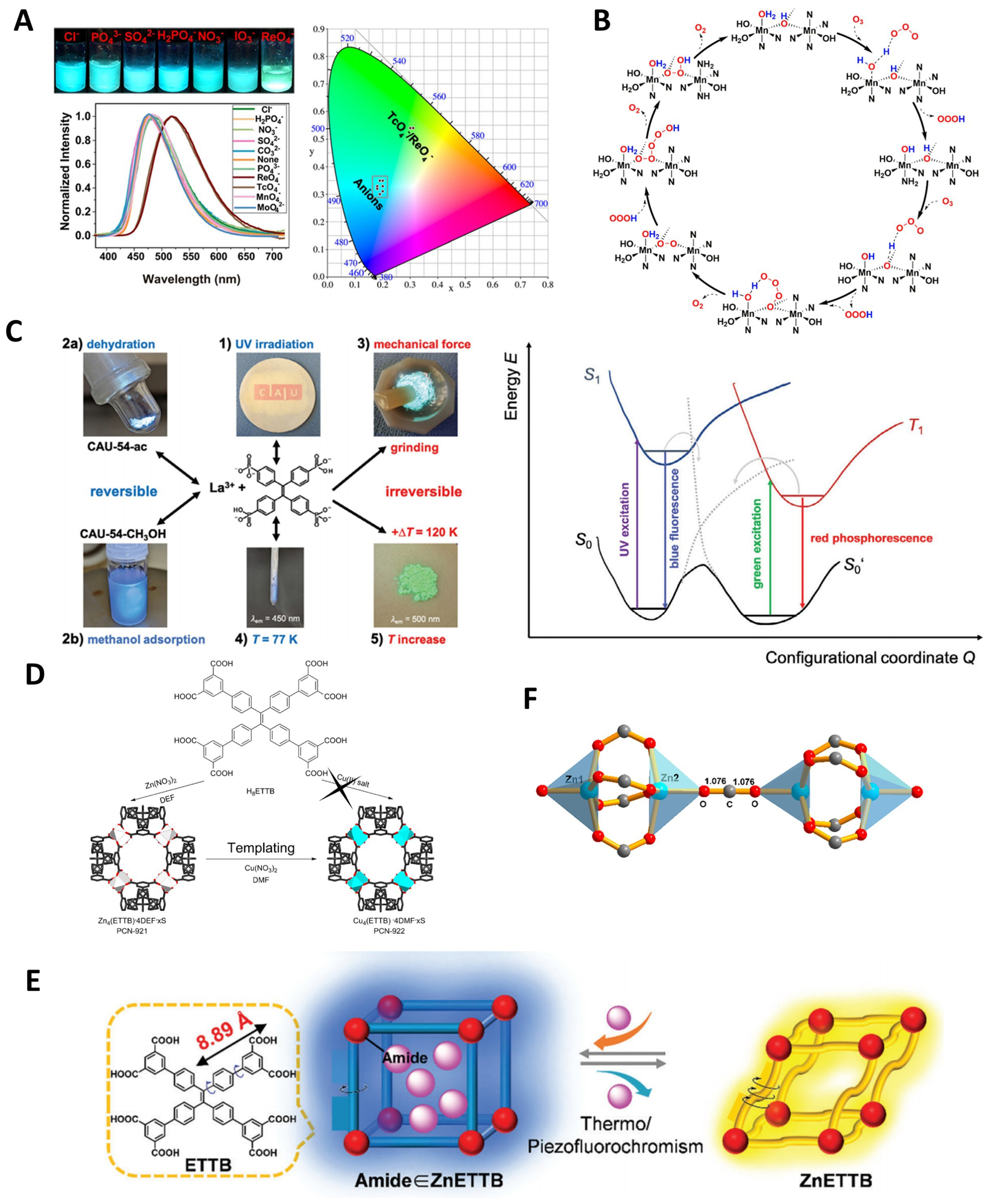
Figure 5. (A) Fluorescence photographs, emission spectra, and the CIE color space chromaticity diagram of ZJU-X8 in the presence of various anions, showing the fluorescent recognition toward TcO4-/ReO4-[148], Copyright 2021, Wiley-VCH; (B) The proposed mechanism of O3 degradation by ZZU-281[35], Copyright 2021, American Chemical Society; (C) CAU-54’s optical properties, responses to stimuli 1-5, and photophysical process diagram (stimuli 1, 4)[187], Copyright 2024, Wiley-VCH; (D) Synthesis of PCN-922 using PCN-921 as a template[110], Copyright 2013, American Chemical Society; (E) Schematic illustration thermo-/piezofluorochromic properties of DEF∈ZnETTB[115], Copyright 2022, Wiley-VCH; (F) Dinuclear ZnII2 cluster linearly bridged by CO2[106], Copyright 2019, American Chemical Society. CIE: International Commission on Illumination; TcO4-: pertechnetate; ReO4-: perrhenate; ZZU-281: [Mn3(μ3-OH)2(TTPE)(H2O)4]·2H2O; Zhengzhou University, ZZU; CAU: Christian-Albrechts-University; PCN: porous coordination network; DEF: N,N-diethylformamide; Zn: zinc; ETTB: 4’,4’’’,4’’’’’,4’’’’’’’-(ethene-1,1,2,2-tetrayl)tetrakis(([1,1’-biphenyl]-3,5-dicarboxylic acid)); UV: ultraviolet.