

fig1
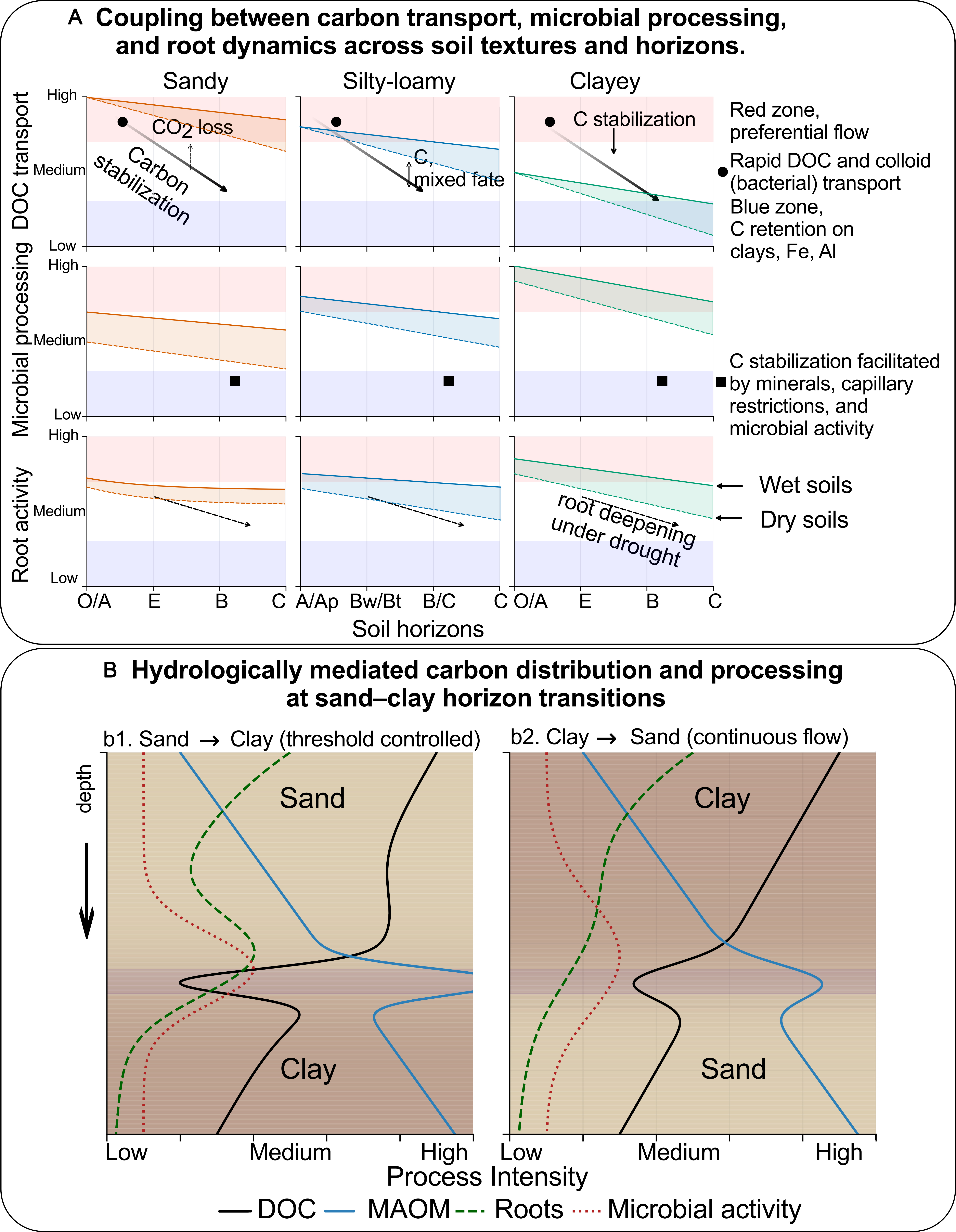
Figure 1. Illustration of transport and processing of carbon to soil depth: texture and horizonation. (A) Soil profiles partition into a preferential flow domain (red shading) and a retention domain (blue shading), which regulate dissolved organic carbon (DOC) mobility, microbial processing, and root activity; (B) Hydraulically mediated carbon distribution and processing at horizon textural boundary transitions for (b1) coarse-over-fine (sand → clay) systems and (b2) fine-over-coarse (clay → sand) systems. Across both panels, horizon transitions are represented as continuous, while variably diverging, gradients rather than discrete boundaries, emphasizing their role as biogeochemical zones where hydrologic, biological, and geochemical processes converge to regulate carbon persistence[44]. MAOM: Mineral-associated organic matter.