



Areas of concern and disagreement in the climate effects of bioenergy from forests
 0
0  ,
, Abstract
Bioenergy from forests (BEF) is widely promoted as a significant contributor to the global renewable energy transition and a primary pathway of achieving climate goals. However, the climate effects of BEF remain deeply contested due to the complexity of the BEF system that requires a multitude of methodological choices and assumptions to contextualize. The resulting divergent conclusions across studies generated scientific disagreement and policy concerns. This review provides a holistic synthesis of the environmental, economic, and social contexts shaping the climate effects of BEF. We first conducted a bibliometric analysis of BEF-related articles to map research trends and dominant paradigms, resulting in four major research clusters spanning forestry systems, bioenergy production, bioeconomy interactions, and emerging climate solutions. Building on this overview, we identifies six key areas of concern and disagreement that critically influence BEF climate assessments: system boundaries, spatial and temporal scales, reference systems, feedstock sourcing, effects of market changes, and social impacts. We provide methodological recommendations for the six aspects. For each area, we articulate contrasting perspectives, underlying assumptions, and empirical evidence, highlighting how methodological choices can lead to fundamentally different conclusions regarding BEF’s climate performance. We provide methodological recommendations to improve comparability, transparency, and policy relevance of BEF assessments. By clarifying sources of disagreement and framing BEF within a broader sustainability context, this work aims to reduce confusion and support more informed, evidence-based decision-making on the future role of BEF in climate mitigation strategies.
Keywords
INTRODUCTION
Bioenergy from forests (BEF) is widely considered a renewable energy[1,2] but deeply contested for its net climate effects[3-5]. Through forest harvesting and thinning operations, tree trunks, branches, tops, and other forest residues comprise forest biomass streams for energy production. BEF uses wood biomass directly as energy sources or as feedstock for further processing into other energy products like pellets or biofuels. Globally, carbon accumulation through forest growth, including regrowth of harvested forests, is greater than carbon loss through disturbances and deforestation. Forests are therefore estimated to be a net carbon sink of -7.6 Gt CO2e per year[6]. Therefore, under the assumption that across large spatial scales and for longer time horizons, forests accumulate carbon through photosynthesis at a faster rate than they lose carbon through the BEF supply chain, the production and consumption of BEF are considered net carbon neutral[7-10].
Because many consider BEF as a renewable energy source, it has been at the forefront of the global sustainable energy transition and widely included in projections of how to meet international carbon neutrality goals. Currently, modern bioenergy (excluding traditional use of biomass such as wood, charcoal and dung) accounts for 55% of global renewable energy supply and over 6% of global energy supply[11]. In Europe, forestry accounts for more than 60% of all EU domestic biomass supply for energy purposes[12]. One-third of the global population uses of BEF in the form of fuelwood and wood charcoal to support domestic energy provisioning[13], consuming 2,525.7 million m3 of wood biomass globally in 2019 according to latest estimations[14]. Processing wood into pellets for bioenergy is rapidly growing in global popularity. Between 2012 and 2022, global pellet production more than doubled from less than 20 million tons to over 40 million tons, while the total amount of pellets export globally tripled from around 10 million tons to
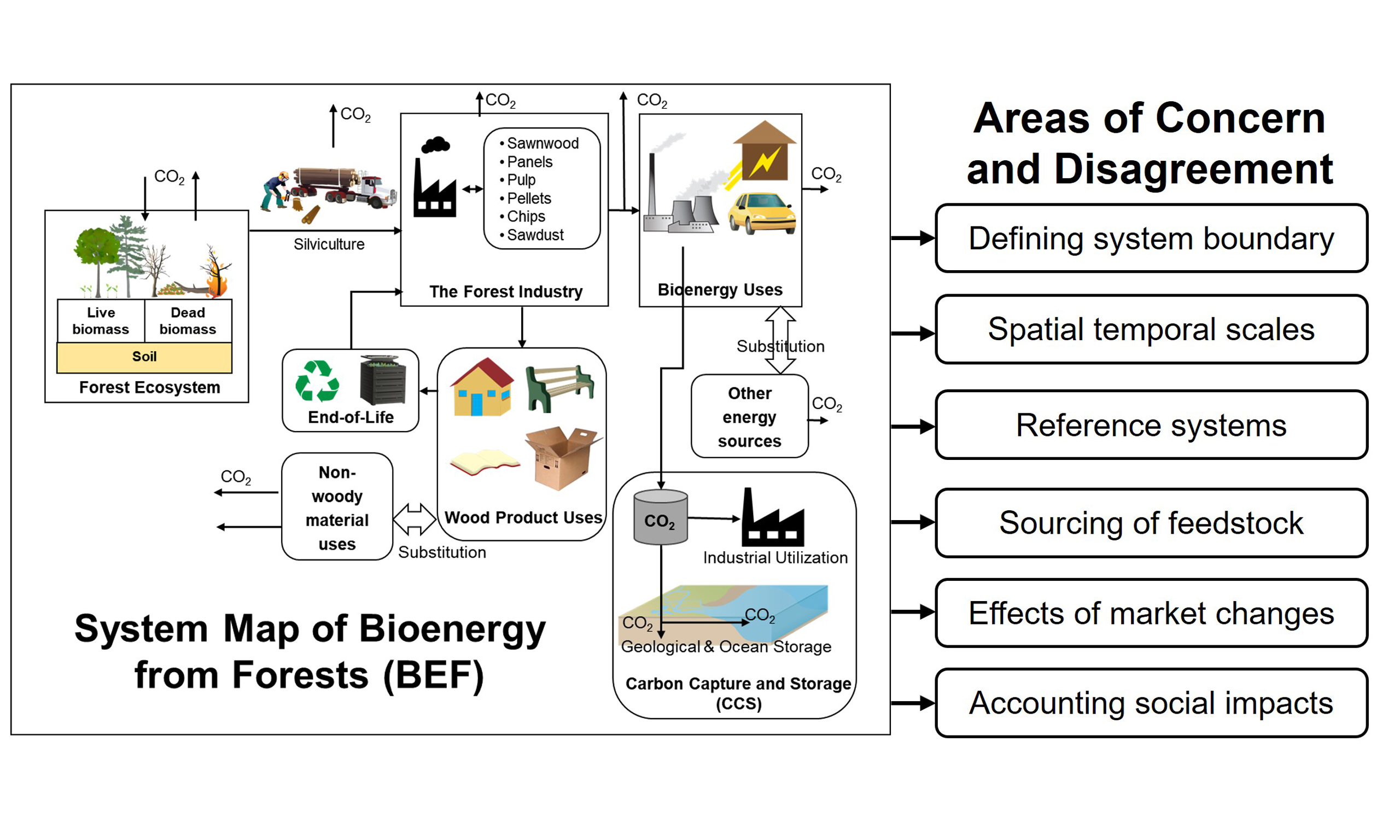
There are longstanding and unresolved concerns and disagreements about the climate effects of BEF, leading to science and policy debates and public confusion that made the production and utilization of BEF controversial. Conversion of wood biomass to energy involves a complex system consisting of interacting ecological, technological, economic, and social processes[17]. Analysis of the BEF system requires a series of methodological choices and model assumptions on the context of the system and its underlying processes. These choices and assumptions resulted in conflicting outcomes in terms of the potential of future BEF market expansion and the climate effects, pointing to different directions where BEF has net positive or negative impact on global sustainability[3,10,18-20].
There is a vast amount of literature discussing climate effects of bioenergy, which some existing studies tried to synthesize to alleviate discrepancies. For example, a meta-analysis by Buchholz et al. (2016)[21] identified in BEF greenhouse gas (GHG) emission accounting studies that the inclusion of wildfire dynamics was the most influential assumption. Martín-Gamboa et al. (2020)[22] reviewed life cycle assessment (LCA) of biomass pellets and identified key methodological choices related with multifunctionality and allocation. Cowie et al. (2021)[18] stressed that temporal and spatial system boundaries and reference (counterfactual) scenarios are key methodological choices that strongly influence results. Here, we try to build upon current synthesis on BEF’s climate effects and provide a more holistic view of the BEF system context across the environmental, economic and social pillars.
In this review, we aim to provide a holistic view for the environmental, economic and social contexts of the BEF system and the implications of the system contexts on BEF’s climate effects. We performed a bibliometric analysis to depict the current state and development patterns of BEF-related research. We summarize from the current state of research six major areas of concern and disagreement related to the BEF system context. Our work complements existing efforts to reconcile the ongoing debate by articulating opposing perspectives and evidence on each of the six key areas. Our goal is to reduce confusion arose from the diverging studies on the climate effects of BEF, thus building a common ground for future discussions around policy and industrial developments of BEF.
CURRENT STATE OF BEF RESEARCH
We performed a bibliometric analysis to give a comprehensive overview of the current state and development patterns of research related to BEF and its climate effects. We selected the Web of Science Core Collection database with records dated from 2006 to 2025 for a complete coverage of the most recent and influential literature. We used the search term “forest” OR “forestry” OR “wood” OR “woody” AND “bioenergy” AND “climate change”. The search resulted in 2,379 articles after removal of duplication. We used VOSviewer v1.6.20 to perform keyword co-occurrence analysis[23] (original input and output files uploaded in Supplementary Material).
Figure 1 illustrates four clusters of research keywords that tent to co-occur in literature. We interpreted the co-occurring keywords in each of the clusters and summarized four major topic areas of current BEF studies. The green cluster focuses on the forest and forestry system, with keywords related to tree species (e.g., poplar, eucalyptus) and biogeochemical processes (e.g., soil organic carbon/SOC, evapotranspiration). The blue cluster focuses on the bioenergy industry system, with keywords related to biomass processing technologies (e.g., pyrolysis, gasification) and bioenergy types (e.g., biogas, bioethanol). The red cluster broadly addresses the bioeconomy, with more general keywords that are sustainability-related (e.g., mitigation, renewable energy, biogenic carbon, carbon neutral). The yellow cluster is relatively small that covers emerging topics of climate solutions such as CDR (carbon dioxide removal), BECCS (bioenergy with carbon capture and storage) and afforestation/reforestation.
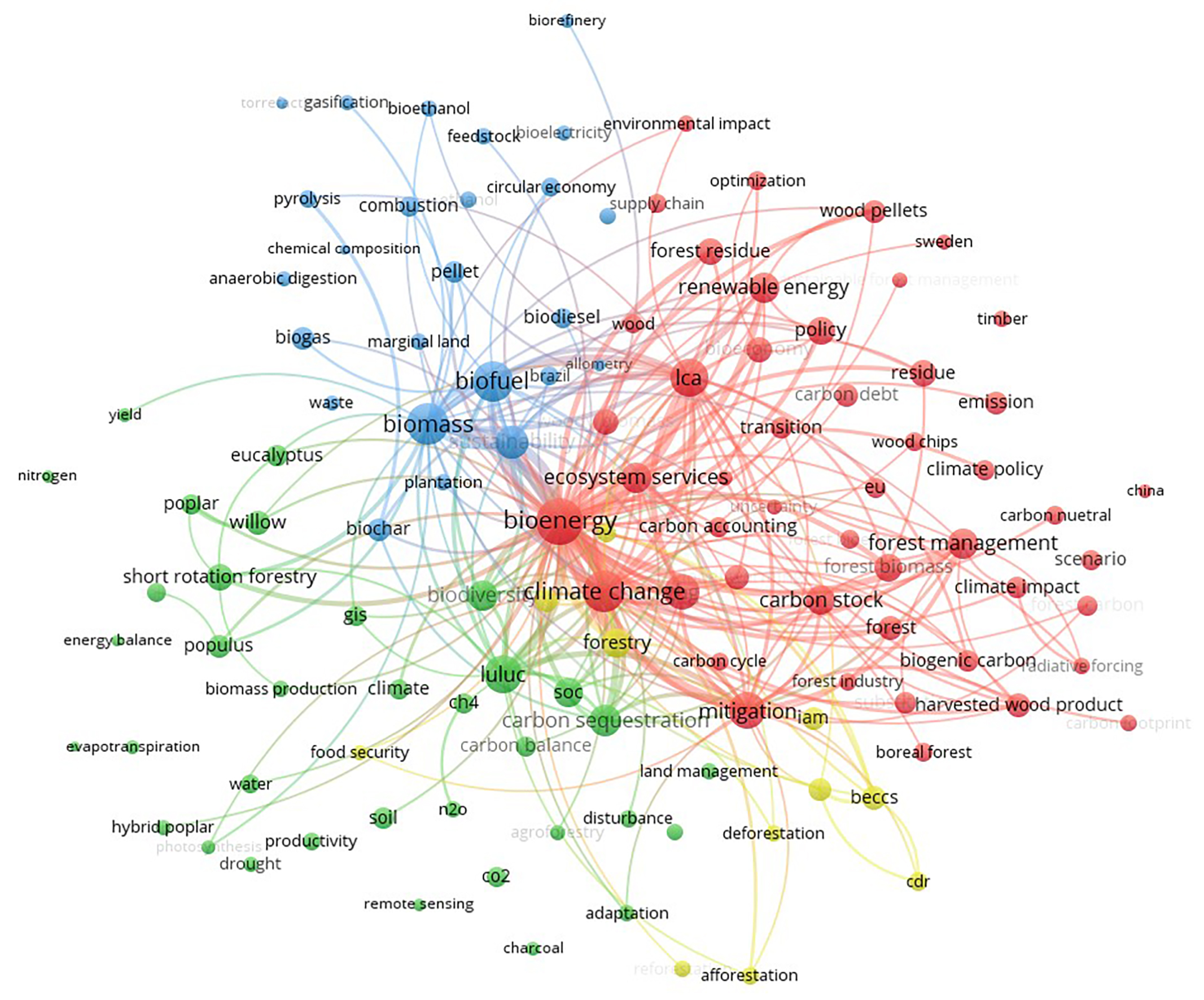
Figure 1. The keyword co-occurrence map of current BEF research. The nodes represent keywords used in literature. Node size indicates the frequency of keywords’ occurrence. The colors (green, blue, red, yellow) distinguish clusters of co-occurring keywords, representing research themes.
The keyword clusters represent the current research paradigms of BEF, with the co-occurring keywords reflecting the different methodological choices made. Results of research from each cluster should be interpreted only in the context of the related methodological choices. Here, we synthesize from current research keywords six key areas of concern and disagreement related to the climate effects of BEF.
DEFINING SYSTEM BOUNDARY
System boundary is a key methodological choice that strongly influences the climate effects of BEF systems and the comparability of results. The BEF system context consists of processes and flows that describe inputs and outputs of the biosphere (i.e., interactions with the natural environment, such as consumption of natural resources and emissions to soil, water, or air) and technosphere (i.e., inputs and outputs of technological systems, such as energy and material consumption)[24]. Each BEF system analysis needs to draw a distinctive boundary between the technical system and the environment, between the significant and insignificant processes, and between the technological system under study and other technological systems[25]. The complex system map of the BEF system provides a multitude of plausible methodological choices in defining system boundaries, from including or excluding components of the forest ecosystem (e.g. soil carbon) to processes of the bioeconomy (e.g. product substitution) [Figure 2A-D]. Many keywords emphasized by current research reflected varying choices on system boundary definition (Figure 1, e.g., SOC, plantation, forest industry, bioeconomy), where we identified four key system components that showed strong influences on the resulting climate effects of BEF.
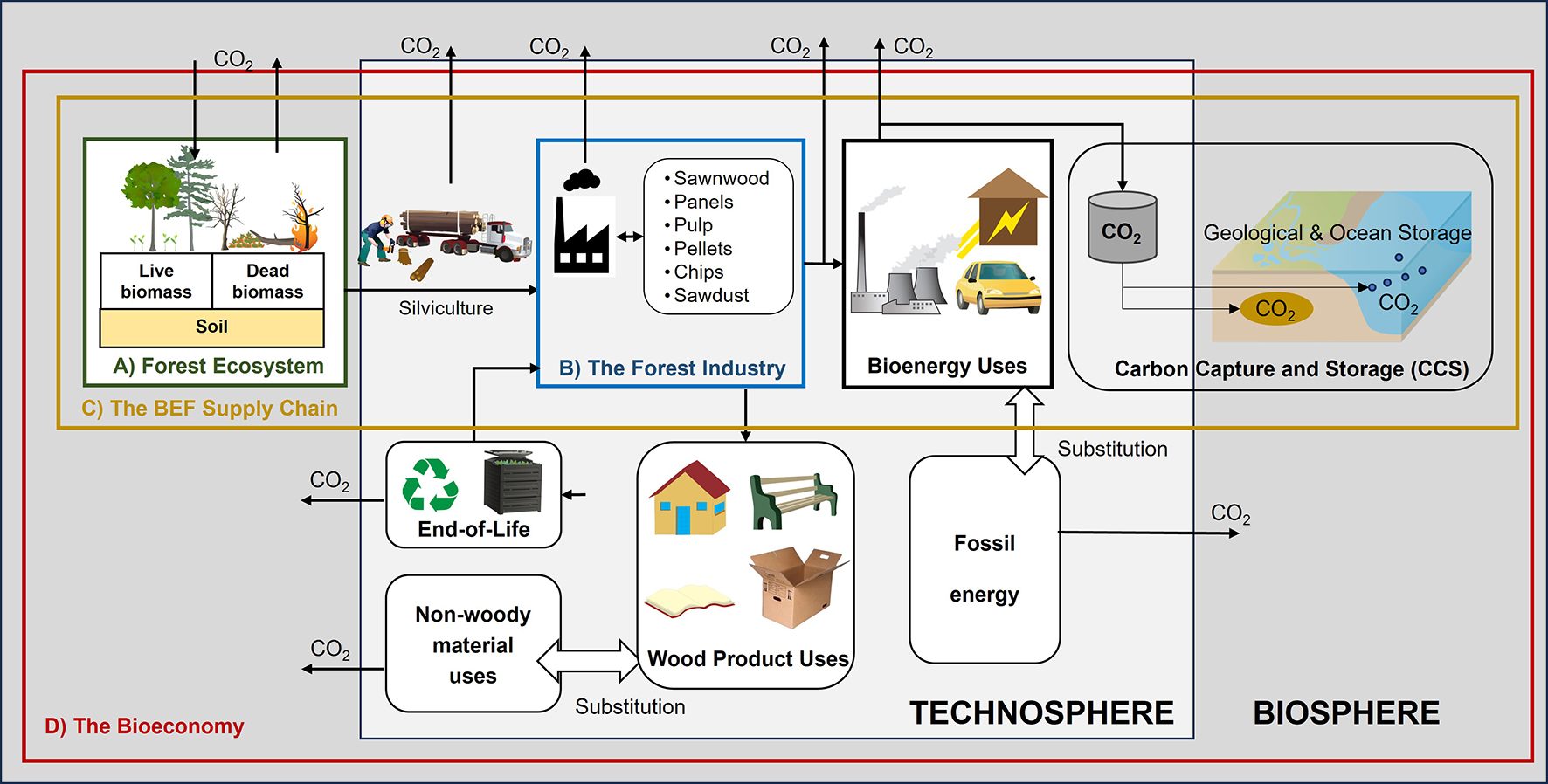
Figure 2. Schematic framework of the BEF system context that includes biosphere and technosphere processes and flows (The concept of the figure is referenced from Giuntoli et al.[17] and Cowie et al.[18]). Rectangles of different colors represent choices of system boundaries. Icons are sourced from Integration and Application Network[26].
(1) Soil carbon. At the forest ecosystem level [Figure 2A], carbon storage in soils is a major contributor to the overall climate effect of a BEF system. For example, Lan et al.[27] reported that changes in the soil organic carbon pool account up to 66% of the GHG emissions from a BEF life cycle. Yet only 10 out of the 84 LCA studies reviewed by Martín-Gamboa et al. (2020)[22] addressed the calculation of soil carbon. In addition, depending on soil depth, harvest intensity, timing of measurement, and forest conditions, the effects of biomass removal on soil carbon storage could range from trivial (~3% reduction) to profound (up to 30% reduction)[28,29]. Therefore, both the inclusion and the variation of soil carbon are essential in understanding the climate effects of a BEF system.
(2) Wood processing. At the forestry industry level [Figure 2B], types of wood biomass and BEF production technologies lead to different categories of BEF products with varying climate effects. Table 1 presents a classification of BEF products with terminologies from the FAO Unified Bioenergy Terminology[30] and the FAO Yearbook of Forest Products[31]. We subsequently classified the BEF product terms into primary, secondary, tertiary post-consumer, and processed bioenergy[17,30]. Physiochemical properties of the wood biomass feedstock[32] and the treatment techniques[33] determine the energy intensity of BEF production and energy efficiency of the final product[34]. Wood pellets produced from steam exploded shavings have 4 times higher global warming potential (GWP) than untreated mixed sawdust[35]. Different pyrolysis pretreatment pathways for biogas co-production lead to GWPs that widely range from 135 to 206 kg CO2-eq per kg main product[36]. Technical pathways included in a BEF system boundary would therefore lead to diverging climate effects.
Product classification of bioenergy from forests
| Classification | Bioenergy from forests | Forest resources and production processes |
| Primary Bioenergy | Slash | Residual harvested from final felling and thinning |
| Stumps | Uprooted from the final felling | |
| Discarded wood | Discarded trunks unsuitable for industry, like rotten or sprinted stems, or species | |
| Firewood | Collected from logs, branches, or wood pieces sourced from various trees and woody vegetation found in the forest | |
| Roundwood | Wood in its natural state as felled, with or without bark. It may be round, split, roughly squared or in other forms. Can be used for firewood production | |
| Pulpwood | Timber primarily used for making wood pulp in paper production. Can be used for bioenergy production | |
| Secondary Bioenergy | Bark | Directly from the trunks and branches of trees |
| Sawdust | A by-product during various wood processing activities | |
| Chips | A by-product during various wood processing activities | |
| Black liquor | A by-product of the pulp-making process | |
| Tall oil | A by-product of the pulp-making process. Some fractions of tall oil can be processed into biofuels or used as additives in biodiesel production | |
| Tertiary Post-consumer Bioenergy | Recovered wood | Including construction and demolition debris, discarded wood from furniture, packaging, pallets, and other wood-containing products that have reached the end of their life cycle |
| Processed Bioenergy | Pellets | Pelletization (compression and densification) of forest residuals, chips, sawdust, bark, or others |
| Wood charcoal | Pyrolysis or destructive distillation (in the presence of limited oxygen) of wood | |
| Biochar | Pyrolysis (in the absence of oxygen) of chips, sawdust, leaves, bark, or forest residuals | |
| Bio-oil | Pyrolysis of chips, sawdust, forest residues, or other woody materials | |
| Ethanol | Biochemical conversion or gasification of logging residues, forest thinning, branches, and others | |
| Syngas | Gasification or pyrolysis of wood chips, sawdust, or others |
(3) Supply chain. At the BEF supply chain level [Figure 2C], inclusion and exclusion of key processes strongly determine BEF’s total climate effects. For example, shipment contributes to 31% of the total carbon footprint of wood pellets exported from the US to the UK[37]; inclusion of carbon capture and storage (CCS) after BEF combustion, termed bioenergy with carbon capture and storage (BECCS)[38], could achieve negative-emissions in specific BEF cases[39].
(4) Substitution. At the bioeconomy level [Figure 2D], consumption of BEF products provides energy that would otherwise be provided by the combustion of fossil fuels, therefore avoiding fossil emission. Substitution or displacement factors measure this climate benefit, which widely ranges from -0.08 to up to 2.5 t C/t C according to existing literature[40], meaning that the use of BEF could induce extra GHG emissions or avoid emissions of up to 2.5 t C from fossil fuels.
Depending on the scientific discipline and the research objective, analysis of BEF systems may choose system boundaries at the forest ecosystem, the forestry industry, the BEF supply chain, and the bioeconomy levels. The varying climate effects resulted should therefore only be compared at the same system level to avoid misinterpretation. Different technosphere options such as the biomass processing techniques and incorporation of CCS should be evaluated using tools such as the Global Sensitivity Analysis (GSA)[24,41], to provide ranges of potential outcomes rather than single-point estimates.
SPATIAL AND TEMPORAL SCALES
The temporal dynamics of forest ecological and management processes and spatial heterogeneity of forest ecosystem properties are major sources of uncertainty in the climate effects of BEF. Choosing a specific time point or period on the curve of forest carbon stock leads to different results of forest standing carbon values and net carbon balances [Figure 3]. From a temporal perspective, the term “carbon debt” is a hotspot of current BEF research [Figure 1]. It describes the pulse of carbon emissions following harvesting and burning of forest biomass produces, while the time required for new trees to gradually remove atmospheric CO2 and store carbon in trees and soils is termed “payback time”[4]. From a spatial perspective, current research adopts multiple choices of scales from plantation to countries (e.g., China, Brazil) and regions (e.g., EU) [Figure 1]. Under these different spatial scales, the harvest-regrow cycle and the associated carbon debt-payback time are diluted over larger scales, because forest management and BEF production generally follow a management plan that involves multiple stands and operates in rotation[18,42] [Figure 3]. Carbon storage per unit area therefore shows milder fluctuations due to the mixture of forest stands at different stages (age classes) in the forest parcel or landscape.
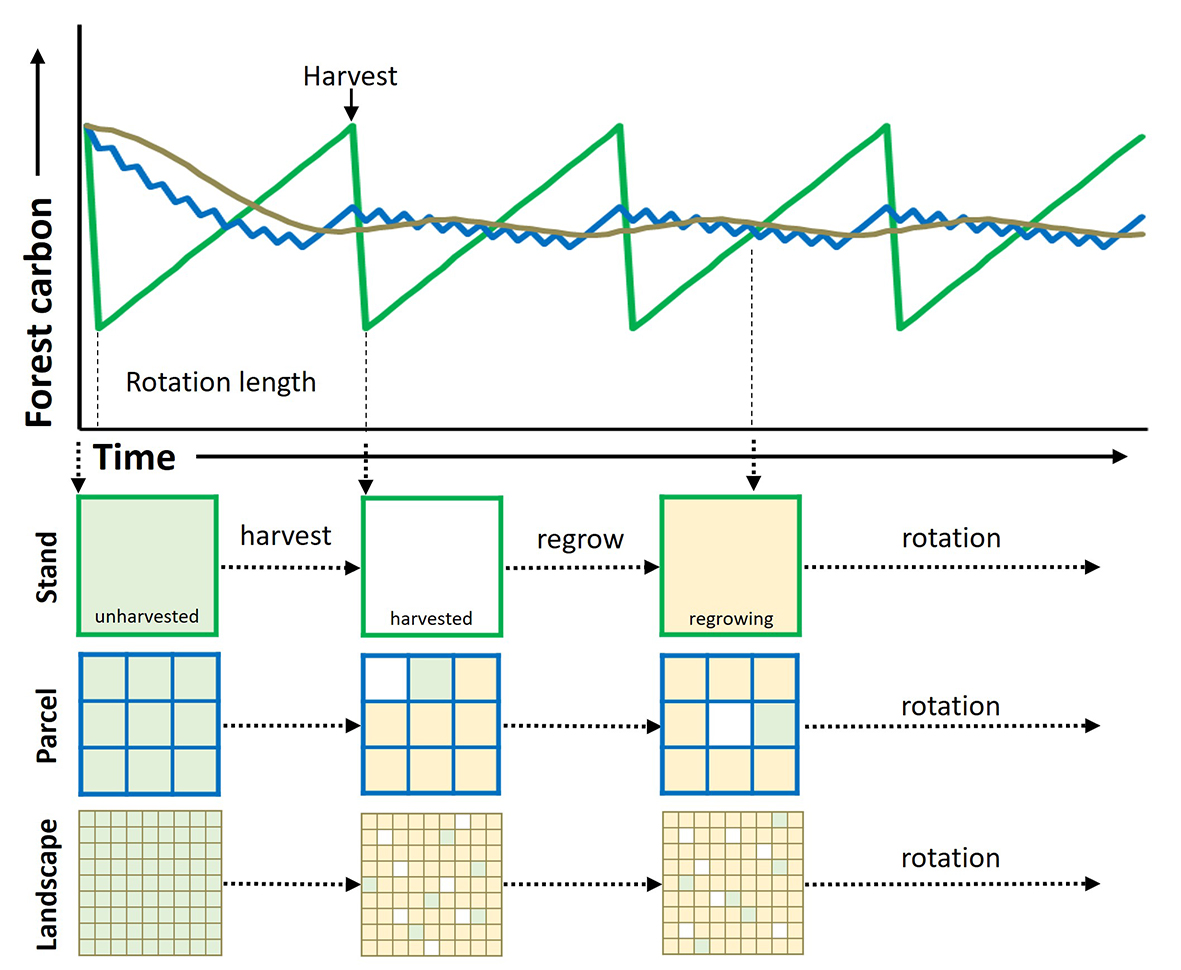
Figure 3. Illustration of forest carbon dynamics under different spatial and temporal scales (The concept of the figure is referenced from Janowiak et al.[42]). Fluctuations of forest carbon per unit area in the line graph depict carbon debt and its payback time at different forest scales. The gridded plots illustrate the harvest rotation of forest stand, parcel and landscape that leads to different behaviors of the dynamics of area-averaged carbon storage.
Such temporal dynamics and spatial heterogeneity caused discrepancies in the estimated carbon debts and payback times. Studies estimated BEF payback times that ranges from less than one year to up to
It is therefore crucial to weigh and synthesize BEF’s climate effects at different spatial and temporal scales to understand the implications of BEF development. Key scale-related elements in an LCA for BEF include spatial scales of the studies forest landscape and the BEF supply chain, and temporal scales of the forestry operations (e.g., rotation length[52]) and the climate targets of interest. Dynamic[53,54] and spatially explicit[55] LCA approaches could address the discrepancies by providing more consistent and higher-resolution climate effects.
REFERENCE SYSTEM
Climate effects of BEF are relative to a reference system (or baseline, counterfactual) that represents the situation in absence of the BEF system of concern. The system contexts often considered are either related to the products replaced by BEF[40] or to the land use changed for BEF production[56] [Figure 4]. Assumption on the reference system is a driving factor for the direction of the climate effects of a BEF system.
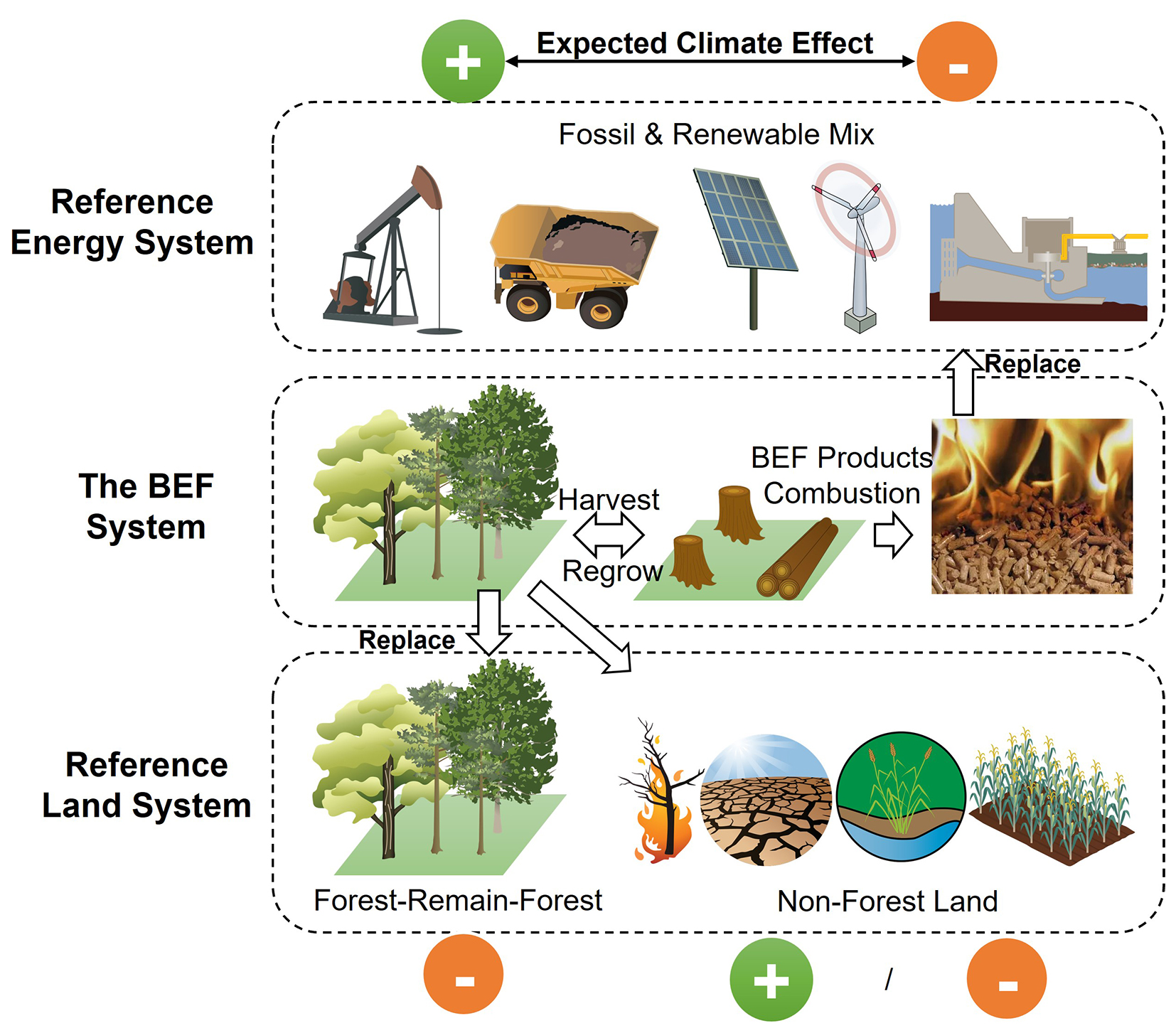
Figure 4. Possible reference energy and land use systems replaced by the BEF system and their influence on the resulting climate effects. Icons are sourced from Integration and Application Network[26].
Climate effects of BEF are highly sensitive to the reference energy system or the energy system replaced. “Substitution” therefore becomes a key node on the keyword map of current BEF research [Figure 1]. However, the multitude of energy sources and technologies involved in the electricity and heat generation processes makes the energy mix highly variable[18,57]. For example, Leturcq[58] compared displacement factors of wood fuels displacing anthracite, heating oil and natural gas at different point-in-time in the energy consumption processes, and found results ranged from net negative impact of -0.95 t C/t C to an emission reduction of 0.88 t C/t C. The share of renewable energy in the counterfactual energy structure also plays a vital role. In current studies, BEF is not often compared with solar and wind energy as counterfactuals but considered as a complement to fill in the gaps of the fluctuating solar and wind energy supply due to constraints in energy generation, transmission and storage[59,60]. Some authors argue, however, that as fossil fuel use declines and renewable energy production increases, wood will compare less favorably as an energy substitution[61,62].
The reference land system or the land use replaced by BEF production also has multiple plausible choices that would largely determine the overall climate effect of a BEF system. Assuming existing forests that would persist without human disturbances, the introduction of BEF production induces large carbon footprints[63] that was estimated to cause annual carbon costs of 3.5-4.2 Gigaton CO2-equivalent between 2010 and 2050[64]. On the other hand, assuming non-forest lands as reference systems leads to mixed effects. For example, converting peatland to forests does not lead to climate benefit but impede peat carbon storage[65]. Meanwhile, wood production on marginal lands is considered climate beneficial, where counterfactual land management would not involve productive uses due to poor soil properties, low quality groundwater, drought, undesired topology, and unfavorable climatic conditions[66-68].
It is therefore important to evaluate the BEF system in the context of a broader portfolio of climate mitigation actions including energy transition and sustainable land use and management. Energy system contexts (e.g., energy structure, policy directions and technology development) and land use system contexts (e.g., forest ownership type and management plan) are essential in determining the climate effects of BEF. Prospective LCA approaches stand better chances in accounting for such contexts by evaluating the BEF system under projected future states[69]. Combination with analytical tools such as the Integrated Assessment Models (IAM)[70] is already represented in the current research [Figure 1]. Such methodological advances would allow better understanding of the trade-offs and synergies among actions and avoid BEF from undermining other climate strategies.
SOURCING OF FEEDSTOCK
Sourcing of BEF feedstock involves forest management, harvesting, processing, transportation and many other processes that determine the climate effect of BEF products. Feedstock is an important topic in current BEF research [Figure 1]. Table 2 gives a comprehensive summary of BEF feedstock sourcing strategies including intensive forest management[71,72], sustainable forest management[73-75], residue mobilization[76-79], domestic sourcing[80,81], and international sourcing[82,83]. Assumptions can be broken down into the questions of how and where the feedstock is acquired. The ‘how’ question reflects pathways of the harvesting and processing of wood biomass. For example, despite the high productivity, intensive management strategy is widely criticized for the destructive consequences of forest clearing[84-87]. Sustainable forest management, on the other hand, is argued to be able to provide climate benefits by improving forest resilience while utilizing the wood biomass that would otherwise be lost due to the disturbances and allowing faster forest recovery[88]. Mobilizing logging residue could intensify BEF feedstock extraction without extra tree harvest, and was estimated to be able to provide 17%-20% additional biomass to the timber and pulp harvest[52]. Sourcing scenarios therefore largely determine the carbon intensity and the cost-efficiency of the BEF system.
Comparison of different feedstock sourcing strategies for BEF supply
| Feedstock sourcing strategies | Sourcing processes involved | Examples | Climate effects | Side effects | References |
| Intensive forest management | Harvesting | Plantation, clearcut, 'Swedish forestry model' | High direct emissions, high productivity/fossil substitution | Negative impacts on native habitats and biodiversity | [71,72] |
| Sustainable forest management | Partial/selective logging, uneven-aged forest management, stand improvement | Relatively low direct emissions, low productivity/fossil substitution | Improvement of forest health and resilience | [73-75] | |
| Residue mobilization | Harvesting and processing | Logging and mill residue utilization, wood product recycling | Relatively low productivity/fossil substitution, potential impact on soil carbon sequestration | Potential impacts on the forest floor ecosystem functions and biodiversity | [76-79] |
| Domestic sourcing | Harvesting, processing and transportation | Afforestation/reforestation, intensification | Potentially higher emissions through intensification and/or lower emissions through improved forest management | Market impacts on domestic forestry industry and land sector | [80,81] |
| International trade | EU wood pellet imports from the US | Embedded emissions of international transportation, regionally different carbon intensity of forest management | Inequality of climate and health risks to the exporting regions | [82,83] |
The “where” question reflects the carbon intensity of the BEF supply chain as well as the regional differences of forest management. Recent boost of the global market for BEF has driven growing international trade of bioenergy sources, especially wood pellet trades between the United States and Europe[15]. Many studies concluded overall climate benefits of BEF international trades with estimated net carbon neutrality[89,90] or carbon savings[37,91]. However, some argue that embedded emissions of international trades, especially the non-CO2 GHGs and air pollutants such as SOx and NOx, are not sufficiently accounted for[92]. In addition, there are concerns that Europe’s international sourcing for BEF would lead to expanded forest clearing worldwide and cause climate and biodiversity deterioration[93], yet empirical evidence is insufficient at large scales[94].
Despite that how and where the feedstock is sourced would lead to substantial differences in the climate effect of BEF, the current United Nations Framework Convention on Climate Change (UNFCCC) accounting rules treat all imported biomass as zero emissions at the point of combustion[95]. It is necessary to account for the effects of different forest management strategies on spatial temporal dynamics of the forest carbon cycle. Meanwhile, BEF scenarios should sufficiently evaluate the availability of domestic and international feedstock[81] as well as risks of leakage[96] to ensure a holistic view of BEF’s climate effects.
EFFECTS OF MARKET CHANGES
Growing demand for BEF at global scale induces market changes in multiple industries including energy, forestry and agriculture [Figure 5]. Evaluation of market-driven effects should adopt consequential LCA as the approach expands the product system to include activities expected to change as a consequence of a change in demand[97,98]. However, definition of market-mediated scenarios is difficult in practice and becomes the main source of uncertainty[99]. On the one hand, BEF market expansion creates conflicts in wood biomass uses. Competition between BEF and the booming traditional wood sectors, such as packaging and construction[13], may cause significant disruptions of the forestry sector. Global projections indicated that increasing demand for BEF would cause nearly 30% price increase for industrial roundwood and 15% for sawnwood, panels and paper by 2030[100], which could hinder the substitution of fossil-based products. Meanwhile, it is not clear whether the ever-growing wood biomass demand would lead to production exceeding the sustainable supply capacity[101,102], or stimulate more investment that facilitates sustainable management strategies[103-106] and the mobilization of residue biomass.
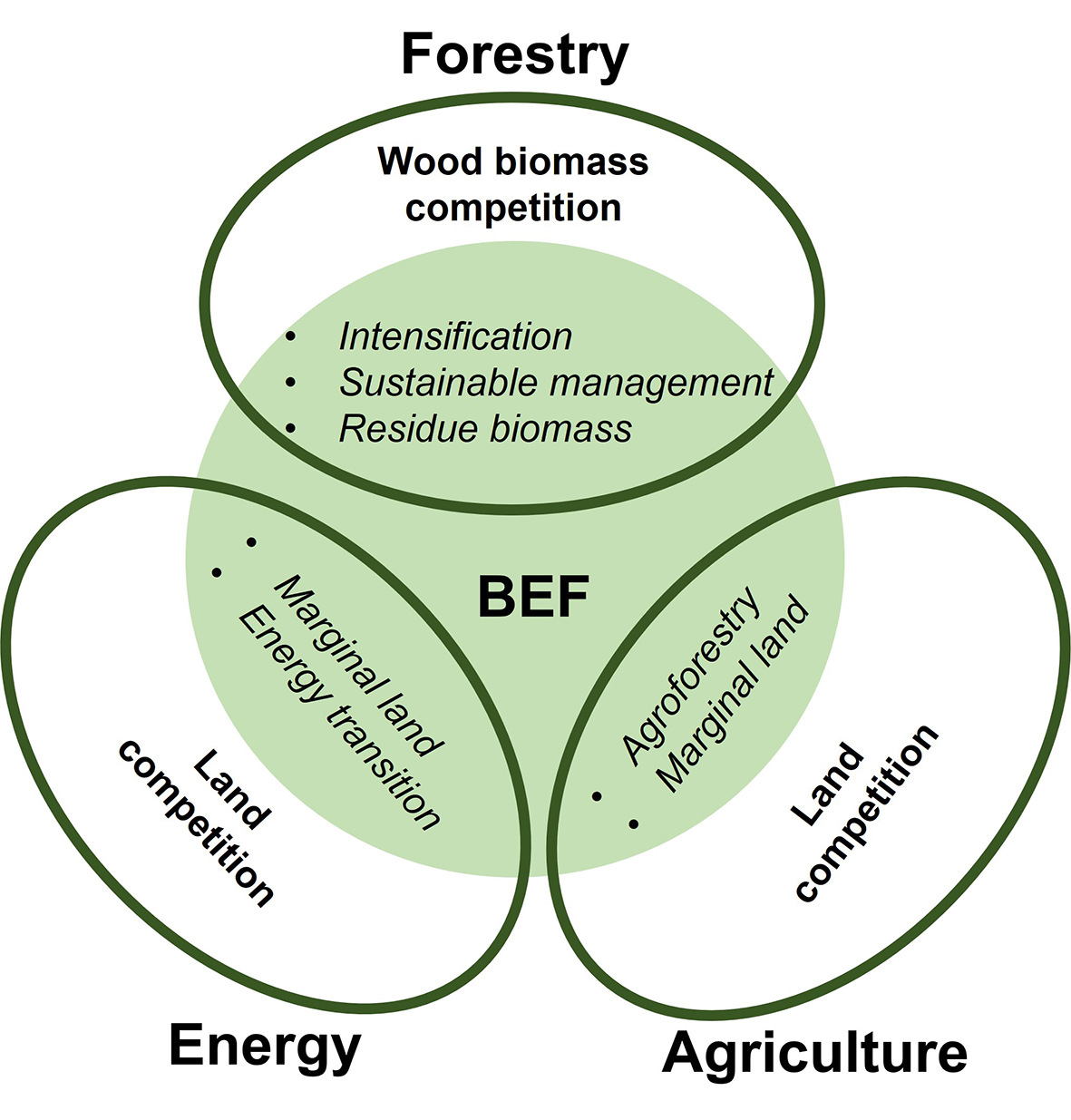
Figure 5. Market conflicts between BEF and other sectors and potential ways of synergy.
On the other hand, expanding demand for wood biomass requires larger forest area. Such higher demand may incentivize afforestation and reforestation on lands that are currently unforested[66], leading to net climate benefits. For example, Costanza et al.[107] projected lower urbanization rates, thus less loss of forest cover and forest carbon storage, due to bioenergy production. However, BEF production could also compete with other land uses such as agriculture. Global analysis by Kraxner et al.[108] warned that humankind may not have enough land to simultaneously conserve natural areas completely, halt forest loss, and switch to 100% renewable energy. Competition between BEF and food production may lead to direct land use changes (dLUC) of cropland conversion and indirect changes (iLUC) where the displaced crops are produced under less efficiency[56,109]. Other resource-intensive renewable energy technologies, such as solar farms, would also compete with BEF for land[110,111]. Current effort tries to reconcile the land conflict with integration (e.g., agroforestry[112], Figure 1) and segregation strategies (e.g., marginal land[68,113], Figure 1).
Evaluation of climate effects of BEF systems needs to account for market changes to better address real-world problems such as feedstock supply challenges and policy or industry tradeoffs. Methodological advances in the consequential LCA methodology will be beneficial, such as developing better standardized procedures and incorporating more solid economic modeling[98]. Comprehensive uncertainty and sensitivity analysis are also crucial to the proper interpretation and communication of climate effects[99].
ACCOUNTING SOCIAL IMPACTS
The BEF system from wood biomass production to BEF combustion creates ecological and environmental benefits and burdens that, when not distributed equally, could raise strong social and environmental justice concerns. Current research showed emphasis on social aspects through keywords such as “food security” and “governance” [Figure 1]. In Table 3 we summarize potential social impacts based on different stages of the BEF supply chain including biomass harvest[114-119], processing[114,119-124], distribution[82,114,123-128], and bioenergy combustion[120,129-131]. For example, from the production side, Koester and Davis[122] estimated that wood pellet production facilities in the southeastern United States are 50% more likely to be located in minority communities, making them more likely to suffer negative health impacts[132]. From the consumption side, the main driver of US’s air pollution has shifted from coal combustion-dominated to more biomass combustion[120], making 2.3 million people live within 2 km of a biomass facility subject to adverse health impacts from their emissions, with disparities to racial and ethnic minority groups[121]. Yet it is unclear whether the demographic groups at risk also receive benefits from BEF projects[116], as economic profits of BEF production may not be distributed equally[127]. On the other hand, many studies highlighted the potential of co-benefits that could improve the current state of unequal and unjust social impacts from BEF. Development of new BEF infrastructures could support wellbeing for indigenous people in areas beyond the sectoral need of energy, such as sustainable forest management, income generation, employment and infrastructures, etc.[114,119].
Potential social risks and co-benefits associated with the BEF supply chain
| Life cycle stage | Social risks | Potential benefits |
| Harvesting | • Loss of access to forests for cultural and traditional uses[114,115] • Land conflicts with agriculture and/or local communities[116,117] | • Job creation and economic benefits for the local forestry industry[114,118] • Rural development with improved infrastructure and improved forest management[119] |
| Processing | • Air and water pollution from dust and chemical emissions[120,121] • Health and safety risks in and around factories and mills[122,123] | • Job creation and economic benefits for the local forestry industry[114,119] • Improved infrastructure and technology due to more investment[114,124] |
| Distribution | • Geopolitical risks due to reliance on international supply chain[125,126] • Uneven distribution of economic benefits[123,127] | • Improvement of transportation infrastructure[114,124] • Economic benefits for the supplier and energy transition for the consumer[82,128] |
| Combustion | • Health risks around power plants due to biomass combustion emissions[120,129] | • Supporting energy security and renewable energy transition[130,131] |
Climate effect of BEF systems should be evaluated in an integrated socio-economic and environmental assessment framework for more nuanced policy rationales and more socially sustainable strategies. Socio-economic performance of BEF system should include six categories of indicators including social well-being (e.g., employment, income, health), energy security (e.g., energy price), trade (e.g., trade volume), profitability (e.g., net present value), resource conservation (e.g., depletion of fossil energy), and social acceptability (e.g., public opinion, transparency)[124]. Participatory processes that engage a diverse community of stakeholders including policymakers, industries and researchers are needed to bridge the current gap between policy and tangible implementation[133,134].
CONCLUSION
This review highlights six key components of the BEF system and the associated methodological choices and assumptions that led to concerns and disagreements related in BEF’s climate effects. We demonstrated how these system contexts are critical in determining the accuracy and relevance of the outcomes, and proposed methodological recommendations regarding each key area:
(1) Definition of system boundaries: inclusion and exclusion of certain ecological and technical system components or processes greatly change the environmental performance of BEF scenarios.
Recommendation: we recommend accounting key processes such as soil carbon dynamics and transportation, and evaluating the sensitivity of different technical pathways such as biomass treatment and CCS.
(2) Spatial temporal scales: spatial heterogeneity and temporal dynamics of BEF systems are prominent contributors to the variations of BEF’s climate effects.
Recommendation: we recommend evaluations at spatial scales that reflect the practical scales of forest management strategies and objectives, and adoption of dynamic LCA approaches that capture temporal scales of both climatic and forest ecological processes.
(3) Reference system: projected energy and land use systems that the BEF system compares to are crucial in determining the relative performance of the target BEF scenario.
Recommendation: we recommend taking a prospective LCA approach that accounts for the current state and projected energy and land use scenarios, including energy structure, renewable energy development, and land use and land management changes.
(4) Sourcing of feedstock: management strategies, harvest practices and the location of forestry wood biomass production will lead to divergent life-cycle climate effects.
Recommendation: we recommend regional-specific considerations that specify the intensive and sustainable forest management strategies adopted, as well as better accounting of the embedded environmental impact of global trade and the risk of carbon leakage.
(5) Effects of market changes: consequences of the blooming BEF market and the increasing wood biomass demand are not yet understood in consensus. Increasing demand for wood biomass may conflict with the traditional forestry industry and cause market disruptions to other wood products.
Recommendation: we recommend consequential LCA approaches with accounting of direct and indirect land use changes and potential displacement of market activities of other sectors including food, energy and forestry.
(6) Accounting social impacts: social impacts of BEF development are not yet sufficiently accounted for and understood. There are potential justice and equity issues due to the unbalanced distribution of environmental burdens (e.g., pollution) and economic benefits of the BEF projects among ethnic groups.
Recommendation: we recommend development of an integrated socio-economic and environmental assessment framework for more nuanced policy rationales and participatory actions for more inclusive implementations.
FUTURE RESEARCH DIRECTIONS
Here, we propose the following three directions for future research to further reconcile the concerns and disagreements identified in this research:
• Quantitative synthesis and comparative analysis of methodological choices. Our understanding of the climate effect of BEF would benefit from more systematic review and meta-analysis to provide a quantitative view of the range of climate effects. For example, effect sizes could be quantified for methodological choices such as the system boundary taken (see section Defining System Boundary) or the time horizons of analysis (see section Spatial and Temporal Scales). Individual assessments should expand their sensitivity analysis to compare plausible methodological alternatives, therefore improve transparency for results’ interpretation and avoid bias in the study design.
• Advancing and standardizing LCA methodologies. LCA studies of BEF should apply consequential approach (see section Effect of Market Changes), but efforts are needed in developing better guidelines for system expansion and accounting of indirect consequences (e.g., iLUC). Systematic evaluation of forest, soil and climate process models including the incorporation of stochastic disturbances (e.g., wildfire) is urgently needed for the advancement of dynamic LCA (see section Spatial and Temporal Scales) to facilitate the standardization of model selection, therefore improve comparability of results. BEF LCAs should also adopt the prospective LCA framework (see section Reference System) and incorporate the latest development of IAMs to improve relevant to future socio-economic state.
• Interdisciplinary research and multi-stakeholder engagement. Although indicator systems are proposed for socio-economic performance of BEF in previous studies (see section Accounting Social Impacts), better guidelines are still needed regarding the categorization of indicators and the evaluation of both quantitative and qualitative indicators. This can only be achieved by interdisciplinary groups integrating social, economic and environmental impacts in a holistic assessment. In addition, wider stakeholder groups need to be included, especially the forest owner, forestry practitioner and local community that are currently underrepresented.
DECLARATIONS
Acknowledgement
This work was commissioned by The Forest Dialogue (TFD) to serve the support needs of the Bioenergy from Forests (BEF) Scoping Dialogue. We thank Sara Kuebbing, Liz Felker, Violet Low-Beinart, and participants of the BEF Scoping Dialogue for discussion and comments on the paper. Work conducted at Yale University is an output of the Yale Applied Science Synthesis Program, which is an initiative of The Forest School (at the Yale School of the Environment) and the Yale Center for Natural Carbon Capture.
Author’s contributions
Conceptualization, methodology, writing - original draft, writing - review & editing: Liu, W.; Tang, M.
Investigation: Liu, W.
Software, visualization: Tang, M.
Availability of data and materials
Not applicable.
AI and AI-assisted tools statement
Not applicable.
Financial support and sponsorship
None.
Conflict of interest
Both authors declared that there are no conflicts of interest.
Ethical approval and consent to participate
Not applicable.
Consent for publication
Not applicable.
Copyright
© The Author(s) 2026.
Supplementary Materials
REFERENCES
1. Smeets, E. M. W.; Faaij, A. P. C. Bioenergy potentials from forestry in 2050: an assessment of the drivers that determine the potentials. Clim. Chang. 2006, 81, 353-90.
2. IEA. Bioenergy - a sustainable and reliable energy source; International Energy Agency Bioenergy: Paris, France, 2009. Available from: https://www.ieabioenergy.com/wp-content/uploads/2013/10/Executive-Summary-Bioenergy-a-sustainable-reliable-energy-source.pdf [Last accessed on 9 Apr 2026].
3. McKechnie, J.; Colombo, S.; Chen, J.; Mabee, W.; MacLean, H. L. Forest bioenergy or forest carbon? Assessing trade-offs in greenhouse gas mitigation with wood-based fuels. Environ. Sci. Technol. 2011, 45, 789-95.
4. Bentsen, N. S. Carbon debt and payback time - Lost in the forest? Renew. Sustain. Energy. Rev. 2017, 73, 1211-7.
6. Harris, N. L.; Gibbs, D. A.; Baccini, A.; et al. Global maps of twenty-first century forest carbon fluxes. Nat. Clim. Chang. 2021, 11, 234-40.
7. Ragauskas, A. J.; Williams, C. K.; Davison, B. H.; et al. The path forward for biofuels and biomaterials. Science 2006, 311, 484-9.
8. IPCC. 2006 IPCC guidelines for national greenhouse gas inventories; 2006. Available from: https://www.ipcc-nggip.iges.or.jp/public/2006gl/ [Last accessed on 9 Apr 2026].
9. Liu, W.; Yu, Z.; Xie, X.; Von Gadow, K.; Peng, C. A critical analysis of the carbon neutrality assumption in life cycle assessment of forest bioenergy systems. Environ. Rev. 2018, 26, 93-101.
10. Kouchaki-Penchah, H.; Bahn, O.; Vaillancourt, K.; Moreau, L.; Thiffault, E.; Levasseur, A. Impact of biogenic carbon neutrality assumption for achieving a net-zero emission target: insights from a techno-economic analysis. Environ. Sci. Technol. 2023, 57, 10615-28.
11. IEA. Tracking clean energy progress 2023; Paris, 2023. Available from: https://www.iea.org/reports/tracking-clean-energy-progress-2023 [Last accessed on 9 Apr 2026].
12. European Commission. Brief on biomass for energy in the European Union; 2019. Available from: https://publications.jrc.ec.europa.eu/repository/handle/JRC109354 [Last accessed on 10 Apr 2026].
13. FAO. The state of the world’s forests 2022. FAO: Rome, Italy; 2022, 166p. Available from: https://openknowledge.fao.org/handle/20.500.14283/cb9360en [Last accessed on 10 Apr 2026].
14. Steel, E. A.; Stoner, O.; Podschwit, H.; et al. Global wood fuel production estimates and implications. Nat. Commun. 2025, 16, 6227.
15. FAO. Available from: https://www.fao.org/faostat/en/#data/FO [Last accessed on 9 Apr 2026].
16. Lauri, P.; Havlík, P.; Kindermann, G.; Forsell, N.; Böttcher, H.; Obersteiner, M. Woody biomass energy potential in 2050. Energy. Policy. 2014, 66, 19-31.
17. Giuntoli, J.; Barredo, J.; Avitabile, V.; et al. The quest for sustainable forest bioenergy: win-win solutions for climate and biodiversity. Renew. Sustain. Energy. Rev. 2022, 159, 112180.
18. Cowie, A. L.; Berndes, G.; Bentsen, N. S.; et al. Applying a science‐based systems perspective to dispel misconceptions about climate effects of forest bioenergy. GCB. Bioenergy. 2021, 13, 1210-31.
19. Pulles, T.; Gillenwater, M.; Radunsky, K. CO2 emissions from biomass combustion accounting of CO2 emissions from biomass under the UNFCCC. Carbon. Manag. 2022, 13, 181-9.
20. Welfle, A. J.; Almena, A.; Arshad, M. N.; et al. Sustainability of bioenergy - Mapping the risks & benefits to inform future bioenergy systems. Biomass. Bioenergy. 2023, 177, 106919.
21. Buchholz, T.; Hurteau, M. D.; Gunn, J.; Saah, D. A global meta‐analysis of forest bioenergy greenhouse gas emission accounting studies. GCB. Bioenergy. 2015, 8, 281-9.
22. Martín-Gamboa, M.; Marques, P.; Freire, F.; Arroja, L.; Dias, A. C. Life cycle assessment of biomass pellets: a review of methodological choices and results. Renew. Sustain. Energy. Rev. 2020, 133, 110278.
23. Eck NJ, Waltman L. Software survey: VOSviewer, a computer program for bibliometric mapping. Scientometrics 2010, 84, 523-38.
24. Kim, A.; Mutel, C. L.; Froemelt, A.; Hellweg, S. Global sensitivity analysis of background life cycle inventories. Environ. Sci. Technol. 2022, 56, 5874-85.
25. Finnveden, G.; Hauschild, M. Z.; Ekvall, T.; et al. Recent developments in life cycle assessment. J. Environ. Manag. 2009, 91, 1-21.
26. University of Maryland. Integration and application network. Available from: https://ian.umces.edu/media-library/ [Last accessed on 9 Apr 2026].
27. Lan, K.; Zhang, B.; Lee, T.; Yao, Y. Soil organic carbon change can reduce the climate benefits of biofuel produced from forest residues. Joule 2024, 8, 430-49.
28. Ameray, A.; Bergeron, Y.; Valeria, O.; Montoro, Girona. M.; Cavard, X. Forest carbon management: a review of silvicultural practices and management strategies across boreal, temperate and tropical forests. Curr. Forestry. Rep. 2021, 7, 245-66.
29. Jandl, R.; Lindner, M.; Vesterdal, L.; et al. How strongly can forest management influence soil carbon sequestration? Geoderma 2007, 137, 253-68.
30. FAO. Unified bioenergy terminology; FAO: Rome, Italy, 2004. Available from: https://www.fao.org/4/j4504e/j4504e00.pdf [Last accessed on 9 Apr 2026].
31. FAO. FAO yearbook of forest products 2018; FAO: Rome, Italy, 2020. Available from: https://openknowledge.fao.org/server/api/core/bitstreams/7b616ad1-8225-4c41-b493-2d867230cabe/content [Last accessed on 9 Apr 2026].
32. Bianchini, L.; Colantoni, A.; Venanzi, R.; Cozzolino, L.; Picchio, R. Physicochemical properties of forest wood biomass for bioenergy application: a review. Forests 2025, 16, 702.
33. Gao, Y.; Wang, M.; Raheem, A.; et al. Syngas production from biomass gasification: influences of feedstock properties, reactor type, and reaction parameters. ACS. Omega. 2023, 8, 31620-31.
34. Yu, Q.; Wang, Y.; Van Le, Q.; et al. An overview on the conversion of forest biomass into bioenergy. Front. Energy. Res. 2021, 9, 684234.
35. Alizadeh, P.; Mupondwa, E.; Tabil, L. G.; Li, X.; Cree, D. Life cycle assessment of bioenergy production from wood sawdust. J. Clean. Prod. 2023, 427, 138936.
36. Bhar, R.; Tiwari, B. R.; Sarmah, A. K.; Brar, S. K.; Dubey, B. K. A comparative life cycle assessment of different pyrolysis-pretreatment pathways of wood biomass for levoglucosan production. Bioresour. Technol. 2022, 356, 127305.
37. Dwivedi, P.; Khanna, M.; Bailis, R.; Ghilardi, A. Potential greenhouse gas benefits of transatlantic wood pellet trade. Environ. Res. Lett. 2014, 9, 024007.
38. Gough, C.; Upham, P. Biomass energy with carbon capture and storage (BECCS or Bio‐CCS). Greenhouse. Gases. 2011, 1, 324-34.
39. Fernanda, Rojas. Michaga. M.; Michailos, S.; Akram, M.; et al. Bioenergy with carbon capture and storage (BECCS) potential in jet fuel production from forestry residues: a combined techno-economic and life cycle assessment approach. Energy. Convers. Manag. 2022, 255, 115346.
40. Myllyviita, T.; Soimakallio, S.; Judl, J.; Seppälä, J. Wood substitution potential in greenhouse gas emission reduction-review on current state and application of displacement factors. For. Ecosyst. 2021, 8, 42.
41. Groen, E. A.; Bokkers, E. A. M.; Heijungs, R.; De, Boer. I. J. M. Methods for global sensitivity analysis in life cycle assessment. Int. J. Life. Cycle. Assess. 2016, 22, 1125-37.
42. Janowiak, M.; Connelly, W. J.; Dante-Wood, K.; et al. Considering forest and grassland carbon in land management; General Technical Report, Washington Office: Washington, DC, 2017.
43. Loehle, C. Carbon accounting for forest products: carbon debt and the time dimension. For. Sci. 2025, 71, 39-52.
44. Sterman, J.; Moomaw, W.; Rooney-Varga, J. N.; Siegel, L. Does wood bioenergy help or harm the climate? Bull. Atomic. Sci. 2022, 78, 128-38.
45. Norton, M.; Walloe, L.; Brack, D.; Booth, M.; Jones, M. B. Time is of the essence when it comes to forest bioenergy. GCB. Bioenergy. 2021, 14, 108-9.
46. Galik, C. S.; Abt, R. C. The effect of assessment scale and metric selection on the greenhouse gas benefits of woody biomass. Biomass. Bioenergy. 2012, 44, 1-7.
47. Cherubini, F.; Peters, G. P.; Berntsen, T.; Strømman, A. H.; Hertwich, E. CO2 emissions from biomass combustion for bioenergy: atmospheric decay and contribution to global warming. GCB. Bioenergy. 2011, 3, 413-26.
48. Cherubini, F.; Gasser, T.; Bright, R.; Ciais, P.; Strømman, A. H. Linearity between temperature peak and bioenergy CO2 emission rates. Nat. Clim. Chang. 2014, 4, 983-7.
49. Jonker, J. G. G.; Junginger, M.; Faaij, A. Carbon payback period and carbon offset parity point of wood pellet production in the South‐eastern United States. GCB. Bioenergy. 2013, 6, 371-89.
50. Nabuurs, G.; Arets, E. J.; Schelhaas, M. European forests show no carbon debt, only a long parity effect. For. Policy. Econ. 2017, 75, 120-5.
51. Favero, A.; Daigneault, A.; Sohngen, B.; Baker, J. A system‐wide assessment of forest biomass production, markets, and carbon. GCB. Bioenergy. 2022, 15, 154-65.
52. Egnell, G.; Björheden, R. Options for increasing biomass output from long-rotation forestry. In: Lund PD, Byrne J, Berndes G, Vasalos IA, editors, Advances in Bioenergy. Wiley; 2015. pp. 285-92.
53. Levasseur, A.; Lesage, P.; Margni, M.; Deschênes, L.; Samson, R. Considering time in LCA: dynamic LCA and its application to global warming impact assessments. Environ. Sci. Technol. 2010, 44, 3169-74.
54. Levasseur, A.; Lesage, P.; Margni, M.; Samson, R. Biogenic carbon and temporary storage addressed with dynamic life cycle assessment. J. Ind. Ecol. 2012, 17, 117-28.
55. Shi, S.; Yan, X. A critical review on spatially explicit life cycle assessment methodologies and applications. Sustain. Prod. Consump. 2024, 52, 566-79.
56. Arvesen, A.; Humpenöder, F.; Navarrete, Gutierrez. T.; et al. Advancing life cycle assessment of bioenergy crops with global land use models. Environ. Res. Commun. 2025, 6, 125004.
57. Howard, C.; Dymond, C. C.; Griess, V. C.; Tolkien-Spurr, D.; van Kooten, G. C. Wood product carbon substitution benefits: a critical review of assumptions. Carbon. Balance. Manag. 2021, 16, 9.
58. Leturcq, P. GHG displacement factors of harvested wood products: the myth of substitution. Sci. Rep. 2020, 10, 20752.
59. Thrän, D.; Dotzauer, M.; Lenz, V.; Liebetrau, J.; Ortwein, A. Flexible bioenergy supply for balancing fluctuating renewables in the heat and power sector-a review of technologies and concepts. Energy. Sustain. Soc. 2015, 5, 35.
60. Tong, D.; Farnham, D. J.; Duan, L.; et al. Geophysical constraints on the reliability of solar and wind power worldwide. Nat. Commun. 2021, 12, 6146.
61. Brown, M. L.; Canham, C. D.; Buchholz, T.; Gunn, J. S.; Donovan, T. M. Net carbon sequestration implications of intensified timber harvest in Northeastern U.S. forests. Ecosphere 2024, 15, e4758.
62. Picciano, P.; Aguilar, F. X.; Burtraw, D.; Mirzaee, A. Environmental and socio-economic implications of woody biomass co-firing at coal-fired power plants. Resour. Energy. Econ. 2022, 68, 101296.
63. Francesconi, W.; Vanegas-cubillos, M.; Bax, V. Carbon footprints of forest degradation and deforestation by “basic-needs populations”: a review. Carbon. Footprints. 2023, 2, 4.
64. Peng, L.; Searchinger, T. D.; Zionts, J.; Waite, R. The carbon costs of global wood harvests. Nature 2023, 620, 110-5.
65. Jurasinski, G.; Barthelmes, A.; Byrne, K. A.; et al. Active afforestation of drained peatlands is not a viable option under the EU Nature Restoration Law. Ambio 2024, 53, 970-83.
66. Gelfand, I.; Sahajpal, R.; Zhang, X.; Izaurralde, R. C.; Gross, K. L.; Robertson, G. P. Sustainable bioenergy production from marginal lands in the US Midwest. Nature 2013, 493, 514-7.
67. Mehmood, M. A.; Ibrahim, M.; Rashid, U.; et al. Biomass production for bioenergy using marginal lands. Sustain. Prod. Consump. 2017, 9, 3-21.
68. Zhang, B.; Lan, K.; Harris, T. B.; Ashton, M. S.; Yao, Y. Climate-smart forestry through innovative wood products and commercial afforestation and reforestation on marginal land. Proc. Natl. Acad. Sci. USA. 2023, 120, e2221840120.
69. Hellweg, S.; Benetto, E.; Huijbregts, M. A. J.; Verones, F.; Wood, R. Life-cycle assessment to guide solutions for the triple planetary crisis. Nat. Rev. Earth. Environ. 2023, 4, 471-86.
70. Mendoza Beltran, A.; Cox, B.; Mutel, C.; et al. When the background matters: using scenarios from integrated assessment models in prospective life cycle assessment. J. Ind. Ecol. 2018, 24, 64-79.
71. Lindahl, K. B.; Sténs, A.; Sandström, C.; et al. The Swedish forestry model: more of everything? For. Policy. Econ. 2017, 77, 44-55.
72. Lundmark, T.; Bergh, J.; Hofer, P.; et al. Potential roles of swedish forestry in the context of climate change mitigation. Forests 2014, 5, 557-78.
73. Liu, W.; Ashton, M. S.; Ducey, M. J.; Bradford, M. A.; Kuebbing, S. E. Sustainable forest management for carbon, wood and biodiversity must consider natural disturbance regimes. Environ. Res. Lett. 2025, 20, 064020.
74. Gan, J.; Cashore, B. Opportunities and challenges for integrating bioenergy into sustainable forest management certification programs. J. Forest. 2013, 111, 11-6.
75. Kneeshaw, D. D.; Leduc, A.; Messier, C.; et al. Development of integrated ecological standards of sustainable forest management at an operational scale. For. Chron. 2000, 76, 481-93.
76. Waste to Wisdom. Utilizing forest residues for the production of bioenergy and biobased products. Award number DE-EE0006297. 2018; 78p.
77. Franzen, K.; Favero, A.; Milliken, C.; Wade, C. Assessing GHG emissions implications of forest residue use for energy production. GCB. Bioenergy. 2025, 17, e70045.
78. Limenih, B. Y.; Stoeckl, N.; O'reilly-wapstra, J.; Volker, P. Managing forest residues for biodiversity, bioenergy, and smoke reduction: insights from a Discrete Choice Experiment in Tasmania, Australia. Energy. Policy. 2024, 195, 114351.
79. Titus, B. D.; Brown, K.; Helmisaari, H.; et al. Sustainable forest biomass: a review of current residue harvesting guidelines. Energ. Sustain. Soc. 2021, 11, 10.
80. U.S. Department of Energy. 2016 billion-ton report: advancing domestic resources for a thriving bioeconomy; DOE/EE-1440, ORNL/TM-2016/160; 2016.
81. Mandley, S.; Daioglou, V.; Junginger, H.; Van Vuuren, D.; Wicke, B. EU bioenergy development to 2050. Renew. Sustain. Energy. Rev. 2020, 127, 109858.
82. Parish, E. S.; Herzberger, A. J.; Phifer, C. C.; Dale, V. H. Transatlantic wood pellet trade demonstrates telecoupled benefits. Ecol. Soc. 2018, 23, art28.
83. Visser, L.; Hoefnagels, R.; Junginger, M. Wood pellet supply chain costs - A review and cost optimization analysis. Renew. Sustain. Energy. Rev. 2020, 118, 109506.
84. Svensson, J.; Andersson, J.; Sandström, P.; Mikusiński, G.; Jonsson, B. G. Landscape trajectory of natural boreal forest loss as an impediment to green infrastructure. Conserv. Biol. 2019, 33, 152-63.
85. Achat, D. L.; Fortin, M.; Landmann, G.; Ringeval, B.; Augusto, L. Forest soil carbon is threatened by intensive biomass harvesting. Sci. Rep. 2015, 5, 15991.
86. Liu, C. L. C.; Kuchma, O.; Krutovsky, K. V. Mixed-species versus monocultures in plantation forestry: Development, benefits, ecosystem services and perspectives for the future. Global. Ecol. Conserv. 2018, 15, e00419.
87. Hua, F.; Bruijnzeel, L. A.; Meli, P.; et al. The biodiversity and ecosystem service contributions and trade-offs of forest restoration approaches. Science 2022, 376, 839-44.
88. Pett-Ridge, J.; Ammar, H. Z.; Aui, A.; et al. Roads to removal: options for carbon dioxide removal in the United States; LLNL-TR-852901; Lawrence Livermore National Laboratory, 2023.
89. Aguilar, F. X.; Sudekum, H.; McGarvey, R.; Knapp, B.; Domke, G.; Brandeis, C. Impacts of the US southeast wood pellet industry on local forest carbon stocks. Sci. Rep. 2022, 12, 19449.
90. Dale, V. H.; Parish, E.; Kline, K. L.; Tobin, E. How is wood-based pellet production affecting forest conditions in the southeastern United States? For. Ecol. Manag. 2017, 396, 143-9.
91. Wang, W.; Dwivedi, P.; Abt, R.; Khanna, M. Carbon savings with transatlantic trade in pellets: accounting for market-driven effects. Environ. Res. Lett. 2015, 10, 114019.
92. Kanemoto, K.; Moran, D.; Lenzen, M.; Geschke, A. International trade undermines national emission reduction targets: new evidence from air pollution. Global. Environ. Chang. 2014, 24, 52-9.
93. Searchinger, T. D.; Beringer, T.; Holtsmark, B.; et al. Europe's renewable energy directive poised to harm global forests. Nat. Commun. 2018, 9, 3741.
94. Gao, Y.; Skutsch, M.; Masera, O.; Pacheco, P. A global analysis of deforestation due to biofuel development; Center For International Forestry Research (CIFOR); 2011.
95. Norton, M.; Baldi, A.; Buda, V.; et al. Serious mismatches continue between science and policy in forest bioenergy. GCB. Bioenergy. 2019, 11, 1256-63.
96. Murphy, F.; Mcdonnell, K. Investigation of the potential impact of the Paris Agreement on national mitigation policies and the risk of carbon leakage; an analysis of the Irish bioenergy industry. Energy. Policy. 2017, 104, 80-8.
97. Weidema, B. P.; Pizzol, M.; Schmidt, J.; Thoma, G. Attributional or consequential life cycle assessment: a matter of social responsibility. J. Clean. Prod. 2018, 174, 305-14.
98. Roos, A.; Ahlgren, S. Consequential life cycle assessment of bioenergy systems - A literature review. J. Clean. Prod. 2018, 189, 358-73.
99. Bamber, N.; Turner, I.; Arulnathan, V.; et al. Comparing sources and analysis of uncertainty in consequential and attributional life cycle assessment: review of current practice and recommendations. Int. J. Life. Cycle. Assess. 2019, 25, 168-80.
100. Buongiorno, J.; Raunikar, R.; Zhu, S. Consequences of increasing bioenergy demand on wood and forests: an application of the Global Forest Products Model. J. Forest. Econ. 2011, 17, 214-29.
101. Börjesson, P.; Hansson, J.; Berndes, G. Future demand for forest-based biomass for energy purposes in Sweden. For. Ecol. Manag. 2017, 383, 17-26.
102. Richardson, K.; Steffen, W.; Lucht, W.; et al. Earth beyond six of nine planetary boundaries. Sci. Adv. 2023, 9, eadh2458.
103. Jåstad, E. O.; Bolkesjø, T. F.; Trømborg, E.; Rørstad, P. K. Integration of forest and energy sector models - New insights in the bioenergy markets. Energy. Convers. Manag. 2021, 227, 113626.
104. Kim, S. J.; Baker, J. S.; Sohngen, B. L.; Shell, M. Cumulative global forest carbon implications of regional bioenergy expansion policies. Resour. Energy. Econ. 2018, 53, 198-219.
105. Favero, A.; Baker, J.; Sohngen, B.; Daigneault, A. Economic factors influence net carbon emissions of forest bioenergy expansion. Commun. Earth. Environ. 2023, 4, 41.
106. Cantegril, P.; Paradis, G.; Lebel, L.; Raulier, F. Bioenergy production to improve value-creation potential of strategic forest management plans in mixed-wood forests of Eastern Canada. Appl. Energy. 2019, 247, 171-81.
107. Costanza, J. K.; Abt, R. C.; Mckerrow, A. J.; Collazo, J. A. Bioenergy production and forest landscape change in the southeastern United States. GCB. Bioenergy. 2016, 9, 924-39.
108. Kraxner, F.; Nordström, E.; Havlík, P.; et al. Global bioenergy scenarios - Future forest development, land-use implications, and trade-offs. Biomass. Bioenergy. 2013, 57, 86-96.
109. Wicke, B.; Verweij, P.; Van Meijl, H.; Van Vuuren, D. P.; Faaij, A. P. Indirect land use change: review of existing models and strategies for mitigation. Biofuels 2014, 3, 87-100.
110. Galik, C. S.; Benedum, M. E.; Kauffman, M.; Becker, D. R. Opportunities and barriers to forest biomass energy: a case study of four U.S. states. Biomass. Bioenergy. 2021, 148, 106035.
111. Calvert, K.; Mabee, W. More solar farms or more bioenergy crops? Mapping and assessing potential land-use conflicts among renewable energy technologies in eastern Ontario, Canada. Appl. Geogr. 2015, 56, 209-21.
112. Sharma, N.; Bohra, B.; Pragya, N.; Ciannella, R.; Dobie, P.; Lehmann, S. Bioenergy from agroforestry can lead to improved food security, climate change, soil quality, and rural development. Food. Energy. Secur. 2016, 5, 165-83.
113. Dauber, J.; Brown, C.; Fernando, A. L.; et al. Bioenergy from “surplus” land: environmental and socio-economic implications. BioRisk 2012, 7, 5-50.
114. Zurba, M.; Bullock, R. Bioenergy development and the implications for the social wellbeing of Indigenous peoples in Canada. Ambio 2020, 49, 299-309.
115. Sténs, A.; Bjärstig, T.; Nordström, E. M.; Sandström, C.; Fries, C.; Johansson, J. In the eye of the stakeholder: the challenges of governing social forest values. Ambio 2016, 45, 87-99.
116. Buck, H. J. Challenges and opportunities of bioenergy with carbon capture and storage (BECCS) for communities. Curr. Sustain. Renew. Energy. Rep. 2019, 6, 124-30.
117. Gamborg, C.; Millar, K.; Shortall, O.; Sandøe, P. Bioenergy and land use: framing the ethical debate. J. Agric. Environ. Ethics. 2011, 25, 909-25.
118. Cambero, C.; Sowlati, T. Incorporating social benefits in multi-objective optimization of forest-based bioenergy and biofuel supply chains. Appl. Energy. 2016, 178, 721-35.
119. Brady, M. A.; Sharma, S.; Baral, H.; Nasi, R. Bioenergy sustainability in the global South: constraints and opportunities. Center for International Forestry Research (CIFOR); 2023.
120. Buonocore, J. J.; Salimifard, P.; Michanowicz, D. R.; Allen, J. G. A decade of the U.S. energy mix transitioning away from coal: historical reconstruction of the reductions in the public health burden of energy. Environ. Res. Lett. 2021, 16, 054030.
121. Tran, H.; Juno, E.; Arunachalam, S. Emissions of wood pelletization and bioenergy use in the United States. Renew. Energy. 2023, 219, 119536.
122. Koester, S.; Davis, S. Siting of wood pellet production facilities in environmental justice communities in the southeastern United States. Environ. Justice. 2018, 11, 64-70.
123. Shrader-frechette, K. S.; Preisser, W. C. Renewable technologies and environmental injustice: subsidizing bioenergy, promoting inequity. Environ. Justice. 2013, 6, 88-93.
124. Dale, V. H.; Efroymson, R. A.; Kline, K. L.; et al. Indicators for assessing socioeconomic sustainability of bioenergy systems: A short list of practical measures. Ecol. Ind. 2013, 26, 87-102.
125. Kożuch, A.; Cywicka, D.; Górna, A. Forest biomass in bioenergy production in the changing geopolitical environment of the EU. Energies 2024, 17, 554.
126. Mandley, S. J.; Wicke, B.; Junginger, M.; Van Vuuren, D. P.; Daioglou, V. The implications of geopolitical, socioeconomic, and regulatory constraints on European bioenergy imports and associated greenhouse gas emissions to 2050. Biofuels. Bioprod. Bioref. 2022, 16, 1551-67.
127. White, W. A. Chapter 6 - Economic and social barriers affecting forest bioenergy mobilisation: a review of the literature. In: Mobilisation of forest bioenergy in the boreal and temperate biomes. Elsevier; 2016. pp. 84-101.
128. Klein, D.; Höllerl, S.; Blaschke, M.; Schulz, C. The contribution of managed and unmanaged forests to climate change mitigation - a model approach at stand level for the main tree species in bavaria. Forests 2013, 4, 43-69.
129. Rogalsky, D. K.; Mendola, P.; Metts, T. A.; Martin, W. J. 2nd. Estimating the number of low-income americans exposed to household air pollution from burning solid fuels. Environ. Health. Perspect. 2014, 122, 806-10.
130. Holmgren, S.; D'Amato, D.; Giurca, A. Bioeconomy imaginaries: a review of forest-related social science literature. Ambio 2020, 49, 1860-77.
131. Stojilovska, A.; Dokupilová, D.; Gouveia, J. P.; et al. As essential as bread: Fuelwood use as a cultural practice to cope with energy poverty in Europe. Energy. Res. Soc. Sci. 2023, 97, 102987.
132. NAACP. Just energy policies: reducing pollution and creating jobs; 2013. Available from: https://www.southeastsdn.org/wp-content/uploads/2019/11/Just-Energy-Policies-Reducing-Pollution-and-Creating-Jobs.pdf [Last accessed on 10 Apr 2026].
133. Ruml, A.; Chen, C.; Kubitza, C.; et al. Minimizing trade-offs and maximizing synergies for a just bioeconomy transition. Energy. Res. Soc. Sci. 2025, 125, 104089.
Cite This Article
 Open Access
How to Cite
Download Citation
Export Citation File:
Type of Import
Tips on Downloading Citation
Citation Manager File Format
Type of Import
Direct Import: When the Direct Import option is selected (the default state), a dialogue box will give you the option to Save or Open the downloaded citation data. Choosing Open will either launch your citation manager or give you a choice of applications with which to use the metadata. The Save option saves the file locally for later use.
Indirect Import: When the Indirect Import option is selected, the metadata is displayed and may be copied and pasted as needed.
About This Article
Copyright

Data & Comments
Data
0











Comments
Comments must be written in English. Spam, offensive content, impersonation, and private information will not be permitted. If any comment is reported and identified as inappropriate content by OAE staff, the comment will be removed without notice. If you have any queries or need any help, please contact us at [email protected].