

MXene interlayer–confined CuFeO2 electroactive membrane for efficient activation of peroxymonosulfate and continuous-flow degradation of 17α-ethynylestradiol
 0
0 Abstract
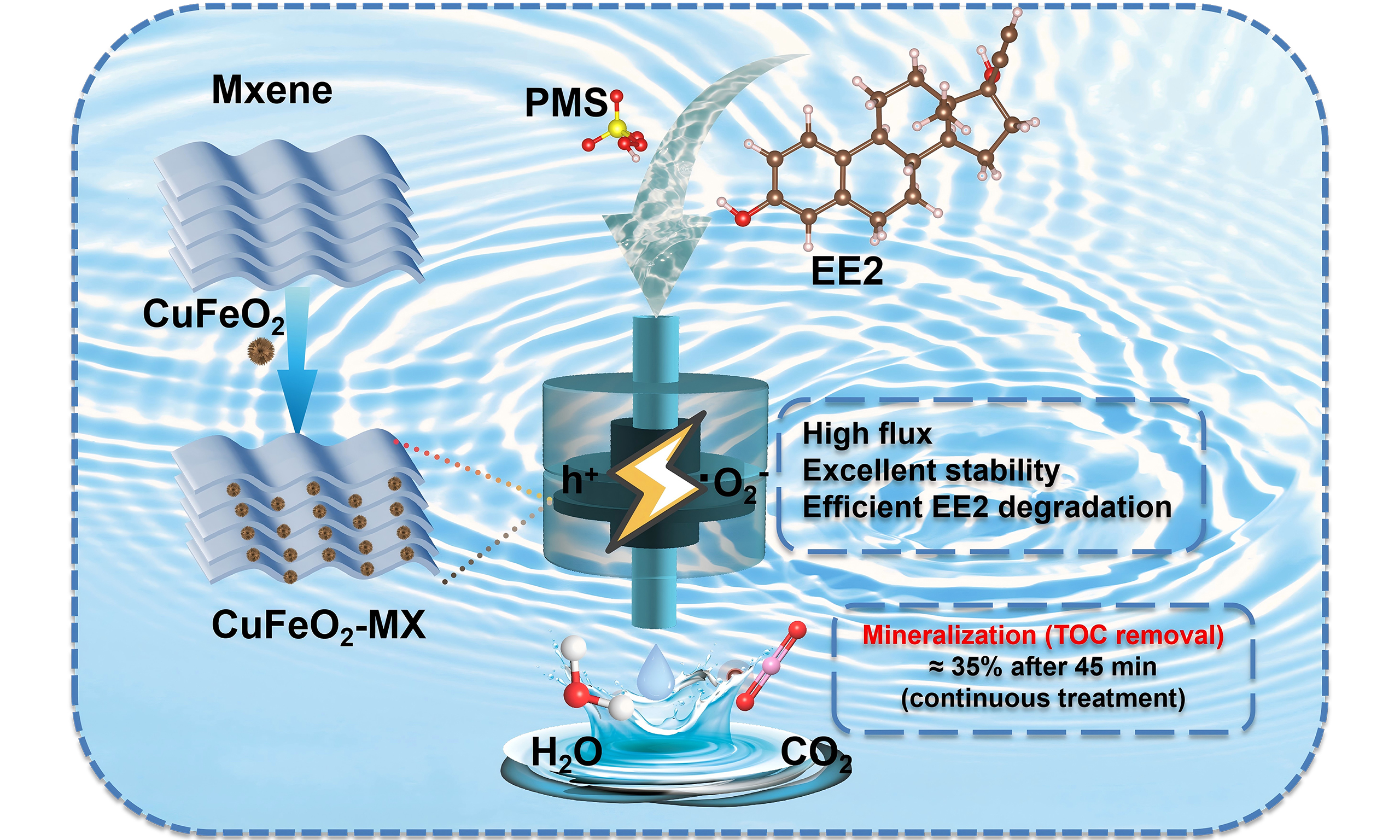
To overcome mass transfer limitation and agglomeration-induced catalyst deactivation during endocrine disruptor degradation, an electroactive membrane composed of CuFeO2 confined between MXene layers was constructed for the efficient activation of peroxymonosulfate (PMS) under continuous-flow operations. The interlayer confinement and conductive framework of the MXene effectively inhibited CuFeO2 agglomeration and enhanced interfacial electron transfer, thereby enriching reactants and enabling rapid catalytic reactions through enhanced convective mass transfer. Under a flux of
Keywords
INTRODUCTION
Endocrine-disrupting compounds (EDCs), owing to their continuous discharge into water environments, pose a serious threat to ecosystem safety and public health. Among these compounds, 17α-ethynylestradiol (EE2), a synthetic estrogen widely used in oral contraceptives and hormone therapies, exhibits notable endocrine-disrupting activity even at trace concentrations. EE2 is characterized by its environmental persistence, poor biodegradability and high ecological risk[1-3]. Numerous studies have shown that prolonged EE2 exposure can induce feminization, reproductive dysfunction and population structure imbalances in aquatic organisms. Therefore, development of water treatment technologies for rapid EE2 removal and effective mitigation of its environmental risks is essential[4-8].
Current wastewater treatment processes for EE2 removal primarily rely on physical adsorption and biological conversion; however, their overall efficiency is limited[9-12]. Adsorption mainly transfers pollutants from the aqueous phase to the adsorbent rather than destroying their molecular structures, and inappropriate regeneration or disposal of spent adsorbents may result in secondary pollution[13,14]. Meanwhile, biological treatments are constrained by the biological inertness of EE2, often resulting in slow reaction kinetics and incomplete removal, thereby highlighting its potential toxicity. Notably, traditional treatment processes often generate intermediate products with endocrine-disrupting activity upon partial conversion of pollutants; therefore, pollution risk is not sufficiently mitigated[1]. Therefore, for high-risk EDCs like EE2, simply focusing on removal efficiency is insufficient to meet environmental safety demands; achieving structural destruction and reducing toxicity risks are also required.
Advanced oxidation processes (AOPs) based on sulfate radicals (SO4•-) are effective methods for treating refractory organic pollutants owing to their strong oxidation capability and broad-spectrum oxidation behavior, although their performance may depend on reaction conditions such as pH[15-18]. In particular, peroxymonosulfate (PMS) is a highly promising oxidant precursor because of its high chemical stability and ease of storage and transport[16-19].
Recently, electrochemical AOPs have gained widespread attention for their ability to activate PMS in situ in a controlled manner while reducing chemical reagent consumption[20-22]. Among various heterogeneous PMS activation catalysts, Cu–Fe bimetallic oxides such as CuFeO2 are promising materials for PMS activation owing to their high element abundance, good environmental compatibility and efficient electron transfer properties triggered by the Cu(II)/Cu(I)–Fe(III)/Fe(II) dual redox cycle system[23-26].
However, CuFeO2-based catalytic systems face two critical challenges in practical applications: (i) owing to their high surface energy, CuFeO2 nanoparticles are prone to aggregation during synthesis and reaction, reducing the surface area and shielding active sites, thereby weakening their catalytic efficiency and long-term stability[27]; and (ii) in traditional batch electrochemical reactors, pollutant mass transfer to the electrode or catalyst surface primarily relies on molecular diffusion and often becomes a rate-limiting step for the overall reaction, thereby hindering high treatment flux. Therefore, addressing catalyst aggregation and mass transfer limitations remains a key scientific and engineering challenge for efficient removal of high-risk pollutants such as EE2, particularly in continuous-flow and electroactive membrane systems[28].
MXenes, especially Ti3C2Tx, have recently emerged as promising components for electroactive catalytic membranes due to their excellent electrical conductivity, two-dimensional layered structure, abundant surface functional groups, and tunable interfacial chemistry. In PMS-based advanced oxidation systems, MXene can facilitate interfacial electron transport, provide catalytic interfaces, and improve the accessibility of active sites. However, pristine MXene generally exhibits limited intrinsic catalytic activity toward PMS activation, and its catalytic efficiency still requires further enhancement through coupling with redox-active catalytic components. Therefore, integrating transition-metal oxides with MXene provides an effective strategy to combine efficient PMS activation sites with rapid electron-transfer pathways.
In this study, a CuFeO2 nanocomposite material supported on Ti3C2Tx MXene as a confinement carrier is constructed and integrated into an electroactive filtration membrane reaction system to achieve rapid PMS activation and efficient EE2 degradation under continuous-flow operation. The performance of the CuFeO2–MXene (CuFeO2–MX) system in EE2 removal, its mineralization ability and applicability in real water bodies in continuous-flow operations are systematically evaluated. The dominant active species and reaction pathways in the catalytic system are identified via free-radical trapping experiments, electron paramagnetic resonance (EPR) and electrochemical analyses, and the evolution of intermediate products and environmental risk changes during degradation are analyzed using liquid chromatography–mass spectrometry (LC–MS) and toxicity prediction software. In addition, density functional theory (DFT) calculations are performed to reveal interfacial electronic interactions and key reaction steps at the atomic scale.
The two-dimensional MXene layered structure not only serves as a conductive framework that inhibits CuFeO2 nanoparticle aggregation and exposes abundant redox-active sites but also promotes interfacial electron transfer owing to its excellent electronic conductivity, accelerating Cu/Fe redox cycling[29,30]. Simultaneously, by constructing the catalyst as a flowing electroactive filter membrane, the contaminated fluid is driven through the catalytic layer under pressure, achieving forced convective mass transfer. As a result, the diffusion limitations of traditional batch systems are overcome, and a high-concentration active-species enrichment zone is formed at the local reaction interface, thereby considerably improving reaction rates and treatment efficiency[31,32]. This material confinement–process intensification synergistic strategy offers a novel approach for the efficient removal and environmental risk reduction of EE2 and other EDCs.
EXPERIMENTAL
Experimental reagents and instruments
The chemical reagents, solution preparation methods, instrument models and specific parameters for DFT calculations are detailed in the Supplementary Materials.
Preparation of Ti3C2Tx MXene
Ti3C2Tx MXene was prepared via selective etching with hydrofluoric acid (HF). First, 0.500 g of Ti3AlC2 MAX-phase powder was slowly added to a polytetrafluoroethylene (PTFE) beaker containing 30 mL of 50% HF solution, and the reaction was magnetically stirred at room temperature for 24 h. Following this, the resulting suspension was centrifuged at 3,500 rpm for 5 min and then repeatedly washed and centrifuged with ultrapure water until the pH of the supernatant exceeded 6. The precipitate was then dried overnight at 70 °C in a vacuum drying oven to obtain the multi-layer Ti3C2Tx MXene powder.
Preparation of CuFeO2–MX
The CuFeO2–MX composite material was synthesized using a one-step hydrothermal method. 15 mmol of Cu(NO3)2·3H2O and 15 mmol of Fe(NO3)3·9H2O (Cu:Fe molar ratio = 1:1) were dissolved in 60 mL of ultrapure water to prepare a clear solution. Following this, 0.100 g of the prepared MXene powder and
Preparation of the CuFeO2–MX electroactive filter membrane
The self-supporting catalytic membrane was prepared using a vacuum filtration method: 0.030 g of CuFeO2–MX composite powder was added to 50 mL of ultrapure water and sonicated for 20 min to obtain a uniform suspension. The suspension was vacuum-filtered onto a polyvinylidene fluoride (PVDF) substrate filter membrane (diameter: 4 cm; pore size: 0.22 μm). After filtration, the membrane was dried at 70 °C for
Electrocatalytic degradation experiment and analytical methods
Electrocatalytic degradation was conducted in a custom-made continuous-flow membrane reactor [Supplementary Figure 1]. The reactor was set up in a flow-through filtration configuration, with the CuFeO2–MX electroactive filter membrane installed inside the reactor. The reaction solution was driven through the catalytic membrane layer under pressure, achieving convective mass transfer enhancement at the interface. A schematic of the reactor structure, the effective filtration area, volume parameters and calculations for flux and hydraulic retention time are provided in the Supplementary Materials. The CuFeO2–MX electroactive filter membrane was used as the working electrode, and a peristaltic pump (Longer Pump) was used to pump the reaction solution into the reactor at a constant flow rate. The reaction solution contained EE2 (3.0 mg·L-1) and 0.5 mM PMS, as well as 50 mM Na2SO4 as the supporting electrolyte. To drive electrocatalytic degradation, a voltage of 1.5 V was applied across the membrane using a DC-regulated power supply (ITECH). Samples were taken at predetermined time intervals, filtered through a 0.45-μm water-based syringe filter and analyzed for residual EE2 concentration in the filtrate using high-performance liquid chromatography (HPLC). The HPLC analysis conditions were as follows: column, Agilent ZORBAX Eclipse Plus C18 (4.6 × 250 mm2, 5 μm); mobile phase, acetonitrile/water (50:50, v/v); flow rate, 1.0 mL·min-1; column temperature, 30 °C; detection wavelength, 280 nm.
RESULTS AND DISCUSSION
Structural characterization of the materials
To verify the successful construction and structural characteristics of the CuFeO2–MX composite catalyst, the phase composition, chemical bonding states and microscopic morphology of the samples were systematically characterized. The X-ray diffraction (XRD; Figure 1A) pattern of the etched MXene shows typical (002) and (004) diffraction peaks, indicating that its layered structure was successfully constructed. In the XRD pattern of CuFeO2–MX, characteristic peaks belonging to CuFeO2, such as (101), (012) and (104), are distinctly observed. Although slight differences in peak positions and relative intensities are observed compared with the standard CuFeO2 pattern, the overall diffraction features are consistent with the rhombohedral CuFeO2 structure. These deviations may originate from the nanoscale crystallite size, lattice distortion, and structural defects generated during the hydrothermal synthesis process. After coupling with MXene, slight shifts of CuFeO2 peaks are observed, possibly due to the interfacial interaction and confinement effect between CuFeO2 and MXene. No additional impurity peaks are detected, confirming the successful formation of the CuFeO2–MX composite.
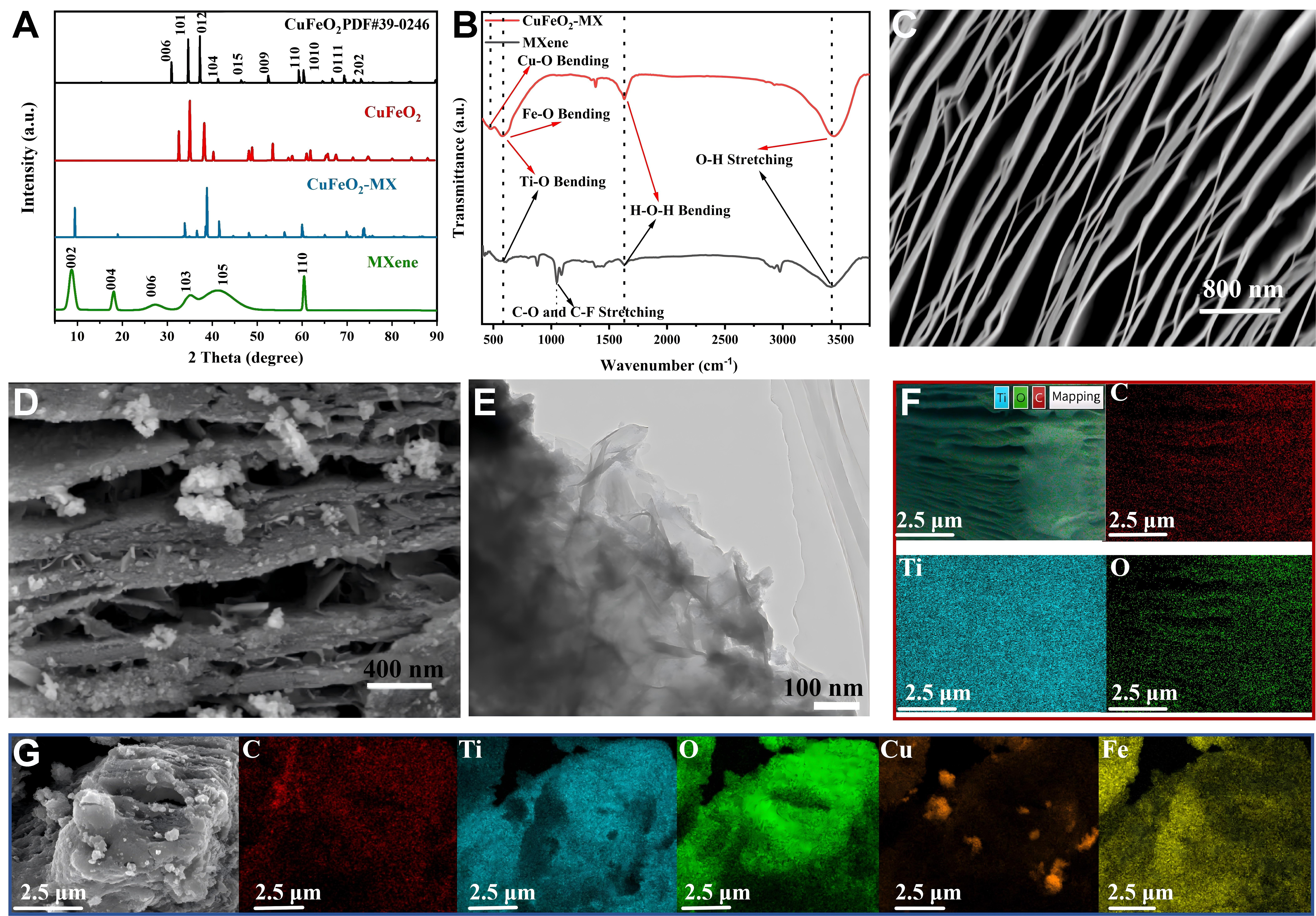
Figure 1. (A) XRD patterns of MXene, CuFeO2 and CuFeO2–MX together with the standard XRD card of CuFeO2; (B) FTIR spectra of MXene and CuFeO2–MX; SEM images of (C) MXene (D) and CuFeO2–MX; (E) TEM images of CuFeO2–MX; Elemental mapping images of (F) MXene and (G) CuFeO2–MX. XRD: X-ray diffraction; CuFeO2–MX: CuFeO2–MXene; FTIR: Fourier transform infrared; SEM: scanning electron microscopy; TEM: transmission electron microscopy.
Fourier transform infrared (FT-IR) spectroscopy [Figure 1B] further revealed the chemical interactions at the composite interface. Compared with pristine MXene, the spectrum of CuFeO2–MX exhibits changes in the low-wavenumber region. The weak absorption band in this region can be assigned to metal–oxygen vibrations, including Fe–O and Ti–O bonds, although the Fe–O vibration is less distinguishable after coupling with MXene. Meanwhile, whereas the C–F signals of the terminal functional group on the MXene surface are weakened. This suggests that CuFeO2 was chemically anchored onto the surface oxygen-containing functional groups of MXene and stabilized within the interlayer. This strong interfacial interaction inhibits the migration and aggregation of CuFeO2 nanoparticles during the reaction and provides continuous channels for subsequent electron transfer.
Scanning electron microscopy (SEM) and transmission electron microscopy (TEM) were used to characterize the morphology of the HF-etched MXene, and the chemical composition and elemental distribution were further confirmed via energy dispersive spectroscopy (EDS) and elemental mapping. MXene exhibits a typical layered stacking structure with regular interlayer channels between the sheets. The overall structure is uniform and continuous, with an apparent interlayer scale of 100-200 nm, good exfoliation and an open two-dimensional morphology [Figure 1C].
After CuFeO2 introduction in the hydrothermal reaction, the overall layered framework structure of the MXene maintained good stability, with no significant collapse or damage [Figure 1D]. CuFeO2 is uniformly distributed as flocculent particles or nanoparticles and embedded between the MXene layers, effectively preventing CuFeO2 aggregation.TEM images [Figure 1E] reveal the layered morphology of MXene and the close contact between CuFeO2 nanoparticles and MXene sheets, suggesting the successful construction of the CuFeO2–MX confined composite structure.
The EDS and elemental mapping results [Figure 1F and Supplementary Figure 2] show that Ti and C elements are uniformly distributed in MXene, and the O element primarily originates from the oxygen-containing terminal groups (–O, –OH, etc.) introduced during etching on the surface and between the layers of the MXene, providing rich active sites and interface binding sites for subsequent reactions.
Additional EDS and elemental mapping results [Figure 1G and Supplementary Figure 3] show that the O, C, Ti, Fe and Cu elements in the CuFeO2–MX composite catalyst are highly overlapped and evenly distributed, indicating that CuFeO2 is highly dispersed between the MXene layers. These structural features characterized by interlayer confinement and uniform loading provide abundant and accessible active sites for the reactants, establishing a structural basis for enhancing catalytic efficiency.
Supplementary Figure 4 shows the N2 adsorption–desorption isotherm and pore structure characteristics of MXene, CuFeO2 and CuFeO2–MX. For comparison, the N2 adsorption–desorption curves of pure CuFeO2 and MXene are shown in Supplementary Figure 4A and B, respectively. The adsorption–desorption isotherm of CuFeO2 shows typical Type II characteristics, indicating a large-pore structure with uneven pore size distribution. In contrast, the isotherms of MXene and CuFeO2–MX exhibit typical Type IV characteristics with a pronounced hysteresis loop, indicating well-developed mesoporous structures [Supplementary Figure 4C]. Further pore size distribution analysis showed that CuFeO2 has a more dispersed pore size distribution, mainly concentrated in the large-pore region, and the MXene has an average pore size of approximately
In summary, CuFeO2 introduction into the MXene interlayer not only regulates the pore structure and surface properties of CuFeO2, thereby effectively inhibiting its aggregation and deactivation during the catalytic process, but also increases the specific surface area and adsorption capacity of the material, providing a structural foundation for efficient pollutant removal in continuous-flow electrocatalytic systems.
To analyse the surface chemical composition and elemental valence states of the CuFeO2–MX composite material, X-ray photoelectron spectroscopy (XPS) was performed. As shown in Figure 2A, the full survey spectrum displays the characteristic signals of Cu, Fe, Ti, C, and O, confirming the successful incorporation of CuFeO2 into the MXene framework. The O 1s high-resolution spectrum [Figure 2B] of the CuFeO2–MX composite was deconvoluted into three components. The peak at 529.63 eV was assigned to lattice oxygen species associated with metal–oxygen bonds (Ti–O/Fe–O). The peak at 531.18 eV was attributed to oxygen vacancy-related species, while the peak at 532.46 eV corresponded to surface-adsorbed oxygen species. These results indicate the coexistence of lattice oxygen, oxygen vacancies, and surface oxygen-containing species in the CuFeO2–MX composite, which may contribute to the interfacial interaction between CuFeO2 and MXene.
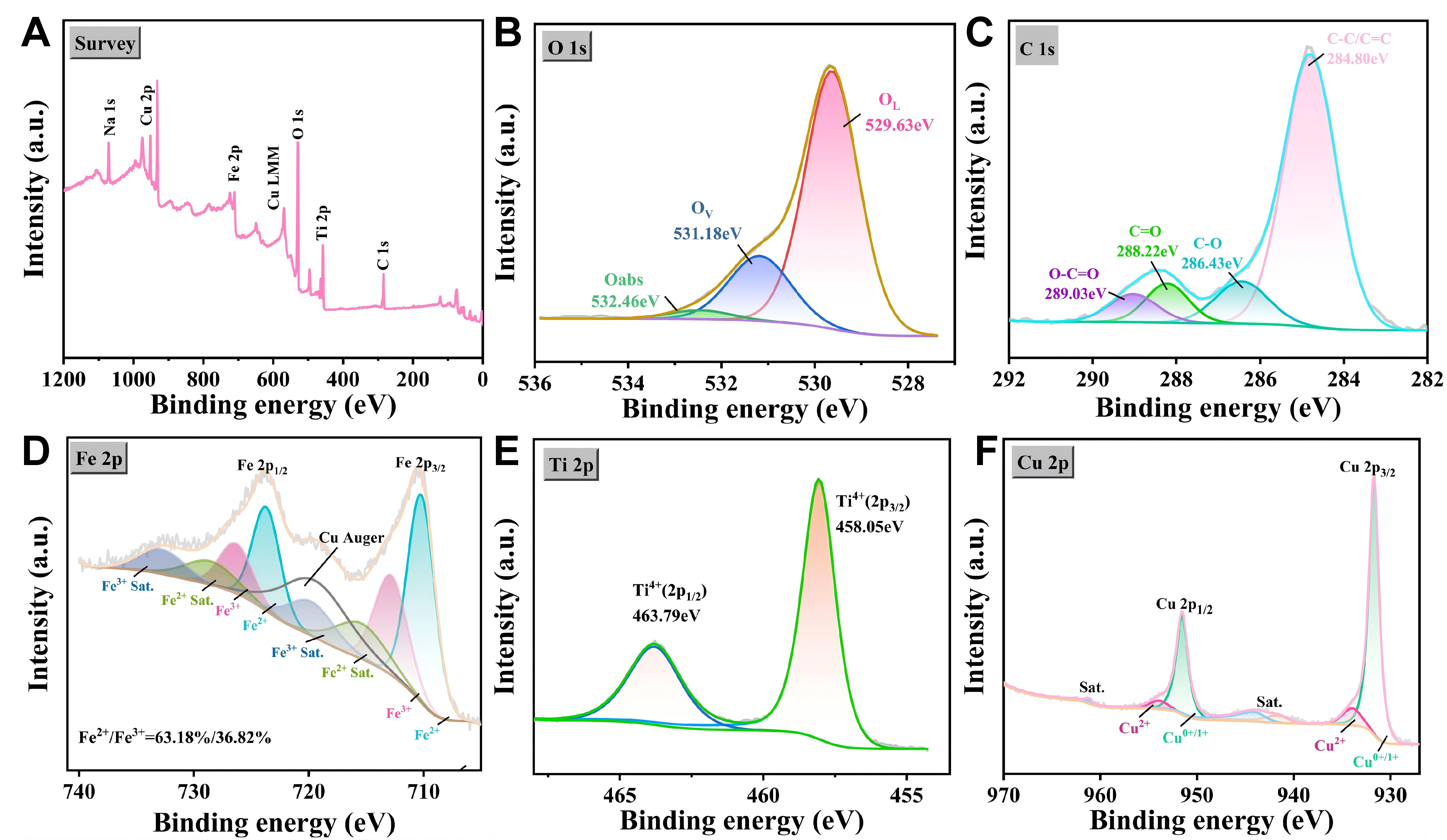
Figure 2. (A) XPS survey spectrum and (B) O 1s, (C) C 1s, (D) Fe 2p, (E) Ti 2p, and (F) Cu 2p high-resolution spectra for CuFeO2–MX. XPS: X-ray photoelectron spectroscopy; CuFeO2–MX: CuFeO2–MXene.
In the C 1s spectrum [Figure 2C], the dominant peak at 284.80 eV is assigned to C–C/C=C bonds from the MXene carbon framework. The peaks located at 286.43, 288.22, and 289.03 eV are attributed to C–O, C=O, and O–C=O species, respectively. A weak contribution from C–Ti bonding is also considered, which is associated with the Ti–C structure of MXene. The presence of these carbon-related components indicates the preservation of the MXene framework after the formation of the CuFeO2–MX composite.
The Fe 2p spectrum [Figure 2D] reveals the coexistence of Fe2+ and Fe3+ species based on the fitted peaks and satellite features, indicating the presence of Fe mixed-valence states in CuFeO2–MX. The Ti 2p spectrum [Figure 2E] exhibits two characteristic peaks at 458.05 and 463.79 eV, corresponding to Ti 2p3/2 and Ti 2p1/2, respectively, confirming the preservation of the MXene structure after composite synthesis. The Cu 2p spectrum [Figure 2F] shows characteristic Cu 2p peaks with corresponding satellite features, suggesting the coexistence of Cu+/Cu2+ species in the composite[31].
To further investigate the interfacial electronic interaction between CuFeO2 and MXene, the XPS spectra of pristine CuFeO2 and CuFeO2–MX were compared [Supplementary Figure 5]. Compared with pristine CuFeO2, the Cu 2p and Fe 2p peaks of CuFeO2–MX exhibit slight shifts in binding energy, indicating the modification of the local electronic environment after coupling with MXene. These shifts suggest interfacial electron redistribution between CuFeO2 and MXene, which is consistent with the strong interaction within the composite structure.
Continuous-flow electrocatalytic performance evaluation
To elucidate the intrinsic relationship between the structural characteristics of the CuFeO2–MX composite material and its catalytic performance, CuFeO2–MX samples with different CuFeO2 loading amounts were systematically characterized and compared [Figure 3A]. The CuFeO2 loading amounts (5, 10, 15, 20, and
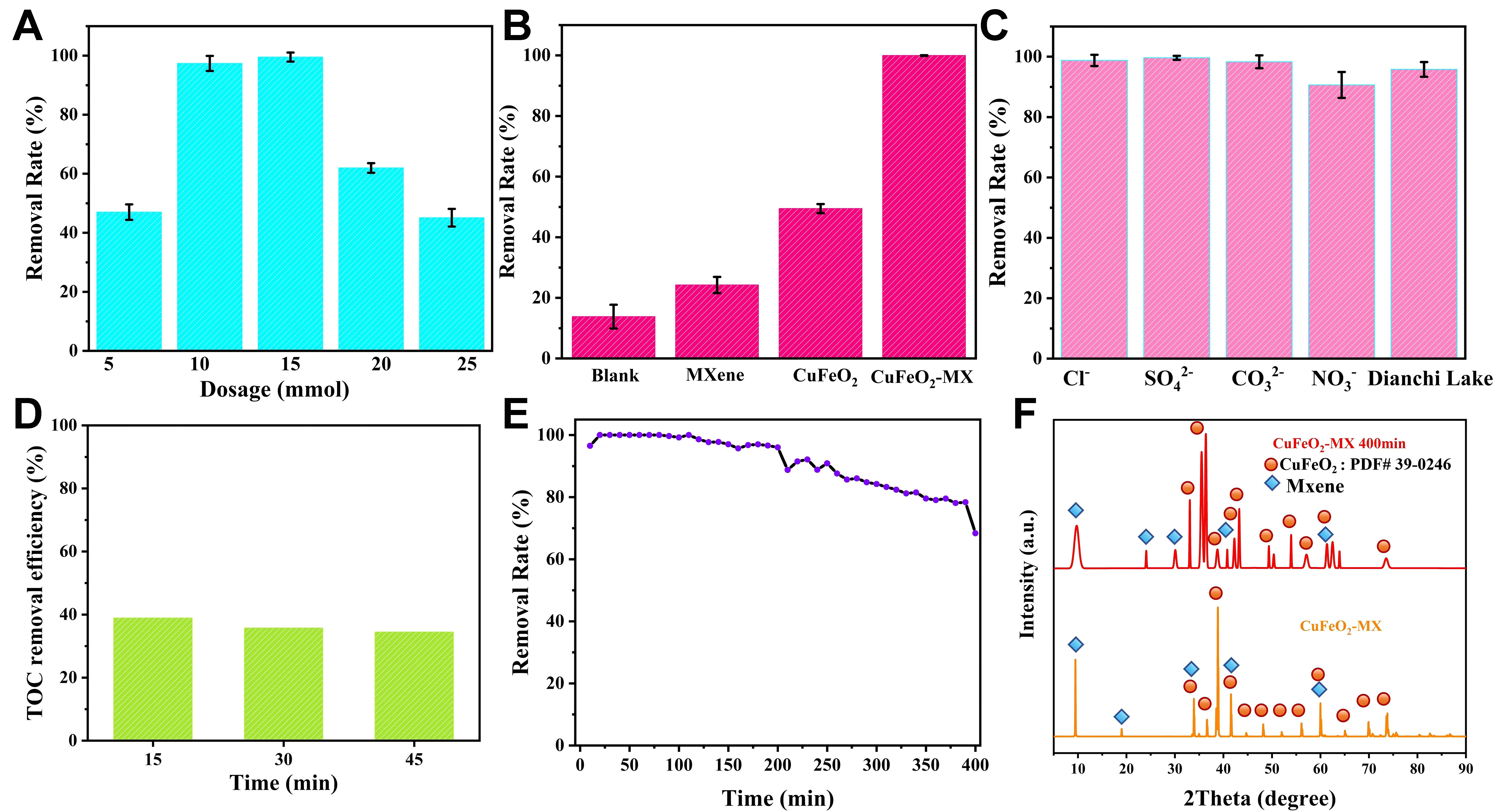
Figure 3. (A) Average instantaneous EE2 degradation efficiency of CuFeO2–MX membranes with different CuFeO2 loadings within 30 min; (B) EE2 degradation performance of a blank PVDF membrane, MXene, CuFeO2 and CuFeO2–MX; (C) EE2 degradation performance of CuFeO2–MX under different electrolyte conditions and in real water matrices; (D) EE2 mineralization efficiency of CuFeO2–MX during the degradation process; (E) EE2 degradation efficiency of CuFeO2–MX over 400 min; (F) XRD patterns of CuFeO2–MX before and after continuous treatment for 400 min. Data are presented as mean ± SD (n = 3). EE2: 17α-Ethynylestradiol; CuFeO2–MX: CuFeO2–MXene; PVDF: polyvinylidene fluoride; XRD: X-ray diffraction; SD: standard deviation.
To evaluate the EE2 removal ability of the CuFeO2–MX electroactive filter membrane under continuous-flow mode, the effects of the composite catalytic system components were compared [Figure 3B]. Under the same operating conditions (flux, 45.83 L·m-2·h-1; applied voltage, 1.5 V; 0.5 mM PMS; reaction time, 30 min), the blank PVDF membrane showed merely 13.81% EE2 removal rate, mainly due to limited physical interception and weak adsorption. The EE2 removal rate of the pure MXene membrane was 24.25%, suggesting that the MXene achieved preliminary removal via surface adsorption but no deep degradation. The removal rate of the pure CuFeO2 membrane increased to 49.47%, indicating that CuFeO2 could activate PMS, but its overall efficiency was still limited by the accessibility of active sites and reaction kinetics. In comparison, the CuFeO2–MX membrane achieved nearly 100% EE2 removal within 30 min, substantially outperforming the single-component materials and the blank membrane, demonstrating a strong synergistic catalytic effect.
To clarify the role of the interlayer-confined structure, a physically mixed CuFeO2/MX sample was prepared as a control [Supplementary Figure 6]. The lower removal efficiency of the physically mixed sample compared with CuFeO2–MX indicates the importance of the confined interfacial structure.
To evaluate the influence of the flow-through configuration on EE2 degradation, the performance of the CuFeO2–MX/PMS system under continuous-flow and static batch conditions was compared [Supplementary Figure 7]. The continuous-flow system achieved an EE2 removal efficiency of approximately 99.8%, which was higher than that of the static batch system (~75.2%). This improvement may be attributed to the continuous transport of reactants through the catalytic membrane, which enhances the contact between EE2, PMS, and active sites. These results indicate that the flow-through configuration contributes to improved catalytic performance, although the contribution of convective mass transfer requires further quantitative evaluation.
This performance improvement can be explained by considering three aspects: structural enrichment, electron transfer and mass transfer enhancement. First, the interlayer confinement by the MXene effectively inhibits the aggregation of CuFeO2 nanoparticles and markedly increases the specific surface area, thereby enhancing the adsorption and enrichment of pollutants and increasing the exposure of active sites. Second, the high conductivity of the MXene promotes fast interfacial electron transfer, facilitating the continuous cycling of Cu/Fe valence states and improving PMS activation efficiency. Third, under the electroactive filtration mode, the pressure-driven convective mass transfer enables pollutants to enter the reaction layer more efficiently and interact with active sites, generating abundant active species at the local interface and ultimately achieving rapid removal under continuous-flow operations.
Considering that inorganic anions are commonly present in actual water bodies and may interfere with the radical process, the Na2SO4 supporting electrolyte was replaced with Na2CO3, NaCl and NaNO3 to investigate the effects of different anions on the degradation behavior [Figure 3C]. The EE2 removal effect under different electrolyte conditions did not differ considerably, indicating the good tolerance of the system to common anions. This also suggests that the supporting electrolyte mainly serves as a charge transfer medium rather than converting into active species that participate in the reaction or cause competitive consumption.
To verify the applicability of the system in real water environments, actual water samples from Dianchi Lake (The water quality parameters of Dianchi Lake water are provided in Supplementary Table 1) were used to prepare EE2 spiked solutions for the experiment [Figure 3C]. Even in the complex background of organic substances and inorganic ions in natural water, the CuFeO2–MX system maintained an EE2 removal rate of over 90%. Cl-, SO42-, and CO32- showed limited effects on EE2 removal, whereas NO3- caused a decrease in removal efficiency (~90%). These results indicate that the CuFeO2–MX/PMS system maintained good tolerance toward most common anions under the investigated conditions.
The mineralization degree of EE2 was further evaluated by measuring the total organic carbon (TOC) removal rate [Figure 3D]. Effluent samples collected at 15, 30 and 45 min during continuous treatment were analyzed to evaluate the mineralization capability of the system. After 45 min of continuous treatment, the TOC removal efficiency reached approximately 35%, indicating that the mineralization of organic intermediates proceeded more slowly than the removal of the parent EE2 molecule. This result suggests that although EE2 can be rapidly removed, further oxidation of the generated intermediates is required for complete mineralization. Therefore, the transformation products were further identified and their toxicity evolution was evaluated.
Electrochemical behavior and interfacial electron transfer characteristics
To further elucidate the interfacial electron transfer characteristics in the CuFeO2–MX composite system and their effect on electrocatalytic performance, electrochemical impedance spectroscopy (EIS) and transient current–time (I–T) response tests were performed on different electrode materials. As shown in Supplementary Figure 8, the Nyquist plots of all electrodes displayed typical features: a high-frequency semicircle related to the charge transfer resistance (Rct) and a low-frequency sloping line. Compared with single MXene and CuFeO2 electrodes, the CuFeO2–MX electrode exhibited the smallest semicircle diameter, indicating a lower interfacial charge transfer resistance. Quantitative fitting of the EIS spectra further revealed that the Rct values of MXene, CuFeO2, and CuFeO2–MX were 316.6, 286.9, and 129.3 Ω, respectively. The significantly reduced Rct of CuFeO2–MX demonstrates the enhanced interfacial electron transfer capability after coupling CuFeO2 with the conductive MXene framework. This improvement can be attributed to the high conductivity of MXene and the strong interfacial interaction between MXene and CuFeO2, which facilitates electron transport at the electrode–electrolyte interface during the electrocatalytic reaction.
The transient current response behavior of different electrodes was evaluated via I–T measurements under constant voltage conditions [Supplementary Figure 9]. The CuFeO2–MX electrode exhibited a higher and more stable current response than the individual MXene and CuFeO2 electrodes, indicating improved electrochemical response and interfacial electron transfer capability after composite formation. Together with the EIS results, the I–T measurements demonstrate that the CuFeO2–MX composite structure facilitates electron transport by reducing the charge transfer resistance and enhancing the electrochemical activity. This improved electron transfer capability may contribute to more efficient PMS activation and enhanced pollutant degradation performance in the continuous-flow electrocatalytic system.
Stability and deactivation mechanism analysis
To evaluate the operational stability and potential deactivation behavior of the CuFeO2–MX electroactive filter membrane under continuous-flow treatment conditions, long-term continuous EE2 treatment was performed using the CuFeO2–MX/PMS system [Figure 3E]. During the first 120 min, the system maintained a high and relatively stable removal efficiency; however, after that, the catalytic performance gradually declined, with a more noticeable decrease at around 400 min. Nevertheless, even after 400 min of continuous operation, the EE2 removal rate remained at about 70%, indicating that the electroactive filtration system retained considerable treatment capability under long-term high-flux conditions.
To further clarify the structural causes of performance degradation, the phase and morphology of the catalytic membrane were characterized before and after operation. As shown in Figure 3F, the XRD pattern of CuFeO2–MX after the reaction showed no new phase peaks, indicating that the main crystal phase of CuFeO2 remained unaltered during long-term operation. However, the intensity of the MXene-related diffraction peaks decreased considerably, whereas the characteristic peaks of CuFeO2 became more prominent, suggesting that the MXene layered structure underwent some collapse or reconstruction during long-term electrochemical and oxidative conditions, leading to the partial exposure of CuFeO2 and facilitating secondary aggregation. Additionally, the characteristic peaks of Fe and Cu shifted slightly, suggesting that the local electronic environment of Cu and Fe species was modified after long-term operation, which may affect the redox process involved in PMS activation.
In addition, inductively coupled plasma–optical emission spectrometry (ICP-OES) analysis was conducted to evaluate possible metal leaching during long-term operation [Supplementary Table 2]. The concentrations of released Cu and Fe ions were 0.7194 and 0.02270 mg·L-1, respectively, indicating limited dissolution of metal species during operation. Both values were below the guideline values recommended by the World Health Organization (WHO) for drinking water (Cu: 2.0 mg·L-1; Fe: 0.3 mg·L-1), suggesting the structural stability of the CuFeO2–MX membrane during continuous operation.
The above observations suggest that the deactivation of the catalytic system is not caused by the destruction of the CuFeO2 crystal phase; instead, it is probably related to the decreased accessibility of active sites due to the weakening of the MXene confinement structure, the deterioration of the mass transfer process and the reduced efficiency of key valence state cycles.
SEM results further verified the structural evolution [Supplementary Figure 10]. Compared with the fresh membrane, the layered framework of CuFeO2–MX exhibited noticeable damage after 400 min of continuous operation, with local structures becoming more compact, indicating that the MXene sheets underwent varying degrees of fracture, stacking or collapse during long-term operation. This directly reduces the pore connectivity of the reaction layer and weakens the convective mass transfer.
In addition, the Brunauer–Emmett–Teller test results [Supplementary Figure 11] showed that after 400 min of continuous operation, the specific surface area of the material decreased substantially to 53.54 m2·g-1 from the initial value, indicating that pore structure collapse and particle aggregation reduced the available surface area considerably. Since this system highly relies on the synergistic enhancement effect induced by the pore structure, convective mass transfer and interfacial reaction in continuous-flow mode, the degradation of specific surface area and pore structure inevitably reduces the pollutant enrichment and diffusion efficiency in the reaction layer, leading to the observed decay in macroscopic catalytic performance.
In conclusion, the CuFeO2–MX electroactive filter membrane maintained good crystal phase stability during long-term continuous operation. The observed performance decay was mainly associated with the gradual evolution of the MXene confinement structure, pore structure degradation, and reduced accessibility of catalytic sites, rather than the destruction of the CuFeO2 crystal phase. These results provide insights into the deactivation mechanism of the catalytic membrane and suggest possible strategies for further improving long-term operational stability.
Active-species identification and reaction mechanism analysis
To elucidate the dominant active species and reaction pathways for the EE2 degradation by the CuFeO2–MX/PMS electroactive filter membrane system, quenching experiments were performed using tert-butanol (TBA), p-benzoquinone (p-BQ), EDTA-2Na, methanol (MeOH) and histidine (L-His), and DMSO as scavengers of the hydroxyl radical (•OH), the superoxide radical (•O2-), holes (h+), SO4•-, singlet oxygen (1O2), and high-valent metal-oxo species, respectively.
Figure 4A shows that the EE2 removal rate considerably decreased after adding EDTA-2Na or p-BQ, indicating that h+ and •O2- play a key role in the reaction. In contrast, TBA caused only slight inhibition, suggesting that •OH might be a secondary intermediate active species in PMS activation. The addition of MeOH and l-His exerted little effect on the removal rate, indicating that SO4•- and 1O2 are not the dominant oxidative species. In addition, the addition of DMSO caused only slight inhibition, suggesting that high-valent metal-oxo species, if generated during PMS activation, may play a limited role and are unlikely to be the dominant oxidation pathway. These results suggest that the CuFeO2–MX/PMS electrocatalytic system follows a non-traditional activation pathway with h+ and •O2- as the dominant active species and •OH playing a secondary role, in contrast to typical SO4•--dominated pathways in classical PMS systems.
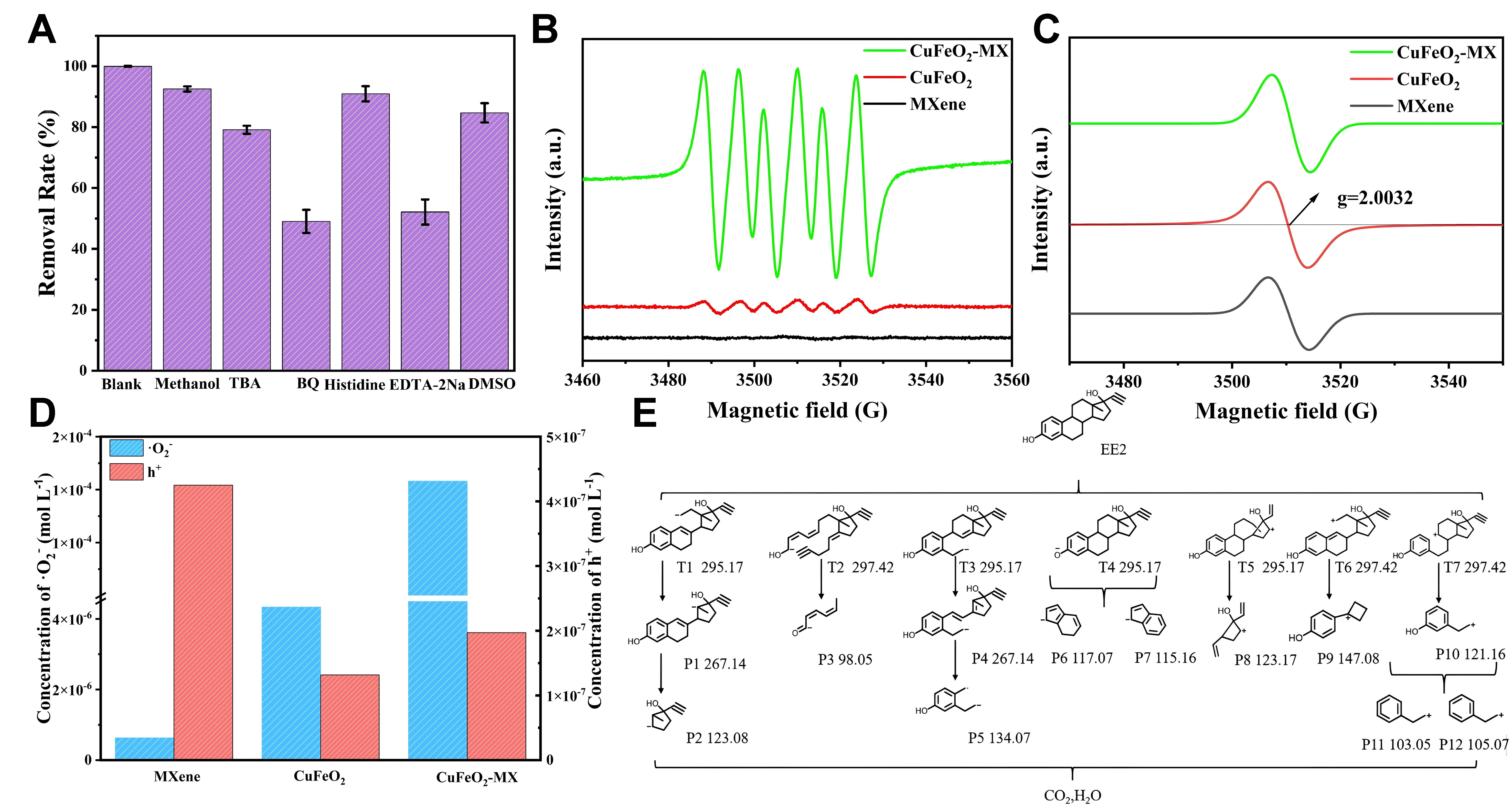
Figure 4. (A) Scavenging of reactive species during EE2 degradation by CuFeO2–MX; EPR spectra of (B) •O2- and (C) h+; (D) Concentrations of h+ and •O2- during the degradation process; (E) Possible intermediates and reaction pathways during EE2 degradation by CuFeO2–MX. Data are presented as mean ± SD (n = 3). EE2: 17α-Ethynylestradiol; CuFeO2–MX: CuFeO2–MXene; EPR: electron paramagnetic resonance; SD: standard deviation
To confirm this hypothesis, EPR was used to detect signals related to h+ and •O2- [Figure 4B and C]. During the electrocatalytic process, the pure CuFeO2 system showed •O2- signals, indicating that CuFeO2 can activate PMS and generate •O2-. Conversely, the pure MXene scarcely exhibited any •O2- signal, indicating that the MXene alone cannot effectively activate PMS to generate •O2-. Notably, the •O2- signal was substantially enhanced in the CuFeO2–MX system, suggesting that the MXene introduction considerably strengthened the electron transfer process associated with •O2- generation.
Meanwhile, the MXene and CuFeO2–MX showed markedly stronger h+ signals than CuFeO2, indicating that the MXene not only provides a conductive network in the composite system but also promotes interfacial charge separation and h+-related oxidation ability, contributing, together with the PMS activation behavior of CuFeO2, to the reaction.
To quantitatively compare the generation of active species in different systems, the instantaneous concentration of active species was measured at 5 min within the reaction [Figure 4D]. CuFeO2 generated a certain amount of •O2- during the catalytic process, whereas MXene produced minimal •O2-. In contrast, CuFeO2–MX exhibited significantly enhanced •O2- generation. The •O2- concentration of CuFeO2–MX reached 1.416 × 10⁻⁴ mol·L-1, approximately 225-fold and 33-fold higher than those of MXene and CuFeO2, respectively. The formation of high concentrations of •O2- promotes interfacial oxidation, explaining the macroscopically fast EE2 removal by CuFeO2–MX under continuous-flow operations. Quantitative analysis further revealed that the CuFeO2–MX system generated a higher h+ concentration (1.97 × 10⁻⁷ mol·L-1) than bare CuFeO2 (1.317 × 10⁻⁷ mol·L-1), but lower than that of bare MXene (4.25 × 10⁻⁷ mol·L-1), indicating that MXene promotes charge separation while partial hole consumption occurs during •O2- generation, confirming h+ and •O2- as the dominant reactive species.
Intermediate product inference and toxicity analysis
To further clarify the EE2 transformation mechanism and environmental risk changes by the CuFeO2–MX/PMS electrocatalytic system at the molecular scale, DFT calculations were combined with product identification for intermediate analysis and toxicity assessment.
First, the Fukui function (f0) was used to predict the reactive sites of the EE2 molecule that are most susceptible to attack by active species [Supplementary Figure 12 and Supplementary Table 3], which helps elucidate the product transformation pathway[24,25]. Following this, intermediate products generated during the EE2 degradation by the CuFeO2–MX/PMS system were identified via LC–MS [Supplementary Figure 13], and potential transformation intermediates and reaction pathways were proposed according to the major characteristic peaks [Figure 4E]. The results indicate that, in this system, EE2 undergoes multi-site and parallel structural transformations, ultimately generating various oxygenated, demethylated, dehydroxylated and skeletal cleavage products, demonstrating deep structural damage to EE2.
In the electrospray ionization mode, 12 main intermediate products were detected; accordingly, the EE2 transformation was proposed to follow six parallel pathways [Figure 4E and Supplementary Figure 13], involving sequential oxidation, dealkylation, hydroxylation, and structural cleavage of the aromatic ring and steroid skeleton. Based on the quenching experiments and EPR results, h+ and •O2- were identified as the dominant reactive species, while •OH may contribute as an auxiliary oxidative species. Therefore, these transformation pathways are mainly associated with h+/•O2--mediated oxidation processes, with possible contribution from •OH.
Specifically, the first pathway involves oxidation at the C4 position of the benzene ring, producing intermediates T1 and T6. Subsequent methyl oxidation and dealkylation of T1 yield P1, followed by further demethylation to P2. Oxidation of the methyl group in T6 leads to P9. The second pathway involves oxidation at the C20 position of the benzene ring, generating intermediate T2, followed by removal of methyl and hydroxyl groups to produce the demethylated and dehydroxylated product P3.
The third pathway proceeds through oxidation at C15, generating intermediate T3, followed by sequential demethylation to form P4 and P5. The fourth pathway involves oxidation at the O22 position of EE2 to produce intermediate T4, followed by alkyl oxidation and cleavage to generate products P6 and P7. In the fifth pathway, oxidation of the cycloalkane moiety produces intermediate T5, followed by further alkyl oxidation to yield product P8. The sixth pathway involves cleavage of the C5–cycloalkane bond of EE2, generating intermediate T7, followed by further cleavage of the alkyl side chain and hydroxyl removal to produce P10, P11, and P12.
This multi-pathway is consistent with the Fukui-predicted high-reactivity sites, suggesting that the system achieves structural damage to EE2 through multi-site attack rather than a simple one-step transformation. This is particularly crucial for controlling the risks of EDCs, as their harmful effects are often closely related to specific steroid skeletons and functional group structures.
After confirming the intermediate product structures, the potential environmental risks of the treatments were assessed using the T.E.S.T. software to predict the bioaccumulation potential and developmental toxicity of EE2 and its main intermediates [Supplementary Figures 14 and 15]. The bioaccumulation factors of most intermediates were substantially lower than those of the parent EE2, suggesting that the products are less likely to accumulate in organisms, thereby reducing long-term ecological risks. Additionally, EE2 was predicted to be a typical developmental toxicant, whereas the developmental toxicity of most intermediates was markedly reduced. In fact, some intermediates, such as P5, P6, P7, P10, P11 and P12, were predicted to be non-developmental toxic substances. Overall, these results suggest that although the system did not achieve complete mineralization, considerable endocrine-disrupting risk reduction was achieved via the destruction of key structural units of EE2 and multi-pathway transformation.
Elucidation of the interface electronic structure regulation mechanism via theoretical calculations
To elucidate the role of the MXene–CuFeO2 composite interface in electronic structure regulation and PMS activation at the atomic scale, systematic DFT calculations were performed. To compare the interface configuration, electronic structure and reaction behavior, CuFeO2–MX and MX–CuFeO2–MX models consisting of CuFeO2 loaded on one side of the MXene surface and CuFeO2 confined by MXene on both sides, respectively, were constructed [Figure 5A].
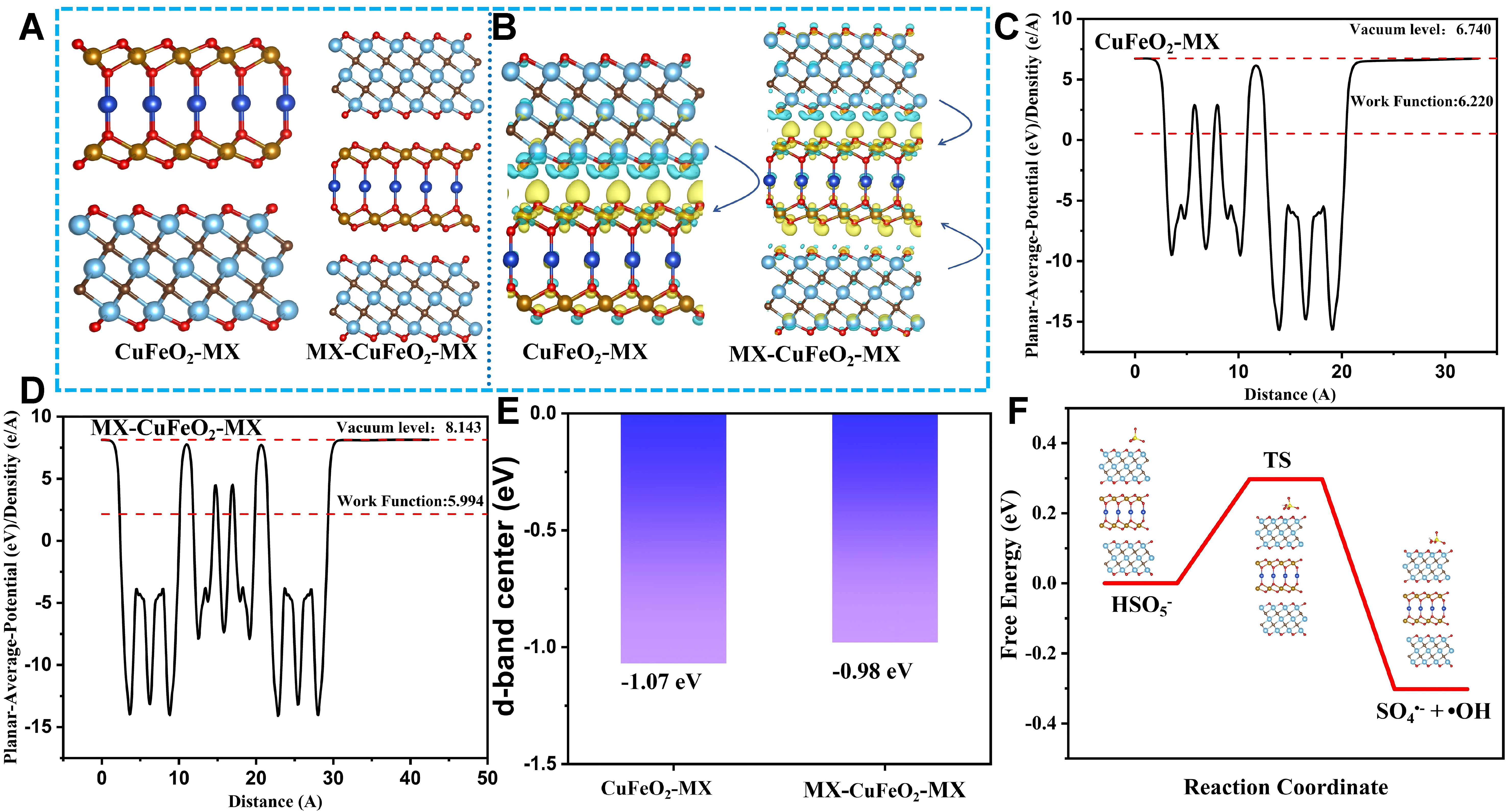
Figure 5. DFT calculation results illustrating the interfacial electronic structure regulation and PMS activation mechanism in the CuFeO2–MX composite system. (A) Optimized geometric structure models of the CuFeO2–MX and MX–CuFeO2–MX systems; (B) Differential charge density distributions of CuFeO2–MX and MX–CuFeO2–MX, where the yellow and blue regions represent electron accumulation and electron depletion, respectively; (C and D) Planar-averaged electrostatic potential distributions along the surface normal direction and the corresponding work functions of CuFeO2–MX and MX–CuFeO2–MX; (E) Total d-band center positions of the two systems calculated from the PDOS; (F) Reaction free-energy pathway of PMS activation on the MX–CuFeO2–MX interface. DFT: Density functional theory; PMS: peroxymonosulfate; CuFeO2–MX: CuFeO2–MXene; PDOS: projected density of states.
Differential charge density analysis revealed the electron transfer behavior at the CuFeO2–MX composite interface. In Figure 5B, the blue region represents electron depletion, and the yellow region represents electron accumulation. In the CuFeO2–MX system, noticeable electron depletion and the corresponding electron accumulation were observed on the MXene side and the CuFeO2 surface, respectively, indicating that electrons transferred from the MXene to CuFeO2, forming an internal electric field at the interface. In contrast, in the double-sided MX–CuFeO2–MX confinement structure, more pronounced electron redistribution occurred at both interfaces, suggesting that double-sided confinement effectively enhances the interface electron coupling.
To quantitatively verify the direction and strength of interfacial charge transfer, Bader charge analysis was performed [Supplementary Table 4]. In the CuFeO2–MX system, the net charge transfer at the single interface was 2.2156 e, confirming the migration of electrons from the MXene to CuFeO2. In the double-sided MX–CuFeO2–MX confinement structure, the net charge transfer across both interfaces summed to 4.0582 e, corresponding to an average of ~2.03 e per interface. This value should be interpreted as the additive effect of two interfaces, rather than enhanced charge transfer at each individual interface. This quantitative result is consistent with the differential charge density diagram of MXene electron depletion–CuFeO2 electron accumulation, further proving that the double-sided confinement structure enhances interfacial electron coupling and facilitates the electron transfer process required for PMS activation, providing the optimal electronic structure for the generation of active species such as h+ and •O2-.
To further explore the electronic transfer characteristics at the composite interface, the electrostatic potential distribution along the surface normal direction of CuFeO2–MX and MX–CuFeO2–MX was calculated, and the work function of each system was obtained [Figure 5C and D]. The work function of CuFeO2–MX was
The decrease in work function indicates that the surface electrons of the composite system are more likely to participate in the interfacial reaction, providing favorable conditions for the formation of a surface reduction environment. This, combined with the Fe2+/Fe3+ and Cu+/Cu2+ coexistence observed in the XPS analysis, suggests that the MXene introduction may regulate the electronic structure of the metal–oxygen bonds via interfacial electron transfer, thereby promoting the formation and stabilization of oxygen-related defects (vacancies) under the reaction conditions.
To quantitatively characterize the role of MXene confinement in regulating the electronic structure at the interface, the total and projected densities of states (PDOSs) of CuFeO2–MX and MX–CuFeO2–MX were calculated. As shown in Supplementary Figure 16, both systems show pronounced electron state distributions near the Fermi level, indicating robust electronic transmission in the composite system. Compared with CuFeO2–MX, MX–CuFeO2–MX exhibits a higher density of states near the Fermi level, due to the joint participation of transition metal d orbitals (such as Fe/Cu d states) and Ti-related states, suggesting that double-sided MXene confinement enhances the electronic state availability at the interface and promotes electron enrichment and migration in the interface region.
Furthermore, the total d-band center position of the system was calculated based on PDOS [Figure 5E]. When integrating over the whole energy range with the Fermi level set to zero, the total d-band center of CuFeO2–MX and MX–CuFeO2–MX was calculated to be -1.07 and -0.98 eV. The shift of the d-band center towards the Fermi level and the enhanced state density near the Fermi level indicate that the composite interface induces a reconstruction of reaction-related d states in energy distribution, promoting their participation in the interfacial electron transfer process. Therefore, the MXene introduction regulates the electronic state distribution via interface coupling and enhances the contribution of electronic states near the Fermi level, contributing to the subsequent electron injection and enhanced PMS activation.
To reveal the adsorption behavior of reactants at the composite interface, the adsorption configurations and energies of PMS and EE2 on different surfaces were calculated [Supplementary Figures 17 and 18]. The adsorption energy of PMS on the MXene surface was considerably higher than that on CuFeO2, with the flat adsorption configuration possessing an adsorption energy of -1.4771 eV, indicating that MXene serves as the primary adsorption and enrichment site for PMS. In the double-sided MX–CuFeO2–MX confinement structure, the adsorption energy of PMS was -1.2385 eV, representing moderately strong adsorption, which facilitates the enrichment of reactants while avoiding excessive adsorption that could inhibit subsequent electron transfer and activation processes.
EE2 also exhibited stronger adsorption on the MXene surface, with the adsorption energy -1.8460 eV for the flat configuration and -1.5957 eV for the MX–CuFeO2–MX structure, indicating that the composite interface can effectively enrich pollutants without limiting their further transformation. Owing to the combination of interface electronic structure regulation and enhanced electron transfer, MXene simultaneously serves as a reactant enrichment platform and an electron regulation carrier, thereby synergistically promoting PMS activation and rapid EE2 degradation.
Further calculations of the reaction free-energy pathway for peroxymonosulfate (HSO5-) activation at the composite interface [Figure 5F] showed that the PMS activation process in the MX–CuFeO2–MX system is thermodynamically favorable and may involve the formation of transient oxidative species such as SO4•- and •OH. This result indicates that the electronic structure regulation introduced by the double-sided MXene confinement effectively enhances electron transfer toward HSO5- and promotes O–O bond cleavage during PMS activation. Combined with the previously observed decreases in work function and the differential charge density and Bader charge analysis results, this result suggests that the enrichment of interface electrons and the thermodynamically and kinetically favorable interfacial electron transfer during PMS activation promote electron transfer and PMS activation.
In conclusion, the DFT calculations demonstrate that the double-sided MXene confinement structure regulates the electronic structure of CuFeO2 by lowering the work function, shifting the d-band center toward the Fermi level, and facilitating interfacial electron transfer during PMS activation. These theoretical results provide mechanistic insights into the enhanced interfacial electron-transfer process, which is consistent with the improved electrochemical properties and catalytic performance observed experimentally. Meanwhile, quenching experiments and EPR measurements identified h+ and •O2- as the dominant reactive species responsible for EE2 degradation, whereas SO4•- and •OH may serve as transient intermediates or minor contributors under the investigated conditions. Benefiting from the strengthened interfacial electron coupling and accelerated Cu/Fe redox cycling, the CuFeO2–MX electroactive membrane achieved nearly complete EE2 removal within 30 min at a flux of 45.83 L·m-2·h-1 and an applied voltage of 1.5 V. Collectively, these results reveal the intrinsic role of MXene interlayer confinement in regulating the electronic structure and promoting efficient PMS activation for rapid EE2 degradation.
CONCLUSIONS
An electroactive membrane based on MXene interlayer–confined CuFeO2 was constructed for efficient PMS activation and EE2 degradation under continuous-flow operations. Benefiting from the synergistic effects of MXene confinement and electroactive filtration, the system effectively suppressed CuFeO2 aggregation, enhanced interfacial electron transfer and improved convective mass transfer. Under optimal conditions (i.e., flux: 45.83 L·m-2·h-1; applied voltage: 1.5 V; and PMS concentration: 0.5 mM), approximately 100% EE2 removal was achieved within 30 min, with approximately 35% mineralization after 45 min, and the membrane maintained stable performance in real water matrices. Mechanistic investigations revealed that h+ and •O2- were the dominant reactive species. The DFT calculations demonstrate that the double-sided MXene confinement structure regulates the electronic structure of CuFeO2 by lowering the work function, shifting the d-band center toward the Fermi level, and facilitating interfacial electron transfer during PMS activation. This study provides a promising strategy for developing high-performance electroactive membrane systems for EDC removal in advanced water treatment.
DECLARATIONS
Acknowledgments
The authors extend their gratitude to Ms. Jinfang Yin from Scientific Compass (www.shiyanjia.com) for providing invaluable assistance with the XRD.
Authors’ contributions
Methodology, investigation, data curation, visualization, writing - original draft: He, C.; Li, M.
Formal analysis: Ran, X.
Writing - review and editing: Liu, Y.
Conceptualization, funding acquisition, supervision, project administration, Writing - review and editing: Jiang, F.
Availability of data and materials
All data that support the findings of this study are provided within the paper and its Supplementary Materials. The data that support the findings of this study are available from the corresponding author upon reasonable request.
AI and AI-assisted tools statement
During the preparation of this manuscript, the AI tool ChatGPT (OpenAI, version GPT-5.5-mini) was used solely for language editing. The tool did not influence the study design, data collection, analysis, interpretation, or the scientific content of the work. All authors take full responsibility for the accuracy, integrity, and final content of the manuscript.
Financial support and sponsorship
This work was funded by the Yunnan Provincial Science and Technology Project at Southwest United Graduate School (202402AO370002), Yunnan Revitalization Talents Support Plan (XDYC-CYCX-2022-0017), and Yunnan International Joint Laboratory of Emerging Pollutants Control (202503AP140002). The authors also thank the financial support from Yunnan Provincial Department of Science and Technology (202105AC160055).
Conflicts of interest
All authors declared that there are no conflicts of interest.
Ethical approval and consent to participate
Not applicable.
Consent for publication
Not applicable.
Copyright
© The Author(s) 2026.
Supplementary Materials
REFERENCES
1. Klaic, M.; Jirsa, F. 17α-Ethinylestradiol (EE2): concentrations in the environment and methods for wastewater treatment - an update. RSC. Adv. 2022, 12, 12794-805.
2. Al Sharabati, M.; Abokwiek, R.; Al-Othman, A.; et al. Biodegradable polymers and their nano-composites for the removal of endocrine-disrupting chemicals (EDCs) from wastewater: a review. Environ. Res. 2021, 202, 111694.
3. Budeli, P.; Ekwanzala, M. D.; Unuofin, J. O.; Momba, M. N. B. Endocrine disruptive estrogens in wastewater: revisiting bacterial degradation and zymoremediation. Environ. Technol. Innovation. 2021, 21, 101248.
4. Tian, K.; Gu, J.; Xie, L.; et al. Mechanism and application potential of short-chain dehydrogenase in Rhodococcus sp. for the efficient degradation of 17α-ethynylestradiol. J. Hazard. Mater. 2026, 505, 141509.
5. Morais, T.; Pereira, D.; Sequera, G.; et al. Silica-based porous adsorbents for efficient 17α-ethinylestradiol removal: role of organic functionalization and water matrices. ACS. Appl. Mater. Interfaces. 2026, 18, 9006-17.
6. Li, Q.; Pan, H.; Jia, Y.; et al. Dynamic adaptive responses, degradation pathway, and iron-mediated enhancement in 17β-estradiol biodegradation by cold-exposed Rhodococcus sp. RCBS9. J. Environ. Chem. Eng. 2026, 14, 122943.
7. Lima, D. L.; Schneider, R. J.; Esteves, V. I. Sorption behavior of EE2 on soils subjected to different long-term organic amendments. Sci. Total. Environ. 2012, 423, 120-4.
8. Kalló, I.; Kádár, A.; Göblyös, B.; et al. Metabolic consequences of perinatal bisphenol A and 17α-ethinylestradiol exposure manifest in circadian alterations of energy homeostasis in adult male mice. Front. Endocrinol. 2026, 16, 170690.
9. Slašťanová, S.; Ivánková, J.; Hanko, M.; Blaškovičová, J. Švorc, Ľ. A simple and cost-effective voltammetric method for the determination of the synthetic hormone 17α-ethinylestradiol in contraceptive pills using a bare glassy carbon electrode. Results. Chem. 2026, 20, 103051.
10. Aris, A. Z.; Shamsuddin, A. S.; Praveena, S. M. Occurrence of 17α-ethynylestradiol (EE2) in the environment and effect on exposed biota: a review. Environ. Int. 2014, 69, 104-19.
11. Latosińska, J.; Grdulska, A. A review of methods for the removal of endocrine-disrupting compounds with a focus on oestrogens and pharmaceuticals found in wastewater. Appl. Sci. 2025, 15, 6514.
12. Crini, G.; Lichtfouse, E. Advantages and disadvantages of techniques used for wastewater treatment. Environ. Chem. Lett. 2018, 17, 145-55.
13. da Mota Oliveira, J. L.; de Souza, T. C.; Gomes, L. C. A.; Saggioro, E. M. Removal of 17β-estradiol (E2) and 17α-ethynylestradiol (EE2) by a sequencing batch reactor following UV/H2O2 process. Int. J. Environ. Sci. Technol. 2024, 21, 7733-48.
14. Kyzas, G.; Kostoglou, M. Green adsorbents for wastewaters: a critical review. Materials 2014, 7, 333-64.
15. Miklos, D. B.; Remy, C.; Jekel, M.; Linden, K. G.; Drewes, J. E.; Hübner, U. Evaluation of advanced oxidation processes for water and wastewater treatment - a critical review. Water. Res. 2018, 139, 118-31.
16. Yang, Y.; Jiang, J.; Lu, X.; Ma, J.; Liu, Y. Production of sulfate radical and hydroxyl radical by reaction of ozone with peroxymonosulfate: a novel advanced oxidation process. Environ. Sci. Technol. 2015, 49, 7330-9.
17. Wu, S.; Zhao, Y.; Sun, R.; Sun, Z.; Yang, C.; Ma, J. Chemistry, generation and regulation of reactive species in persulfate-based advanced oxidation processes. Chem. Eng. J. 2025, 515, 163588.
18. da Silva, T. L.; Costa, C. S. D.; da Silva, M. G. C.; Vieira, M. G. A. Overview of non-steroidal anti-inflammatory drugs degradation by advanced oxidation processes. J. Clean. Prod. 2022, 346, 131226.
19. Li, J.; Li, Y.; Xiong, Z.; Yao, G.; Lai, B. The electrochemical advanced oxidation processes coupling of oxidants for organic pollutants degradation: a mini-review. Chin. Chem. Lett. 2019, 30, 2139-46.
20. Li, J.; Li, D.; Liu, C.; et al. A review of the flow-through electro-catalytic water treatment process. Sep. Purif. Technol. 2025, 365, 132545.
21. Ma, Q.; Gao, J.; Cheng, K.; et al. Electrooxidation of perfluorocarboxylic acids by an interfacially engineered magnéli phase titanium oxide (Ti4O7) electrode with MXene. ACS. EST. Eng. 2024, 4, 1102-12.
22. Xie, Q.; Ding, Z.; Cao, J.; et al. Degradation of organic pollutants by electrochemical activation of persulfate: the role of anode and cathode materials - a review. J. Environ. Chem. Eng. 2025, 13, 115006.
23. Dai, C.; Tian, X.; Nie, Y.; et al. Surface facet of CuFeO2 nanocatalyst: a key parameter for H2O2 activation in Fenton-like reaction and organic pollutant degradation. Environ. Sci. Technol. 2018, 52, 6518-25.
24. Karthikeyan, S.; Pachamuthu, M. P.; Isaacs, M. A.; Kumar, S.; Lee, A. F.; Sekaran, G. Cu and Fe oxides dispersed on SBA-15: a Fenton type bimetallic catalyst for N,N-diethyl-p-phenyl diamine degradation. Appl. Catal. B. Environ. 2016, 199, 323-30.
25. Xu, P.; Wang, P.; Li, X.; et al. Efficient peroxymonosulfate activation by CuO-Fe2O3/MXene composite for atrazine degradation: performance, coexisting matter influence and mechanism. Chem. Eng. J. 2022, 440, 135863.
26. Xing, Y.; Duan, J.; Wang, D.; et al. Optimizing photoelectrocatalytic efficiency: synergistic activation of peroxymonosulfate by CuFeO2/BiVO4 composites for antibiotic removal. Inorg. Chem. Commun. 2025, 171, 113571.
27. Xu, T.; He, G.; Zhao, Y.; et al. Benzenoid-like CuFeO2@reduced graphene oxide: facile synthesis and its excellent catalytic performance in selective oxidation. Appl. Surf. Sci. 2016, 389, 840-8.
28. Zhao, Y.; Sun, M.; Winter, L. R.; et al. Emerging challenges and opportunities for electrified membranes to enhance water treatment. Environ. Sci. Technol. 2022, 56, 3832-5.
29. Sun, Y.; Lu, J.; Li, S.; Dai, C.; Zou, D.; Jing, W. MXene-based membranes in water treatment: current status and future prospects. Sep. Purif. Technol. 2024, 331, 125640.
30. Gao, M.; Lu, X.; Li, W.; et al. High electron storage MXene-based adsorption membrane electrode for rapid remediation of uranium-containing wastewater. Chem. Eng. J. 2026, 534, 174488.
31. Xin, S.; Liu, G.; Ma, X.; et al. High efficiency heterogeneous Fenton-like catalyst biochar modified CuFeO2 for the degradation of tetracycline: economical synthesis, catalytic performance and mechanism. Appl. Catal. B. Environ. 2021, 280, 119386.
Cite This Article
 Open Access
How to Cite
Download Citation
Export Citation File:
Type of Import
Tips on Downloading Citation
Citation Manager File Format
Type of Import
Direct Import: When the Direct Import option is selected (the default state), a dialogue box will give you the option to Save or Open the downloaded citation data. Choosing Open will either launch your citation manager or give you a choice of applications with which to use the metadata. The Save option saves the file locally for later use.
Indirect Import: When the Indirect Import option is selected, the metadata is displayed and may be copied and pasted as needed.
About This Article
Copyright

Data & Comments
Data
0





Comments
Comments must be written in English. Spam, offensive content, impersonation, and private information will not be permitted. If any comment is reported and identified as inappropriate content by OAE staff, the comment will be removed without notice. If you have any queries or need any help, please contact us at [email protected].