

Randomized multicentre Phase 2 clinical trial of non-viral gene therapy for pancreatic cancer: clinical and molecular findings
 0
Graphical Abstract
Abstract
Aim: Pancreatic ductal adenocarcinoma (PDAC) has a dismal prognosis, and innovative therapies are needed. We developed a phase I pilot, non-viral gene therapy (CYL-02) encoding SST2 and DCK::UMK genes complexed with a polyethyleneimine non-viral vector to sensitize tumours to gemcitabine chemotherapy, which showed excellent feasibility and safety.
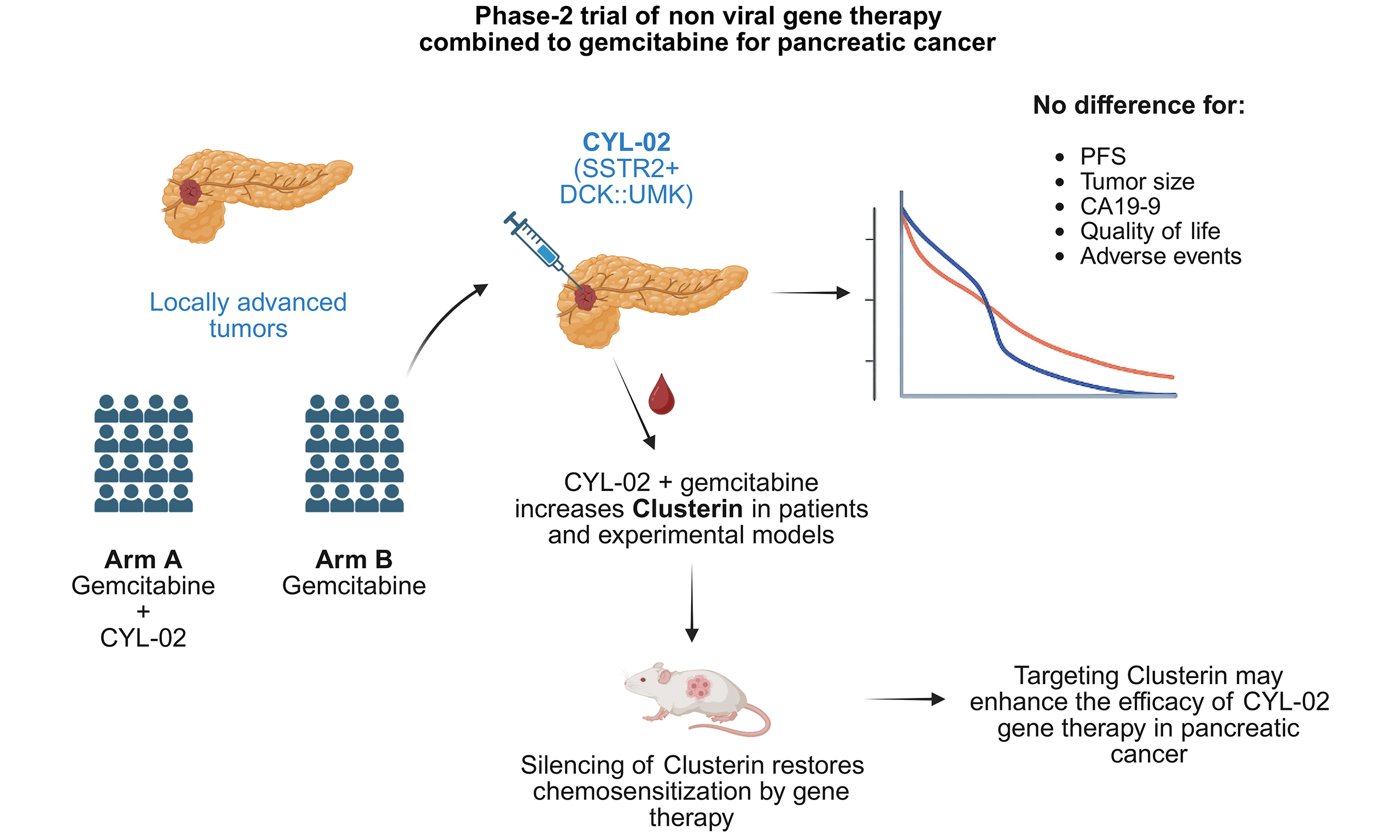
Methods: An open-label, multicentre, randomized Phase 2 trial (NCT02806687) compared CYL-02 [two intratumoral endoscopic ultrasound (EUS)-guided injections one month apart] + gemcitabine injected weekly vs. gemcitabine alone in 70 patients (n = 35 per arm) with locally advanced PDAC. The primary endpoint was progression-free survival (PFS). Secondary endpoints were overall survival (OS), tumour response, safety, and ancillary studies.
Results: PFS did not differ between arms. Unexpectedly, OS was worse in the gene therapy + chemotherapy arm. Exploratory analyses revealed no differences in clinical status, baseline characteristics, or the number of patients receiving second-line therapy, with the exception of a more frequent use of FOLFOX post-progression in the control arm, which could explain this difference. Proteomic profiling identified clusterin (CLU) as a candidate treatment-induced resistance factor in patients: CYL-02 + gemcitabine significantly increased circulating CLU levels, while gemcitabine alone did not. In vitro and in vivo models confirmed CLU induction by DCK combined with gemcitabine and demonstrated that CLU silencing restored chemosensitivity, reducing experimental tumour volume in mice.
Conclusion: CLU induction in patients receiving CYL-02 and gemcitabine may explain adaptive resistance and lack of efficacy of gene therapy. These results provide a rationale for combining CYL-02 and gemcitabine with CLU targeting to overcome resistance in pancreatic cancer.
Keywords


 Download PDF
REFERENCES
2. Rahib L, Smith BD, Aizenberg R, Rosenzweig AB, Fleshman JM, Matrisian LM. Projecting cancer incidence and deaths to 2030: the unexpected burden of thyroid, liver, and pancreas cancers in the United States. Cancer Res. 2014;74:2913-21.
3. Hosein AN, Dougan SK, Aguirre AJ, Maitra A. Translational advances in pancreatic ductal adenocarcinoma therapy. Nat Cancer. 2022;3:272-86.
4. O’Reilly EM, Wainberg ZA, Hendifar AE, et al.; RASolute 302 Trial Investigators. Daraxonrasib or chemotherapy in previously treated metastatic pancreatic cancer. N Engl J Med. 2026;395:325-37.
5. Burris HA 3rd, Moore MJ, Andersen J, et al. Improvements in survival and clinical benefit with gemcitabine as first-line therapy for patients with advanced pancreas cancer: a randomized trial. J Clin Oncol. 1997;15:2403-13.
6. Conroy T, Hammel P, Hebbar M, et al.; Canadian Cancer Trials Group and the Unicancer-GI–PRODIGE Group. FOLFIRINOX or gemcitabine as adjuvant therapy for pancreatic cancer. N Engl J Med. 2018;379:2395-406.
7. Von Hoff DD, Ervin T, Arena FP, et al. Increased survival in pancreatic cancer with nab-paclitaxel plus gemcitabine. N Engl J Med. 2013;369:1691-703.
8. Neoptolemos JP, Kleeff J, Michl P, Costello E, Greenhalf W, Palmer DH. Therapeutic developments in pancreatic cancer: current and future perspectives. Nat Rev Gastroenterol Hepatol. 2018;15:333-48.
9. Huang HC, Chen YJ, Lin MW, et al. Stroma-targeted gene delivery for efficient immunogene therapy against pancreatic cancer. Mol Ther. 2026;34:232-48.
10. Yi L, Wang T, Song B, et al. Virus-like nanoparticles deliver small interfering RNA to pancreatic cancer cells through filopodia-mediated internalization. ACS Nano. 2025;19:21614-28.
11. Ganesh S, Kim MJ, Lee J, et al. RNAi mediated silencing of STAT3/PD-L1 in tumor-associated immune cells induces robust anti-tumor effects in immunotherapy resistant tumors. Mol Ther. 2024;32:1895-916.
12. Chen Y, Chen X, Zhang Y, et al. Macrophage-specific in vivo RNA editing promotes phagocytosis and antitumor immunity in mice. Sci Transl Med. 2025;17:eadl5800.
13. Hahn A, Irenaeus S, Sandin LC, et al. Tumor microenvironment gene engineering with LOAd703 in patients with solid malignancies: LOKON002 Phase I/IIb clinical trial. Clin Cancer Res. 2026;32:3157-68.
14. Barbey O, Lulka H, Hanoun N, et al. Preclinical development of non-viral gene therapy for patients with advanced pancreatic cancer. Mol Ther Methods Clin Dev. 2023;29:162-72.
15. Carrere N, Vernejoul F, Souque A, et al. Characterization of the bystander effect of somatostatin receptor sst2 after in vivo gene transfer into human pancreatic cancer cells. Hum Gene Ther. 2005;16:1175-93.
16. Vernejoul F, Ghénassia L, Souque A, et al. Gene therapy based on gemcitabine chemosensitization suppresses pancreatic tumor growth. Mol Ther. 2006;14:758-67.
17. Saiki Y, Hirota S, Horii A. Attempts to remodel the pathways of gemcitabine metabolism: recent approaches to overcoming tumours with acquired chemoresistance. Cancer Drug Resist. 2020;3:819-31.
18. Buscail L, Bournet B, Vernejoul F, et al. First-in-man phase 1 clinical trial of gene therapy for advanced pancreatic cancer: safety, biodistribution, and preliminary clinical findings. Mol Ther. 2015;23:779-89.
19. Martín-García D, García-Aranda M, Redondo M. Therapeutic potential of clusterin inhibition in human cancer. Cells. 2024;13:665.
20. Dummer R, Eichmüller S, Gellrich S, et al. Phase II clinical trial of intratumoral application of TG1042 (adenovirus-interferon-gamma) in patients with advanced cutaneous T-cell lymphomas and multilesional cutaneous B-cell lymphomas. Mol Ther. 2010;18:1244-7.
21. Ye W, Liu R, Pan C, et al. Multicenter randomized phase 2 clinical trial of a recombinant human endostatin adenovirus in patients with advanced head and neck carcinoma. Mol Ther. 2014;22:1221-9.
22. Hecht JR, Farrell JJ, Senzer N, et al. EUS or percutaneously guided intratumoral TNFerade biologic with 5-fluorouracil and radiotherapy for first-line treatment of locally advanced pancreatic cancer: a phase I/II study. Gastrointest Endosc. 2012;75:332-8.
23. Hajda J, Leuchs B, Angelova AL, et al. Phase 2 trial of oncolytic H-1 parvovirus therapy shows safety and signs of immune system activation in patients with metastatic pancreatic ductal adenocarcinoma. Clin Cancer Res. 2021;27:5546-56.
24. Lee JC, Shin DW, Park H, et al. Tolerability and safety of EUS-injected adenovirus-mediated double-suicide gene therapy with chemotherapy in locally advanced pancreatic cancer: a phase 1 trial. Gastrointest Endosc. 2020;92:1044-52.e1.
25. Musher BL, Rowinsky EK, Smaglo BG, et al. LOAd703, an oncolytic virus-based immunostimulatory gene therapy, combined with chemotherapy for unresectable or metastatic pancreatic cancer (LOKON001): results from arm 1 of a non-randomised, single-centre, phase 1/2 study. Lancet Oncol. 2024;25:488-500.
26. Ducreux M, Desgrippes R, Rinaldi Y, et al. PRODIGE 29-UCGI 26 (NEOPAN): a phase III randomized trial comparing chemotherapy with FOLFIRINOX or gemcitabine in locally advanced pancreatic carcinoma. J Clin Oncol. 2025;43:2255-64.
27. Li Y, Wang X, Chen YH, Tan QQ, Liu XB, Tan C. Clusterin is upregulated by erastin, a ferroptosis inducer and exerts cytoprotective effects in pancreatic adenocarcinoma cells. Anticancer Drugs. 2024;35:227-36.
28. Amada K, Hijiya N, Ikarimoto S, et al. Involvement of clusterin expression in the refractory response of pancreatic cancer cells to a MEK inhibitor. Cancer Sci. 2023;114:2189-202.
29. Tang Y, Liu F, Zheng C, Sun S, Jiang Y. Knockdown of clusterin sensitizes pancreatic cancer cells to gemcitabine chemotherapy by ERK1/2 inactivation. J Exp Clin Cancer Res. 2012;31:73.
30. Kususda Y, Miyake H, Gleave ME, Fujisawa M. Editorial Expression of Concern: Clusterin inhibition using OGX-011 synergistically enhances antitumour activity of sorafenib in a human renal cell carcinoma model. Br J Cancer. 2025;132:138.
31. Shaashua L, Ben-Shmuel A, Pevsner-Fischer M, et al. BRCA mutational status shapes the stromal microenvironment of pancreatic cancer linking clusterin expression in cancer associated fibroblasts with HSF1 signaling. Nat Commun. 2022;13:6513.
Cite This Article
 Open Access
How to Cite
Buscail L, Lebrin M, Hanoun N, Gourgou S, Dorat N, Vernejoul F, Cambois G, Gross F, Guimbaud R, Bournet B, Mitry E, Artru P, Ouvrier D, Flori N, Thuillier F, Barthet M, Tiraby M, Cordelier P; the Thergap-2 Investigator Group. Randomized multicentre Phase 2 clinical trial of non-viral gene therapy for pancreatic cancer: clinical and molecular findings. Cancer Drug Resist. 2026;9:35. https://dx.doi.org/10.20517/cdr.2026.68
Download Citation
If you have the appropriate software installed, you can download article citation data to the citation manager of your choice. Simply select your manager software from the list below and click on download.
Export Citation File
Type of Import
Tips on Downloading Citation
Citation Manager File Format
Type of Import
Direct Import: When the Direct Import option is selected (the default state), a dialogue box will give you the option to Save or Open the downloaded citation data. Choosing Open will either launch your citation manager or give you a choice of applications with which to use the metadata. The Save option saves the file locally for later use.
Indirect Import: When the Indirect Import option is selected, the metadata is displayed and may be copied and pasted as needed.
About This Article
Special Topic
Copyright

Data & Comments
Data
0












Comments
Comments must be written in English. Spam, offensive content, impersonation, and private information will not be permitted. If any comment is reported and identified as inappropriate content by OAE staff, the comment will be removed without notice. If you have any queries or need any help, please contact us at [email protected].