

Extracellular vesicles as integrative hubs of drug resistance in bladder cancer
 0

Graphical Abstract
Abstract
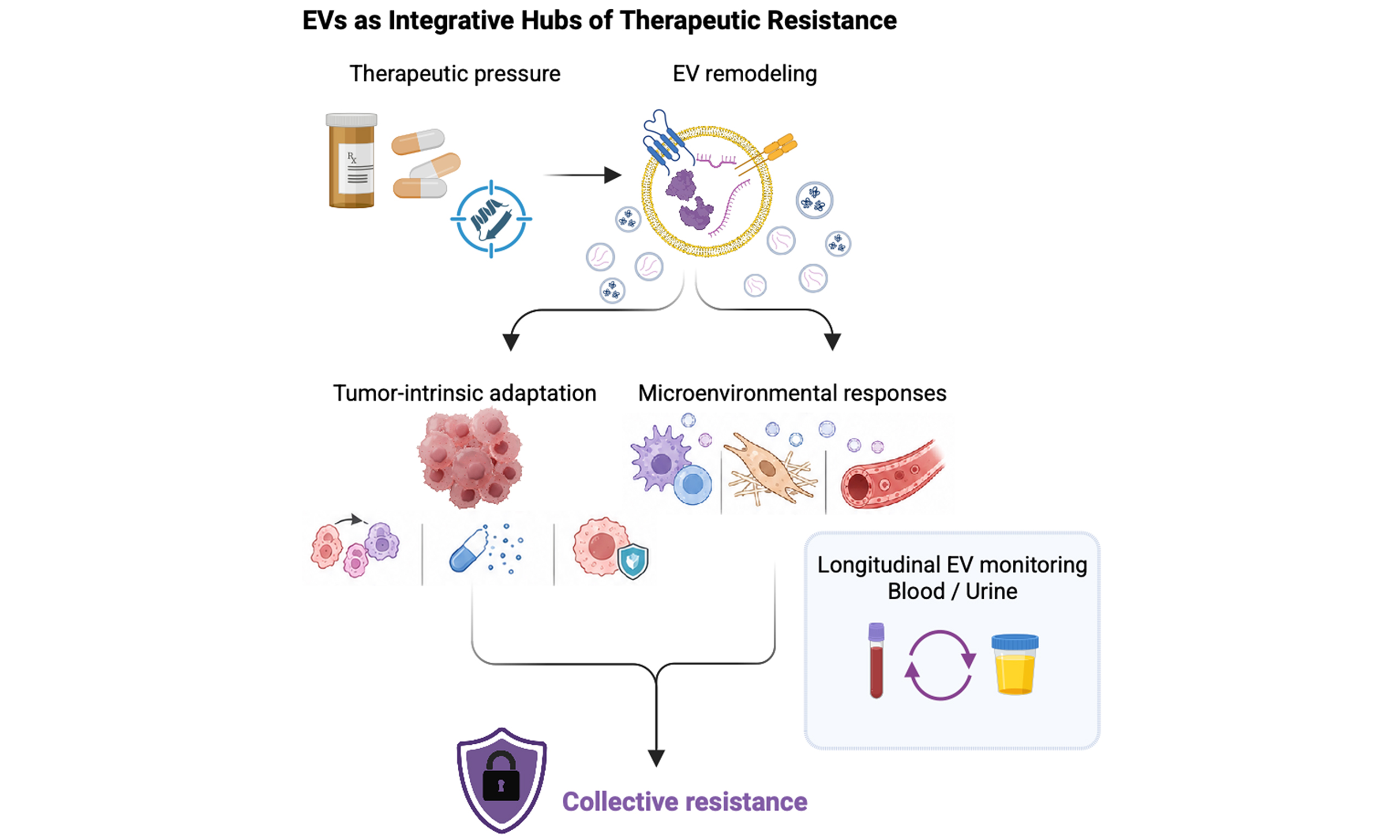
Therapeutic resistance remains a major challenge in bladder cancer, encompassing resistance to intravesical Bacillus Calmette–Guérin (BCG) therapy, platinum- and gemcitabine-based chemotherapy and immune-checkpoint blockade. Although extracellular vesicles (EVs) have been implicated in cancer drug resistance, their roles in bladder cancer are often discussed within the broader context of EV biology, making it difficult to distinguish direct mechanisms of treatment resistance from treatment-associated remodelling or biomarker associations. In this review, we refocus EV-mediated therapeutic resistance in bladder cancer and propose an evidence-stratified framework, distinguishing EVs as causal mediators, permissive amplifiers or biomarkers of drug adaptation. Studies have provided substantial mechanistic evidence from chemotherapy-associated models, including EV-mediated regulation of gemcitabine resistance through H3C14-associated EV remodelling and chemotherapy-exposed bladder cancer EVs that support stem-like, treatment-tolerant tumour states. Evidence supporting EV involvement in platinum resistance, BCG failure and immunotherapy resistance remains biologically plausible but less directly established. Therefore, clearer drug-specific models, improved EV-subtype resolution, cargo perturbation and functional rescue experiments are needed. We also discuss urinary EVs for longitudinal monitoring of treatment response and emerging resistance in bladder cancer. By integrating drug-specific therapeutic contexts with EV-specific causality criteria, this review provides a focused framework for evaluating when EVs mediate bladder cancer drug resistance, amplify adaptive tumour–microenvironment states or primarily serve as biomarkers for therapeutic monitoring.
Keywords


 Download PDF
REFERENCES
1. Jian N, Yu L, Ma L, Zheng B, Huang W. BCG therapy in bladder cancer and its tumor microenvironment interactions. Clin Microbiol Rev. 2025;38:e0021224.
2. Huang X, Wang X, He Z, et al. Mechanisms, clinical trials, and new treatments for BCG-unresponsive in nonmuscle invasive bladder cancer. Cancer Med. 2025;14:e71243.
3. Abou Chakra M, Duquesne I, O’Donnell MA. Decoding immune mechanisms in BCG-unresponsive non-muscle invasive bladder cancer. Front Biosci. 2026;31:47606.
4. Holzbeierlein J, Bixler BR, Buckley DI, et al. Treatment of non-metastatic muscle-invasive bladder cancer: AUA/ASCO/SUO Guideline (2017; Amended 2020, 2024). J Urol. 2024;212:3-10.
5. Powles T, Bellmunt J, Comperat E, et al.; ESMO Guidelines Committee. ESMO Clinical Practice Guideline interim update on first-line therapy in advanced urothelial carcinoma. Ann Oncol. 2024;35:485-90.
6. Holzbeierlein JM, Bixler BR, Buckley DI, et al. Diagnosis and treatment of non-muscle invasive bladder cancer: AUA/SUO Guideline: 2024 Amendment. J Urol. 2024;211:533-8.
7. Kates M, Matoso A, Choi W, et al. Adaptive immune resistance to intravesical BCG in non-muscle invasive bladder cancer: implications for prospective BCG-unresponsive trials. Clin Cancer Res. 2020;26:882-91.
8. Pan W, Miao Q, Yin W, et al. The role and clinical applications of exosomes in cancer drug resistance. Cancer Drug Resist. 2024;7:43.
9. Archer M, Lin KM, Kolanukuduru KP, et al. Impact of cell plasticity on prostate tumor heterogeneity and therapeutic response. Am J Clin Exp Urol. 2024;12:331-51.
10. Bhattacharya S, Mohanty A, Achuthan S, et al. Group behavior and emergence of cancer drug resistance. Trends Cancer. 2021;7:323-34.
11. Brena D, Huang MB, Bond V. Extracellular vesicle-mediated transport: reprogramming a tumor microenvironment conducive with breast cancer progression and metastasis. Transl Oncol. 2022;15:101286.
12. Wang J, Zeng H, Zhang H, Han Y. The role of exosomal PD-L1 in tumor immunotherapy. Transl Oncol. 2021;14:101047.
13. Sun DS, Chang HH. Extracellular vesicles: function, resilience, biomarker, bioengineering, and clinical implications. Tzu Chi Med J. 2024;36:251-9.
14. Hu T, Shi R, Gu Y, et al. Cancer-derived non-coding RNAs endow tumor microenvironment with immunosuppressive properties. Wiley Interdiscip Rev RNA. 2023;15:e1822.
15. Sultana F, Ghosh A. Exosome: the hidden messengers in cancer detection and immunotherapy. Urol Oncol. 2025;43:609-27.
16. Dou X, Feng C, Li J, Jiang E, Shang Z. Extracellular vesicle-mediated crosstalk in tumor microenvironment dominates tumor fate. Trends Cell Biol. 2025;35:230-47.
17. Hu S, Hu Y, Yan W. Extracellular vesicle-mediated interorgan communication in metabolic diseases. Trends Endocrinol Metab. 2023;34:571-82.
18. Huang CS, Yu DS, Jiang SS, Wu YS, Ho JY, Yu CP. Extracellular vesicle-mediated regulation of H3C14 contributes to gemcitabine resistance in bladder cancer. J Extracell Vesicles. 2025;14:e70179.
19. Chung WM, Molony RD, Lee YF. Non-stem bladder cancer cell-derived extracellular vesicles promote cancer stem cell survival in response to chemotherapy. Stem Cell Res Ther. 2021;12:533.
20. Huang CS, Ho JY, Chiang JH, Yu CP, Yu DS. Exosome-derived LINC00960 and LINC02470 promote the epithelial-mesenchymal transition and aggressiveness of bladder cancer cells. Cells. 2020;9:1419.
21. Wu ATH, Srivastava P, Yadav VK, et al. Ovatodiolide, isolated from Anisomeles indica, suppresses bladder carcinogenesis through suppression of mTOR/β-catenin/CDK6 and exosomal miR-21 derived from M2 tumor-associated macrophages. Toxicol Appl Pharmacol. 2020;401:115109.
22. Ortiz-Bonilla CJ, Molony RD, Miyamoto H, Messing E, Lee YF. Bacillus Calmette-Guérin immunotherapy-induced extracellular vesicles promote antitumor immunity in bladder cancer. Front Immunol. 2026;17:1707754.
23. Tomiyama E, Fujita K, Hashimoto M, Uemura H, Nonomura N. Urinary markers for bladder cancer diagnosis: a review of current status and future challenges. Int J Urol. 2024;31:208-19.
24. Urabe F, Kimura T, Ito K, et al. Urinary extracellular vesicles: a rising star in bladder cancer management. Transl Androl Urol. 2021;10:1878-89.
25. Droste M, Puhka M, van Royen ME, et al. Roadblocks of urinary EV biomarkers: moving toward the clinic. J Extracell Vesicles. 2025;14:e70120.
26. Sun N, Zhang Z, Yang X, et al. Unveiling urinary extracellular vesicle mRNA signature for early diagnosis and prognosis of bladder cancer. Theranostics. 2025;15:1272-84.
27. Kasiński D, Szeliski K, Drewa T, Pokrywczyńska M. Extracellular vesicles-a new player in the development of urinary bladder cancer. Ther Adv Med Oncol. 2025;17:17588359241297529.
28. Ng K, Stenzl A, Sharma A, Vasdev N. Urinary biomarkers in bladder cancer: a review of the current landscape and future directions. Urol Oncol. 2021;39:41-51.
29. Welsh JA, Goberdhan DCI, O’Driscoll L, et al.; MISEV Consortium. Minimal information for studies of extracellular vesicles (MISEV2023): from basic to advanced approaches. J Extracell Vesicles. 2024;13:e12404.
30. EV-TRACK Consortium; Van Deun J, Mestdagh P, Agostinis P, et al.. EV-TRACK: transparent reporting and centralizing knowledge in extracellular vesicle research. Nat Methods. 2017;14:228-32.
31. Jeppesen DK, Fenix AM, Franklin JL, et al. Reassessment of exosome composition. Cell. 2019;177:428-45.e18.
32. de Jong OG, Murphy DE, Mäger I, et al. A CRISPR-Cas9-based reporter system for single-cell detection of extracellular vesicle-mediated functional transfer of RNA. Nat Commun. 2020;11:1113.
33. Mateescu B, Kowal EJ, van Balkom BW, et al. Obstacles and opportunities in the functional analysis of extracellular vesicle RNA - an ISEV position paper. J Extracell Vesicles. 2017;6:1286095.
34. Gupta D, Zickler AM, El Andaloussi S. Dosing extracellular vesicles. Adv Drug Deliv Rev. 2021;178:113961.
35. Vago R, Radano G, Zocco D, Zarovni N. Urine stabilization and normalization strategies favor unbiased analysis of urinary EV content. Sci Rep. 2022;12:17663.
36. Qu L, Ding J, Chen C, et al. Exosome-transmitted lncARSR promotes sunitinib resistance in renal cancer by acting as a competing endogenous RNA. Cancer Cell. 2016;29:653-68.
37. Pan Y, Lu X, Shu G, et al. Extracellular vesicle-mediated transfer of lncRNA IGFL2-AS1 confers sunitinib resistance in renal cell carcinoma. Cancer Res. 2023;83:103-16.
38. He J, He J, Min L, et al. Extracellular vesicles transmitted miR-31-5p promotes sorafenib resistance by targeting MLH1 in renal cell carcinoma. Int J Cancer. 2020;146:1052-63.
39. Del Re M, Conteduca V, Crucitta S, et al. Androgen receptor gain in circulating free DNA and splicing variant 7 in exosomes predict clinical outcome in CRPC patients treated with abiraterone and enzalutamide. Prostate Cancer Prostatic Dis. 2021;24:524-31.
40. Peak TC, Panigrahi GK, Praharaj PP, et al. Syntaxin 6-mediated exosome secretion regulates enzalutamide resistance in prostate cancer. Mol Carcinog. 2020;59:62-72.
41. Shan G, Gu J, Zhou D, et al. Cancer-associated fibroblast-secreted exosomal miR-423-5p promotes chemotherapy resistance in prostate cancer by targeting GREM2 through the TGF-β signaling pathway. Exp Mol Med. 2020;52:1809-22.
42. Hirpara J, Thuya WL, Cheow SH, et al. Tumor-derived extracellular vesicles convey solute transporters to induce bioenergetic dependence shift contributing to treatment resistance. Theranostics. 2024;14:6350-69.
43. Han J, Xu K, Xu T, Song Q, Duan T, Yang J. The functional regulation between extracellular vesicles and the DNA damage responses. Mutat Res Rev Mutat Res. 2025;795:108532.
44. Hu X, He C, Zhang L, et al. Mesenchymal stem cell-derived exosomes attenuate DNA damage response induced by cisplatin and bleomycin. Mutat Res Genet Toxicol Environ Mutagen. 2023;889:503651.
45. Sun H, Zhu R, Guo X, et al. Exosome miR-101-3p derived from bone marrow mesenchymal stem cells promotes radiotherapy sensitivity in non-small cell lung cancer by regulating DNA damage repair and autophagy levels through EZH2. Pathol Res Pract. 2024;256:155271.
46. Tsujino T, Sugito N, Taniguchi K, et al. MicroRNA-143/Musashi-2/KRAS cascade contributes positively to carcinogenesis in human bladder cancer. Cancer Sci. 2019;110:2189-99.
47. Gellings P, Galeas-Pena M, Morici LA. Mycobacterium bovis bacille Calmette-Guerin-derived extracellular vesicles as an alternative to live BCG immunotherapy. Clin Exp Med. 2023;23:519-27.
48. Ranti D, Yu H, Salomé B, et al. HLA-E and NKG2A mediate resistance to BCG immunotherapy in non-muscle-invasive bladder cancer. bioRxiv. 2025.
49. Feng R, Li Z, Ge G, Wang C, Jia Y, Ouyang J. Cancer-associated fibroblast-derived extracellular vesicles mediate immune escape of bladder cancer via PD-L1/PD-1 expression. Endocr Metab Immune Disord Drug Targets. 2023;23:1410-20.
50. Gorgulho J, Loosen SH, Masood R, et al. Soluble and EV-bound CD27 act as antagonistic biomarkers in patients with solid tumors undergoing immunotherapy. J Exp Clin Cancer Res. 2024;43:298.
51. Tosev G, Wahafu W, Reimold P, et al. Detection of PD-L1 in the urine of patients with urothelial carcinoma of the bladder. Sci Rep. 2021;11:14244.
52. Liao C, Hu L, Zhang Q. Von Hippel-Lindau protein signalling in clear cell renal cell carcinoma. Nat Rev Urol. 2024;21:662-75.
53. Ahmad F, Cherukuri MK, Choyke PL. Metabolic reprogramming in prostate cancer. Br J Cancer. 2021;125:1185-96.
54. Zhang X, Zhang X, Deng X, et al. Prostate cancer stem cell dynamics in the evolution of drug resistance. Int J Surg. 2025;111:5403-19.
55. Zhou M, Wang L, Yu B, et al. How advanced are extracellular vesicles in renal cell carcinoma? For diagnostic and therapeutic frontiers. Int J Nanomedicine. 2025;20:10963-76.
56. Hatano K, Fujita K. Extracellular vesicles in prostate cancer: a narrative review. Transl Androl Urol. 2021;10:1890-907.
57. Soekmadji C, Riches JD, Russell PJ, et al.; Australian Prostate Cancer Collaboration BioResource. Modulation of paracrine signaling by CD9 positive small extracellular vesicles mediates cellular growth of androgen deprived prostate cancer. Oncotarget. 2017;8:52237-55.
58. Murakami T, Minami K, Harabayashi T, et al. Cross-sectional and longitudinal analyses of urinary extracellular vesicle mRNA markers in urothelial bladder cancer patients. Sci Rep. 2024;14:6801.
59. Tomiyama E, Fujita K, Matsuzaki K, et al. EphA2 on urinary extracellular vesicles as a novel biomarker for bladder cancer diagnosis and its effect on the invasiveness of bladder cancer. Br J Cancer. 2022;127:1312-23.
60. Ertl I, Shariat SF, Berger W, Englinger B. Preclinical models for bladder cancer therapy research. Curr Opin Urol. 2024;34:244-50.
Cite This Article
 Open Access
How to Cite
Huang CS, Yu CP, Yu DS, Wu YS, Jiang SS, Zhao R, Lee DF, Ho JY. Extracellular vesicles as integrative hubs of drug resistance in bladder cancer. Cancer Drug Resist. 2026;9:37. https://dx.doi.org/10.20517/cdr.2026.118
Download Citation
If you have the appropriate software installed, you can download article citation data to the citation manager of your choice. Simply select your manager software from the list below and click on download.
Export Citation File
Type of Import
Tips on Downloading Citation
Citation Manager File Format
Type of Import
Direct Import: When the Direct Import option is selected (the default state), a dialogue box will give you the option to Save or Open the downloaded citation data. Choosing Open will either launch your citation manager or give you a choice of applications with which to use the metadata. The Save option saves the file locally for later use.
Indirect Import: When the Indirect Import option is selected, the metadata is displayed and may be copied and pasted as needed.
About This Article
Copyright

Data & Comments
Data
0











Comments
Comments must be written in English. Spam, offensive content, impersonation, and private information will not be permitted. If any comment is reported and identified as inappropriate content by OAE staff, the comment will be removed without notice. If you have any queries or need any help, please contact us at [email protected].