

fig2
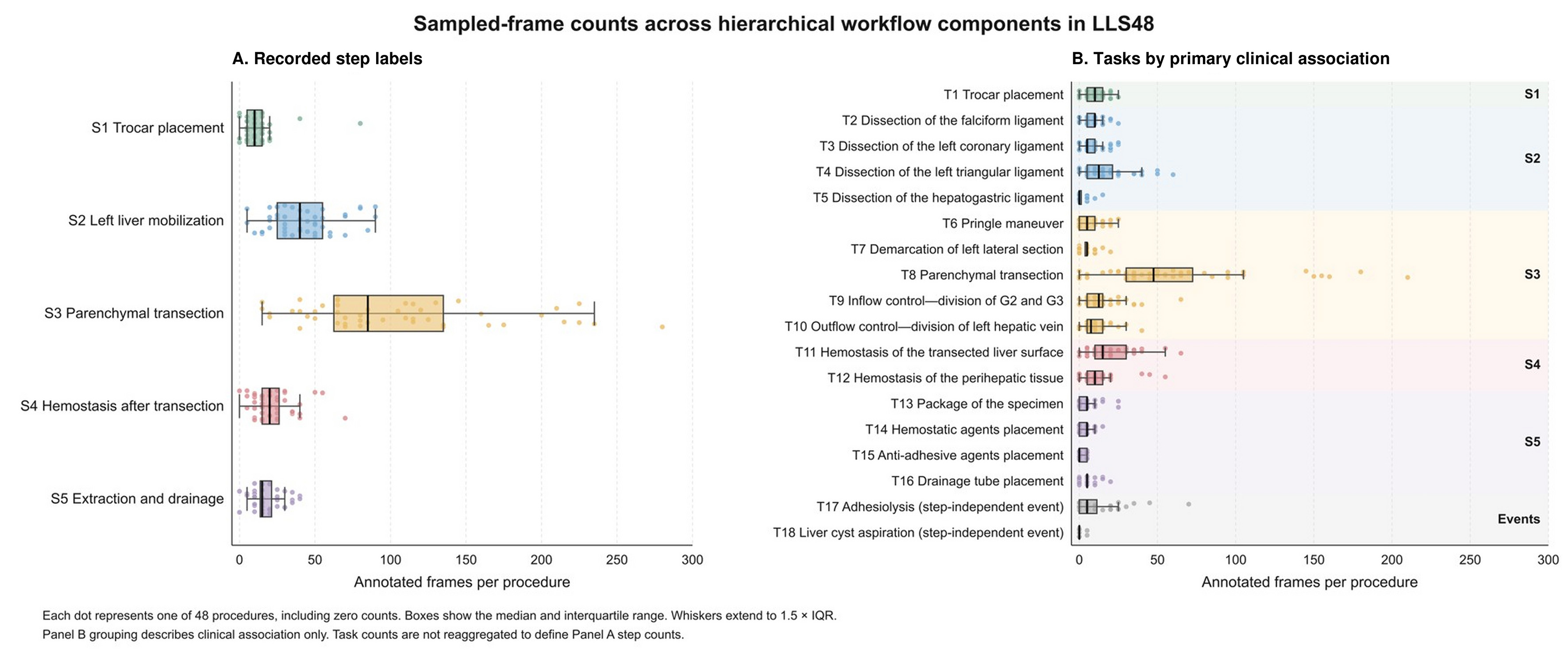
Figure 2. Hierarchical distribution of workflow components in LLS. (A) Distribution of sampled-frame counts calculated directly from the recorded step labels for all 48 laparoscopic LLS procedures. Each frame contributes to exactly one of the five steps, including frames annotated with step-independent tasks. Parenchymal transection (S3) is the dominant step, followed by left liver mobilization (S2) and hemostasis after transection (S4); (B) Distribution of sampled-frame counts for the 18 tasks, arranged by their primary clinical association. This arrangement is descriptive only. Tasks can occur in different procedural contexts, and their grouped counts are not used to calculate the step counts in panel A. Adhesiolysis and liver cyst aspiration are displayed as step-independent events. Each dot represents one procedure, with all 48 procedures included for each step or task, including zero counts. Boxes show the median and IQR, and whiskers reach the most extreme observations within 1.5 times the IQR. Frames were sampled at 1-s intervals within 5-s clips extracted every 90 s. Counts describe sampled annotations, not operative durations or proportions of operative time. LLS: Laparoscopic left lateral sectionectomy; IQR: interquartile range.