
fig1
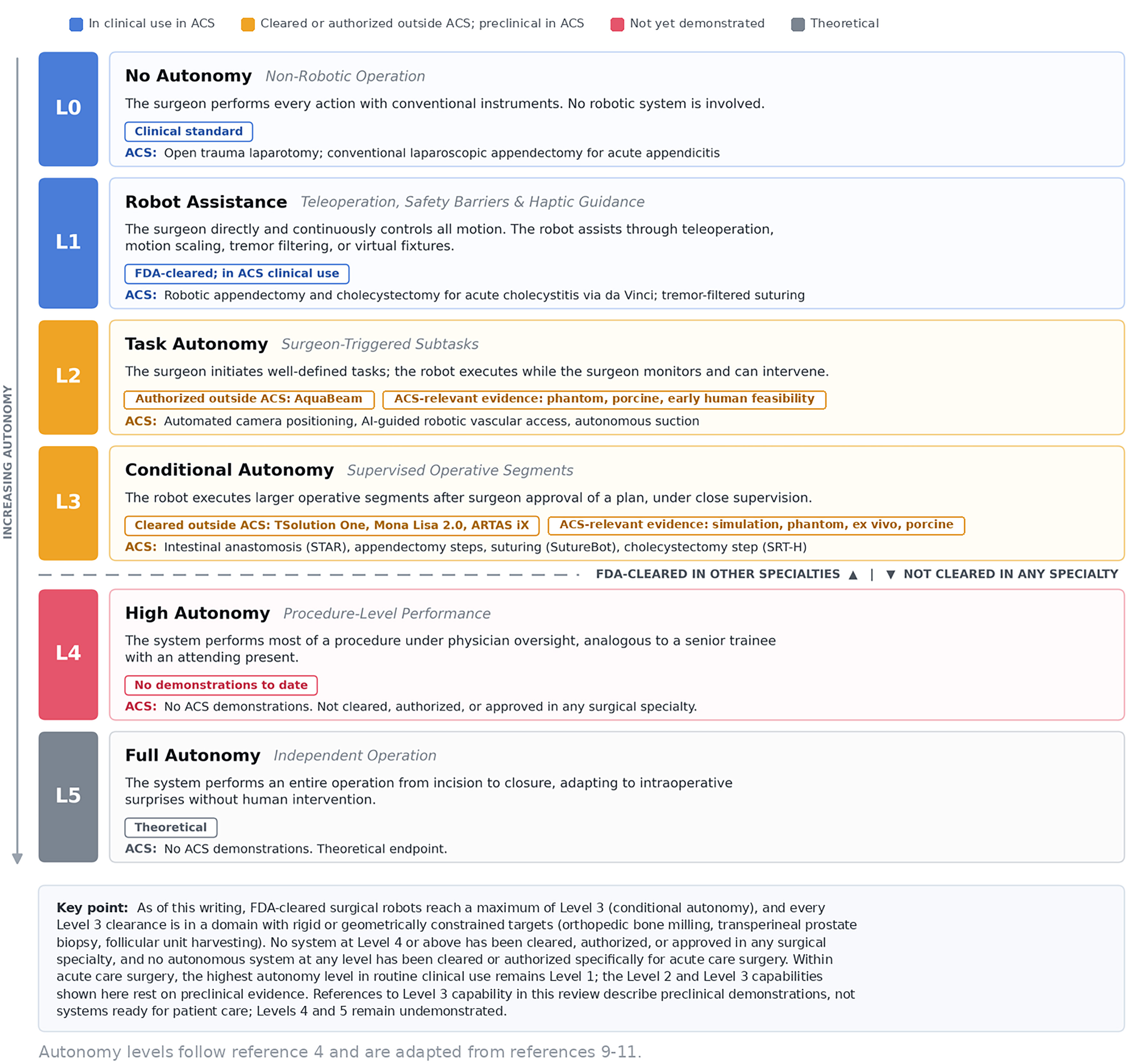
Figure 1. Levels of autonomy in surgical robotics, from Level 0 (no autonomy; equivalent to non-robotic, manual surgery) through Level 5 (full autonomy). Teleoperated robotic surgery, in which the surgeon continuously controls all motion and the system provides passive support such as motion scaling or tremor filtration, is classified as Level 1 (robot assistance). At each ascending level, the system assumes greater responsibility for perception, planning, and action while human control correspondingly decreases. Levels follow the LASR scale of Lee et al.[4] and are adapted from the surgical-autonomy frameworks of Haidegger, Yang et al., and Opfermann et al.[9-11] Published frameworks differ on where teleoperation is classified: some, such as that of Yang et al.[10], place teleoperated robots at Level 0, whereas the LASR scale reserves Level 0 for non-robotic surgery and assigns teleoperation to Level 1. FDA device classifications shown in the figure, including the Level 3 systems TSolution One, iSR’obot Mona Lisa 2.0, and ARTAS iX, are those reported by Lee et al.[4] Evidence labeled ACS-relevant was obtained in preclinical models or in patients outside the acute care setting, not in acute care patients. No system above Level 3 has been cleared or authorized for clinical use in any surgical specialty. ACS: Acute care surgery; FDA: Food and Drug Administration; LASR: Levels of Autonomy in Surgical Robotics.