

Building responsible surgical artificial intelligence: the AiCCESS Consortium and the next phase of translational innovation
 0
0 


 Download PDF
Artificial intelligence (AI) is rapidly permeating surgical care. Predictive analytics, computer vision, workflow optimization, large language models, and multimodal systems are now positioned to influence nearly every phase of surgical care - from diagnosis and perioperative planning, to prediction of surgical site infection (SSI) and other complications, intraoperative decision support, technical performance assessment, postoperative surveillance, and surgical education[1,2]. Yet an important question remains insufficiently addressed: What kind of surgical AI ecosystem is actually being built?
The history of surgical innovation teaches that technical capability alone is never sufficient. Innovations that endure are those that become integrated into the realities of patient care, clinical judgment, systems infrastructure, education, implementation, and public trust. AI is unlikely to prove different. The future of AI in surgery will depend not only on algorithmic performance, but also on whether the field can develop frameworks that are rigorous scientifically, grounded in biology, educationally responsible[3-5], relevant globally[6], reproducible, and accountable to the patients and communities it serves[7].
It is within this context that the AiCCESS Consortium - Artificial Intelligence for Comprehensive Care, Education, and Sustainability in Surgery - was established at Rutgers Robert Wood Johnson Medical School. The consortium was created around a simple but demanding premise: Surgical AI should improve outcomes not merely within highly resourced systems, but across the broad spectrum of surgical care delivery and education, including in environments constrained by workforce limitations, infrastructure variability, geography, or access[6,8].
Acute Care Surgery (ACS) evolved from the convergence of trauma surgery, surgical critical care, and emergency general surgery into a discipline organized around the continuous care of patients with time- and context-sensitive surgical disease. Its development reflected recognition that these patients often traverse traditional boundaries of diagnosis, resuscitation, operative intervention, intensive care, and rescue, requiring coordinated expertise across the entire episode of acute illness. ACS therefore represents more than the aggregation of several surgical practices; it is an integrated model of care designed to respond to physiologic instability, incomplete information, and rapidly changing clinical priorities[9-11].
The AiCCESS Consortium emerged within this environment, accustomed to managing complex adaptive systems under conditions of physiologic instability, incomplete information, time pressure, and resource variability. ACS workflows require continuous integration of heterogeneous clinical signals across multidisciplinary teams and evolving operational environments. These characteristics make ACS not merely a setting for AI deployment, but an important translational laboratory for understanding how intelligent systems integrate into high-risk clinical ecosystems[12,13].
The consortium likewise emerged from the intersection of two historically distinct domains: global surgery and AI in surgery. Traditionally, these fields have evolved along different trajectories. Global surgery has focused on access, workforce shortages, trauma infrastructure, systems development, and disparities in outcomes. AI in surgery, by contrast, has evolved so far in technologically advanced centers emphasizing robotics, computational sophistication, and predictive analytics. Increasingly, these domains are converging, although development, validation, and clinical deployment remain markedly uneven[14].
The extant evidence base illustrates the uneven development and translation of surgical AI. A 2026 scoping review of 475 studies of AI in surgical care in low- and middle-income countries found that 79% originated in upper-middle-income countries, with China alone accounting for 64% of all studies, whereas only 1% originated in low-income countries. Moreover, 68% of studies were retrospective, only 30% included external validation, and just 3% reported clinical deployment[14].
AI possesses the potential to narrow longstanding disparities in surgical care through scalable decision support, workflow augmentation, predictive systems, remote education, and intelligent triage. At the same time, poorly designed AI systems risk amplifying precisely the inequities they seek to solve. Algorithms trained exclusively in high-resource environments may fail when deployed elsewhere[14]. Black-box systems that cannot be interrogated clinically may undermine trust. Models optimized for statistical performance but disconnected from biological plausibility, workflow integration, or implementation realities may produce elegant publications without meaningful clinical impact[7].
These tensions have shaped the intellectual foundation of the AiCCESS Consortium from its inception. Several recurring risks accompany surgical AI deployment and inform the consortium’s organizational philosophy[15] [Table 1]. The consortium’s design philosophy emphasizes biologic grounding over purely black-box inference, patient-centered outcomes over technical novelty alone, and implementation-aware deployment rather than algorithmic performance in isolation [Figure 1]. These principles inform project selection, mentorship structure, data governance, methodological standards, collaborative partnerships, and publication practices.
Major risks and challenges in surgical AI
| Domain | Risk | Potential consequence | Mitigation strategy |
| Data Bias | Non-representative training datasets | Reduced performance in underrepresented populations or resource-limited settings[14] | Diverse datasets; external validation; equity-focused evaluation |
| Black-Box Inference | Limited explainability of model outputs | Loss of clinician trust; unsafe recommendations[7] | Biological grounding; interpretable models; clinician oversight |
| Automation Bias | Overreliance on AI recommendations | Erosion of independent clinical judgment[15] | Human-in-the-loop systems; education in AI literacy |
| Reproducibility | Nontransparent methods or inaccessible code | Irreproducible findings; diminished scientific credibility | Open science standards; version-controlled code; reporting guidelines |
| Implementation Failure | Poor workflow integration | Low adoption despite strong technical performance[14] | Human factors engineering; implementation science |
| Privacy and Security | Use of sensitive clinical data | Confidentiality breaches; regulatory exposure | Robust governance; de-identification; secure infrastructure |
| Commercialization Pressures | Premature deployment or performance inflation | Patient harm; erosion of public trust | Independent validation; transparent conflict disclosure |
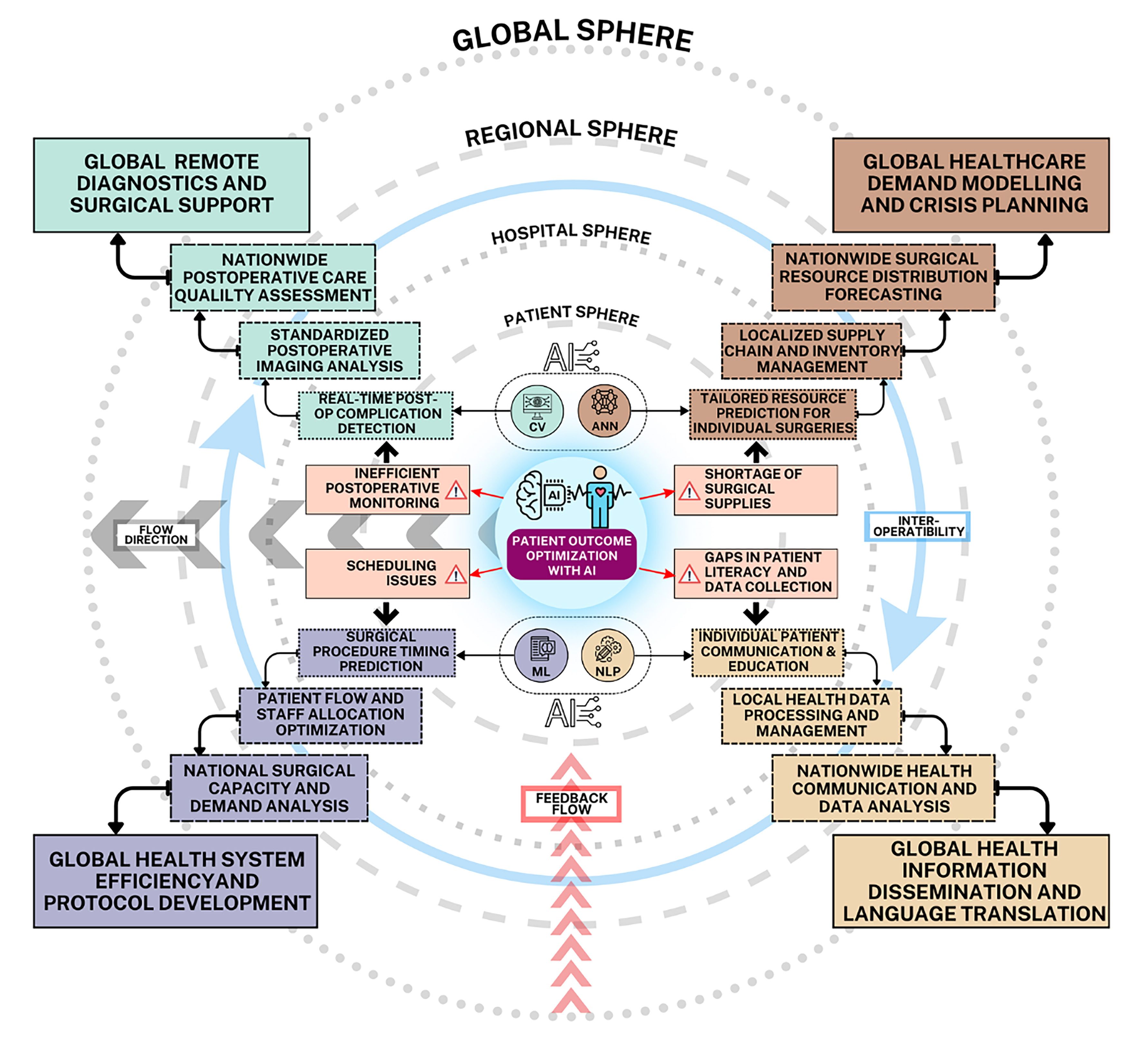
Figure 1. PCASE model. The PCASE model provides a multilevel framework for the expansion of AI across surgical care, illustrating how patient-centered applications can scale from the patient sphere to the hospital, regional, and global spheres. Beginning with individual patient needs and outcomes, AI modalities - including CV, ANN, ML, and NLP - address challenges in postoperative monitoring, surgical resource availability, scheduling, and patient communication and data collection. These applications progressively support broader functions, including postoperative complication detection, procedural timing and workforce optimization, individualized resource prediction, supply-chain management, health-data processing, and quality assessment. Through interoperability, bidirectional information flow, and iterative feedback, these capabilities can extend to national and global applications in surgical capacity planning, healthcare demand modeling, remote diagnostic and surgical support, health-system efficiency, protocol development, and information dissemination and language translation. The model emphasizes patient outcome optimization as the central objective, with data and insights generated across levels feeding back toward patient-level care and enabling context-responsive, scalable AI implementation in surgery. PCASE: Patient-Centered Artificial Intelligence Surgery Expansion; AI: artificial intelligence; CV: computer vision; ANN: artificial neural networks; ML: machine learning; NLP: natural language processing.
Current consortium work spans three major domains: AI-enabled surgical education and competency assessment, AI for surgical infection prediction and management, and the economics and implementation science of surgical AI systems. Concurrently, the consortium maintains active global surgery collaborations in India, Pakistan, Nigeria, and Somaliland focused on trauma systems development and outcomes research. Importantly, these are not parallel efforts occurring in isolation. Rather, they are intentionally integrated programs designed to ensure that AI development remains connected to real-world surgical systems and diverse patient populations.
Surgical infection prevention illustrates this translational approach. The fragmented signals accompanying evolving infection and postoperative deterioration span laboratory data, imaging, operative details, nursing assessments, and longitudinal clinical documentation; AI may facilitate their integration for earlier recognition, risk stratification, and intervention[16-18]. Because postoperative infection remains relevant across diverse care environments, it also provides a useful model for implementation-focused collaborative research.
The Consortium’s early scholarly output reflects this orientation, emphasizing that AI may help bridge global surgical gaps when coupled with thoughtful systems integration, educational investment, accessibility, and attention to scalability[8]. The rapidly expanding role of AI in surgical education is another focus of the Consortium. This area may prove to be among the more important applications of surgical AI. Beyond technical automation, AI is poised to reshape how surgeons acquire knowledge, assess competence, receive feedback, and maintain lifelong learning throughout practice[3]. Video-based assessment systems, intelligent tutoring platforms, simulation environments, adaptive curricula, and multimodal educational systems may reshape the apprenticeship model that has defined surgical education for generations[3,5,19-21].
Yet these technologies also raise crucial questions regarding validity, bias, surveillance, autonomy, and the preservation of human judgment. For this reason, the Consortium’s educational mission extends beyond teaching surgeons how to use AI tools. It also seeks to train future investigators capable of evaluating, governing, validating, and integrating intelligent systems within complex clinical environments[22,23]. Reproducibility, open science, transparent reporting, responsible AI disclosure, and methodologic rigor are therefore embedded in the Consortium’s operational structure from the earliest stages of trainee development[24]. In an era increasingly vulnerable to automation bias, this educational mission may prove as important as any individual algorithmic innovation[15].
Equally important is the Consortium’s explicit emphasis on mentorship culture. AiCCESS frames scientific development as both an intellectual and moral enterprise grounded in accountability, collaboration, humility, and service. The Consortium draws upon the principle of seva - selfless service - as an animating value. Such language is uncommon in discussions of AI, which are frequently dominated by technical benchmarks and commercial narratives. Yet surgical AI will ultimately be defined not solely by computational advances, but by the cultures, institutions, and ethical commitments that shape how those advances are developed, evaluated, and deployed.
The next phase of AI in surgery will require more than increasingly sophisticated models. Responsible surgical AI development depends on multidisciplinary expertise extending well beyond algorithm development alone [Table 2]. It will require collaboration among surgeons, engineers, implementation scientists, educators, economists, ethicists, and global health investigators. It will require datasets that are representative rather than convenient, validation that prioritizes generalizability over performance inflation, and systems designed for transparency rather than opacity[7,14]. Most importantly, it will require sustained attention to the question of whom these technologies are ultimately intended to serve.
Multidisciplinary expertise required for responsible surgical AI development
| Expertise domain | Contribution to consortium-based AI research |
| Acute Care Surgery and Surgical Critical Care | Clinical problem identification; outcome prioritization; implementation feasibility |
| Global Surgery | Contextualization for diverse and resource-variable care environments |
| Epidemiology | Study design; bias assessment; population-level inference |
| Biostatistics | Statistical modeling; validation; calibration; uncertainty assessment |
| Trial Design | Prospective evaluation; comparative effectiveness methodology |
| Computer Science/Machine Learning | Algorithm development; multimodal modeling; systems engineering |
| Health Economics | Cost-effectiveness; implementation sustainability; value assessment |
| Surgical Education | AI curriculum development; competency assessment; AI literacy |
| Implementation Science | Workflow integration; adoption science; scalability |
| Ethics and Governance | Transparency; accountability; fairness; regulatory alignment |
| Engineering and Applied Design | Systems integration; device interoperability; workflow optimization; sensor, hardware, and translational technology development |
The promise of surgical AI is real. But the measure of success will not be whether machines become more capable. It will be whether patients receive safer, more accessible, more equitable, and more humane surgical care because of them. The future of surgical AI will likely be determined less by standalone algorithmic sophistication than by the quality of its integration into complex clinical systems, educational structures, and cultures of accountable scientific practice [Table 3].
Historical and operational features of ACS and their relevance to the integration of AI
| ACS historical anchor | Operational characteristic | AI-relevant correlate |
| Trauma systems development[9,11] | Regional coordination under time pressure | Real-time triage and predictive decision support |
| Surgical critical care[9,10] | Continuous physiologic monitoring | Multimodal signal integration and surveillance |
| Emergency general surgery[9-11] | Decision-making with incomplete information | Probabilistic modeling under uncertainty |
| Perioperative rescue[9,11] | Dynamic escalation pathways | Early deterioration detection |
| Multidisciplinary ICU workflows[9,11] | Team-based coordination across data streams | Human-AI collaborative systems |
| Damage control philosophy[9] | Staged intervention in unstable systems | Adaptive and iterative decision support |
| ACS workforce model[10,11] | Continuous operational coverage | Workflow-aware implementation |
| Outcomes registries and verification[9,11] | Continuous performance assessment | Data-driven model validation and feedback loops |
ACS may be one of the most receptive and informative environments in which to study responsible AI integration. That is the opportunity the AiCCESS Consortium was created to address.
DECLARATIONS
Authors’ contributions
Conceptualization, Writing and Editing Manuscript: Kewalramani D, Barie PS, Narayan M
Availability of data and materials
Not applicable.
AI and AI-assisted tools statement
During the preparation of this manuscript, the AI tool ChatGPT (version 4.5, released 2025-02-27) was used solely for language editing. The tool did not influence the study design, data collection, analysis, interpretation, or the scientific content of the work. All authors take full responsibility for the accuracy, integrity, and final content of the manuscript.
Financial support and sponsorship
None.
Conflicts of interest
Kewalramani D and Narayan M are principal investigators of AiCCESS. They have received funding from the National Institute of Environmental Health Sciences, National Science Foundation, New Jersey Health Foundation, Rutgers Robert Wood Johnson Medical School, and Rutgers Center of Biomedical Informatics and Health Artificial Intelligence. Kewalramani D, Barie PS and Narayan M are Guest Editors of the journal Artificial Intelligence Surgery for the Topic titled “Artificial Intelligence in Acute Care Surgery”. Kewalramani D, Barie PS and Narayan M were not involved in any stage of the editorial process, including manuscript handling and decision-making.
Ethical approval and consent to participate
Not applicable.
Consent for publication
Not applicable.
Copyright
© The Author(s) 2026.
REFERENCES
1. Hashimoto DA, Rosman G, Rus D, Meireles OR. Artificial intelligence in surgery: promises and perils. Ann Surg. 2018;268:70-6.
2. Byrd Iv TF, Tignanelli CJ. Artificial intelligence in surgery - a narrative review. J Med Artif Intell. 2024;7:29.
3. Leon S, Lee S, Perez JE, Hashimoto DA. Artificial intelligence and the education of future surgeons. Am J Surg. 2025;246:116257.
4. Gordon M, Daniel M, Ajiboye A, et al. A scoping review of artificial intelligence in medical education: BEME Guide No. 84. Med Teach. 2024;46:446-70.
5. Riddle EW, Kewalramani D, Narayan M, Jones DB. Surgical simulation: virtual reality to artificial intelligence. Curr Probl Surg. 2024;61:101625.
6. Tumati A, Singh HK, Kewalramani D, Joshi M, Barie PS, Narayan M. ; Surgical Infection Society. Gaps and opportunities in antimicrobial stewardship and surgical site infection surveillance across India. Surg Infect. 2025;26:694-701.
7. Vasey B, Nagendran M, Campbell B, et al. ; DECIDE-AI expert group. Reporting guideline for the early-stage clinical evaluation of decision support systems driven by artificial intelligence: DECIDE-AI. Nat Med. 2022;28:924-33.
8. Kewalramani D, Loftus TJ, Coleman JR, Kaafarani H, Narayan M. Using AI to bridge global surgical gaps: high tech, high impact. Lancet. 2024;403:1746-7.
9. Richardson JD, Spain DA, Livingston DH. Trauma and acute care surgery: The evolution of a specialty. J Trauma Acute Care Surg. 2022;92:242-9.
10. Lilienstein JT, Murphy P, Pathak A, de Moya MA, Sarani B, Savage SA. ; with the Acute Care Surgery Committee of the AAST. The educational foundation for acute care surgery: evolution of the specialty. J Trauma Acute Care Surg. 2026;100:520-3.
11. Staudenmayer KL, Barmparas G, Barnes SL, et al. The current state of acute care surgery workforce and practice models: a joint statement by the American Association for the Surgery of Trauma, the American College of Surgeons Committee on Trauma, the Eastern Association for the Surgery of Trauma, and the Western Trauma Association. J Trauma Acute Care Surg. 2026;100:178-83.
12. Salwei ME, Carayon P. A sociotechnical systems framework for the application of artificial intelligence in health care delivery. J Cogn Eng Decis Mak. 2022;16:194-206.
13. Barie PS, Kewalramani D, Rotondo MF, et al. Artificial intelligence in Acute Care Surgery: integrating new capabilities into a complex adaptive system. Art Int Surg. 2026;6:494-508.
14. Valli AD, Tingle SJ, Kazerouni S, et al. Artificial intelligence in surgical care within low-income and middle-income countries: a scoping review of development, validation, and deployment. EClinicalMedicine. 2026;94:103836.
15. Khera R, Simon MA, Ross JS. Automation bias and assistive AI: risk of harm from AI-driven clinical decision support. JAMA. 2023;330:2255-7.
16. Nemati S, Holder A, Razmi F, Stanley MD, Clifford GD, Buchman TG. An interpretable machine learning model for accurate prediction of sepsis in the ICU. Crit Care Med. 2018;46:547-53.
17. Sroka-Oleksiak A, Pardyl A, Rymarczyk D, et al. AI-driven rapid identification of bacterial and fungal pathogens in blood smears of septic patients. Comput Biol Med. 2025;199:111328.
18. D’Onofrio V, Salimans L, Bedenić B, Cartuyvels R, Barišić I, Gyssens IC. The clinical impact of rapid molecular microbiological diagnostics for pathogen and resistance gene identification in patients with sepsis: a systematic review. Open Forum Infect Dis. 2020;7:ofaa352.
19. Kewalramani D, Grunhut J, Jopling J, Narayan M. Distinguishing signal from perception: what video-based assessment reveals about surgical decision-making and technical performance. J Am Coll Surg. 2026;242:1478-80.
20. Kewalramani D, Roman DS, Lagos SA, et al. Quality matters: artificial intelligence-based assessment of feedback quality predicts technical skill improvement. Surgery. 2025;187:109625.
21. Isaac S, Phillips MR, Chen KA, Carlson R, Greenberg CC, Khairat S. Usability, acceptability, and implementation of artificial intelligence (AI) and machine learning (ML) techniques in surgical coaching and training: a scoping review. J Surg Educ. 2024;81:994-1003.
22. Kewalramani D, Jawa RS, Martin CA, et al. Position statement from the society of University surgeons, surgical education committee: artificial intelligence in surgical training for medical students, residents, and fellows. Surgery. 2026;190:109849.
23. Barie PS, Kewalramani D, Narayan M. Artificial intelligence literacy and infectious diseases competency: essential considerations for future revisions of the surgical critical care curriculum. J Trauma Acute Care Surg. 2026;101:e4-6.
Cite This Article
 Open Access
How to Cite
Kewalramani D, Barie PS, Narayan M. Building responsible surgical artificial intelligence: the AiCCESS Consortium and the next phase of translational innovation. Art Int Surg. 2026;6:509-15. https://dx.doi.org/10.20517/ais.2026.61
Download Citation
If you have the appropriate software installed, you can download article citation data to the citation manager of your choice. Simply select your manager software from the list below and click on download.
Export Citation File
Type of Import
Tips on Downloading Citation
Citation Manager File Format
Type of Import
Direct Import: When the Direct Import option is selected (the default state), a dialogue box will give you the option to Save or Open the downloaded citation data. Choosing Open will either launch your citation manager or give you a choice of applications with which to use the metadata. The Save option saves the file locally for later use.
Indirect Import: When the Indirect Import option is selected, the metadata is displayed and may be copied and pasted as needed.
About This Article
Special Topic
Copyright

Data & Comments
Data
0









Comments
Comments must be written in English. Spam, offensive content, impersonation, and private information will not be permitted. If any comment is reported and identified as inappropriate content by OAE staff, the comment will be removed without notice. If you have any queries or need any help, please contact us at [email protected].