

fig1
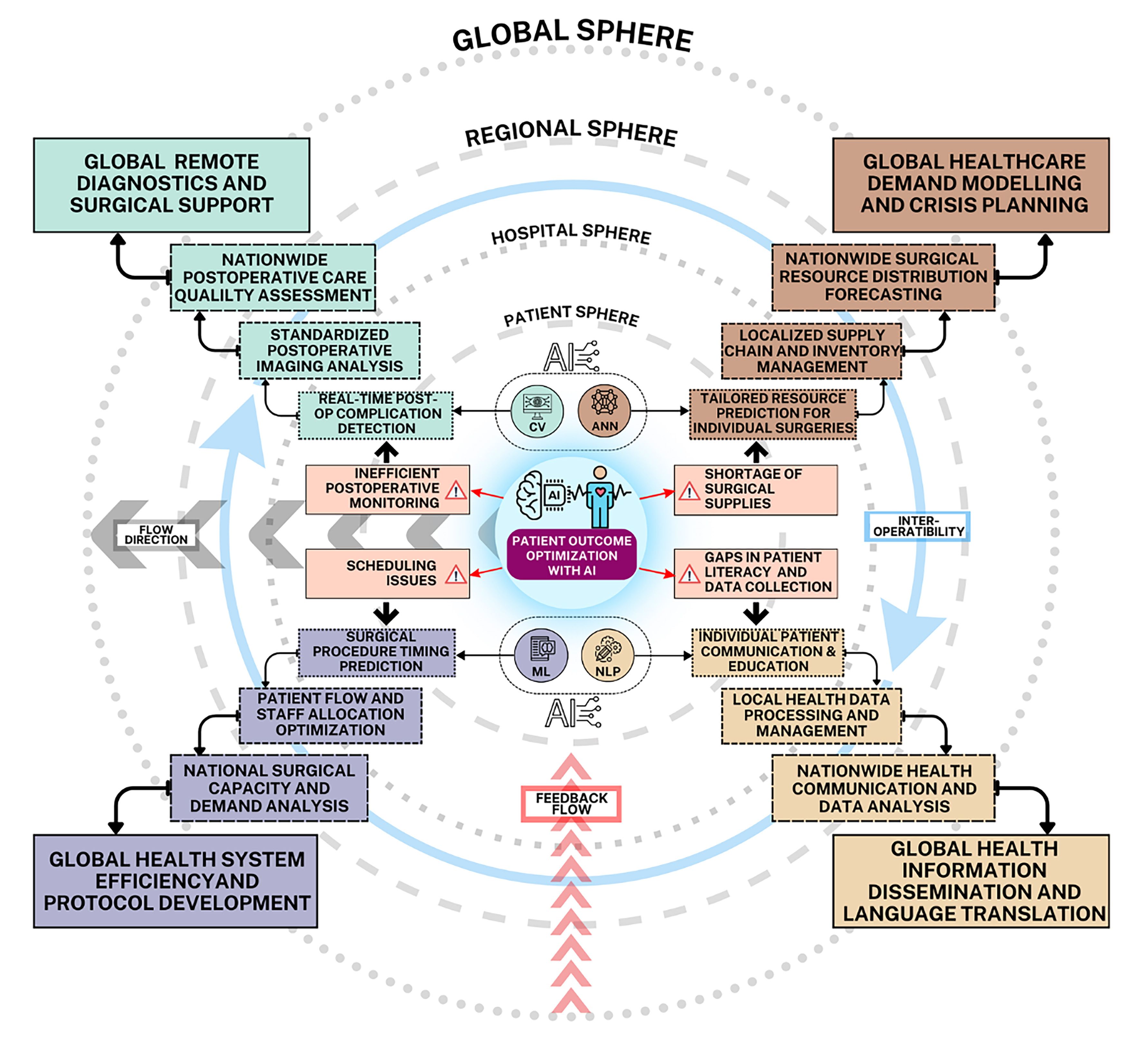
Figure 1. PCASE model. The PCASE model provides a multilevel framework for the expansion of AI across surgical care, illustrating how patient-centered applications can scale from the patient sphere to the hospital, regional, and global spheres. Beginning with individual patient needs and outcomes, AI modalities - including CV, ANN, ML, and NLP - address challenges in postoperative monitoring, surgical resource availability, scheduling, and patient communication and data collection. These applications progressively support broader functions, including postoperative complication detection, procedural timing and workforce optimization, individualized resource prediction, supply-chain management, health-data processing, and quality assessment. Through interoperability, bidirectional information flow, and iterative feedback, these capabilities can extend to national and global applications in surgical capacity planning, healthcare demand modeling, remote diagnostic and surgical support, health-system efficiency, protocol development, and information dissemination and language translation. The model emphasizes patient outcome optimization as the central objective, with data and insights generated across levels feeding back toward patient-level care and enabling context-responsive, scalable AI implementation in surgery. PCASE: Patient-Centered Artificial Intelligence Surgery Expansion; AI: artificial intelligence; CV: computer vision; ANN: artificial neural networks; ML: machine learning; NLP: natural language processing.