

fig1
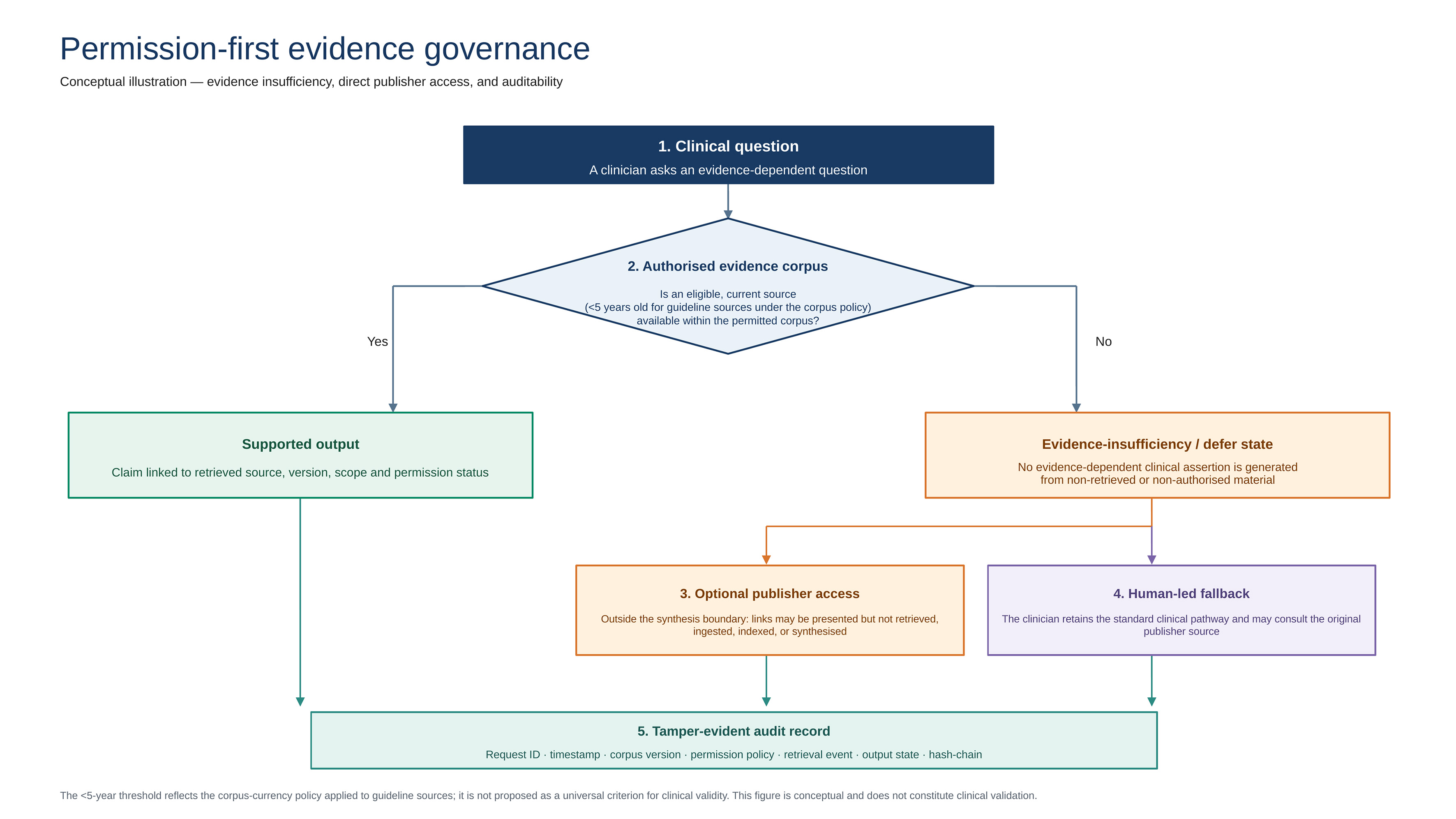
Figure 1. Permission-first evidence governance: supported output, defer state, human fallback, and auditable record. A clinician’s evidence-dependent question is evaluated only against an authorised evidence corpus. When an eligible and current source is available within the permitted corpus, the system may produce a supported output linked to the retrieved source, its version, scope, and permission status. When no eligible source is available, the system enters an evidence-insufficiency/defer state and does not generate an evidence-dependent clinical assertion from material that has not been retrieved or is not authorised for synthesis. Official publisher links may optionally be presented outside the synthesis boundary for direct consultation, but are not retrieved, ingested, indexed, or synthesised. The clinician retains the standard clinical pathway. The request identifier, timestamp, corpus version, permission policy, retrieval event, output state, and hash-chain reference are retained in a tamper-evident audit record. The “less than five years” condition shown in the figure reflects the corpus-currency policy applied to guideline sources in the illustrated architecture; it is not proposed as a universal criterion for clinical validity. This figure is conceptual and does not constitute clinical validation.