


Update on the cardiovascular application of targeting factor XI
 0
0 Abstract
Cardiovascular diseases remain the leading global cause of morbidity and mortality, and thrombotic events contribute substantially to their clinical burden. Established anticoagulants, including vitamin K antagonists and direct oral anticoagulants, reduce thromboembolic events but remain limited by bleeding risk in selected patients. Factor XI (FXI), a serine protease in the intrinsic coagulation pathway, has emerged as a promising investigational target because FXI-dependent thrombin amplification appears to contribute more to pathological thrombosis than to physiological hemostasis. This review consolidates contemporary progress in FXI/activated factor XI (FXIa)-targeted therapeutics, encompassing monoclonal antibodies (e.g., abelacimab, osocimab), antisense oligonucleotides (e.g., fesomersen), and small-molecule inhibitors (e.g., milvexian, asundexian). Clinical evidence suggests that FXI/FXIa inhibition may reduce thrombosis or bleeding in selected settings, particularly postoperative venous thromboembolism prophylaxis and certain high-bleeding-risk populations; however, efficacy signals have been inconsistent across indications such as atrial fibrillation, acute coronary syndrome, and secondary stroke prevention. Remaining challenges, including long-term safety, dose selection, patient stratification, perioperative management, and definitive efficacy in outcome trials, are also discussed. Overall, FXI/FXIa inhibition remains a promising but still investigational strategy that may improve the balance between antithrombotic efficacy and bleeding risk in selected clinical contexts.
Keywords
INTRODUCTION
Cardiovascular diseases (CVDs) continue to impose a substantial global health burden, and thrombotic events are major contributors to cardiovascular morbidity and mortality[1,2]. Arterial and venous thrombosis are central to many cardiovascular events, although they differ substantially in their dependence on platelet activation, coagulation amplification, and local hemodynamic conditions. Although coagulation activation and fibrin formation contribute to both processes, arterial thrombosis is often more platelet-driven, whereas venous thrombosis and contact pathway-mediated thrombosis may depend more heavily on coagulation amplification.
Heparins, vitamin K antagonists (VKAs), and direct oral anticoagulants (DOACs) have transformed the management of thromboembolic diseases, but bleeding risk and patient-specific limitations remain important clinical concerns. For VKAs, these limitations include a narrow therapeutic index, food and drug interactions, and the need for laboratory monitoring, whereas DOACs have reduced several of these burdens but do not eliminate bleeding risk[3-5]. Important gaps remain in patients with advanced renal dysfunction, high bleeding risk, or conditions in which DOACs are unsuitable, such as mechanical heart valves[6-13]. These limitations have stimulated interest in next-generation antithrombotic strategies designed to preserve efficacy while reducing bleeding risk.
Observational and mechanistic studies have linked higher factor XI (FXI) levels or FXI activity to an increased risk of selected thrombotic events. FXI inhibition is hypothesized to attenuate pathological thrombin amplification while having less effect on primary hemostasis than inhibition of factors in the common pathway[14,15]. These approaches include antisense oligonucleotides (ASOs) that reduce hepatic FXI synthesis, monoclonal antibodies targeting FXI and/or activated factor XI (FXIa), and oral small-molecule FXIa active-site inhibitors.
Currently, these FXI/FXIa-targeted agents remain investigational and have not yet received regulatory approval for clinical use worldwide. This narrative review summarizes the biological rationale, pharmacological modalities, clinical trial evidence, and unresolved challenges of FXI/FXIa inhibition in cardiovascular medicine.
LITERATURE SEARCH STRATEGY AND SCOPE
This is a narrative review. We searched PubMed, Web of Science, ClinicalTrials.gov, and the EU Clinical Trials Register for articles and trial records related to FXI/FXIa inhibition up to March 29, 2026. Search terms included "factor XI", "factor XIa", "FXI inhibitor", "FXIa inhibitor", "abelacimab", "osocimab", "gruticibart", "fesomersen", "IONIS-FXIRx", "asundexian", "milvexian", "frunexian", "atrial fibrillation", "acute coronary syndrome", "stroke", "cancer-associated thrombosis", "hemodialysis", "mechanical circulatory support", and "high bleeding risk". Priority was given to randomized clinical trials, phase I/II/III studies, trial-registry records, primary pharmacokinetic/pharmacodynamic studies, and recent high-quality reviews. Because this article is not a systematic review or meta-analysis, formal risk-of-bias grading and quantitative evidence synthesis were not performed.
BIOLOGICAL ROLE OF FXI IN HEMOSTASIS AND THROMBOSIS
FXI is a homodimeric serine protease with four apple domains that contributes to thrombin amplification within the intrinsic coagulation pathway[14]. Unlike factors in the common pathway, FXI acts mainly as an amplification factor that links contact activation and thrombin-mediated feedback. After activation by FXIIa or thrombin, FXIa activates FIX to FIXa, thereby supporting intrinsic tenase formation, sustained thrombin generation, and fibrin formation[16,17]. Clinical observations from congenital FXI deficiency suggest that FXI is less essential for baseline hemostasis than FVIII or FIX, because bleeding is generally milder and more variable than in hemophilia A or B[18,19]. In contrast, FXI appears to contribute importantly to pathological thrombus propagation, particularly in settings involving contact activation, artificial surfaces, or polyanions such as neutrophil extracellular traps and polyphosphate[20-23] [Figure 1]. This biological profile provides a mechanistic rationale for the hypothesis that FXI/FXIa inhibition may reduce bleeding compared with anticoagulants targeting the common pathway[24]. Overall, FXI appears to function primarily as an amplifier of thrombin generation and thrombus propagation rather than as an indispensable component of basal hemostasis.
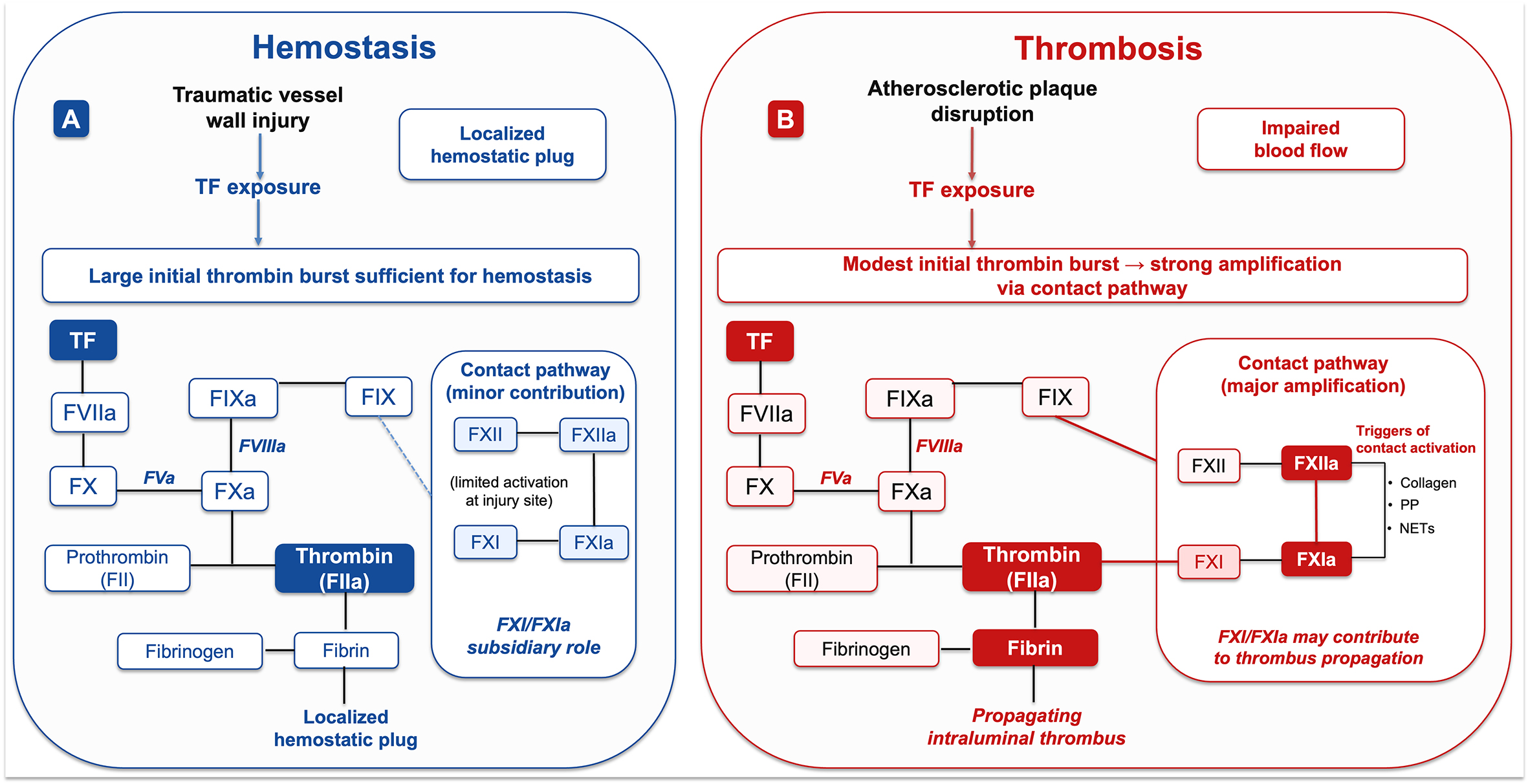
Figure 1. Pathological thrombosis versus physiological hemostasis. This schematic illustrates the differential contribution of FXI/FXIa to physiological hemostasis and pathological thrombosis. (A) shows hemostasis after traumatic vessel wall injury. TF exposure initiates coagulation and generates a large initial thrombin burst sufficient for localized hemostatic plug formation. In this setting, the contact pathway and FXI/FXIa-mediated amplification play a subsidiary role. (B) shows thrombosis after atherosclerotic plaque disruption. TF exposure initiates coagulation, but the initial thrombin burst is relatively modest and requires stronger amplification through the contact pathway. Contact activation triggers, including collagen, NETs, and PP, promote FXII/FXIIa and FXI/FXIa activation, thereby amplifying thrombin generation and supporting propagating intraluminal thrombus formation. FII: prothrombin; FIIa: thrombin; FIX: factor IX; FIXa: activated factor IX; FX: factor X; FXa: activated factor X; FXI: factor XI; FXIa: activated factor XI; FXII: factor XII; FXIIa: activated factor XII; FVa: activated factor V; FVIIIa: activated factor VIII; NETs: neutrophil extracellular traps; PP: polyphosphate; TF: tissue factor.
Preliminary and hypothesis-generating evidence suggests that FXI/FXIa inhibition may modulate thromboinflammatory responses in selected settings. For example, AB023 was associated with reductions in thrombin-antithrombin (TAT) complexes and C-reactive protein (CRP) in hemodialysis studies[25,26]. However, direct evidence for a class-wide anti-inflammatory effect remains limited, and whether anti-inflammatory effects contribute meaningfully to the clinical effects of FXI/FXIa inhibitors requires further investigation.
PHARMACOLOGICAL PROFILES AND MODALITIES OF FXI/FXIA INHIBITORS
Development of FXI/FXIa inhibitors has focused on three major pharmacological modalities: monoclonal antibodies, ASOs, and small-molecule FXIa inhibitors. These approaches reduce FXI synthesis, prevent FXI activation, or inhibit FXIa enzymatic activity, thereby attenuating FXI-dependent thrombin amplification. Table 1 summarizes the major drug classes and representative agents, and Figure 2 illustrates their mechanisms of action.
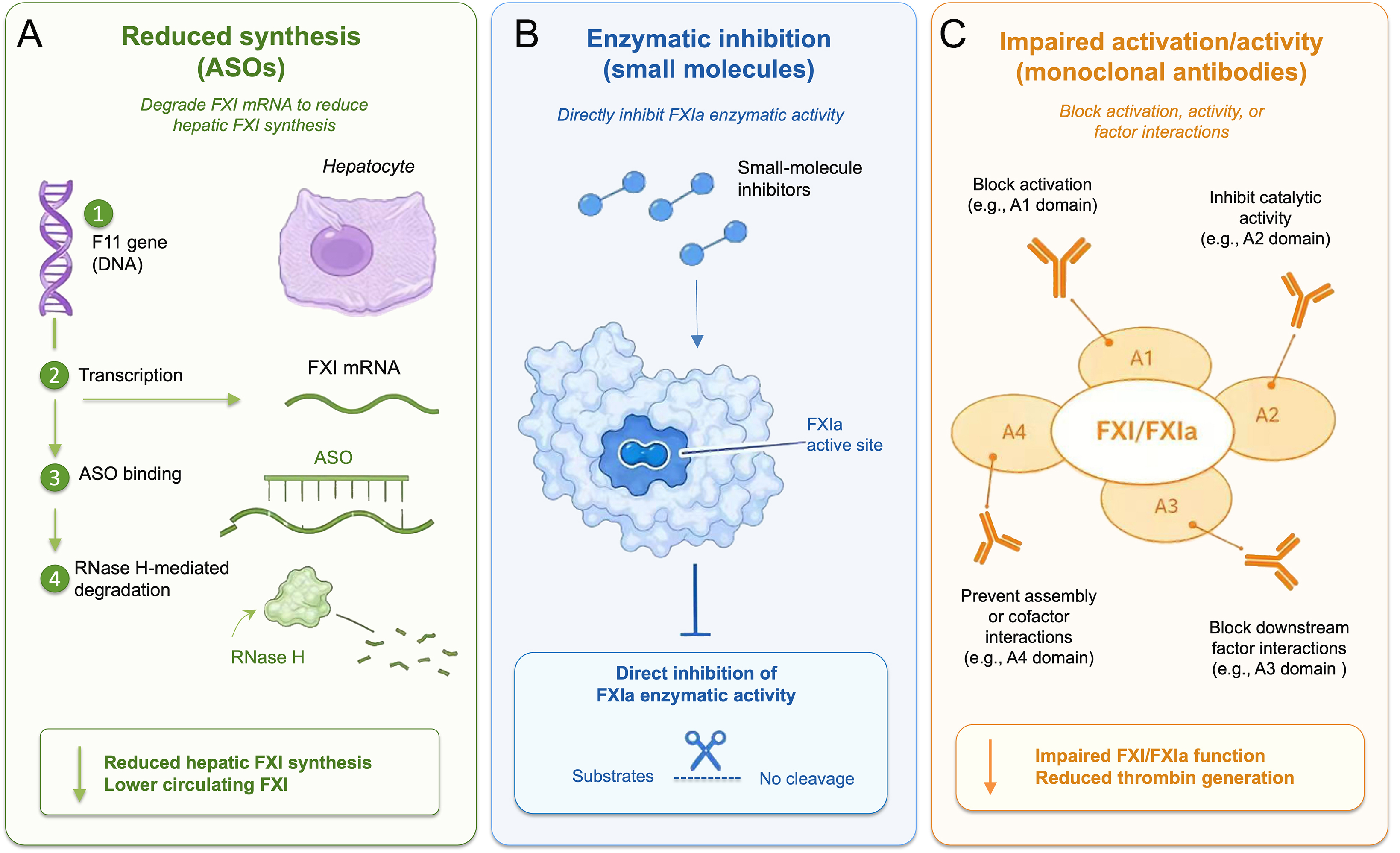
Figure 2. Pharmacological strategies targeting FXI/FXIa. This schematic summarizes the three major pharmacological approaches for targeting the FXI pathway. (A) Reduced synthesis by ASOs decreases hepatic FXI production by binding FXI mRNA and promoting RNase H-mediated degradation, thereby lowering circulating FXI levels. (B) Enzymatic inhibition by small molecules directly inhibits FXIa catalytic activity by binding the FXIa active site and preventing substrate cleavage. (C) Impaired activation or activity by monoclonal antibodies targets specific FXI/FXIa domains and may block FXI activation, inhibit catalytic activity, prevent cofactor assembly, or interfere with downstream factor interactions. Although these modalities differ in route of administration, onset and offset, and pharmacokinetic properties, they all aim to attenuate FXI-dependent thrombin amplification. ASO: Antisense oligonucleotide; FXI: factor XI; FXIa: activated factor XI; mRNA: messenger RNA.
Pharmacological characteristics of major FXI/FXIa inhibitor modalities[27]
| ASOs | Monoclonal antibodies | Small molecules | Natural/experimental inhibitors | |
| Representative drugs | Fesomersen[28], ISIS-FXIRx[29] | BAY 1213790[30] Abelacimab[31,32] | Milvexian[33] Asundexian[34] | Ir-CPI[35] |
| Mechanism | Reduce hepatic FXI synthesis through RNase H-mediated degradation of FXI mRNA | Block FXI activation and/or inhibit FXIa activity | Directly inhibit the catalytic active site of FXIa | Inhibit multiple contact-pathway proteases, including FXIIa, FXIa, and plasma kallikrein |
| Administration route | SC | IV or SC | Oral or IV; agent-dependent | IV |
| Frequency | Weekly to monthly | Monthly | Daily, twice daily, or short-term IV; agent-dependent | Daily |
| Onset of action | Slow (weeks) | Rapid (hours to days) | Rapid; agent-dependent | Rapid (minutes) |
| Offset of action | Slow (weeks) | Slow (weeks) | Rapid to intermediate; agent-dependent | Rapid (hours) |
| Renal excretion | No | No | Agent-dependent | Uncertain |
| CYP metabolism | No | No | Agent-dependent | No |
| Drug-drug interactions | No | No | Agent-dependent | Unknown |
| Clinical stage | Phase IIb | Phase III | Preclinical to phase III | Preclinical |
| Key advantages | Long-lasting effect | Target-specific inhibition | Oral bioavailability | Natural mechanism |
ASOs bind hepatic FXI messenger RNA (mRNA) and promote RNase H-mediated degradation, thereby reducing FXI synthesis. Small-molecule inhibitors bind the catalytic active site of FXIa and directly inhibit its enzymatic activity. Monoclonal antibodies bind FXI and/or FXIa at specific domains, thereby blocking FXI activation, FXIa activity, or interactions with upstream and downstream coagulation factors.
Monoclonal antibodies targeting FXI/FXIa
Monoclonal antibodies targeting FXI and/or FXIa represent an important modality in FXI-pathway inhibition and have been evaluated in both preclinical models and early-phase clinical studies. Depending on their epitope, these antibodies may prevent FXI activation, inhibit FXIa activity, or disrupt interactions between FXI/FXIa and other components of the coagulation cascade.
(1) BAY 1213790 (FXIa-targeting antibody): Early clinical evaluation showed dose-dependent aPTT prolongation and reduced FXI activity, with no apparent effects on bleeding time or clinically relevant anti-drug antibody formation, supporting further clinical evaluation[36]. (2) Abelacimab (dual FXI/FXIa-targeting antibody): Phase 1 and 2 data demonstrate a terminal half-life of 25-30 days, providing sustained FXI suppression and aPTT prolongation for over 4 weeks. Its monthly subcutaneous dosing may offer adherence advantages for chronic anticoagulation[31,32]. (3) AB023 (FXI-targeting antibody): AB023 selectively inhibits FXIIa-mediated FXI activation while preserving thrombin-mediated feedback activation. In a Phase 2 trial of end-stage kidney disease (ESKD) patients on hemodialysis, AB023 significantly improved circuit patency, reduced occlusive events, and lowered TAT and CRP levels[25,26]. (4) BJTJ-1837 (FXI-targeting antibody): In preclinical primate models, BJTJ-1837 reduced thrombosis in arteriovenous shunt models without an apparent increase in bleeding[37]. (5) BAY 1831865 (dual FXI/FXIa-targeting antibody): In early-phase evaluation, BAY 1831865 showed rapid onset after intravenous administration, dose-dependent systemic exposure, and a half-life of up to 208 h. It reduced FXI clotting activity and was not associated with major bleeding signals in the available early-phase data[38]. (6) SKB336 (dual FXI/FXIa-targeting antibody): An anti-FXI antibody with a prolonged half-life of up to 33 days. Healthy volunteer data showed dose-proportional exposure and sustained FXI inhibition, supporting further evaluation of once-monthly dosing. However, bleeding risk requires confirmation in larger patient studies[39].
Antisense oligonucleotides
ASOs targeting FXI mRNA reduce hepatic FXI synthesis and have been evaluated in early clinical and selected patient studies. They bind FXI mRNA and promote RNase H-mediated degradation, thereby reducing FXI protein synthesis.
(1) ISIS-FXIRx: This agent achieves FXI suppression by degrading hepatic FXI mRNA. Clinical data showed that repeated dosing could produce marked reductions in FXI activity and FXI antigen levels over several weeks[29]. (2) Fesomersen: In patients with kidney failure receiving hemodialysis, fesomersen reduced FXI levels in a dose-dependent manner. Lower FXI levels were associated with fewer hemodialysis circuit-clotting events and possibly fewer vascular access thrombotic events[28].
Small-molecule FXIa inhibitors
Small-molecule FXIa inhibitors directly inhibit the active site of FXIa.
(1) Milvexian: An oral FXIa inhibitor with predictable pharmacokinetic/pharmacodynamic profiles and generally favorable tolerability in early studies. Phase 1/2 studies showed dose-dependent aPTT prolongation, with no major bleeding signal reported in the studied populations[33]. (2) SHR2285: An oral FXIa inhibitor developed in China. It produced dose-dependent FXIa inhibition and aPTT prolongation in early-phase studies. The absence of clinically meaningful pharmacokinetic or pharmacodynamic interactions with aspirin or ticagrelor in early studies supports further evaluation in combination with antiplatelet therapy[40-42]. (3) Asundexian (BAY 2433334): A once-daily oral FXIa inhibitor. Early studies showed predictable pharmacokinetic/pharmacodynamic profiles and low bleeding rates compared with apixaban in selected settings, but the interpretation of safety must be balanced against later efficacy concerns. However, the Phase 3 OCEANIC-atrial fibrillation (AF) trial was terminated early because asundexian was less effective than apixaban for prevention of stroke or systemic embolism. This finding indicates that reduced bleeding alone does not guarantee non-inferior efficacy and that dose, degree of FXIa inhibition, patient selection, and prior anticoagulant exposure require careful consideration[34,43,44]. (4) ONO-7684: An oral FXIa inhibitor that showed dose-dependent pharmacodynamic effects, including reduced FXI clotting activity and aPTT prolongation, with a half-life of up to 27.9 h in early-phase evaluation. No major bleeding signal was reported in the available early data[45]. (5) EP-7041: An investigational parenteral FXIa inhibitor being evaluated for critical care settings such as extracorporeal membrane oxygenation (ECMO), where rapid titration and offset may be clinically useful[46]. (6) Montelukast (MK): Montelukast has been identified through drug-repurposing approaches as a potential FXIa-inhibitory candidate in preclinical studies. Its possible antithrombotic and anti-inflammatory effects remain exploratory and should not be extrapolated to clinical anticoagulation without further validation[47]. (7) Frunexian & BMS-962212: Frunexian and BMS-962212 are examples of agents with pharmacokinetic profiles that may be suitable for settings requiring rapid onset or offset. Frunexian is a short-acting intravenous agent, whereas BMS-962212 has shown dose-proportional pharmacokinetics in early studies[48,49].
Natural and experimental inhibitors
Ir-CPI is a Kunitz-type protein derived from the saliva of the tick Ixodes ricinus. Ir-CPI inhibits several components of the contact pathway, including FXIIa, FXIa, and plasma kallikrein. In preclinical rat and mouse models, Ir-CPI reduced venous and arterial thrombus formation in a dose-dependent manner[35]. Its clinical relevance remains to be established.
Clinical implications of pharmacological differences
Although FXI/FXIa inhibitors share a common pathway-level rationale, they should not be considered a homogeneous therapeutic class. Monoclonal antibodies generally provide deep and sustained FXI/FXIa inhibition and may improve adherence through infrequent dosing, but their long half-lives may complicate perioperative interruption, urgent reversal, and management of unexpected bleeding. ASOs reduce hepatic FXI synthesis and therefore have a slower onset and offset, making them more suitable for stable chronic-risk settings than for acute anticoagulation. In contrast, oral small-molecule FXIa inhibitors provide more flexible dosing and faster offset, which may be advantageous in perioperative or rapidly changing clinical scenarios, but they require daily adherence and may be more susceptible to renal function, drug-drug interactions, and dose-dependent efficacy limitations. Parenteral short-acting agents may be particularly relevant for critical care or extracorporeal circulation settings, where rapid titration and offset are important. These differences are clinically important and should be considered when interpreting trial results across indications.
CLINICAL EVIDENCE FOR FXI/FXIA INHIBITORS ACROSS THROMBOTIC CONDITIONS [Table 2]
FXI/FXIa inhibition for stroke prevention in AF
In recent years, FXI/FXIa inhibition has become an active investigational strategy for stroke prevention in AF[66]. The PACIFIC-AF trial (NCT04218266) systematically evaluated asundexian, an oral FXIa inhibitor, in 753 patients with AF. Results showed that asundexian achieved near-complete in vivo FXIa inhibition at doses of 20 and 50 mg once daily and was associated with lower bleeding rates than standard-dose apixaban[51]. The subsequent Phase III OCEANIC-AF trial (NCT05643573) was terminated early because asundexian was less effective than apixaban for prevention of stroke or systemic embolism. This result challenged the assumption that FXIa inhibition can directly replace DOAC therapy for stroke prevention in unselected AF populations[34]. Post-hoc analyses suggested that prior anticoagulant exposure may have influenced the observed efficacy difference, but these findings should be considered exploratory and require prospective validation[67].
In contrast, the Phase II AZALEA-TIMI 71 study (NCT04755283) provided an important bleeding-safety signal for abelacimab, a monoclonal antibody targeting FXI/FXIa. In 1,287 moderate-to-high-risk patients with AF, monthly subcutaneous abelacimab achieved near-complete FXI suppression and reduced major or clinically relevant non-major bleeding compared with rivaroxaban[53]. Prespecified subgroup analyses suggested that the bleeding reduction was generally consistent in patients receiving concomitant antiplatelet therapy[68].
Ongoing investigations, including LILAC-TIMI 76 (NCT05712200) and LIBREXIA-AF (NCT05757869), may help clarify whether specific FXI/FXIa inhibitors can provide an acceptable balance between efficacy and bleeding in selected AF populations. Collectively, AF trial results indicate that bleeding reduction and antithrombotic efficacy may diverge. The clinical performance of FXI/FXIa inhibitors appears to depend on drug modality, dose, degree of pathway inhibition, prior anticoagulant exposure, and patient selection.
Clinical development of FXI/FXIa inhibitors in major thrombotic conditions
| Drug | Potency (Kd/Ki/IC50, if available) | Type | Trial ID | Key findings |
| Stroke prevention in atrial fibrillation | ||||
| Asundexian | IC50 = 1.0 nM (FXIa, buffer); IC50 = 0.14 μM (human plasma after contact activation)[50] | Oral FXIa inhibitor | NCT04218266 (PACIFIC-AF, Phase II) | Near-complete in vivo FXIa inhibition and lower bleeding than apixaban in a Phase II dose-finding trial; not powered for definitive stroke-prevention efficacy[51] |
| Asundexian | Same as above | Oral FXIa inhibitor | NCT05643573 (OCEANIC-AF, Phase III) | Trial terminated early because asundexian was less effective than apixaban for prevention of stroke or systemic embolism[34,52] |
| Abelacimab | Kd = 1.3 ± 0.3 pM (FXI); 4.7 ± 2.1 pM (FXIa)[31,32] | FXI/FXIa monoclonal antibody | NCT04755283 (AZALEA-TIMI 71, Phase II) | Reduced major or clinically relevant non-major bleeding versus rivaroxaban; efficacy for stroke/systemic embolism prevention remains to be established[53] |
| Abelacimab | Same as above | FXI/FXIa monoclonal antibody | NCT04213807 (ANT-004, Phase II) | Dose-dependent and sustained FXI/FXIa inhibition in early-phase evaluation; clinical outcome efficacy remains unproven[32] |
| Postoperative thrombosis | ||||
| Abelacimab | Same as above | FXI/FXIa monoclonal antibody | EudraCT 2019-003756-37 (ANT-005 TKA, Phase II) | Dose-dependent reduction in postoperative VTE compared with enoxaparin, with low bleeding rates in this Phase II setting[30] |
| Osocimab | IC50 = 16 ± 0.02 nM[27] | FXIa monoclonal antibody | NCT03276143 (FOXTROT, Phase II) | Met noninferiority or superiority criteria for trial-defined VTE endpoints depending on dose and timing; bleeding outcomes require cautious interpretation[54] |
| IONIS-FXIRx | pharmacodynamic effect reflected by FXI antigen/activity reduction | Antisense oligonucleotide | NCT01713361 (Phase II) | Comparable VTE prevention to enoxaparin; reduced bleeding; marked FXI reduction[21] |
| Milvexian | Ki = 0.11 nM[55] | Oral FXIa inhibitor | NCT03891524 (AXIOMATIC-TKR, Phase II) | Dose-response observed for postoperative VTE reduction; no major bleeding signal in the studied population[56] |
| KN060 | Potency data not clearly available from current public sources | FXIa monoclonal antibody | NCT06180889 (Phase II) | Ongoing |
| Cancer-associated thrombosis | ||||
| Gruticibart (CSL777) | Potency data not clearly available from current public sources | FXIa monoclonal antibody | NCT04465760 (Phase II) | Reduced catheter-related thrombosis (12.5% vs. 40%)[57] |
| Abelacimab | Same as above | FXI/FXIa monoclonal antibody | NCT05171075 (MAGNOLIA, Phase III) | Ongoing |
| Abelacimab | Same as above | FXI/FXIa monoclonal antibody | NCT05171049 (ASTER, Phase III) | Ongoing |
| End-stage kidney disease/hemodialysis | ||||
| Osocimab | Same as above | FXIa monoclonal antibody | NCT04523220 (Phase II) | Bleeding rates comparable to placebo in a Phase II setting; larger studies are needed to confirm clinical safety[58] |
| IONIS-FXIRx | Pharmacodynamic effect reflected by FXI antigen/activity reduction | Antisense oligonucleotide | NCT02553889 (Phase II) | Stable PK exposure; no accumulation[59] |
| IONIS-FXIRx | Pharmacodynamic effect reflected by FXI antigen/activity reduction | Antisense oligonucleotide | NCT03358030 (EMERALD, Phase II) | Evaluating safety and repeated dosing (ongoing) |
| Fesomersen | Pharmacodynamic effect reflected by FXI antigen/activity reduction | Antisense oligonucleotide | NCT04534114 (Phase II) | Dose-dependent FXI reduction; potential reduction in dialysis circuit-clotting events without an apparent increase in major bleeding in selected patients[28] |
| AB023 | Kd = 3.66 nM (FXI); 1.38 nM (FXIa)[26] | Anti-FXI monoclonal antibody | NCT03612856 (Phase II) | Reduced circuit clotting[25] |
| Asundexian | Same as above | Oral FXIa inhibitor | NCT04510987 (Phase I) | Predictable pharmacokinetics across renal impairment groups; exposure largely unaffected by dialysis in available data[60] |
| Milvexian | Same as above | Oral FXIa inhibitor | NCT03000673 (Phase I/II) | Safety evaluation in ESRD patients (ongoing) |
| ACS secondary prevention | ||||
| Asundexian | Same as above | Oral FXIa inhibitor | NCT04304534 (PACIFIC-AMI, Phase II) | Near-complete FXIa inhibition added to DAPT; acceptable safety[61] |
| Milvexian | Same as above | Oral FXIa inhibitor | NCT05754957 (LIBREXIA-ACS, Phase III) | Trial terminated early; unlikely to meet primary endpoint[62] |
| Secondary prevention after stroke/TIA | ||||
| Asundexian | Same as above | Oral FXIa inhibitor | NCT04304508 (PACIFIC-Stroke, Phase II) | Did not meet primary endpoint[63] |
| Milvexian | Same as above | Oral FXIa inhibitor | NCT03766581 (AXIOMATIC-SSP, Phase II) | No significant reduction in recurrence; low bleeding[64] |
| Asundexian | Same as above | Oral FXIa inhibitor | NCT05686070 (OCEANIC-Stroke, Phase III) | Ongoing |
| Milvexian | Same as above | Oral FXIa inhibitor | NCT05702034 (LIBREXIA-STROKE, Phase III) | Evaluating addition to antiplatelet therapy |
| COVID-19/ECMO/LVAD | ||||
| EP-7041 | Potency data not clearly available from current public sources | Intravenous FXIa inhibitor | NCT05040776 (Phase II) | Designed for ICU use; trial withdrawn[46] |
| Osocimab | Same as above | FXIa monoclonal antibody | Preclinical | Reduced thrombus burden in ECMO/LVAD models[65] |
Venous thromboembolism (VTE) prophylaxis in orthopedic surgery
Orthopedic procedures, particularly total knee and hip arthroplasty (TKA/THA), provide an established clinical model for evaluating novel anticoagulants because of their high postoperative VTE risk[69]. In a Phase II TKA study (NCT01713361), the FXI-ASO ISIS 416858/IONIS-FXIRx reduced postoperative VTE compared with enoxaparin and was associated with less bleeding, supporting the feasibility of FXI reduction in this setting[21]. In the FOXTROT trial, osocimab showed non-inferiority to enoxaparin when administered postoperatively, whereas preoperative administration of 1.8 mg/kg achieved clinical superiority (NCT03276143)[54]. Similarly, the ANT-005 TKA study (EudraCT2019-003756-37) showed dose-dependent reductions in postoperative VTE with a single postoperative infusion of abelacimab compared with enoxaparin, with low bleeding rates in this Phase II setting[30].
Milvexian also showed a dose-response relationship for postoperative VTE reduction in the AXIOMATIC-TKR trial (NCT03891524)[56]. More recently, the ROXI-VTE (NCT05618808; NCT06454630) program further suggested that epitope and domain selection may matter: REGN7508, which targets the catalytic domain, performed better than enoxaparin for the trial-defined endpoint, whereas REGN9933, which binds the Apple 2 domain, did not demonstrate superiority[70].
Ongoing studies, including KN060, may provide additional information on alternative antibody-based approaches (NCT06180889). Collectively, orthopedic surgery provides some of the most supportive Phase II evidence for FXI/FXIa inhibition, suggesting effective postoperative VTE reduction with low bleeding rates in selected trials. However, these findings still require confirmation in larger outcome studies and should not be extrapolated uncritically to all surgical populations.
Anticoagulation in cancer-associated thrombosis (CAT)
CAT is clinically challenging because patients with cancer often have both increased thrombotic risk and increased bleeding risk[71-74]. Although low-molecular-weight heparins (LMWHs) and DOACs remain standard options, their use may be complicated by bleeding, particularly in patients with gastrointestinal or genitourinary malignancies. This unmet need has made FXI/FXIa inhibitors an attractive investigational strategy in CAT. Two Phase III trials, MAGNOLIA (NCT05171075) and ASTER (NCT05171049), are evaluating whether abelacimab can improve the safety profile of anticoagulation in cancer patients at increased bleeding risk.
Central venous catheter-associated thrombosis is another important complication in patients with cancer. In a Phase II trial, gruticibart was associated with a lower incidence of catheter-related thrombosis than placebo, without an apparent increase in bleeding in the studied population[57] .
These findings suggest that FXI/FXIa inhibition may address an important unmet need in selected CAT populations. If ongoing Phase III trials confirm favorable efficacy and safety, FXI/FXIa inhibitors may become a useful option for selected cancer patients at high bleeding risk.
Anticoagulation in ESKD and hemodialysis
Patients with ESKD undergoing maintenance hemodialysis face both extracorporeal circuit thrombosis and increased bleeding risk. This clinical context makes anticoagulation difficult and often requires individualized risk assessment[75].
AB023 (Xisomab 3G3) provided early clinical evidence supporting FXI-pathway inhibition in hemodialysis. In a Phase II trial (NCT03612856), a single pre-dialysis bolus enhanced circuit patency and achieved a 42% reduction in TAT complexes without any drug-related bleeding events[25]. Similarly, fesomersen, an ASO that reduces hepatic FXI synthesis, also produced dose-dependent FXI reduction in dialysis patients (NCT04534114)[28]. A Phase II randomized, double-blind, placebo-controlled study of IONIS-FXIRx/fesomersen showed consistent pharmacokinetic exposure in relation to dialysis timing and no apparent accumulation after repeated dosing (NCT02553889)[59]. A Phase IIb evaluation of osocimab reported bleeding rates comparable to placebo and acceptable tolerability, but larger studies are needed to confirm clinical safety (NCT04523220)[58]. Among oral agents, asundexian showed a predictable pharmacokinetic profile across different degrees of renal impairment, with exposure largely unaffected by dialysis (NCT04510987; EudraCT 2020-000626-25/022-000196-38)[60].
However, the evidence remains mixed. A Phase II trial of the monoclonal antibody MK-2060 achieved substantial FXI inhibition but did not significantly improve arteriovenous graft patency and was associated with increased access-related bleeding (NCT05027074)[76].
Ongoing investigations, including the EMERALD study (NCT03358030) evaluating ISIS 416858 and a Phase I/II trial of milvexian (NCT03000673), may provide additional information on dosing, pharmacokinetics, and safety in this high-risk population. Overall, hemodialysis is a biologically plausible setting for FXI/FXIa inhibition because of contact activation within extracorporeal circuits. However, mixed clinical results indicate that efficacy and bleeding risk may differ by molecule, endpoint, and patient population.
Secondary prevention in acute coronary syndrome (ACS)
Patients with ACS continue to harbor a significant residual thrombotic risk despite standard-of-care dual antiplatelet therapy (DAPT)[77]. Because conventional anticoagulation added to DAPT increases bleeding risk, FXIa inhibitors have been explored as a potential adjunctive strategy. The PACIFIC-AMI trial (NCT04304534) evaluated the addition of asundexian (10 mg, 20 mg, or 50 mg daily) to DAPT in patients following acute myocardial infarction. The study showed dose-dependent pharmacodynamic inhibition of FXIa, with the 50 mg dose achieving more than 90% inhibition. All three doses achieved pharmacodynamic inhibition without an apparent increase in bleeding compared with placebo[61]. However, the favorable bleeding signal did not translate into a reduction in ischemic events, suggesting that efficacy in ACS may depend not only on the degree of FXIa inhibition but also on the platelet-driven and high-shear nature of arterial thrombosis. This uncertainty was further reinforced by the early termination of LIBREXIA-ACS for futility. The trial evaluated whether milvexian added to standard antiplatelet therapy could reduce major adverse cardiovascular events (MACE) (NCT05754957)[52]. An independent interim analysis concluded that the trial was unlikely to meet its primary efficacy endpoint, leading to its early cessation.
Overall, PACIFIC-AMI suggests that FXIa inhibition can be added to DAPT with acceptable bleeding in a Phase II setting, but it did not demonstrate clinical efficacy. Together with the futility termination of LIBREXIA-ACS, these findings raise the possibility that FXI/FXIa inhibition may be less effective in platelet-rich, high-shear arterial thrombosis than in venous or contact pathway-mediated thrombosis.
Secondary prevention in non-cardioembolic ischemic stroke (NCEIS)
Non-cardioembolic ischemic stroke and TIA are associated with substantial risks of recurrence and long-term disability. Antithrombotic therapy is central to secondary prevention, but recurrent ischemic risk must be balanced against intracranial bleeding risk, particularly in older or high-risk patients[78].
The PACIFIC-Stroke trial (NCT04304508) evaluated the oral FXIa inhibitor asundexian in patients with NCEIS already receiving background antiplatelet therapy. At 26 weeks, asundexian did not significantly reduce the composite primary endpoint across all dose cohorts compared with placebo[63]. Similarly, the AXIOMATIC-SSP trial (NCT03766581) for milvexian did not establish a clear dose-response relationship for its primary endpoint; however, a directional trend toward reduced recurrence was observed in specific dose groups without a significant increase in major bleeding[64]. These Phase II findings suggest low bleeding rates but uncertain efficacy. Future studies need to determine whether patient selection, dose intensity, or the biological contribution of FXI/FXIa to cerebrovascular thrombosis explains these mixed results. Several Phase III trials are ongoing to further evaluate this question. The OCEANIC-STROKE trial (NCT05686070) is evaluating whether asundexian added to antiplatelet therapy can reduce recurrent stroke. In parallel, the LIBREXIA-STROKE trial (NCT05702034) is evaluating milvexian added to antiplatelet therapy for secondary stroke prevention. The results of these ongoing trials may help clarify whether FXIa inhibition has a role in secondary prevention after NCEIS or TIA.
Emerging frontiers: COVID-19, mechanical support, and critical care
FXI/FXIa inhibition has also been investigated in high-acuity settings, although evidence remains very limited. EP-7041/frunexian is a short-acting parenteral FXIa inhibitor developed for settings requiring rapid titration. However, the Phase II trial (NCT05040776) in critically ill COVID-19 patients was withdrawn, and no clinical efficacy data are available from this program[46].
In mechanical circulatory support (MCS) settings such as ECMO and left ventricular assist device (LVAD), FXI/FXIa inhibition is biologically plausible because contact activation and artificial surfaces contribute to thrombosis. Preclinical baboon models suggest that FXI targeting can reduce fibrin deposition and circuit thrombosis[65]. Nevertheless, translating these findings to the ICU remains challenging, as device-related thrombosis is a multifactorial process involving high shear stress, platelet activation, and complement responses beyond the contact pathway. Carefully designed early-phase trials are needed to define feasibility, dosing, safety, and efficacy signals in these complex high-risk settings.
Lessons learned from failed or neutral trials
Recent failed or neutral trials highlight that FXI/FXIa inhibition should not be considered a homogeneous substitute for established anticoagulants. First, a reduction in bleeding does not necessarily translate into non-inferior antithrombotic efficacy. This is particularly evident in AF, where OCEANIC-AF was terminated early because asundexian was less effective than apixaban for prevention of stroke or systemic embolism. Second, the role of FXI/FXIa may differ across thrombotic mechanisms. In venous thrombosis or extracorporeal circuit-related thrombosis, contact activation and thrombin amplification may be more relevant, whereas ACS and non-cardioembolic stroke are more platelet-driven and occur under high-shear arterial conditions. Third, drug-specific factors, including molecular modality, dose, degree of FXIa inhibition, onset and offset, renal clearance, and prior anticoagulant exposure, may strongly influence trial outcomes. Finally, patient selection remains unresolved. In addition to exploratory biomarkers, clinical high-bleeding-risk frameworks may help guide future trial design and patient stratification, particularly in populations in whom the intensity or duration of antithrombotic therapy must be balanced against bleeding complications. Recent reviews of antithrombotic therapy in high-bleeding-risk patients undergoing cardiac and noncardiac percutaneous interventions further emphasize the importance of individualized bleeding-risk assessment and treatment modulation[79,80]. Potential biomarkers such as FXI activity, FXI antigen levels, thrombin generation assays, contact activation markers, FXIa-antithrombin complexes, D-dimer, and NET-related markers may help identify responsive subgroups, but these remain exploratory and are not yet established for routine clinical decision-making.
CONCLUSION AND FUTURE PERSPECTIVES
FXI/FXIa inhibition is a biologically compelling and clinically promising investigational strategy, but current evidence does not support a uniform conclusion of preserved efficacy with reduced bleeding across all indications. The most supportive signals have emerged in postoperative VTE prophylaxis and selected extracorporeal or high-bleeding-risk settings, whereas results in AF, ACS, and secondary stroke prevention have been mixed or inconclusive[81]. Although several early-phase trials have shown favorable pharmacodynamic or bleeding signals, adequately powered outcome trials are needed to define efficacy, safety, and cost-effectiveness in specific patient populations. Future research should focus on patient selection, including clinical risk profiles and exploratory biomarkers such as FXI activity, contact activation markers, thrombin generation assays, and NET-related signatures. Dose selection, perioperative management, reversal strategies, renal dysfunction, adherence, and combination with antiplatelet or anticoagulant therapy also require systematic evaluation. If ongoing and future trials identify indications in which efficacy is preserved while bleeding is reduced, FXI/FXIa inhibitors may become useful additions to the antithrombotic armamentarium for selected patients.
DECLARATIONS
Acknowledgments
The authors would like to thank the Department of Cardiovascular Medicine, The Second Xiangya Hospital, Central South University, for providing academic support.
Authors’ contributions
Drafted the manuscript: Zhu Z, Gong W
Provided supervision and reviewed the manuscript: Hu X, Zhou S
Availability of data and materials
Not applicable.
AI and AI-assisted tools statement
During the preparation of this manuscript, ChatGPT (OpenAI, GPT-5.5 Thinking, released 2026-04-23) was used solely for language editing and readability improvement. The tool did not influence the study design, data collection, analysis, interpretation, or the scientific content of the work. All authors take full responsibility for the accuracy, integrity, and final content of the manuscript.
Financial support and sponsorship
None.
Conflicts of interest
Zhou S is the Guest Editor of the special issue "Interventional Cardiology: Recent Advances in Clinical and Translational Research" in the journal Vessel Plus, and also serves as an Associate Editor of the journal Vessel Plus. Zhou S was not involved in any steps of the editorial process for this manuscript, including reviewer selection, manuscript handling, or decision-making, while the other authors have declared that they have no conflicts of interest.
Ethical approval and consent to participate
Not applicable.
Consent for publication
Not applicable.
Copyright
© The Author(s) 2026.
REFERENCES
1. Raskob G, Angchaisuksiri P, Blanco A, et al. Thrombosis: a major contributor to global disease burden. Arterioscler Thromb Vasc Biol. 2014;34:2363-71.
2. Lozano R, Naghavi M, Foreman K, et al. Global and regional mortality from 235 causes of death for 20 age groups in 1990 and 2010: a systematic analysis for the Global Burden of Disease Study 2010. Lancet. 2012;380:2095-128.
3. Zapata-Wainberg G, Ximénez-Carrillo Rico Á, Benavente Fernández L, et al. Epidemiology of intracranial haemorrhages associated with vitamin K antagonist oral anticoagulants in Spain: TAC registry. Intervent Neurol. 2015;4:52-8.
4. Wilson D, Charidimou A, Shakeshaft C, et al. Volume and functional outcome of intracerebral hemorrhage according to oral anticoagulant type. Neurology. 2016;86:360-6.
5. Steiner T, Rosand J, Diringer M. Intracerebral hemorrhage associated with oral anticoagulant therapy: current practices and unresolved questions. Stroke. 2006;37:256-62.
6. Mulder FI, Bosch FTM, Young AM, et al. Direct oral anticoagulants for cancer-associated venous thromboembolism: a systematic review and meta-analysis. Blood. 2020;136:1433-41.
7. Zhou S, Xiao Y, Zhou C, et al. Effect of rivaroxaban vs enoxaparin on major cardiac adverse events and bleeding risk in the acute phase of acute coronary syndrome: the H-REPLACE randomized equivalence and noninferiority trial. JAMA Netw Open. 2023;6:e2255709.
8. Connolly SJ, Ezekowitz MD, Yusuf S, et al. Dabigatran versus warfarin in patients with atrial fibrillation. N Engl J Med. 2009;361:1139-51.
9. Granger CB, Alexander JH, Mcmurray JJ, et al. Apixaban versus warfarin in patients with atrial fibrillation. N Engl J Med. 2011;365:981-92.
10. Giugliano RP, Ruff CT, Braunwald E, et al. Edoxaban versus warfarin in patients with atrial fibrillation. N Engl J Med. 2013;369:2093-104.
12. Van Es N, Coppens M, Schulman S, Middeldorp S, Büller HR. Direct oral anticoagulants compared with vitamin K antagonists for acute venous thromboembolism: evidence from phase 3 trials. Blood. 2014;124:1968-75.
13. Eikelboom JW, Connolly SJ, Brueckmann M, et al. Dabigatran versus Warfarin in patients with mechanical heart valves. N Engl J Med. 2013;369:1206-14.
15. Mohammed BM, Matafonov A, Ivanov I, et al. An update on factor XI structure and function. Thromb Res. 2018;161:94-105.
16. Al-Horani RA, Afosah DK. Recent advances in the discovery and development of factor XI/XIa inhibitors. Med Res Rev. 2018;38:1974-2023.
17. Grover SP, Mackman N. Intrinsic pathway of coagulation and thrombosis: insights from animal models. Arterioscler Thromb Vasc Biol. 2019;39:331-8.
18. Brummel Ziedins K, Branda R, Butenas S, Mann K. Discordant fibrin formation in hemophilia. J Thromb Haemost. 2009;7:825-32.
19. Duga S, Salomon O. Congenital factor XI deficiency: an update. Semin Thromb Hemost. 2013;39:621-31.
20. Meijers JC, Tekelenburg WL, Bouma BN, Bertina RM, Rosendaal FR. High levels of coagulation factor XI as a risk factor for venous thrombosis. N Engl J Med. 2000;342:696-701.
21. Büller HR, Bethune C, Bhanot S, et al. Factor XI antisense oligonucleotide for prevention of venous thrombosis. N Engl J Med. 2015;372:232-40.
23. Visser M, Heitmeier S, Ten Cate H, Spronk HMH. Role of factor XIa and plasma kallikrein in arterial and venous thrombosis. Thromb Haemostasis. 2020;120:883-993.
24. Hsu C, Hutt E, Bloomfield DM, Gailani D, Weitz JI. Factor XI inhibition to uncouple thrombosis from hemostasis. J Am Coll Cardiol. 2021;78:625-31.
25. Lorentz CU, Tucker EI, Verbout NG, et al. The contact activation inhibitor AB023 in heparin-free hemodialysis: results of a randomized phase 2 clinical trial. Blood. 2021;138:2173-84.
26. Lorentz CU, Verbout NG, Wallisch M, et al. Contact activation inhibitor and factor XI antibody, AB023, produces safe, dose-dependent anticoagulation in a phase 1 first-in-human trial. Arterioscler Thromb Vasc Biol. 2019;39:799-809.
27. Campello E, Simioni P, Prandoni P, Ferri N. Clinical pharmacology of factor XI inhibitors: new therapeutic approaches for prevention of venous and arterial thrombotic disorders. J Clin Med. 2022;11:6314.
28. Winkelmayer WC, Lensing AW, Thadhani RI, et al. A phase II randomized controlled trial evaluated antithrombotic treatment with fesomersen in patients with kidney failure on hemodialysis. Kidney Int. 2024;106:145-53.
29. Liu Q, Bethune C, Dessouki E, Grundy J, Monia BP, Bhanot S. ISIS-FXIRx, a novel and specific antisense inhibitor of factor XI, caused significant reduction in FXI antigen and activity and increased aPTT without causing bleeding in healthy volunteers. Blood. 2011;118:209.
30. Verhamme P, Yi BA, Segers A, et al. Abelacimab for prevention of venous thromboembolism. N Engl J Med. 2021;385:609-17.
31. Koch AW, Schiering N, Melkko S, et al. MAA868, a novel FXI antibody with a unique binding mode, shows durable effects on markers of anticoagulation in humans. Blood. 2019;133:1507-16.
32. Yi BA, Freedholm D, Widener N, et al. Pharmacokinetics and pharmacodynamics of Abelacimab (MAA868), a novel dual inhibitor of factor XI and factor XIa. J Thromb Haemost. 2022;20:307-15.
33. Perera V, Wang Z, Luettgen J, et al. First-in-human study of milvexian, an oral, direct, small molecule factor XIa inhibitor. Clin Transl Sci. 2021;15:330-42.
34. Piccini JP, Patel MR, Steffel J, et al. Asundexian versus Apixaban in patients with atrial fibrillation. N Engl J Med. 2025;392:23-32.
35. Decrem Y, Rath G, Blasioli V, et al. Ir-CPI, a coagulation contact phase inhibitor from the tick Ixodes ricinus, inhibits thrombus formation without impairing hemostasis. J Exp Med. 2009;206:2381-95.
36. Thomas D, Thelen K, Kraff S, et al. BAY 1213790, a fully human IgG1 antibody targeting coagulation factor XIa: first evaluation of safety, pharmacodynamics, and pharmacokinetics. Res Pract Thromb Haemost. 2019;3:242-53.
37. He X, Zhang J, Du Y, et al. BJTJ-1837, a novel FXI activation-blocking antibody. Res Pract Thromb Haemost. 2023;7:100067.
38. Nowotny B, Thomas D, Schwers S, et al. First randomized evaluation of safety, pharmacodynamics, and pharmacokinetics of BAY 1831865, an antibody targeting coagulation factor XI and factor XIa, in healthy men. J Thromb Haemost. 2022;20:1684-95.
39. Xiang Q, Liu Z, Xie Q, et al. Pharmacokinetics, pharmacodynamics and safety profile of SKB336, a selective inhibitor of coagulation factor XI/XIa in healthy subjects. Br J Clin Pharmacol. 2025;91:2817-26.
40. Chen R, Guan X, Hu P, et al. First-in-human study to assess the safety, pharmacokinetics, and pharmacodynamics of SHR2285, a small-molecule factor XIa inhibitor in healthy subjects. Front Pharmacol. 2022;13:821363.
41. Ma T, Dong Y, Huang L, et al. SHR2285, the first selectively oral FXIa inhibitor in China: safety, tolerability, pharmacokinetics and pharmacodynamics combined with aspirin, clopidogrel or ticagrelor. Front Pharmacol. 2022;13:1027627.
42. Xu J, Zhao N, Huang J, et al. The safety, pharmacokinetics, and pharmacodynamics of SHR2285, an oral small molecule factor XIa inhibitor, in healthy chinese volunteers. Clin Drug Investig. 2023;43:435-45.
43. Thomas D, Kanefendt F, Schwers S, Unger S, Yassen A, Boxnick S. First evaluation of the safety, pharmacokinetics, and pharmacodynamics of BAY 2433334, a small molecule targeting coagulation factor XIa. J Thromb Haemost. 2021;19:2407-16.
44. Chen H, Hashizume K, Kanefendt F, Brase C, Schmitz S, Liu T. Pharmacokinetics, pharmacodynamics, and safety of asundexian in healthy Chinese and Japanese volunteers, and comparison with Caucasian data. Clin Transl Sci. 2024;17:e13895.
45. Beale D, Dennison J, Boyce M, et al. ONO-7684 a novel oral FXIa inhibitor: safety, tolerability, pharmacokinetics and pharmacodynamics in a first-in-human study. Br J Clin Pharmacol. 2021;87:3177-89.
46. Pollack CV, Kurz MA, Hayward NJ. EP-7041, a factor XIa inhibitor as a potential antithrombotic strategy in extracorporeal membrane oxygenation: a brief report. Crit Care Explor. 2020;2:e0196.
47. Zhou Y, Wang D, Wu J, et al. Discovery of the low-hemorrhagic antithrombotic effect of montelukast by targeting FXIa in mice. Arterioscler Thromb Vasc Biol. 2025;45:e150-62.
48. Perera V, Luettgen JM, Wang Z, et al. First-in-human study to assess the safety, pharmacokinetics and pharmacodynamics of BMS-962212, a direct, reversible, small molecule factor XIa inhibitor in non-Japanese and Japanese healthy subjects. Br J Clin Pharmacol. 2018;84:876-87.
49. Zhang JY, Ruan ZR, Jiang B, et al. Pharmacokinetics, pharmacodynamics, and safety of frunexian in healthy Chinese volunteer adults: a randomized dose-escalation phase I study. Clin Transl Sci. 2024;17:e13787.
50. Roehrig S, Ackerstaff J, Jiménez Núñez E, et al. Design and preclinical characterization program toward asundexian (BAY 2433334), an oral factor XIa inhibitor for the prevention and treatment of thromboembolic disorders. J Med Chem. 2023;66:12203-24.
51. Piccini JP, Caso V, Connolly SJ, et al. Safety of the oral factor XIa inhibitor asundexian compared with apixaban in patients with atrial fibrillation (PACIFIC-AF): a multicentre, randomised, double-blind, double-dummy, dose-finding phase 2 study. Lancet. 2022;399:1383-90.
52. Update on phase 3 librexia ACS trial. Available from: https://news.bms.com/news/details/2025/Update-on-Phase-3-Librexia-ACS-Trial/default.aspx [Last accessed on 13 Aug 2026].
53. Ruff CT, Patel SM, Giugliano RP, et al. Abelacimab versus rivaroxaban in patients with atrial fibrillation. N Engl J Med. 2025;392:361-71.
54. Weitz JI, Bauersachs R, Becker B, et al. Effect of osocimab in preventing venous thromboembolism among patients undergoing knee arthroplasty: the FOXTROT randomized clinical trial. JAMA. 2020;323:130.
55. Wong PC, Crain EJ, Bozarth JM, et al. Milvexian, an orally bioavailable, small-molecule, reversible, direct inhibitor of factor XIa: in vitro studies and in vivo evaluation in experimental thrombosis in rabbits. J Thromb Haemost. 2022;20:399-408.
56. Weitz JI, Strony J, Ageno W, et al. Milvexian for the prevention of venous thromboembolism. N Engl J Med. 2021;385:2161-72.
57. Pfeffer MA, Kohs TC, Vu HH, et al. Factor XI inhibition for the prevention of catheter-associated thrombosis in patients with cancer undergoing central line placement: a phase 2 clinical trial. Arterioscler Thromb Vasc Biol. 2024;44:290-9.
58. Weitz JI, Tankó LB, Floege J, et al. Anticoagulation with osocimab in patients with kidney failure undergoing hemodialysis: a randomized phase 2 trial. Nat Med. 2024;30:435-42.
59. Walsh M, Bethune C, Smyth A, et al. Phase 2 study of the factor XI antisense inhibitor IONIS-FXIRx in patients with ESRD. Kidney Int Rep. 2022;7:200-9.
60. Brase C, Schmitz S, Sommer K, Halabi A, Kanefendt F. Effect of age, sex, renal impairment and hepatic impairment on the safety, pharmacokinetics and pharmacodynamics of asundexian. Clin Pharmacokinet. 2024;63:1631-48.
61. Rao SV, Kirsch B, Bhatt DL, et al. A multicenter, phase 2, randomized, placebo-controlled, double-blind, parallel-group, dose-finding trial of the oral factor XIa inhibitor asundexian to prevent adverse cardiovascular outcomes after acute myocardial infarction. Circulation. 2022;146:1196-206.
62. Gibson CM, Bahit MC, Mehran R, et al. Oral factor xia inhibitor milvexian after a recent acute coronary syndrome: rationale and design of the phase 3 (Librexia ACS). Am Heart J. 2025;285:21-8.
63. Shoamanesh A, Mundl H, Smith EE, et al. Factor XIa inhibition with asundexian after acute non-cardioembolic ischaemic stroke (PACIFIC-Stroke): an international, randomised, double-blind, placebo-controlled, phase 2b trial. Lancet. 2022;400:997-1007.
64. Sharma M, Molina CA, Toyoda K, et al. Safety and efficacy of factor XIa inhibition with milvexian for secondary stroke prevention (AXIOMATIC-SSP): a phase 2, international, randomised, double-blind, placebo-controlled, dose-finding trial. Lancet Neurol. 2024;23:46-59.
65. Samaha E, Schwameis M, Schranz S, et al. The factor XIa antibody osocimab strongly inhibits clotting in extracorporeal circuits with human blood and in baboons. Res Pract Thromb Haemost. 2025;9:102932.
66. Bentley R, Hardy LJ, Scott LJ, Sharma P, Philippou H, Lip GYH. Drugs in phase I and II clinical development for the prevention of stroke in patients with atrial fibrillation. Expert Opin Investig Drugs. 2021;30:1057-69.
67. Alexander JH, Lydon EJ, Piccini JP, et al. Asundexian or apixaban in patients with atrial fibrillation according to prior oral anticoagulant use: a subgroup analysis of the OCEANIC-AF randomized clinical trial. JAMA Cardiol. 2025;10:555.
68. Al Said S, Patel SM, Giugliano RP, et al. Abelacimab versus rivaroxaban in patients with atrial fibrillation on antiplatelet therapy: a prespecified analysis of the AZALEA-TIMI 71 trial. Circulation. 2025;152:290-6.
69. Geerts WH, Pineo GF, Heit JA, et al. Prevention of venous thromboembolism: the seventh ACCP conference on antithrombotic and thrombolytic therapy. Chest. 2004;126:338S-400S.
70. Weitz JI, Kithcart AP, O'brien MP, et al. Efficacy and safety of REGN9933A2 and REGN7508Cat for preventing postoperative venous thromboembolism (ROXI-VTE-I and ROXI-VTE-II): two randomised, open-label, phase 2 trials. Lancet. 2025;406:2551-63.
71. Khorana AA, Mackman N, Falanga A, et al. Cancer-associated venous thromboembolism. Nat Rev Dis Primers. 2022;8:11.
72. Key NS, Khorana AA, Kuderer NM, et al. Venous thromboembolism prophylaxis and treatment in patients with cancer: ASCO guideline update. J Clin Oncol. 2023;41:3063-71.
73. Ageno W, Caramelli B, Donadini MP, Girardi L, Riva N. Changes in the landscape of anticoagulation: a focus on direct oral anticoagulants. Lancet Haematol. 2024;11:e938-50.
74. Van Cutsem E, Mahé I, Felip E, et al. Treating cancer-associated venous thromboembolism: a practical approach. Eur J Cancer. 2024;209:114263.
75. Ades M, Simard C, Vanassche T, Verhamme P, Eikelboom J, Mavrakanas TA. Factor XI inhibitors: potential role in end-stage kidney disease. Semin Nephrol. 2023;43:151484.
76. Winkelmayer W. Factor XI inhibition is not useful for end-stage kidney disease patients receiving haemodialysis. Medical Conferences. 2026. Available from: https://conferences.medicom-publishers.com/specialisation/nephrology/era-2025/factor-xi-inhibition-is-not-useful-for-end-stage-kidney-disease-patients-receiving-haemodialysis/ [Last accessed on 13 Aug 2026].
77. Moon JY, Nagaraju D, Franchi F, Rollini F, Angiolillo DJ. The role of oral anticoagulant therapy in patients with acute coronary syndrome. Ther Adv Hematol. 2017;8:353-66.
78. Kleindorfer DO, Towfighi A, Chaturvedi S, et al. 2021 guideline for the prevention of stroke in patients with stroke and transient ischemic attack: a guideline from the American Heart Association/American Stroke Association. Stroke. 2021;52:e364-467.
79. Galli M, Gragnano F, Berteotti M, et al. Antithrombotic therapy in high bleeding risk, part I: percutaneous cardiac interventions. JACC Cardiovasc Interv. 2024;17:2197-215.
80. Galli M, Gragnano F, Berteotti M, et al. Antithrombotic therapy in high bleeding risk, part II: noncardiac percutaneous interventions. JACC Cardiovasc Interv. 2024;17:2325-36.
Cite This Article
 Open Access
How to Cite
Download Citation
Export Citation File:
Type of Import
Tips on Downloading Citation
Citation Manager File Format
Type of Import
Direct Import: When the Direct Import option is selected (the default state), a dialogue box will give you the option to Save or Open the downloaded citation data. Choosing Open will either launch your citation manager or give you a choice of applications with which to use the metadata. The Save option saves the file locally for later use.
Indirect Import: When the Indirect Import option is selected, the metadata is displayed and may be copied and pasted as needed.
About This Article
Special Topic
Copyright

Data & Comments
Data
0









Comments
Comments must be written in English. Spam, offensive content, impersonation, and private information will not be permitted. If any comment is reported and identified as inappropriate content by OAE staff, the comment will be removed without notice. If you have any queries or need any help, please contact us at [email protected].