

fig1
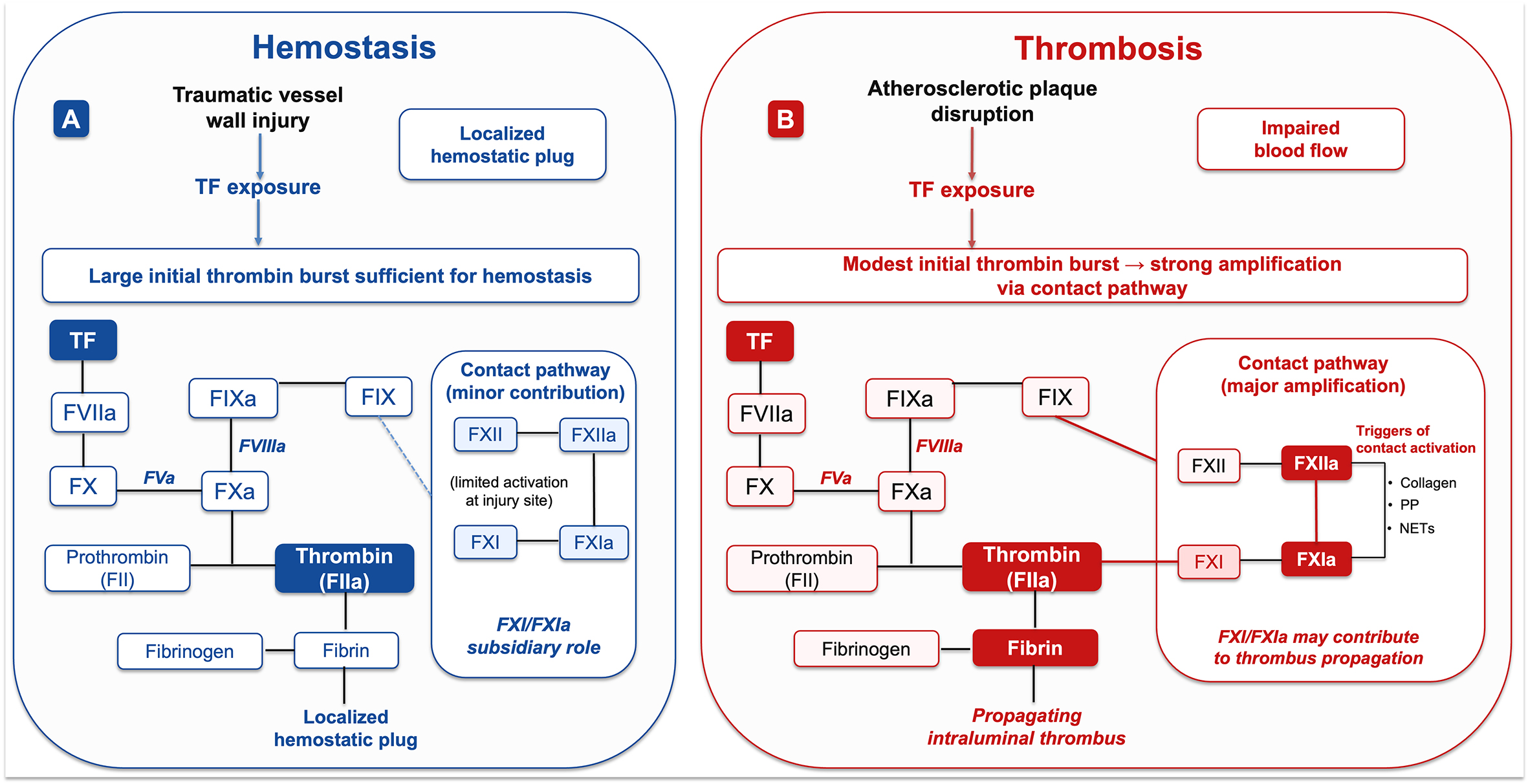
Figure 1. Pathological thrombosis versus physiological hemostasis. This schematic illustrates the differential contribution of FXI/FXIa to physiological hemostasis and pathological thrombosis. (A) shows hemostasis after traumatic vessel wall injury. TF exposure initiates coagulation and generates a large initial thrombin burst sufficient for localized hemostatic plug formation. In this setting, the contact pathway and FXI/FXIa-mediated amplification play a subsidiary role. (B) shows thrombosis after atherosclerotic plaque disruption. TF exposure initiates coagulation, but the initial thrombin burst is relatively modest and requires stronger amplification through the contact pathway. Contact activation triggers, including collagen, NETs, and PP, promote FXII/FXIIa and FXI/FXIa activation, thereby amplifying thrombin generation and supporting propagating intraluminal thrombus formation. FII: prothrombin; FIIa: thrombin; FIX: factor IX; FIXa: activated factor IX; FX: factor X; FXa: activated factor X; FXI: factor XI; FXIa: activated factor XI; FXII: factor XII; FXIIa: activated factor XII; FVa: activated factor V; FVIIIa: activated factor VIII; NETs: neutrophil extracellular traps; PP: polyphosphate; TF: tissue factor.