

Green tea consumption and hepatocellular carcinoma: a meta-analysis lacking evidence for a protective effect
 0
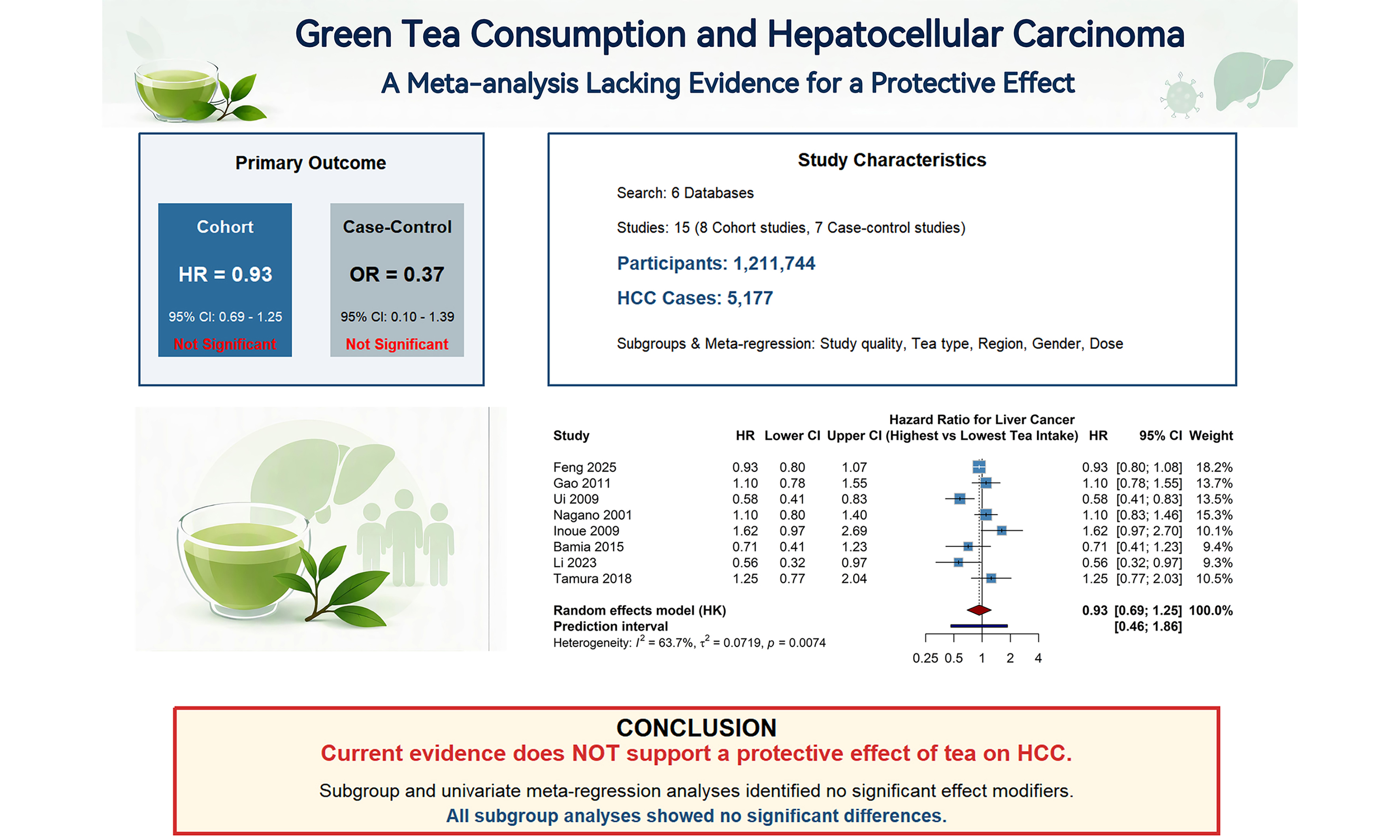
0 Graphical Abstract
Abstract
Aim: The association between green tea consumption and hepatocellular carcinoma (HCC) risk remains controversial. This meta-analysis aimed to quantify this association using rigorous epidemiological evidence.
Methods: Six electronic databases (PubMed, Embase, Cochrane Library, SinoMed, CNKI, and Wanfang Data) were searched for studies published up to December 2025. Study quality was assessed using the Newcastle-Ottawa Scale, and only studies with a score ≥ 6 were included. Heterogeneity was quantified by I2, and pooled hazard ratio (HR) and odds ratio (OR) with 95% confidence intervals (CI) were calculated using random-effects models with the Hartung-Knapp-Sidik-Jonkman method. Subgroup analyses and meta-regression were conducted by study quality, tea type, region, sex, and dose, and by adjustment for 11 potential confounders, including hepatitis B virus and body mass index. Sensitivity analysis was performed using the leave-one-out method to assess the robustness of the pooled estimates. Publication bias was examined using funnel plots, Egger’s test, and Begg’s test.
Results: Fifteen studies, including 8 cohort studies and 7 case-control studies, comprising 1,211,744 participants with 5,208 HCC cases, were eligible. For cohort studies, the pooled HR for HCC associated with tea consumption was 0.93 (95%CI: 0.69-1.25). For case-control studies, the pooled OR was 0.37 (95%CI: 0.10-1.39). Neither was statistically significant. Subgroup analyses showed no significant association for any examined factor, including study quality, tea type, sex, and dose. However, a statistically significant ass ociation was observed in the European subgroup (HR = 0.41, P = 0.0058), although this finding was based on a single study and should be considered exploratory. Leave-one-out sensitivity analysis confirmed the robustness of the findings. No obvious publication bias was observed.
Conclusion: In the overall pooled analysis of cohort studies, current evidence, derived predominantly from East Asian populations, does not support a causative effect of tea consumption on HCC, although a modest protective effect cannot be completely ruled out based on the available data. Further rigorous studies are needed to clarify this relationship.
Keywords


 Download PDF
INTRODUCTION
Hepatocellular carcinoma (HCC), the most common type of primary liver cancer, is one of the leading causes of cancer-related mortality worldwide[1,2]. East Asia carries the highest burden of HCC, with age-standardized incidence rates ranging from 8.5 to 14.7 per 100,000 population[3], where hepatitis B virus (HBV) infection is the predominant cause of HCC-related mortality[4]. HCC is a complex, multifactorial disease involving interactions between genetic and environmental factors[5-8]. In addition to well-established risk factors for HCC including HBV infection, hepatitis C virus (HCV) infection, aflatoxin exposure, and alcohol consumption[9-11], evidence from nutritional epidemiology revealed the important role of lifestyle factors in HCC development and prevention[12,13].
Tea is one of the most widely consumed beverages globally and is rich in polyphenolic compounds, particularly catechins. These compounds exhibit multiple potential anti-cancer biological activities, including antioxidant, anti-inflammatory, anti-proliferative, and detoxification enzyme-regulating effects[14]. However, experimental evidence from cellular and animal studies is insufficient to establish a protective effect at the population level. Epidemiological evidence regarding the association between tea consumption and HCC risk remains inconclusive.
Numerous epidemiological studies have explored the association between tea consumption and HCC risk. Most of these studies examined tea consumption as one component of a broader dietary pattern, with relatively few focusing on tea as an independent exposure. Among existing studies, certain case-control and prospective cohort studies reported a significant inverse association between green tea or black tea consumption and reduced HCC risk[15,16], whereas others found no statistically significant association[17,18]. Inconsistent results have also been observed in specific populations, such as individuals with concomitant hepatitis virus infection or excessive alcohol consumption. This heterogeneity may be attributed to differences in study design, tea type, dose-response relationship, confounding factor control, and baseline liver disease status across study populations. Thus, whether tea consumption is an independent protective factor against HCC remains controversial. This meta-analysis aimed to synthesize current epidemiological evidence, quantitatively evaluate the strength of the association between tea consumption and HCC, and explore effect modification by tea type, sex, dose, and study quality through subgroup analyses.
METHODS
Literature search strategy
The literature search followed the Preferred Reporting Items for Systematic Reviews and Meta-Analyses (PRISMA) 2020 Statement. Six electronic databases (PubMed, Embase, Cochrane Library, SinoMed, CNKI, and Wanfang Data) were systematically searched, supplemented by manual search of gray literature including dissertations and conference proceedings. Original research papers investigating the association between HCC risk and tea intake, published before December 15, 2025, were eligible for inclusion. The full search strategies for all databases are provided in Supplementary Table 1. The full search strategy for PubMed was as follows: (“Liver Neoplasms”[Mesh] OR “Hepatocellular Carcinoma”[Mesh]) AND (“Tea”[Mesh] OR “Tea, Green”[Mesh] OR “Tea, Black”[Mesh]) OR (liver cancer OR hepatoma OR hepatic neoplasm) AND (tea OR green tea OR black tea OR tea polyphenol OR catechin). Similar strategies were adapted for other databases. This review was registered in Prospective Register of Systematic Reviews (PROSPERO) (CRD420261343011).
Inclusion and exclusion criteria
Studies were eligible for inclusion if they met all the following criteria: (1) published in English or Chinese; (2) publicly available population-based cohort studies or case-control studies investigating the association between tea consumption and HCC; (3) HCC cases in the study were confirmed by pathological examination or imaging diagnosis, or through validated cancer registries/International Classification of Diseases (ICD) coding systems with established diagnostic accuracy; (4) original studies provided data on the association between tea intake and HCC risk, including odds ratio (OR) or hazard ratio (HR) with corresponding 95% confidence interval (CI), or sufficient data to calculate the above effect estimates; (5) only studies with HCC as the target outcome were included. Studies were excluded based on the following criteria: (1) reviews, meta-analyses, conference abstracts and other types of studies without original primary data; (2) non-population-based studies including animal experiments and in vitro cell experiments; (3) studies with a sample size of less than 10; (4) studies with incomplete or erroneous data that cannot be corrected or supplemented; (5) for multiple publications from the same research team based on the same study population, only the study with the largest sample size and longest follow-up duration was included to avoid duplicate data bias.
Study selection and data extraction
Literature screening was performed independently by two trained researchers (Ling ST, Xie LZ) according to the pre-specified inclusion and exclusion criteria. Irrelevant records were first excluded based on title and abstract screening. The remaining potentially eligible records were subsequently evaluated via full-text review to determine the final inclusion. Disagreements between the two researchers were resolved by discussion; if no consensus was reached, a third senior researcher was consulted for final adjudication.
Two researchers independently assessed the methodological quality of the included cohort studies and case-control studies using the Newcastle-Ottawa Scale (NOS). Detailed evaluation criteria are provided in Supplementary Table 2. The NOS evaluates studies from three dimensions: selection of study participants, comparability between study groups, and ascertainment of exposure or outcome, with a maximum score of 9. An adapted version of the NOS was used, allowing 0.5-point increments for individual criteria to better discriminate between studies that partially met specific criteria; this adaptation was pre-specified in the study protocol and applied consistently by two independent reviewers. Only studies with a total score of ≥ 6 were included; studies were categorized as high (H: ≥ 8), medium (M: 7.5), or low (L: 6 to < 7.5) quality based on NOS scores. The average of the scores assigned by the two independent reviewers was adopted as the final score, rounded to one decimal place. If the score difference between the two reviewers was ≥ 1 point, a third researcher was invited for arbitration.
Data extraction was similarly conducted independently by two researchers. The extracted information included: first author, publication year, country/region, study design, sample size, participant baseline characteristics, tea type and exposure assessment, definition of outcome events, effect estimates (HR or OR with 95%CI), and adjustment for confounders. For studies reporting multiple effect estimates, the estimate fromthe most fully adjusted model was selected for the primary meta-analysis. Whermultiple exposure contrasts were available, the comparison of the highestversus the lowest dose category was used. If several follow-up durations were reported, tihe estimate with the longest follow-up was selected. The detailed data extraction form is shown in Supplementary Table 3. Disagreements during data extraction were resolved using the same procedure as for literature screening.
Statistical analysis
All statistical analyses were conducted using the metafor package (v4.8-0) in R (v4.5.3). Effect estimates were extracted separately for cohort studies and case-control studies. For cohort studies, we extracted HR or risk ratios (RR) as reported; for case-control studies, we used OR. No overall pooled estimate combining both study designs was calculated. Instead, subgroup analyses were performed in cohort studies.
Heterogeneity was evaluated using the Q test and I2 statistic. Given expected between-study heterogeneity and the relatively small number of studies (≤ 10 per analysis), a random-effects model was applied for all pooled analyses. The Hartung-Knapp-Sidik-Jonkman (HKSJ) method was used as the primary approach, as the DerSimonian-Laird (DL) method often yields inflated type I error rates when the number of studies is small[19].
To explore potential effect modifiers and sources of heterogeneity, we performed subgroup analyses and univariate meta-regression for cohort studies stratified by predefined covariates: study quality, tea type, geographic region, sex, and dose category (the latter based on within-study tertiles without cross-study standardization). Given the limited number of studies (k = 8), these analyses were exploratory and underpowered; no multivariable meta-regression was performed. Random-effects models with the Hartung-Knapp adjustment were used for all analyses; meta-regression additionally estimated the proportion of between-study variance explained (R²) by each covariate.
Categorical trend analysis was performed for cohort studies using a within-study categorization approach. Tea consumption levels in each study were classified into three ordered categories (low, medium, high) based on the reported dose groups, with the lowest category as the reference. For studies reporting three or more dose groups, effect estimates for the low, medium, and high groups were extracted. For studies reporting only two dose levels, only the low and high groups were extracted. Pooled effect estimates for each dose level were then calculated using random-effects models. To evaluate the trend across exposure categories, ordinal scores (1, 2, 3) were assigned to low, medium, and high levels, and meta-regression was performed. P-value for the slope was reported as the trend P-value.
To examine whether control for key confounders affected the overall estimates, subgroup analyses were stratified by whether individual studies had adjusted for each of the following predefined covariates: body mass index (BMI), coffee consumption, diabetes, education, family history of liver cancer, HBV infection, HCV infection, income, liver disease, physical activity, and sex. For each covariate, studies were classified into “Adjusted” (the factor included in multivariable adjustment) and “Not adjusted” (the factor not adjusted for). Pooled effect sizes (HR) with 95%CIs were calculated using random-effects models. When only one study was available in a subgroup, the estimate was presented descriptively. Interaction between subgroups was tested using meta-regression (P < 0.05 indicating significant modification). This analysis was restricted to cohort studies due to the limited number of case-control studies.
Sensitivity analysis was performed using the leave-one-out method. Publication bias was evaluated by funnel plot, Egger’s regression test, and Begg’s rank correlation test (P < 0.05 indicating significant publication bias).
RESULTS
Literature search results and screening process
A total of 2,868 records were retrieved. After removing 920 duplicates, 1,948 records remained for title and abstract screening. After excluding 1,880 ineligible records, 68 underwent full-text review, of which 42 were excluded. After further excluding 4 studies with overlapping populations and 7 low-quality studies, 15 studies were finally included [Figure 1].
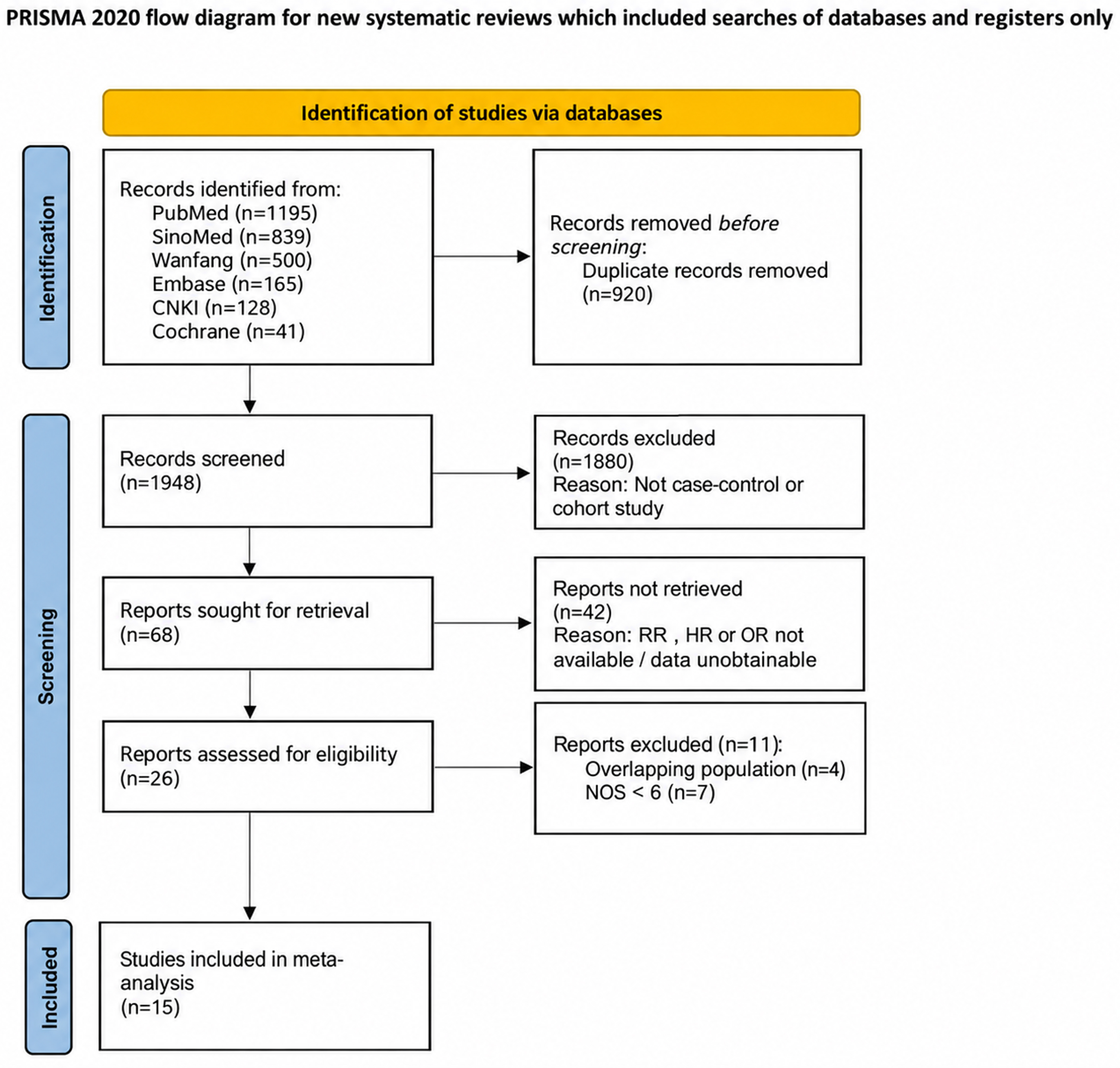
Figure 1. Four-stage flowchart of study selection according to the PRISMA Statement. PRISMA: Preferred Reporting Items for Systematic Reviews and Meta-Analyses.
Included studies
A total of 15 studies (8 cohort studies and 7 case-control studies) were included in this meta-analysis. Among them, 14 were peer-reviewed articles published in academic journals, and one was a doctoral dissertation from Fudan University[20]. Geographically, 13 studies were conducted in Asia (9 in China, 4 in Japan), and 2 were carried out in Europe (1 in Italy, 1 multinational study). The total sample size was 1,211,744 participants, including 5,208 HCC cases, with individual study sample sizes ranging from 200 to 482,292.
Regarding exposure factors, among the 15 included studies, 10 assessed green tea consumption, 4 assessed unspecified tea types, 4 assessed mixed tea, 3 assessed black tea, 2 assessed other tea types (including oolong or herbal tea), and 1 assessed jasmine tea. Since several studies reported on more than one tea type, the sum of these counts exceeds the total number of studies. For subgroup analyses stratified by tea type, each study was classified according to its primary tea type of interest as defined in the original study, ensuring that each study contributed only one effect estimate to a given subgroup analysis to preserve statistical independence. Exposure assessment was performed using self-administered Food Frequency Questionnaires (FFQs) in seven studies, face-to-face interviews in seven studies, and urinary biomarker measurement in one study. For liver cancer diagnosis, 6 studies adopted pathological examination or combined imaging and clinical diagnosis as the confirmation criteria, and 9 studies determined outcomes based on cancer registration systems or ICD coding. In these 9 studies, the registry- or ICD-based outcome ascertainment was derived from well-validated cancer registries or hospital record systems, where HCC diagnoses were originally confirmed by pathological examination or imaging in clinical practice. All included studies adjusted for confounding factors including smoking and alcohol consumption. Eleven studies further adjusted for sex, seven for education, and twelve for HBV or HCV infection status.
For methodological quality assessment, based on the NOS, the average score of included cohort studies was 8.0, and the average score of case-control studies was 7.2, indicating high overall quality of the included studies. The baseline characteristics of all included studies are detailed in Table 1.
Baseline characteristics of included studies
| No. | Author (year) | Area | Study design | Participation (n) | Cases (n) | Male (%) | Median age (range) | Median follow-up (years) | Main tea type | Exposure assessment method | Adjustment factors | Quality (NOS) |
| 1 | Feng et al., 2025[17] | China | Prospective cohort | 482,292 | 398 | 41.1 | 52 (30-79) | 10.1 | Mixed | Interview | ①②③④⑤⑥⑦⑧⑨⑩⑪⑫ | H |
| 2 | Ui et al., 2009[15] | Japan | Prospective cohort | 41,761 | 247 | 47.3 | 59 (40-79) | 9 | Green tea | FFQ | ①②③⑫⑬ | L |
| 3 | Nagano et al., 2001[21] | Japan | Prospective cohort | 38,540 | 418 | 38.6 | 55 (40-69) | 10 | Green tea | Questionnaire | ①②③⑥⑭ | L |
| 4 | Inoue et al., 2009[22] | Japan | Prospective cohort | 18,815 | 110 | 34.1 | 55 (40-69) | 12.7 | Green tea | FFQ | ①②④⑤⑥⑩⑬⑮ | H |
| 5 | Bamia et al., 2015[18] | 10 European countries | Prospective cohort | 450,921 | 201 | 41.1 | 48 (25-70) | 11 | Mixed | FFQ | ①②③⑥⑨⑩⑫⑬ | H |
| 6 | Gao, 2011[20] | China | Prospective cohort | 61,500 | 111 | 100 | 57 (40-74) | 11.8 | Mixed | Questionnaire | ①②③④⑥⑦⑨⑪⑩⑰ | H |
| 7 | Li et al., 2023[23] | China | Prospective cohort | 71,841 | 253 | 0 | 55 (40-70) | 18.1 | Mixed | Interview | ①②③⑥⑦⑨⑪⑩⑫⑰ | H |
| 8 | Tamura et al., 2018[24] | Japan | Prospective cohort | 30,824 | 62 | 46.2 | 55 (35-79) | 16 | Green tea | FFQ | ①②③⑥⑨⑩⑫ | L |
| 9 | Butler et al., 2015[25] | China | Nested case-control | 1,278 | 211 | 100 | 55 (45-64) | NA | Green tea | Urinary biomarker | ④⑪ | M |
| 10 | Duan and Zhang, 2018[26] | China | Case-control | 794 | 330 | 81.2/76.1 | 54 (20-80) | NA | NR | Interview | ③④⑧⑪ | L |
| 11 | Lin et al., 2017[27] | China | Case-control | 1,818 | 757 | 87.3/87.9 | 55 (35-70) | NA | NR | Interview | ④⑧⑯ | M |
| 12 | Song et al., 2014[28] | China | Case-control | 200 | 100 | 86/86 | 51 (35-70) | NA | NR | Interview | ④⑧ | L |
| 13 | Liu et al., 2025[29] | China | Case-control | 9,944 | 1,621 | 76.3/71.9 | ≥ 18 | NA | Mixed | Interview | ①②③④⑤⑥⑦⑧ | M |
| 14 | Li et al., 2011[30] | China | Case-control | 619 | 204 | 76.0/64.1 | ≥ 20 | NA | Green tea | Interview | ①②③④⑥⑦⑧ | M |
| 15 | Montella et al.,2007[31] | Italy | Case-control | 597 | 185 | 80.5/68.2 | 66 (43-84) | NA | NR | FFQ | ①②③④⑤ | M |
Meta-analysis of tea consumption and HCC risk
Using the HKSJ method, cohort studies showed no statistically significant association between tea consumption and HCC risk, with a pooled HR of 0.93 (95%CI: 0.69-1.25). Heterogeneity among cohort studies was substantial (I2 = 63.7%, τ2 = 0.072, P = 0.0074); therefore, a random-effects model was used [Figure 2]. Given the substantial heterogeneity (I2 = 91.9%) and very wide CI, the case-control results should be interpreted with extreme caution and are presented here as a sensitivity analysis only, not as primary evidence [Supplementary Figure 1]. Due to the substantial differences in study design and effect estimates, no overall pooled estimate combining both designs was calculated.
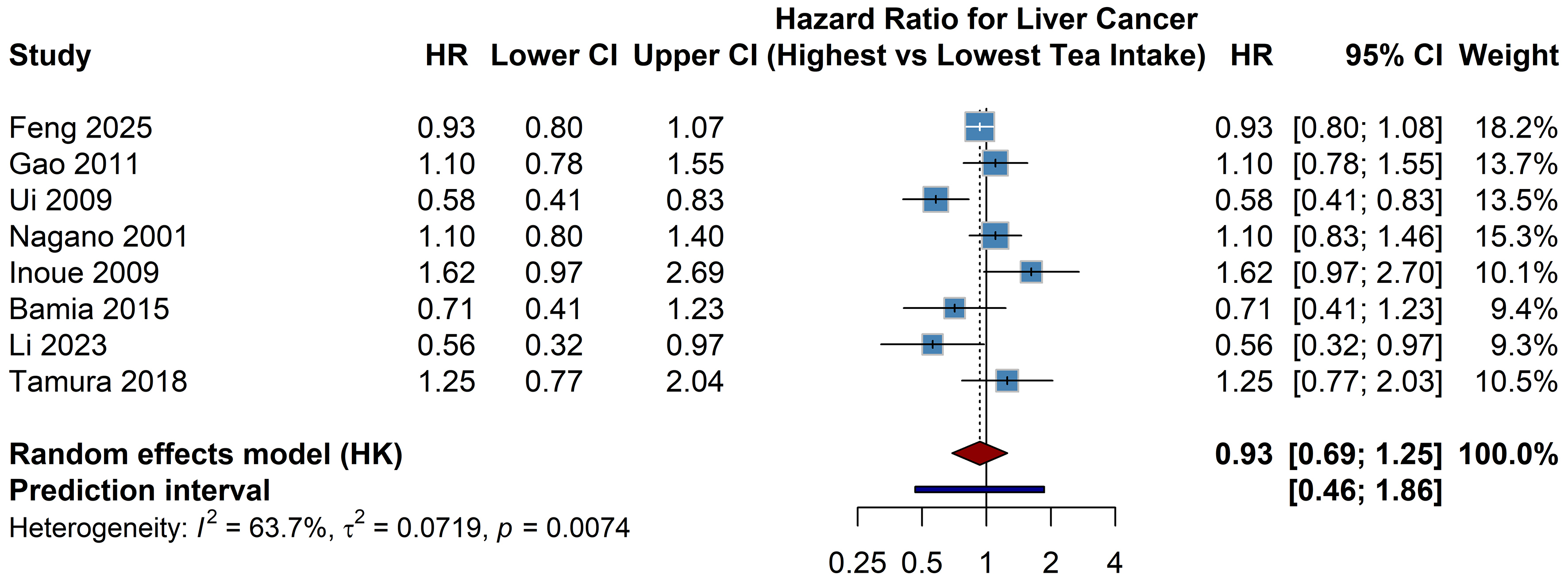
Figure 2. Forest plot of the association between tea consumption and risk of liver cancer in cohort studies; Random-effects models were fitted using the HKSJ method. CI: Confidence intervals; HKSJ: Hartung-Knapp-Sidik-Jonkman; HR: hazard ratio.
Exploration of heterogeneity and sensitivity analyses
Given the substantial heterogeneity observed in the overall meta-analysis (cohort studies: I2 = 63.7%; case-control studies: I2 = 91.9%), subgroup analyses were performed for cohort studies stratified by study quality, tea type, geographic region, sex, and dose level [Table 2 and Supplementary Figures 2-6]. In most subgroups, no statistically significant association was observed (P > 0.05). However, the European subgroup, which included only a single study (Bamia et al.), showed a potential protective effect (HR = 0.41, 95%CI: 0.22-0.77, P = 0.0058)[18]. Given that this finding is derived from only one study and has a very wide CI, it should be interpreted as exploratory rather than confirmatory. This finding requires replication in larger, multi-center European cohorts. Heterogeneity remained high in most subgroups (I2 range: 51.8%-92.8%). The Baujat plot [Supplementary Figure 7] further explored individual study contributions to overall heterogeneity.
Subgroup analysis of the association between tea consumption and HCC risk
| Group | Number of studies | HR (95%CI) | P | Heterogeneity test | ||
| τ 2 | I 2 (%) | P | ||||
| NOS scores | ||||||
| H | 5 | 0.84 (0.46,1.52) | 0.4630 | 0.1508 | 69.5 | 0.0107 |
| L | 3 | 0.87 (0.33,2.24) | 0.5806 | 0.1049 | 72.9 | 0.0250 |
| Tea type | ||||||
| Green tea | 4 | 1.04 (0.52-2.08) | 0.8646 | 0.1478 | 78.3 | 0.0031 |
| Other tea | 4 | 0.89 (0.62-1.28) | 0.3841 | 0.0113 | 39.8 | 0.1730 |
| Geographic region | ||||||
| China | 3 | 0.91 (0.46,1.80) | 0.6006 | 0.0243 | 51.8 | 0.1258 |
| Japan | 4 | 0.97 (0.51,1.83) | 0.8718 | 0.1153 | 72.2 | 0.0129 |
| Europe | 1 | 0.41 (0.22,0.77) | 0.0058 | |||
| Gender | ||||||
| Male | 3 | 0.92 (0.39,2.15) | 0.7201 | 0.0669 | 56 | 0.1031 |
| Female | 3 | 0.63 (0.19,2.04) | 0.2336 | 0.0344 | 42.2 | 0.1777 |
| Dose* | ||||||
| Low | 8 | 0.95 (0.85,1.06) | 0.3034 | 0.0058 | 16.3 | 0.3014 |
| Moderate | 8 | 0.94 (0.78,1.14) | 0.4713 | 0.0065 | 40.2 | 0.1108 |
| High | 8 | 0.86 (0.66,1.11) | 0.3162 | 0.0962 | 66.7 | 0.0037 |
Univariate meta-regression analyses were further performed to formally test whether the five prespecified covariates explained the heterogeneity among cohort studies [Table 3]. None of the examined factors - geographic region, NOS score, tea type, sex, or dose level - was significantly associated with the effect estimates (all P > 0.05). The R2 values were 0 for most covariates, indicating that these factors individually accounted for little to none of the observed between-study variance.
Univariate meta-regression analyses of study-level covariates for the association between tea consumption and hepatocellular carcinoma risk
| Covariate | Subgroup (Comparison vs. Reference) | β (95%CI)* | P* | R2 (%) |
| Geographic region | ||||
| Japan vs. China | 0.177 (-0.588,0.942) | 0.578 | 0 | |
| Europe vs. China | -0.200 (-1.471,1.071) | 0.702 | 0 | |
| NOS scores | Low vs. High | -0.024 (-0.710,0.662) | 0.934 | 0 |
| Tea type | Other tea vs. Green tea | -0.019 (-0.809,0.770) | 0.954 | 0 |
| Sex | Female vs. Male | -0.362 (-1.308,0.584) | 0.348 | NE† |
| Dose | ||||
| Medium vs. Low | 0 (-0.269,0.269) | 1.000 | 0 | |
| High vs. Low | -0.028 (-0.349,0.203) | 0.590 | 0 | |
Sensitivity analysis using the leave-one-out method showed that after excluding each study individually, the pooled HR for cohort studies varied from 0.88 (95%CI: 0.66-1.17) to 1.00 (95%CI: 0.78-1.29) [Supplementary Table 4]. None of these recalculated pooled estimates reached statistical significance (all P > 0.05), confirming the robustness of the null association.
We further examined whether adjustment for specific confounders influenced the association between tea consumption and HCC risk. Studies were stratified by whether they adjusted for 11 pre-specified covariates: BMI, coffee consumption, diabetes, education, family history of liver cancer, HBV infection, HCV infection, income, liver disease, physical activity, and sex. Detailed adjustment factors for each included study are presented in Supplementary Table 5 and Supplementary Figures 8-16. For each factor, pooled effect estimates did not differ significantly between the “adjusted” and “not adjusted” subgroups (all interaction P > 0.05; range: 0.114-0.930). For covariates where only one study was available in a subgroup (BMI not adjusted and HCV adjusted), pooled estimates were not calculable (Supplementary Table 6, composite forest plot in Supplementary Figure 17). However, these subgroup comparisons should be interpreted with caution, as several subgroups contained only one or two studies, limiting statistical power.
Publication bias
Publication bias was assessed using funnel plots, Egger’s regression test, and Begg’s rank correlation test. Funnel plots [Figure 3] showed a generally symmetric distribution of effect sizes. Neither Egger’s test (P = 0.923) nor Begg’s test (P = 0.720) indicated significant publication bias.
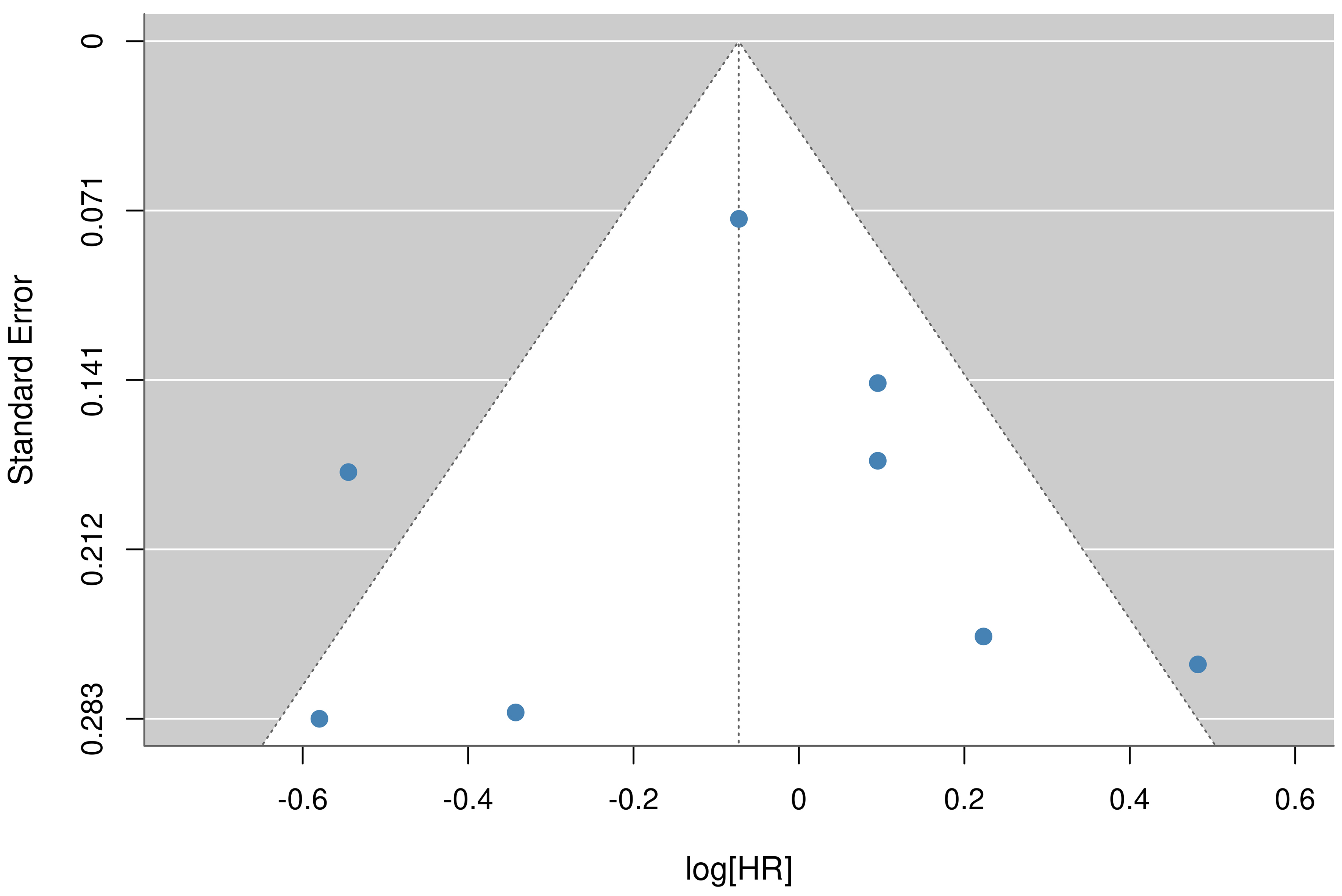
Figure 3. Funnel plot for publication bias of studies on tea consumption and liver cancer risk. The horizontal axis represents the logHR, and the vertical axis represents the SE. The vertical dashed line indicates the pooled effect estimate from the random-effects model. The diagonal dotted lines represent the 95%CI around the pooled effect. Symmetry was assessed using Egger’s test (P = 0.923), suggesting no significant publication bias. No trim-and-fill adjustment was applied. CI: Confidence interval; log[HR]: log hazard ratio; SE: standard error.
DISCUSSION
This meta-analysis found no robust evidence for a protective effect of tea consumption against HCC. After pooling all eligible studies, no statistically significant association between tea consumption and HCC risk was observed in either cohort studies (HR = 0.93, 95%CI: 0.69-1.25) or case-control studies (OR = 0.37, 95%CI: 0.10-1.39). Subgroup analyses did not identify any consistent effect modifier (all interaction P > 0.05). Although a single European study suggested a potentially protective effect (HR = 0.41, 95%CI: 0.22-0.77), this result should be interpreted with caution given the limited number of studies in that subgroup. Moreover, meta-regression did not support geographic region as a significant source of heterogeneity (P = 0.702), suggesting that this isolated finding is likely attributable to chance or single-study influence rather than a true regional difference.
Between-study heterogeneity was substantial (I2 = 63.7% in cohort studies, 91.9% in case-control studies), reflecting the diverse methodologies across primary studies. Meta-regression did not identify significant sources of this heterogeneity, likely due to the limited number of studies (k = 8), which reduces statistical power to detect true effect modifiers. This heterogeneity may partly explain why meta-analyses on this topic have reached inconsistent conclusions. Our null finding is consistent with that reported by Zhao et al. but differs from that reported by Li et al. who reported a significant inverse association for green tea (RR = 0.85, 95%CI: 0.74-0.91)[32,33]. Several methodological issues common to observational studies of tea and HCC may contribute to these conflicting results. First, residual confounding is difficult to eliminate. Tea drinking is often correlated with healthier lifestyles, including higher education, less smoking or alcohol, and more exercise. Many primary studies have not adequately adjusted for these factors. Second, standardized quantitative measures of tea exposure, including type, dose, brewing method, and duration of drinking are lacking. Third, hepatocarcinogenesis typically requires decades of exposure, but most cohort studies may have insufficient follow-up to capture long-term risk. Moreover, as noted by a methodological review[34], directly pooling RRs and ORs without stringent quality control can introduce bias. The present meta-analysis applied stricter inclusion criteria, including multivariable-adjusted estimates and clearly defined tea consumption metrics, to mitigate this issue.
Beyond confounding and measurement issues, biological factors also limit the potential anti-HCC effect of tea. Although experimental studies have suggested that tea polyphenols, particularly epigallocatechin gallate (EGCG), may exert anti-HCC effects through antioxidant, anti-inflammatory, and pro-apoptotic pathways[35-42], these findings from controlled experimental conditions do not translate well to real-world settings. Several factors constrain the actual efficacy of tea consumption. First, tea polyphenols undergo extensive metabolic transformation before reaching the liver, leaving only a limited fraction of active compounds available[43,44]. This low bioavailability fundamentally constrains the realworld anti-HCC efficacy of tea components. Second, individuals at high risk of HCC, particularly those with obesity or metabolic syndrome, not only exhibit significantly reduced absorption of EGCG[45] but also face greater difficulty in achieving effective accumulation in liver tissue[46]. Third, most previous mechanistic studies have relied on monolayer cell cultures to suggest potential anti-tumor effects of EGCG; however, recent evidence indicates that its activity is substantially attenuated in three-dimensional models that more closely recapitulate the in vivo tumor microenvironment[47], suggesting the efficacy of EGCG may be overestimated in more complex tumor settings. Adding to the complexity, high-dose green tea extracts have also been linked to herb-induced liver injury (HILI), with causality verified via the Roussel Uclaf Causality Assessment Method (RUCAM) assessment[48,49]. This dual role suggests that the biological impact of tea components is more complex than simple chemoprevention, which aligns with earlier editorials emphasizing that despite encouraging in vitro findings, clinical translation remains unproven and requires cautious interpretation[50,51].
Several limitations should be acknowledged. First, the included case-control studies may be subject to recall and selection bias, and some cohort studies had relatively short follow-up durations, which may be insufficient to capture the long-term cumulative risk of HCC. Second, most included studies were conducted in China and Japan, with only one European study and none from Africa or the Americas. This limits the generalizability of our findings to populations with different tea consumption patterns, genetic backgrounds, or liver cancer etiologies including aflatoxin-related HCC in sub-Saharan Africa. Third, the categorical trend analysis was limited by the lack of uniform dose metrics. Because units for tea intake (cups, grams, or mL) and brewing methods varied substantially, we could not perform a robust restricted cubic spline (RCS) analysis, which requires continuous standardized dose data. We therefore used a within-study categorical trend method, which should be interpreted as exploratory. Additionally, the lack of standardized definitions for “high intake” across studies inevitably introduced non-differential exposure misclassification, which typically attenuates true associations toward the null. This represents a key methodological limitation that may partly explain the observed null findings.
In conclusion, this meta-analysis found no statistically significant association between tea consumption and HCC risk based on prospective cohort studies. Although a statistically significant association was observed in the European subgroup (HR = 0.41, P = 0.0058), this finding was based on a single study and should be considered exploratory. The case-control estimates, limited by extreme heterogeneity and imprecision, provide insufficient evidence and should not be overinterpreted. Therefore, based on current evidence, tea consumption cannot be recommended for HCC prevention, and no causative effect has been established.
DECLARATIONS
Authors’ contributions
Conceptualised the study: Cao G
Contributed to the study design: Cao G, Xi Y
Led the drafting of the manuscript and analysis: Ling S, Xie L
Contributed to the interpretation of the data: Ling S, Xie L, Liu W, Cao G
Critically revised the manuscript for important intellectual content: Cao G, Liu W, Xi Y
Funding acquisition: Cao G
Visualisation: Ling S, Xie L
All authors have read and agreed to the published version of the manuscript.
Availability of data and materials
The data generated in this study are available within the article and its Supplementary Materials.
AI and AI-assisted tools statement
Not applicable.
Financial support and sponsorship
This work was supported by the 2030 Key Program for Chronic Diseases in China (2023ZD0500100) and the National Natural Science Foundation of China (82473715, 82373671).
Conflicts of interest
Cao G is the Editor-in-Chief of the journal Hepatoma Research. Cao G was not involved in any stage of the editorial process, including the selection of reviewers, manuscript handling, or decision-making. The other authors declare that there are no conflicts of interest.
Ethical approval and consent to participate
Not applicable.
Consent for publication
Not applicable.
Copyright
© The Author(s) 2026.
Supplementary Materials
REFERENCES
1. Ma T, Lu Y, Liu K, et al. Global, regional, and national burden of liver cancer attributable to high BMI, 1990-2021, with future projections to 2040. Front Oncol. 2025;15:1630875.
2. Li P, Ding Z, Feng Y, et al. Global, regional, and national burden of hepatocellular carcinoma and contribution of nine modifiable risk factors across 185 countries/territories in 2022. Sci Bull. 2026;71:838-49.
3. Mauro E, de Castro T, Zeitlhoefler M, et al. Hepatocellular carcinoma: epidemiology, diagnosis and treatment. JHEP Rep. 2025;7:101571.
4. Hsu YC, Huang DQ, Nguyen MH. Global burden of hepatitis B virus: current status, missed opportunities and a call for action. Nat Rev Gastroenterol Hepatol. 2023;20:524-37.
5. Pelizzaro F, Ferrarese A, Gambato M, et al. Hepatocellular carcinoma recurrence after liver transplantation: risk factors, targeted surveillance and management options. Hepatoma Res. 2024;10:44.
6. Zhang X, Zhao L, Campbell PT, et al. The impact of genetic and environmental risk factors on adverse liver outcomes. Int J Cancer. 2026;158:2317-28.
7. Llovet JM, Kelley RK, Villanueva A, et al. Hepatocellular carcinoma. Nat Rev Dis Primers. 2021;7:6.
8. Akinyemiju T, Abera S, Ahmed M, et al. ; Global Burden of Disease Liver Cancer Collaboration. The burden of primary liver cancer and underlying etiologies from 1990 to 2015 at the global, regional, and national level: results from the global burden of disease study 2015. JAMA Oncol. 2017;3:1683-91.
9. Pu R, Liu W, Zhou X, et al. The effects and underlying mechanisms of hepatitis B virus X gene mutants on the development of hepatocellular carcinoma. Front Oncol. 2022;12:836517.
10. Chen JG, Kensler TW, Sun GJ, et al. Aflatoxin and liver cancer in China: the evolving research landscape. Toxins. 2026;18:61.
11. Tan J, Xing Z, Zu J, et al. Global burden of liver cancer mortality due to alcohol use from 1990 to 2021 and predictions to 2050. Hepatoma Res. 2026;12:31.
12. Tan J, Li Z, Shen Q, et al. Associations between physical activity and risk of liver cancer: results from a population-based cohort study in Chinese women. Hepatoma Res. 2024;10:1.
13. Zhou Y, Li Y, Zhou T, Zheng J, Li S, Li HB. Dietary natural products for prevention and treatment of liver cancer. Nutrients. 2016;8:156.
15. Ui A, Kuriyama S, Kakizaki M, et al. Green tea consumption and the risk of liver cancer in Japan: the Ohsaki Cohort study. Cancer Causes Control. 2009;20:1939-45.
16. Kim TL, Jeong GH, Yang JW, et al. Tea consumption and risk of cancer: an umbrella review and meta-analysis of observational studies. Adv Nutr. 2020;11:1437-52.
17. Feng X, Li R, Yan M, Yuan C, Wu Y. Alcohol and tea consumption in relation to liver cancer risk by diabetes status: a prospective cohort study of 0.5 million Chinese adults. Nutrients. 2025;17:2870.
18. Bamia C, Lagiou P, Jenab M, et al. Coffee, tea and decaffeinated coffee in relation to hepatocellular carcinoma in a European population: multicentre, prospective cohort study. Int J Cancer. 2015;136:1899-908.
19. IntHout J, Ioannidis JP, Borm GF. The Hartung-Knapp-Sidik-Jonkman method for random effects meta-analysis is straightforward and considerably outperforms the standard DerSimonian-Laird method. BMC Med Res Methodol. 2014;14:25.
20. Gao S. Epidemiological study of primary liver cancer in urban Shanghai. Ph.D. Dissertation, Fudan University, 2011. (in Chinese) Available from https://kns.cnki.net/kcms2/article/abstract?v=tQWh-SbE9Gpp101axFGWPn2dvLsbbwqd-KLiAsHLY-uswmYpCWNn3T_fOBoJ0qwCN0gBHDTihNdcrDAgTTx6_bQrpmTDNZlY90_Q5gqTrWR5GdmRqAbyuEISsYz_VHZ6TZLAX5vIJmUErL_b0dzUvXCC2dkTVi4rsGEZ3GrJp_bs8FXujhix_H9FhNrQNJrT_nObPgabg2o&uniplatform=NZKPT&captchaId=5da905f0-da7f-41da-b273-8e80d2d56fd5 [accessed 24 September 2026].
21. Nagano J, Kono S, Preston DL, Mabuchi K. A prospective study of green tea consumption and cancer incidence, Hiroshima and Nagasaki (Japan). Cancer Causes Control. 2001;12:501-8.
22. Inoue M, Kurahashi N, Iwasaki M, et al. ; Japan Public Health Center-Based Prospective Study Group. Effect of coffee and green tea consumption on the risk of liver cancer: cohort analysis by hepatitis virus infection status. Cancer Epidemiol Biomarkers Prev. 2009;18:1746-53.
23. Li ZY, Tan YT, Liu DK, Gao LF, Li HL, Xiang YB. Cumulative consumption of tea is associated with lower risk of liver cancer: updated results from the Shanghai Women’s Health Study. Int J Cancer. 2023;152:1115-23.
24. Tamura T, Wada K, Konishi K, et al. Coffee, green tea, and caffeine intake and liver cancer risk: a prospective cohort study. Nutr Cancer. 2018;70:1210-6.
25. Butler LM, Huang JY, Wang R, et al. Urinary biomarkers of catechins and risk of hepatocellular carcinoma in the Shanghai Cohort Study. Am J Epidemiol. 2015;181:397-405.
26. Duan JX, Zhang JB. A case-control study on pathogenic factors of primary liver cancer in Dianjiang County, Chongqing. Southwest Military Doctor. 2018;20:545-9. (in Chinese) Available from https://kns.cnki.net/kcms2/article/abstract?v=tQWh-SbE9GrqrCtd7dh4WfdC-LOAMbQEq2Wk5yIP-DAY1cnLGdoM5fn0r4K2GaqSRzWzf5SXmb0ZnUOeI-RgpYmwfkLJ6JZFPLrpVFUUNTQ_0G4dD4_w9oJVvGkx2mTlcfMu6KWmsZojCpS16TL0bgPmomLPdUD6-CRNpVJMEAuRi8kmVQJDcGoHDJlqKdIOht2NJpfNGqI&uniplatform=NZKPT&captchaId=abf3a8fb-a380-4a99-8468-446692f7e737 [accessed 24 September 2026].
27. Lin ZB, Qi YF, Zhou XF, et al. Risk factors for primary liver cancer in Shunde District, Guangdong. Chin J Dis Control Prev. 2017;21:993-6. (in Chinese).
28. Song SF, Shen JC, Lin GZ, et al. Matched case-control study on risk factors for primary liver cancer in Guangzhou. South China J Prev Med. 2014;40:517-20. (in Chinese).
29. Liu X, Baecker A, Wu M, et al. Tea consumption and liver cancer: a population-based case-control study in eastern China. Nutrients. 2025;17:2647.
30. Li Y, Chang SC, Goldstein BY, et al. Green tea consumption, inflammation and the risk of primary hepatocellular carcinoma in a Chinese population. Cancer Epidemiol. 2011;35:362-8.
31. Montella M, Polesel J, La Vecchia C, et al. Coffee and tea consumption and risk of hepatocellular carcinoma in Italy. Int J Cancer. 2007;120:1555-9.
32. Zhao LG, Li ZY, Feng GS, et al. Tea drinking and risk of cancer incidence: a meta-analysis of prospective cohort studies and evidence evaluation. Adv Nutr. 2021;12:402-12.
33. Li M, Duan Y, Wang Y, Chen L, Abdelrahim MEA, Yan J. The effect of green tea consumption on body mass index, lipoprotein, liver enzymes, and liver cancer: an updated systemic review incorporating a meta-analysis. Crit Rev Food Sci Nutr. 2024;64:1043-51.
34. Bravi F, La Vecchia C, Turati F. Green tea and liver cancer. Hepatobiliary Surg Nutr. 2017;6:127-9.
35. Zhao T, Li C, Wang S, Song X. Green tea (Camellia sinensis): a review of its phytochemistry, pharmacology, and toxicology. Molecules. 2022;27:3909.
36. Capasso L, De Masi L, Sirignano C, et al. Epigallocatechin gallate (EGCG): pharmacological properties, biological activities and therapeutic potential. Molecules. 2025;30:654.
37. Farhan M. Green tea catechins: nature’s way of preventing and treating cancer. Int J Mol Sci. 2022;23:10713.
38. Goleij P, Heidari MM, Motevalli H, et al. Targeting the HGF/MET axis in cancer: therapeutic promise for natural compounds. Eur J Med Chem. 2025;298:118027.
39. Alam M, Gulzar M, Akhtar MS, et al. Epigallocatechin-3-gallate therapeutic potential in human diseases: molecular mechanisms and clinical studies. Mol Biomed. 2024;5:73.
40. Alam M, Ali S, Ashraf GM, Bilgrami AL, Yadav DK, Hassan MI. Epigallocatechin 3-gallate: from green tea to cancer therapeutics. Food Chem. 2022;379:132135.
41. Li S, Yin S, Ding H, et al. Polyphenols as potential metabolism mechanisms regulators in liver protection and liver cancer prevention. Cell Prolif. 2023;56:e13346.
42. Niu C, Zhang J, Okolo PI 3rd. Liver cancer wars: plant-derived polyphenols strike back. Med Oncol. 2024;41:116.
43. Hayashi A, Terasaka S, Nukada Y, et al. 4”-Sulfation is the major metabolic pathway of epigallocatechin-3-gallate in humans: characterization of metabolites, enzymatic analysis, and pharmacokinetic profiling. J Agric Food Chem. 2022;70:8264-73.
44. Scholl C, Lepper A, Lehr T, et al. Population nutrikinetics of green tea extract. PLoS One. 2018;13:e0193074.
45. Sasaki GY, Vodovotz Y, Yu Z, Bruno RS. Catechin bioavailability following consumption of a green tea extract confection is reduced in obese persons without affecting gut microbial-derived valerolactones. Antioxidants. 2022;11:2490.
46. Hodges JK, Sasaki GY, Vodovotz Y, Bruno RS. Gallation and B-Ring dihydroxylation increase green tea catechin residence time in plasma by differentially affecting tissue-specific trafficking: compartmental model of catechin kinetics in healthy adults. Nutrients. 2023;15:4021.
47. Dos Reis Simpronio M, Machado ART, Santos P, Ribeiro DL, Antunes LMG, Aissa AF. Unraveling the effects of epigallocatechin-3-gallate on hepatocellular carcinoma cells: a comparative analysis of monolayer vs multicellular tumor spheroids. ACS Omega. 2025;10:34238-53.
48. EFSA Panel on Food Additives and Nutrient Sources added to Food (ANS); Younes M, Aggett P, Aguilar F, et al. Scientific opinion on the safety of green tea catechins. EFSA J. 2018;16:e05239.
49. Teschke R, Xuan TD. Suspected herb induced liver injury by green tea extracts: critical review and case analysis applying RUCAM for causality assessment. Jap J Gastroenterol Hepatol. 2019;6:1-16. Available from https://jajgastrohepto.org/pdf/JJGH-v2-1030.pdf [accessed 24 September 2026].
50. Teschke R, Schulze J. Green tea and the question of reduced liver cancer risk: the dawn of potential clinical relevance? Hepatobiliary Surg Nutr 2017;6:122-6.
Cite This Article
 Open Access
How to Cite
Ling S, Xie L, Liu W, Xi Y, Cao G. Green tea consumption and hepatocellular carcinoma: a meta-analysis lacking evidence for a protective effect. Hepatoma Res. 2026;12:58. https://dx.doi.org/10.20517/2394-5079.2026.73
Download Citation
If you have the appropriate software installed, you can download article citation data to the citation manager of your choice. Simply select your manager software from the list below and click on download.
Export Citation File
Type of Import
Tips on Downloading Citation
Citation Manager File Format
Type of Import
Direct Import: When the Direct Import option is selected (the default state), a dialogue box will give you the option to Save or Open the downloaded citation data. Choosing Open will either launch your citation manager or give you a choice of applications with which to use the metadata. The Save option saves the file locally for later use.
Indirect Import: When the Indirect Import option is selected, the metadata is displayed and may be copied and pasted as needed.
About This Article
Copyright

Data & Comments
Data
0









Comments
Comments must be written in English. Spam, offensive content, impersonation, and private information will not be permitted. If any comment is reported and identified as inappropriate content by OAE staff, the comment will be removed without notice. If you have any queries or need any help, please contact us at [email protected].