

fig1
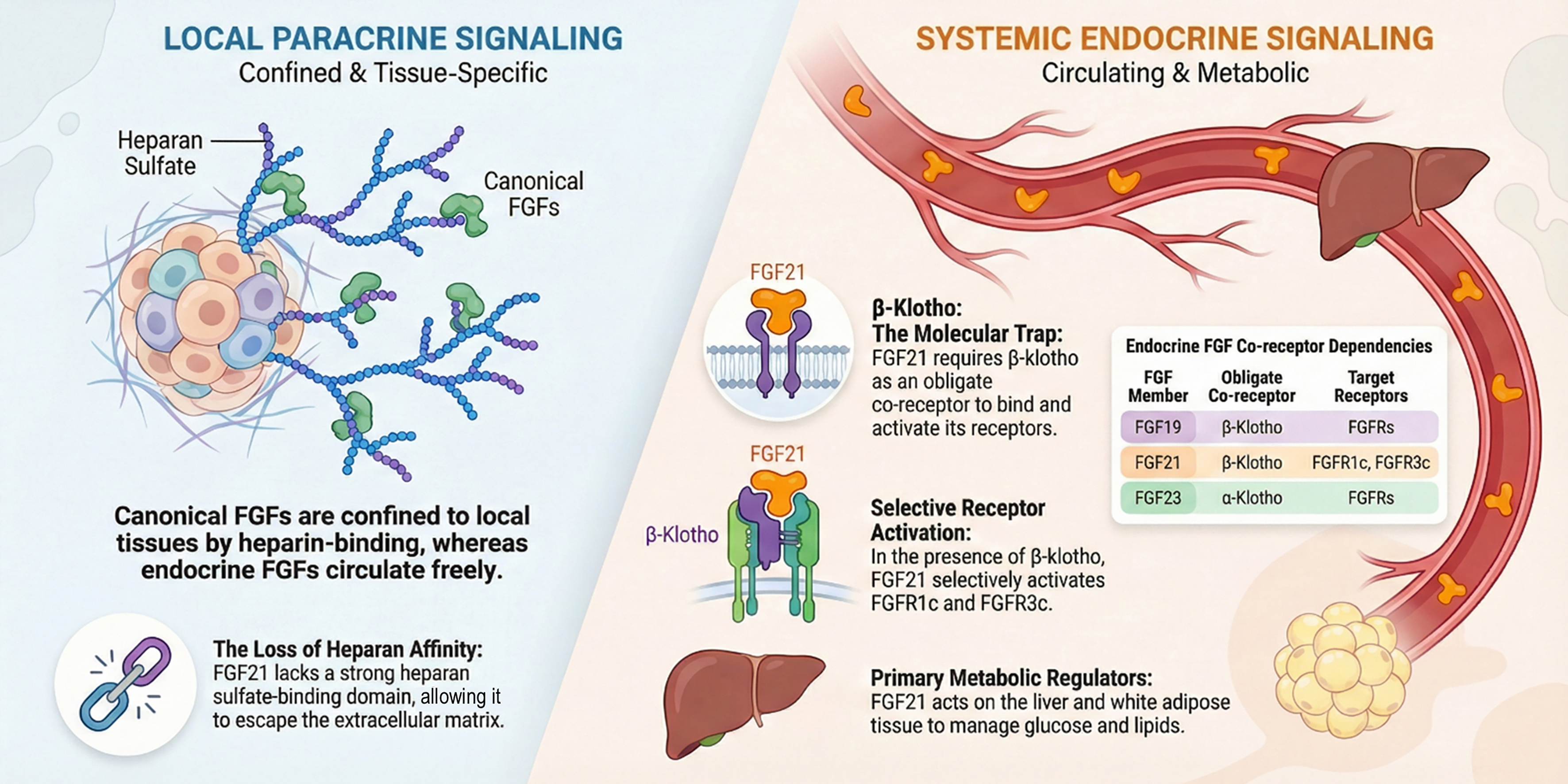
Figure 1. FGF21 signalling transitions from local paracrine to systemic endocrine action. (Left) Canonical FGFs bind HSPGs in the extracellular matrix, restricting their activity to local, tissue-specific paracrine signalling; (Right) In contrast, FGF21 lacks a strong heparan sulfate-binding domain, allowing it to escape the extracellular matrix and circulate systemically as an endocrine hormone. FGF21 requires the co-receptor β-Klotho to bind and activate FGFRs, conferring tissue specificity by limiting receptor activation to cells co-expressing β-Klotho and the appropriate FGFR isoforms (FGFR1c and FGFR3c). Through this mechanism, FGF21 primarily regulates metabolic functions in the liver and white adipose tissue. The inset table summarizes co-receptor dependencies and target receptors of endocrine FGFs. FGF: Fibroblast growth factor; FGFR: fibroblast growth factor receptor; HSPG: heparan sulfate proteoglycan.