Time
10:00 AM, 29 September 2026 (Beijing, China)
11:00 AM, 29 September 2026 (Seoul, South Korea)
11:00 AM, 29 September 2026 (Seoul, South Korea)
Share
Host

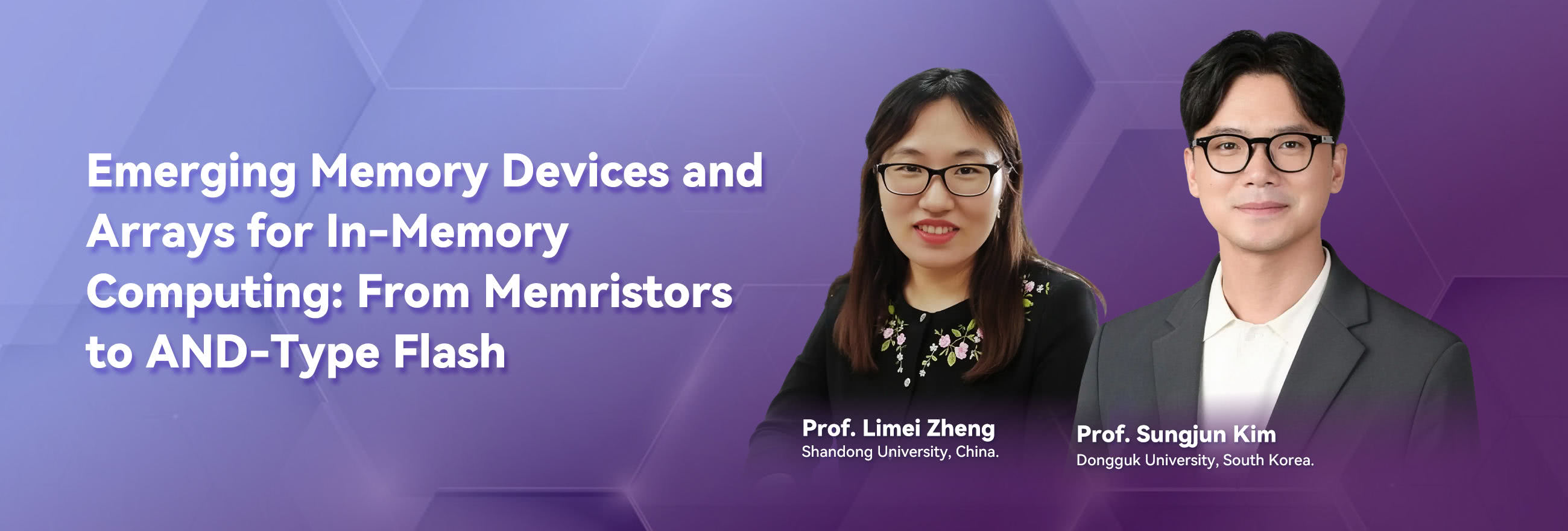
Prof. Limei Zheng
School of Physics, Shandong University, Jinan, China.
Abstract: The rapid growth of artificial intelligence applications has increased the demand for energy-efficient computing architectures that can alleviate the data-transfer bottleneck of conventional von Neumann systems. Emerging memory devices offer promising opportunities for in-memory computing by combining nonvolatile information storage with parallel computation.
In this talk, I will present our recent progress in emerging memory devices and array architectures for in-memory computing, focusing on resistive random-access memory (RRAM), ferroelectric tunnel junctions (FTJs), and AND-type Flash memory. For RRAM, device and stack engineering approaches for improving switching uniformity, multilevel conductance control, and array-level reliability will be discussed, together with hardware demonstrations of vector–matrix multiplication and neuromorphic inference. The use of both precisely controlled conductance states and intrinsic device stochasticity for computing, hardware security, and generative applications will also be introduced.
In addition, vertical memristive structures will be presented as an approach toward higher integration density, along with ferroelectric tunnel junctions for low-power and analog memory operation. Finally, Si-based AND-type Flash arrays will be discussed as an alternative platform for in-memory computing, taking advantage of their parallel current paths and mature memory technology. Throughout the talk, practical challenges in array implementation, including device variability, programming accuracy, interference, retention, line resistance, and accumulated off-current, will be highlighted.
These results demonstrate the potential of emerging memory devices and array architectures to provide versatile hardware platforms for energy-efficient artificial intelligence and neuromorphic computing.
Keywords: In-Memory Computing, Emerging Memory Devices, Ferroelectric Tunnel Junctions, Flash Memory.
In this talk, I will present our recent progress in emerging memory devices and array architectures for in-memory computing, focusing on resistive random-access memory (RRAM), ferroelectric tunnel junctions (FTJs), and AND-type Flash memory. For RRAM, device and stack engineering approaches for improving switching uniformity, multilevel conductance control, and array-level reliability will be discussed, together with hardware demonstrations of vector–matrix multiplication and neuromorphic inference. The use of both precisely controlled conductance states and intrinsic device stochasticity for computing, hardware security, and generative applications will also be introduced.
In addition, vertical memristive structures will be presented as an approach toward higher integration density, along with ferroelectric tunnel junctions for low-power and analog memory operation. Finally, Si-based AND-type Flash arrays will be discussed as an alternative platform for in-memory computing, taking advantage of their parallel current paths and mature memory technology. Throughout the talk, practical challenges in array implementation, including device variability, programming accuracy, interference, retention, line resistance, and accumulated off-current, will be highlighted.
These results demonstrate the potential of emerging memory devices and array architectures to provide versatile hardware platforms for energy-efficient artificial intelligence and neuromorphic computing.
Keywords: In-Memory Computing, Emerging Memory Devices, Ferroelectric Tunnel Junctions, Flash Memory.
Speaker

Prof. Sungjun Kim
Department of Electronics & Electrical Engineering, Dongguk University, Seoul, South Korea.
Sungjun Kim is an Associate Professor in the Department of Electronic and Electrical Engineering at Dongguk University, South Korea. His research focuses on emerging memory technologies, neuromorphic electronics, in-sensor computing, and in-memory computing hardware for next-generation artificial intelligence systems. Before joining academia, he worked at Samsung Electronics, where he contributed to the development of phase-change memory (PRAM) and ovonic threshold switch (OTS) selector technologies for future non-volatile memory applications. He received his BS degree from Hanyang University and his MS and PhD degrees in Electrical and Computer Engineering from Seoul National University. His current research interests include resistive random-access memory (RRAM), ferroelectric devices, oxide semiconductor electronics, memory-centric AI hardware, and neuromorphic computing systems. He serves as a committee member of the Memory Division of the K-Chips Program in Korea.