


Printing of polymer blend films for application in organic solar cells
Contents
Host
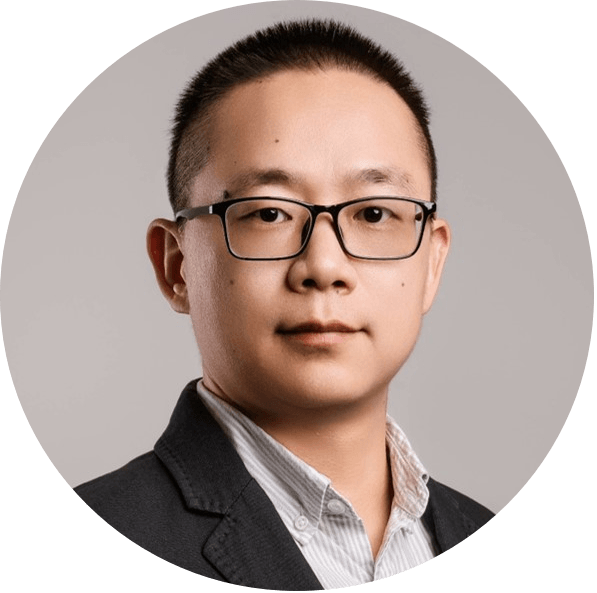
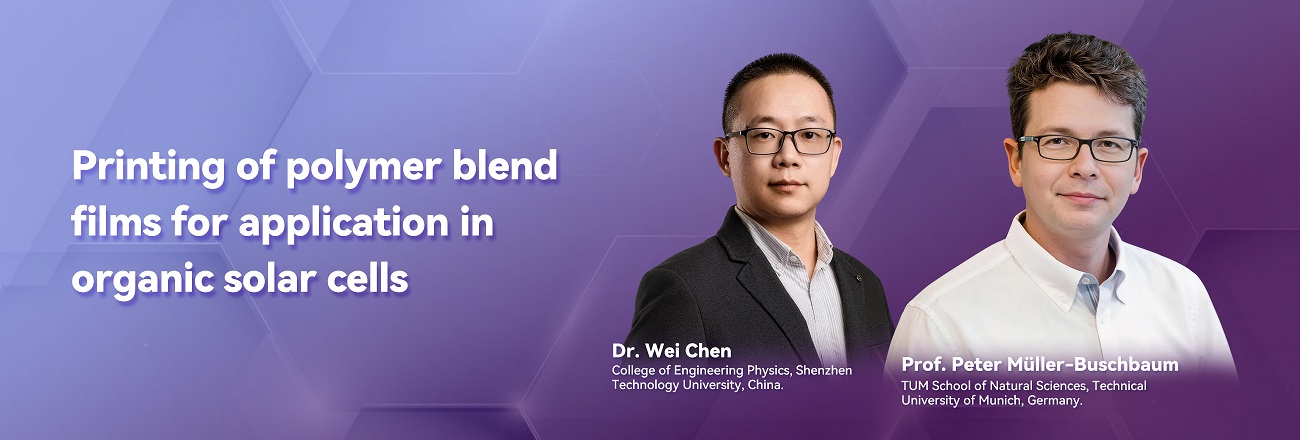
Dr. Wei Chen (Associate Professor)
College of Engineering Physics, Shenzhen Technology University, China.
Bio:
Dr. Wei Chen, Associate Professor. He received his doctoral degree from the Department of Physics at the Technical University of Munich (TUM), Germany, in 2020. He joined Shenzhen Technology University in 2022 as an Assistant Professor in the College of Engineering Physics and was promoted to tenured Associate Professor in 2024. His primary research focuses on smart optoelectronic integrated systems (SOIS), colloidal quantum dot detection and imaging technologies (QD-SWIR), and grazing-incidence X-ray scattering (GIXS: GISAXS & GIWAXS). To date, he has published over 120 academic papers in journals such as Nature Energy, Nature Electronics, Energy & Environmental Science, etc., and holds more than 40 authorized patents. He serves as a Young Editorial Board Member of Microstructures and as a reviewer for multiple journals including Advanced Materials, Nature Communications, Applied Energy, etc.
Dr. Wei Chen, Associate Professor. He received his doctoral degree from the Department of Physics at the Technical University of Munich (TUM), Germany, in 2020. He joined Shenzhen Technology University in 2022 as an Assistant Professor in the College of Engineering Physics and was promoted to tenured Associate Professor in 2024. His primary research focuses on smart optoelectronic integrated systems (SOIS), colloidal quantum dot detection and imaging technologies (QD-SWIR), and grazing-incidence X-ray scattering (GIXS: GISAXS & GIWAXS). To date, he has published over 120 academic papers in journals such as Nature Energy, Nature Electronics, Energy & Environmental Science, etc., and holds more than 40 authorized patents. He serves as a Young Editorial Board Member of Microstructures and as a reviewer for multiple journals including Advanced Materials, Nature Communications, Applied Energy, etc.
Speaker

Chair Professor Peter Müller-Buschbaum
TUM School of Natural Sciences, Technical University of Munich, Germany.
Bio:
Professor Dr. Müller-Buschbaum carries out research in the field of functional materials, with a particular focus on energy materials, e.g., solar cells and batteries. Professor Müller-Buschbaum studied physics in Kiel and earned his doctorate there in 1996. He then worked as a postdoctoral fellow at the Max Planck Institute for Polymer Research in Mainz and as a visiting scientist at the Institut Laue-Langevin and the European Synchrotron Radiation Facility in Grenoble, France. He acquired his postdoctoral teaching qualification (Habilitation) in 2002 and headed the Chair of Functional Materials at the TUM Department of Physics before his appointment as a full professor in 2018. From 2018 to 2023, he was scientific director of the Forschungs-Neutronenquelle FRM-II and of the Heinz Maier-Leibnitz Zentrums MLZ. Since 2011, he has been the German representative at the European Polymer Federation and, since 2024, Deputy Editor of the journal ACS Applied Materials & Interfaces. He also heads the Bavarian key laboratory TUM.solar and the Network for Renewable Energies (NRG). Since 2024, he has been a member of the TUM sustainability board.
Professor Dr. Müller-Buschbaum carries out research in the field of functional materials, with a particular focus on energy materials, e.g., solar cells and batteries. Professor Müller-Buschbaum studied physics in Kiel and earned his doctorate there in 1996. He then worked as a postdoctoral fellow at the Max Planck Institute for Polymer Research in Mainz and as a visiting scientist at the Institut Laue-Langevin and the European Synchrotron Radiation Facility in Grenoble, France. He acquired his postdoctoral teaching qualification (Habilitation) in 2002 and headed the Chair of Functional Materials at the TUM Department of Physics before his appointment as a full professor in 2018. From 2018 to 2023, he was scientific director of the Forschungs-Neutronenquelle FRM-II and of the Heinz Maier-Leibnitz Zentrums MLZ. Since 2011, he has been the German representative at the European Polymer Federation and, since 2024, Deputy Editor of the journal ACS Applied Materials & Interfaces. He also heads the Bavarian key laboratory TUM.solar and the Network for Renewable Energies (NRG). Since 2024, he has been a member of the TUM sustainability board.
Abstract
Organic solar cells (OSCs) have attracted significant attention in recent years due to their rapid efficiency gains, low toxicity, short energy payback times, and potential for low-cost, solution-based fabrication. Their high optical absorption, lightweight and flexible design, and compatibility with scalable techniques such as slot-die printing make them promising candidates for a future generation of solar cells. Since OSCs offer a superior power-to-weight ratio, which can reduce both manufacturing and launch costs, they are also of particular interest for space applications.
However, the printing of polymer blend films comprising donor and acceptor materials remains poorly understood due to the high complexity of the printing process. Using advanced scattering techniques, such as grazing incidence small- and wide-angle X-ray scattering (GISAXS and GIWAXS), in situ during printing, a fundamental understanding of the underlying film-forming processes can be gained. GIWAXS provides structural insights into the crystalline part of the donor and acceptor components, while GISAXS elucidates the morphology of the blend films. Balancing the solvent evaporation rate to optimize the crystalline phase of the blend film and balancing pre-aggregation and crystallization kinetics to optimize morphology turn out to be key factors for achieving high-efficiency OSCs.
Keywords: printing, slot-die coating, in-situ X-ray scattering, GISAXS, GIWAXS
However, the printing of polymer blend films comprising donor and acceptor materials remains poorly understood due to the high complexity of the printing process. Using advanced scattering techniques, such as grazing incidence small- and wide-angle X-ray scattering (GISAXS and GIWAXS), in situ during printing, a fundamental understanding of the underlying film-forming processes can be gained. GIWAXS provides structural insights into the crystalline part of the donor and acceptor components, while GISAXS elucidates the morphology of the blend films. Balancing the solvent evaporation rate to optimize the crystalline phase of the blend film and balancing pre-aggregation and crystallization kinetics to optimize morphology turn out to be key factors for achieving high-efficiency OSCs.
Keywords: printing, slot-die coating, in-situ X-ray scattering, GISAXS, GIWAXS