



Effect of Structure on Properties of MXene Nanosheets and Films
Contents
Host

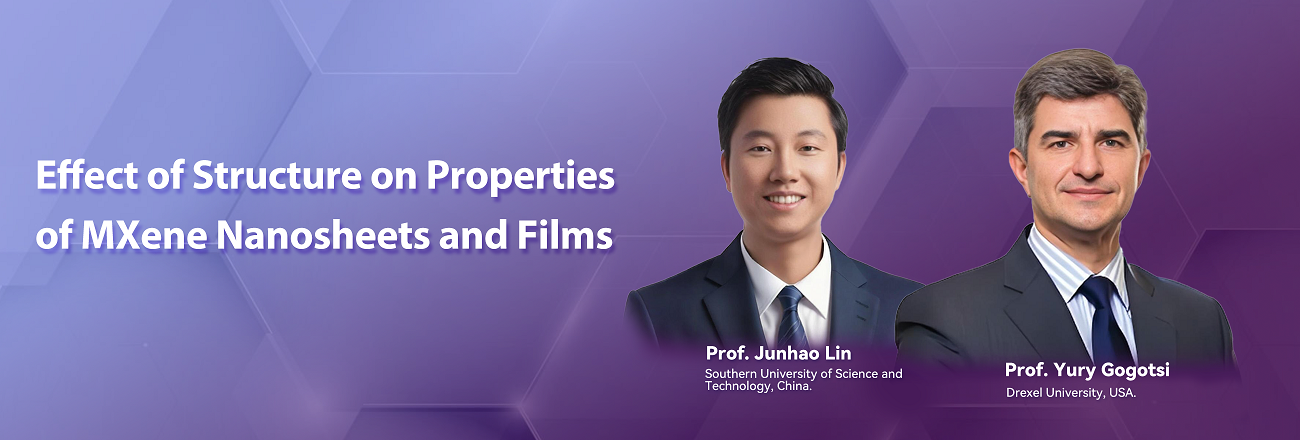
Professor Junhao Lin
Department of Physics, Southern University of Science and Technology, China.
Dr. Junhao Lin obtained his PhD degree in Physics from Vanderbilt University, USA, in 2015. He conducted his postdoctoral work as a JSPS fellow at AIST, Tsukuba, Japan, from 2015-2018, under the supervision of Dr. Kazu Suenaga, focusing on atomic structure-property investigation of 2D materials using advanced S/TEM characterizations. He joined the Department of Physics at Southern University of Science and Technology (SuSTech) in 2018 as a tenure-track associate professor and was promoted to tenured full professor in 2024. His main research directions include the analysis of complex defect structures in novel 2D materials, real-time in situ observation of the dynamical processes during the structural transition of materials under various environmental stimuli, and the development of 2D ferromagnetic and ferroelectric materials. He has published more than 190 journal papers, including first-/corresponding-author papers in Nature (3), Science (1), etc., with a total citation count of more than 19,000 and an H-index of 62 (GoS data).
Speaker

Professor Yury Gogotsi
College of Engineering, Drexel University, USA.
Prof. Yury Gogotsi is a Distinguished University Professor and the Charles T. and Ruth M. Bach Endowed Chair in the Department of Materials Science and Engineering. He also serves as Director of the A.J. Drexel Nanomaterials Institute. He received his MS (1984) and PhD (1986) from Kyiv Polytechnic and a DSc degree from the National Academy of Sciences of Ukraine (1995). Together with his students and colleagues, he has made principal contributions to the development of materials for electrochemical capacitors and other energy storage devices, discovered MXenes, demonstrated the tuning of structure and porosity of carbide-derived carbons, and developed new processes for the synthesis, surface modification, and purification of nanotubes and nanodiamonds. He also published the first microscopic observation of water inside carbon nanotubes, discovered polygonal nanotubes (graphite polyhedral crystals), and shaped the field of high-pressure surface science. He is recognized as a Highly Cited Researcher in Materials Science, Chemistry, and Engineering, as well as a Citations Laureate in Physics by Clarivate. He has received numerous awards for his research, including the Blaise Pascal Medal from the European Academy of Sciences, the Ceramic Prize from the World Academy of Ceramics, the Materials Research Society (MRS) Medal, the American Chemical Society (ACS) Award in the Chemistry of Materials, etc. He has been elected a Fellow of the National Academy of Inventors, the World Academy of Ceramics, the European Academy of Sciences, Academia Europaea, and many professional societies. He holds honorary doctorates from multiple universities.
Abstract
New nanomaterials will shape our future by enabling technologies in healthcare, robotics, quantum electronics, and space that are impossible today. Nanomaterials, especially 2D materials, are building blocks that can be assembled into micro- and macroscopic structures and devices. By combining nanosheets with various structures and compositions, one can design microstructures and nanostructured materials with unique combinations of properties. With guidance from computational techniques, including machine learning and AI, we should be able to program the properties and functions of those assembled nanomaterials, ushering in the new materials age. The most diverse family of 2D materials is carbides, nitrides, and related structures known as MXenes. They complement graphene, transition metal dichalcogenides, and other 2D materials by offering high metallic conductivity, electrochemically active surfaces, and extreme strength. More importantly, the optical and electronic properties of MXenes can be tuned and modulated during use.
More than 50 stoichiometric MX compositions and dozens of solid solutions have been reported since the discovery of Ti3C2Tx in 2011. The number of possible compositions is infinite when considering solid solutions, high-entropy compositions, in- and out-of-plane ordered MXenes, and combinations of surface terminations. They can be synthesized by direct synthesis from metal halogenides and carbon sources, or by selectively etching layered ceramics in aqueous etchants, molten salts, or halogen-containing gases. MXenes have ushered in an era of computationally driven atomistic design of 2D materials, but we are just beginning our journey into the world of atomistically designed materials.
The properties of MXenes are tunable by design. For example, chemically tunable superconductivity, work function, electromagnetic interference (EMI) shielding effectiveness, and optical properties have been demonstrated by controlling the microstructure of MXene films. These properties can be modulated using an ionotronic approach, leading to breakthroughs in fields ranging from optoelectronics and EMI shielding to communication, energy storage, catalysis, sensing, and healthcare. I'll discuss how structure affects the properties of MXenes. I'll also outline prospects for applications of MXenes and their assemblies with other 2D materials in electronics, healthcare, thermal management, communication, and energy generation and storage.
Keywords: Nanomaterials, 2D materials, MXene, structure, properties
More than 50 stoichiometric MX compositions and dozens of solid solutions have been reported since the discovery of Ti3C2Tx in 2011. The number of possible compositions is infinite when considering solid solutions, high-entropy compositions, in- and out-of-plane ordered MXenes, and combinations of surface terminations. They can be synthesized by direct synthesis from metal halogenides and carbon sources, or by selectively etching layered ceramics in aqueous etchants, molten salts, or halogen-containing gases. MXenes have ushered in an era of computationally driven atomistic design of 2D materials, but we are just beginning our journey into the world of atomistically designed materials.
The properties of MXenes are tunable by design. For example, chemically tunable superconductivity, work function, electromagnetic interference (EMI) shielding effectiveness, and optical properties have been demonstrated by controlling the microstructure of MXene films. These properties can be modulated using an ionotronic approach, leading to breakthroughs in fields ranging from optoelectronics and EMI shielding to communication, energy storage, catalysis, sensing, and healthcare. I'll discuss how structure affects the properties of MXenes. I'll also outline prospects for applications of MXenes and their assemblies with other 2D materials in electronics, healthcare, thermal management, communication, and energy generation and storage.
Keywords: Nanomaterials, 2D materials, MXene, structure, properties