

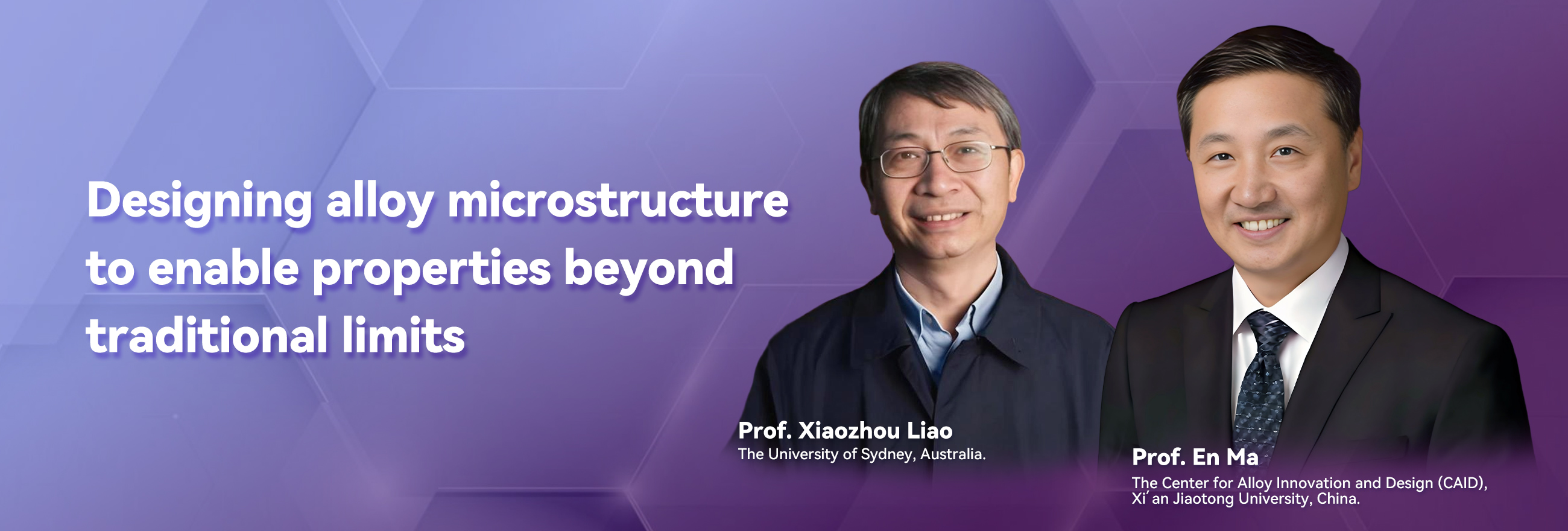
Designing alloy microstructure to enable properties beyond traditional limits
Contents
Host

Professor Xiaozhou Liao
Executive Editor of Microstructures
School of Aerospace, Mechanical and Mechatronic Engineering, The University of Sydney, Australia.
School of Aerospace, Mechanical and Mechatronic Engineering, The University of Sydney, Australia.
Professor Xiaozhou Liao is a full professor and co-director of the Australian Centre for Microscopy and Microanalysis at the University of Sydney (USyd), Australia. He received his PhD from USyd in 2000 and subsequently undertook a Director Funded Postdoctoral Fellowship at Los Alamos National Laboratory, USA, in 2001. From 2004 to 2006, he served as a research scientist and Associate Director of the Electron Microscopy Core Facility at the University of Chicago. He returned to USyd in June 2006 as a lecturer and was promoted through the ranks to full professor in January 2013.
Professor Liao specialises in the use of advanced electron microscopy techniques to investigate structural and functional materials, including metals and alloys, ferroelectrics, and nanomaterials. His research focuses on the relationships among synthesis/processing, microstructure, and properties. He has authored more than 360 journal articles, which have collectively received over 35,600 citations, and he has an h-index of 92 (Google Scholar).
Professor Liao specialises in the use of advanced electron microscopy techniques to investigate structural and functional materials, including metals and alloys, ferroelectrics, and nanomaterials. His research focuses on the relationships among synthesis/processing, microstructure, and properties. He has authored more than 360 journal articles, which have collectively received over 35,600 citations, and he has an h-index of 92 (Google Scholar).
Speaker
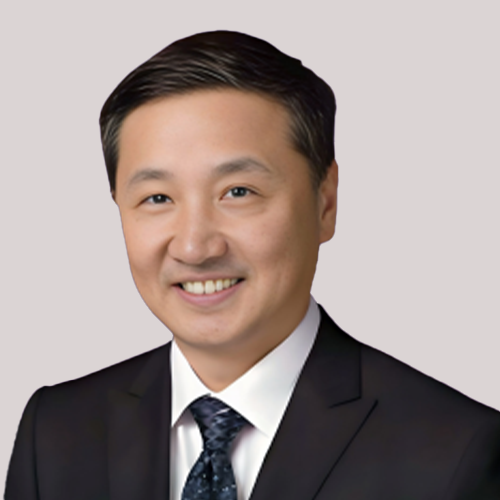
Professor En (Evan) Ma
The Center for Alloy Innovation and Design (CAID), Xi’an Jiaotong University, China.
Professor En (Evan) Ma is currently a professor at the Center for Alloy Innovation and Design (CAID), Xi’an Jiaotong University in China, after retiring from the Johns Hopkins University in 2020. Dr. Ma received his degrees from Tsinghua University, and worked at Caltech, MIT/IBM, University of Michigan, UIUC, and LSU. He was a tenured professor at JHU between 1998 and 2020. Prof. Ma’s research interest focuses on metastable alloys, including metallic glasses, nanostructured metals, chalcogenide phase-change materials for memory applications, multi-principal element high-entropy alloys, mechanical properties and plasticity mechanisms, and thermodynamics/kinetics of phase transformations. Dr. Ma has published ~440 papers, including 33 in Science, Nature, and Nature Materials (or Physics/Electronics). His publications have received more than 72,000 citations (Google Scholar) with an H index of 134. Prof. Ma is an elected Fellow of TMS, MRS, ASM International, APS and the European Academy of Sciences.
Abstract
This talk uses two examples, one each for crystalline alloys and amorphous alloys, as case studies for designing the micro/nano/atomic structure to achieve unprecedented properties. In the first example, we discuss how to fill the blank in the strength-ductility space, pushing towards 2 GPa yield strength in combination with 30% uniform tensile elongation [Nature 643(2025)119]. In particular, we leverage additional strengthening and strain hardening mechanisms enabled by the expanded compositional scope in complex concentrated alloys, on top of previously known plasticity mechanisms. We then show that "structure determines properties” also works for amorphous solids, as demonstrated with chalcogenide glasses used for non-volatile memory. There, the key idea is to design a single-type of robust atomic-motif, thus affording little flexibility volume in the amorphous structure. The absence of structural relaxation eliminates the electrical resistance drift that hampers reliable multi-value recognition. The amorphous Cr-Te alloy designed as such offers the first no-drift phase-change memory material [Nature Materials (2025) online Oct. 1].
Keywords: strength-ductility synergy, multi-principal-element alloys, phase-change memory, amorphous alloys.
Keywords: strength-ductility synergy, multi-principal-element alloys, phase-change memory, amorphous alloys.