
Volume

Cover

Volume 6, Issue 6 (2026)

20 Articles | 2026
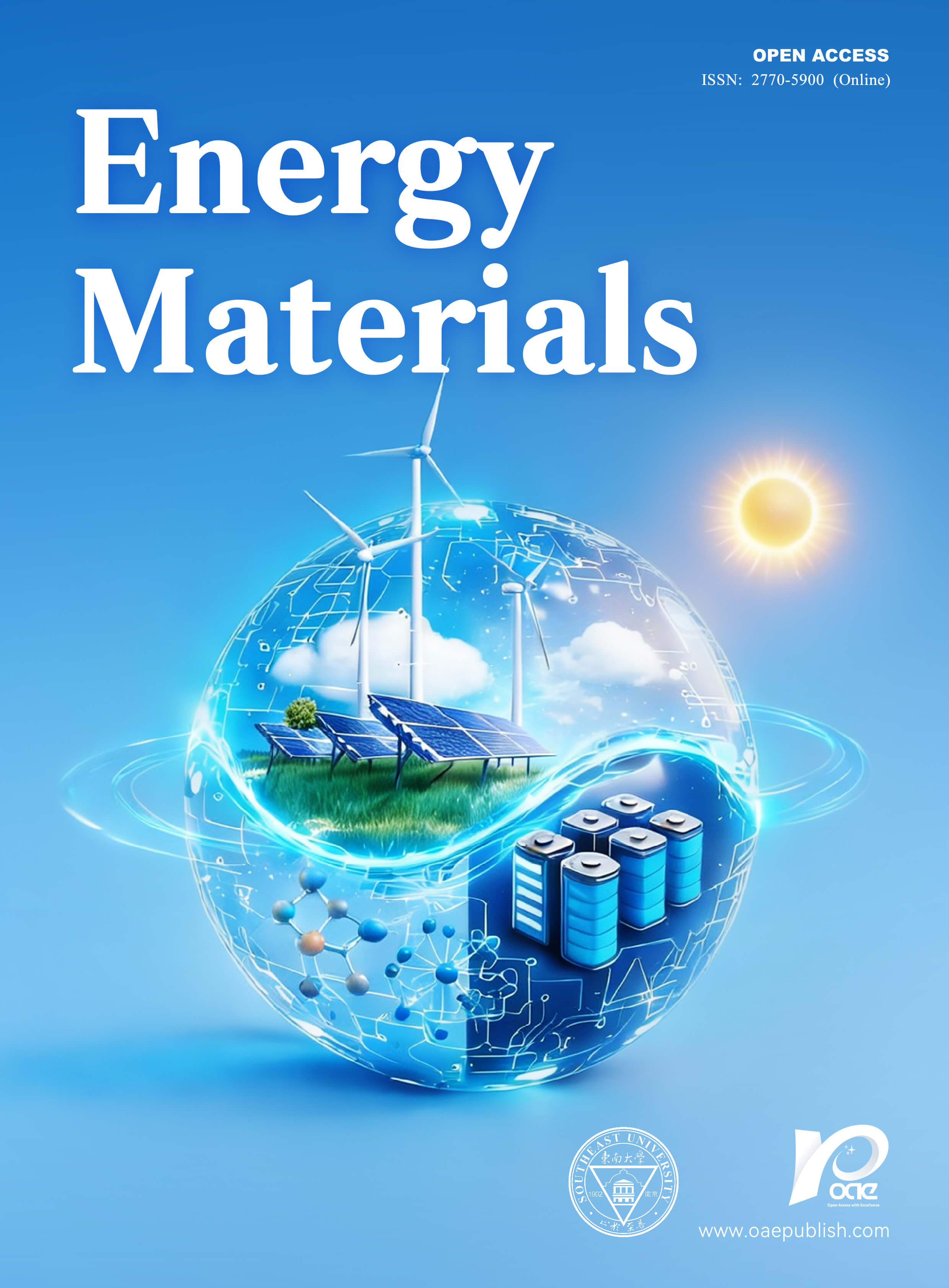
Cover Picture: Conventional lithium-ion batteries (LIBs) anodes suffer from critical drawbacks including severe volume expansion, inferior conductivity, insufficient initial Coulombic efficiency (ICE), and limited cycling life. Biomass-based hard carbon (HC) features low cost, abundant sources, stable cyclability, and minor volume variation, making it ideal to overcome the bottlenecks of traditional anodes. In this work, hierarchical porous HC was synthesized via high-temperature pyrolysis and carbonization with walnut shells, reed stalks, and corn stalks as raw precursors. The morphology and structural properties were characterized by scanning electron microscopy (SEM), X-ray diffraction (XRD), Raman spectroscopy, and nitrogen adsorption-desorption. Electrochemical lithium storage performance was evaluated by cyclic voltammetry (CV) and constant current charge-discharge tests. Results indicate that walnut shell-derived HC shows a more ordered carbon skeleton and low impurities, improving material yield and cycling stability. Phosphorus doping enhances conductivity and electron transport, increases active sites, and reduces side reactions with electrolytes, thus boosting ICE and stability. The 5% phosphorus-doped sample exhibits excellent lithium storage performance via the triple synergistic effect of structure, interface, and electronic conductivity. At 0.5 C for 100 cycles, it delivers an ICE of 82.81%, reversible capacity of 242.6 mA h g-1, and capacity retention of 80.15%. Even at 1.86 A g-1, a rate capability of 129.1 mA h g-1 is achieved. These findings provide a feasible route for constructing advanced hard carbon HC electrodes with superior lithium-storage capability.
Back Cover

Volume 6, Issue 6 (2026)

20 Articles | 2026
Back Cover Picture: Household-scale sand-based thermal energy storage (TES) integrated with thermoelectric generators (TEGs) is constrained by insufficient radial thermal transport, interfacial heat transfer losses, and uncertain cyclic durability. This study addresses all three issues through a finite-element parametric investigation of thirty composite configurations spanning five dopant candidates, three volume fractions, and two spatial architectures. The 30 vol% functionally graded Solar Salt formulation produced a well-defined isothermal plateau near 493 K at the TEG interface, stabilizing the hot-side temperature to within 10 K through a spatially coherent phase-change front. No purely conductive dopant reproduced this temporal stability despite achieving higher peak temperatures. Interfacial analysis revealed that a 0.1 mm thermal interface material layer imposed a 40 K temperature discontinuity comparable to the TEG operating differential. Thermomechanical screening across nine insulation-shell material combinations demonstrated that compatibility among the coefficients of thermal expansion governed long-term reliability, with zirconia paired with Inconel 718 achieving a fatigue safety factor exceeding 2.0 over the 20-year service horizon projected by the power-law ratcheting extrapolation. Furthermore, coupled parametric mapping of interface conductivity and contact pressure identified an optimized design point capable of delivering 82% of the thermal energy to the TEG surface. This interfacial optimization secured a projected thermal interface material (TIM) fatigue life of 6,200 cycles (approximately 17 years) and ultimately yielded an end-to-end electrical efficiency of approximately 5%. These findings establish quantitative design criteria for transitioning sand-based thermal storage to compact household-scale modules.

Review

Research Highlight

Article

Actions for 0 selected articles

Energy Materials
ISSN 2770-5900 (Online)
Follow Us

Portico

All published articles are preserved here permanently:

https://www.portico.org/publishers/oae/

Portico

All published articles are preserved here permanently:

https://www.portico.org/publishers/oae/