

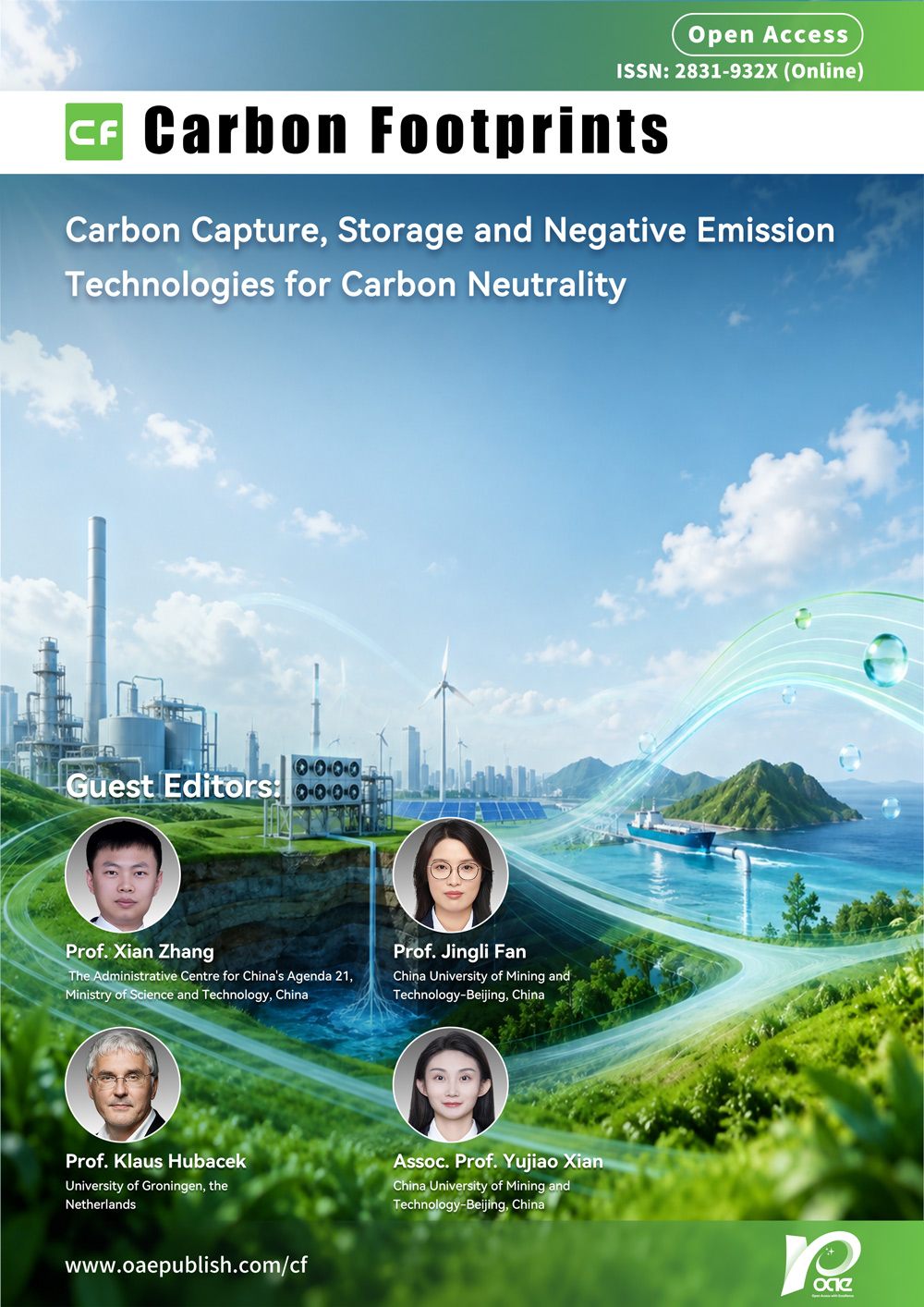
Topic: Carbon Capture, Storage and Negative Emission Technologies for Carbon Neutrality
Guest Editors
Special Topic Introduction
Global carbon neutrality agendas have accelerated the transition toward low-carbon and zero-carbon energy systems worldwide. While renewable energy penetration and energy efficiency improvement remain the core solutions of decarbonization, they cannot fully eliminate residual emissions from hard-to-abate industrial sectors, aviation, and agricultural activities. In this context, carbon capture, utilization and storage (CCUS) and negative emission technologies (NETs) have emerged as indispensable technical pillars to bridge the remaining emission gap and support the timely achievement of global net-zero climate targets.
However, the climate benefits of these technologies cannot be assessed solely by the amount of CO₂ captured or removed. Their effectiveness depends on the entire deployment chain, including capture efficiency, energy requirements, source–sink matching, transport and storage infrastructure, geological storage capacity, permanence, and life-cycle carbon footprints. As CCUS and carbon removal move from individual projects toward large-scale deployment across sectors and regions, understanding their system-wide environmental performance, spatial heterogeneity, and potential trade-offs has become increasingly important.
The related topics of this special topic include but are not limited to:
● CCUS technologies: carbon capture (post‑combustion, pre‑combustion, oxy‑fuel, direct air capture, etc.), carbon utilization (chemicals, fuels, materials, other value-added products), carbon transport and geological storage (onshore and offshore settings), as well as full process evaluation of CCUS technologies;
● NETs:bioenergy with CCS (BECCS), direct air capture with storage (DAC+S), enhanced weathering, ocean alkalinity enhancement, biochar, and soil carbon sequestration, including their energy, land, water, and biomass trade-offs;
● Life-cycle assessment and carbon footprinting:full-chain carbon footprint analysis of CCUS and NETs, comparative LCA of different CDR pathways, and supply chain emissions;
● Techno-economic analysis and systems integration:cost modeling, scalability assessment, infrastructure planning, and regional deployment strategies for CCUS and NETs;
● Emission potential evaluation and sectoral applications: source‑sink matching and capacity mappingacross spatially heterogeneous settings, sector‑specific deployment pathway optimization for industries (power, cement, steel, chemicals, and other hard-to-abate sectors), and integration with existing industrial infrastructures and energy systems;
● Policy, governance, and social acceptance:regulatory frameworks, carbon pricing and incentive mechanisms, public perception, environmental justice, and cross-border governance of CDR;
● Emerging frontiers:artificial intelligence and machine learning for carbon management, synergy between CCUS/NETs and renewable energy systems, and novel monitoring technologies.
This Special Topic aims to advance a system-level understanding of carbon capture, storage, and negative emission technologies for carbon neutrality. We welcome original research articles, reviews, perspectives, and case studies across the topics above, and especially encourage interdisciplinary approaches that bridge engineering, environmental science, economics, and social sciences.
Keywords
Carbon capture and storage (CCS), carbon capture, utilization and storage (CCUS), negative emission technologies (NETs), direct air capture (DAC), bioenergy with carbon capture and storage (BECCS), carbon footprint assessment, life-cycle assessment, emission potential, carbon neutrality, climate change mitigation
Submission Deadline
Submission Information
For Author Instructions, please refer to https://www.oaepublish.com/cf/author_instructions
For Online Submission, please login at https://www.oaecenter.com/login?JournalId=cf&IssueId=cf26090210600
Submission Deadline: 31 Mar 2027
Contacts: Litchi Duan, In-house Editor, [email protected], [email protected]