



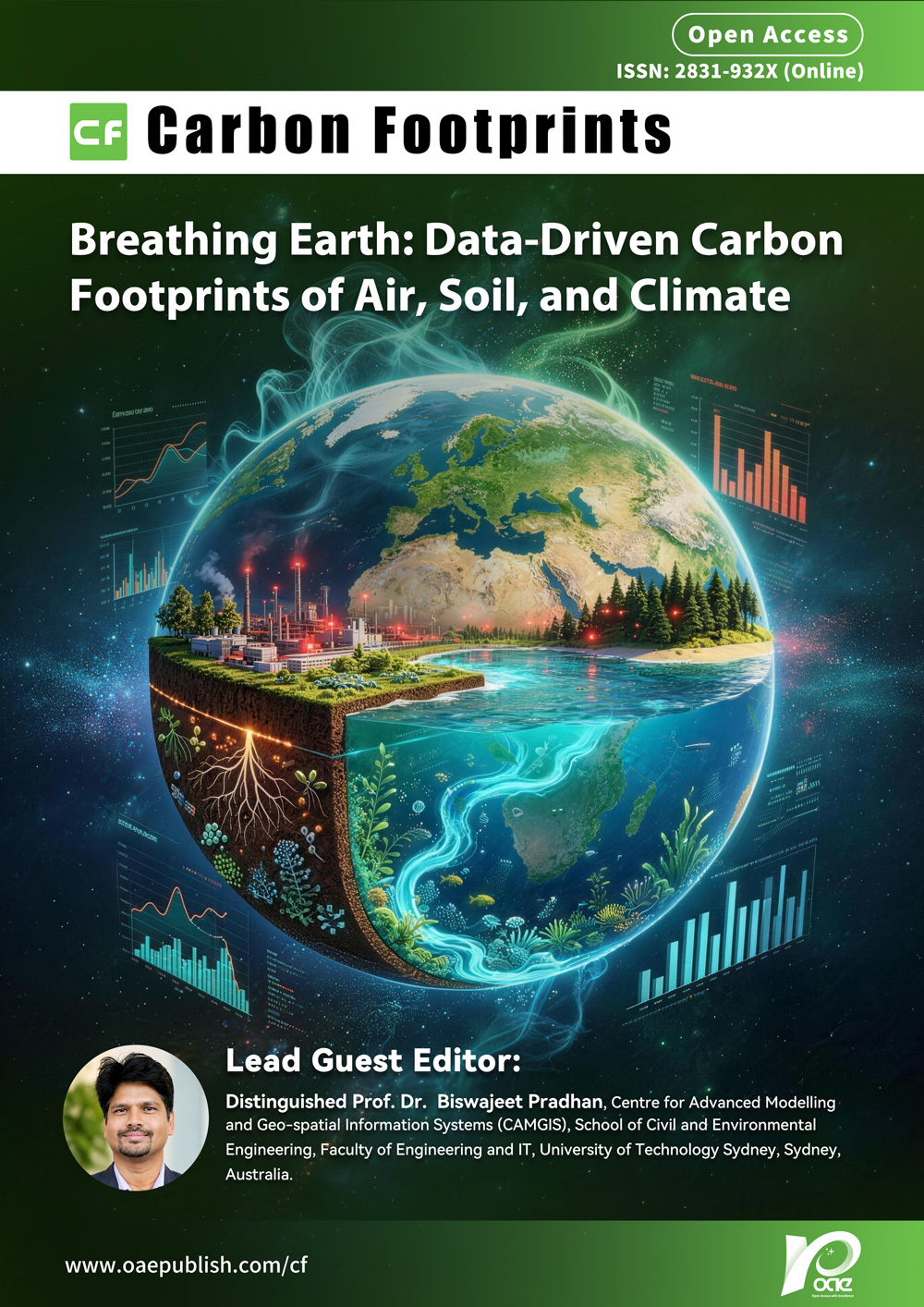
Topic: Breathing Earth: Data-Driven Carbon Footprints of Air, Soil, and Climate
Guest Editor
Special Topic Introduction
The intertwined challenges of air pollution, climate change, and soil degradation demand integrated analytical frameworks grounded in carbon footprint quantification and systems-level assessment. Soil Organic Carbon (SOC), as a critical component of the terrestrial carbon cycle, plays a pivotal role in mediating land–atmosphere interactions and influencing both greenhouse gas emissions and particulate matter formation. SOC sequestration not only contributes to climate change mitigation but also enhances soil structure, reducing wind erosion and associated dust emissions that degrade air quality. Conversely, atmospheric processes and climate extremes can alter SOC dynamics, creating complex feedback loops that remain insufficiently quantified in current carbon footprint assessments.
This Special Issue aims to advance the quantification, modeling, and mitigation of carbon footprints across interconnected environmental systems by leveraging cutting-edge applications of Big Data and Artificial Intelligence (AI). We invite interdisciplinary contributions that integrate diverse data streams—such as satellite remote sensing (hyperspectral, SAR, lidar), in situ soil and air monitoring, and IoT-enabled environmental sensing—to improve the accuracy, scalability, and policy relevance of carbon footprint accounting.
Topics of interest include, but are not limited to:
(1) AI-driven spatial quantification and forecasting of SOC stocks and their contribution to regional and global carbon footprints;
(2) machine learning approaches for evaluating the carbon footprint mitigation potential of soil management practices (e.g., regenerative agriculture, biochar);
(3) integrated assessment of co-benefits and trade-offs between air pollution control, SOC sequestration, and greenhouse gas emissions;
(4) development of coupled models and digital twins linking soil biogeochemical processes with atmospheric transport to assess system-wide carbon impacts;
(5) remote sensing and data-driven approaches for monitoring land management practices and their implications for dust emissions and carbon budgets; and
(6) life-cycle carbon footprint assessment of AI and digital infrastructures supporting environmental monitoring.
By bridging soil science, atmospheric chemistry, and data science, this Special Issue aims to provide robust methodologies and actionable insights for reducing carbon footprints and enhancing climate resilience through integrated environmental governance.
Keywords
Carbon footprint, artificial intelligence, big data, soil organic carbon (SOC), air pollution, climate change mitigation, integrated assessment, remote sensing, regenerative agriculture, carbon sequestration
Submission Deadline
Submission Information
For Author Instructions, please refer to https://www.oaepublish.com/cf/author_instructions
For Online Submission, please login at https://www.oaecenter.com/login?JournalId=cf&IssueId=cf26042710443
Submission Deadline: 30 Nov 2026
Contacts: Leah Zhang, Assistant Editor, [email protected]