
Special Interview with Prof. Artem R. Oganov: Exploring AI-Driven Materials Discovery and the Future of Computational Design
On July 7th, 2026, the Editorial Office of Iontronics had the honor of interviewing Prof. Artem R. Oganov from the Skolkovo Institute of Science and Technology (Skoltech), Moscow, Russia. Prof. Oganov’s research focuses on computational materials discovery, crystal structure prediction, high-pressure chemistry, and artificial intelligence-driven materials design. Through this interview, Prof. Oganov shares his perspectives on the evolving relationship between evolutionary algorithms and machine learning, the future of inverse materials design, energy landscape-based approaches for understanding complex materials systems, and the role of computational methods in advancing the discovery of next-generation functional materials and coupled ion–electron systems.
Interview Questions:
Q1. In computational materials discovery, how do you see the relationship between physics-based approaches such as evolutionary structure prediction and modern machine learning methods? Are these approaches converging toward a unified paradigm of materials discovery, or do they still represent fundamentally different ways of exploring materials space?
Q2. Evolutionary structure prediction methods such as USPEX have had a transformative impact on crystal structure prediction. What do you consider the key conceptual breakthroughs that allow these methods to efficiently navigate complex energy landscapes and identify stable structures?
Q3. Your research spans machine learning for materials, magnetic systems, ionic systems, and high-pressure phases. Do you see these diverse research directions converging toward a deeper unified framework of materials discovery, or do they remain fundamentally distinct classes of problems governed by different physical principles?
Q4. How is the transition from predictive modeling toward physics-guided inverse design changing the way researchers approach the discovery and development of functional materials? What role do artificial intelligence and computational approaches play in accelerating this transformation?
Q5. Iontronics explores systems where ionic transport, electronic structure, atomic-scale dynamics, and nonequilibrium processes are strongly coupled. From your perspective, what fundamental principles or theoretical frameworks are needed to understand such coupled ion–electron phenomena, and how might advances in this direction influence future materials discovery and functional material design?
About Prof. Artem R. Oganov:
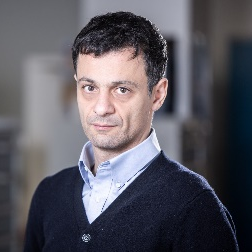
Prof. Artem R. Oganov is a Distinguished Professor at the Skolkovo Institute of Science and Technology (Skoltech). His research focuses on computational materials discovery, crystal structure prediction, high-pressure chemistry, computational mineral physics, and artificial intelligence for materials design. He is internationally recognized as the developer of the USPEX evolutionary crystal structure prediction method, which has become one of the most widely used computational platforms for predicting crystal structures and discovering materials with targeted properties.
Throughout his career, Prof. Oganov has published more than 300 peer-reviewed papers, including numerous publications in Nature, Science, and other leading journals. His work has received over 46,726 citations with an h-index of 104 (Google Scholar, July 2026). He is the recipient of numerous international honors, including the ETH Latsis Prize, European Mineralogical Union Research Excellence Medal, the Chinese Government Friendship Award, and election as Fellow of the American Physical Society (APS), Fellow of the Royal Society of Chemistry (RSC), and Member of Academia Europaea. His interdisciplinary research continues to shape the future of computational materials discovery by integrating evolutionary algorithms, machine learning, quantum mechanics, and inverse design methodologies toward autonomous materials innovation.
Editor: Xingcheng Li
Production Editor: Xingyue Luo
Respectfully Submitted by the Editorial Office of Iontronics

