
Interview with Prof. Prashanth Menezes - Editorial Board Member of Energy Materials
On November 5, 2026, the Energy Materials editorial team had the pleasure of interviewing Prof. Prashanth Menezes, Editorial Board Member of the journal and Head of the Department of Materials Chemistry for Catalysis at Helmholtz-Zentrum Berlin für Materialien und Energie (HZB), Germany. His research focuses on advanced inorganic functional materials, heterogeneous catalysis, electrocatalysis, and sustainable energy conversion.
The interview covered several key aspects of the journal's development. Prof. Menezes shared practical suggestions for enhancing the journal's international visibility through regional academic outreach, student-oriented seminars, online poster presentations, and support programs for young scientists. He also highlighted the importance of publishing more forward-looking perspectives, broadening the journal's coverage across energy research fields, and maintaining efficient yet rigorous peer review. In addition, he discussed key factors influencing authors' journal selection, including impact factor, open access fees, and readership relevance. Looking ahead, he highlighted the promising potential of electrocatalysis in renewable energy-driven chemical production, while pointing out persistent challenges in CO₂ reduction, particularly product selectivity and catalyst performance. His insights offer valuable guidance for strengthening the journal's international presence, optimizing its content and services, and supporting its continued development in the energy materials field.
Watch the following video for expert insights from Prof. Prashanth Menezes:
Interview Questions:
1. Energy Materials has maintained an Impact Factor above 11 for three consecutive years, reflecting its steady development. However, we believe there is still considerable room to increase the journal's international visibility and reach more researchers worldwide. From your perspective, what would be the most effective ways to help more international scholars become aware of the journal and recognize its value?
2. Energy Materials is committed to providing valuable services to researchers and fostering academic exchange. For example, we have organized 15 online Webinars to date, providing a platform for researchers to share their work and exchange ideas. From your perspective, how attractive and valuable are these initiatives to researchers? What else could the journal do to make these services more valuable and appealing to the academic community?
3. In addition to providing researchers with opportunities to showcase their work, Energy Materials strives to maintain a rigorous yet efficient peer-review process, with an average of around 70 days from submission to acceptance. From your perspective, how important is a timely and rigorous review process when researchers choose a journal for their work? Do you think this could be a compelling advantage for Energy Materials, and how might we better communicate this to potential authors?
4. When researchers at your institution choose a journal for submission, what criteria do they usually prioritize? For example, do they focus more on the journal's impact factor, indexing status, or other factors?
5. Your recent research spans several exciting areas, including MXene-based heterojunction electrocatalysts for hydrogen evolution, sulfur-redox chemistry and ion-electron transport in high-rate lithium–sulfur batteries, and cobalt borophosphate precatalysts for electrocatalytic organic oxidation. Given your expertise in inorganic materials chemistry, solid-state chemistry, and electrochemistry, which emerging research directions do you think hold the greatest potential for Energy Materials?
About the Interviewee:
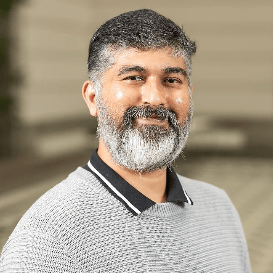
Prof. Prashanth Menezes is currently Head of the Department of Materials Chemistry for Catalysis at Helmholtz-Zentrum Berlin für Materialien und Energie (HZB), Germany, and is also involved in research activities at Technische Universität Berlin (TU Berlin). His research focuses on the design of advanced inorganic functional materials and heterogeneous catalysts, particularly for electrocatalysis, redox catalysis, photoelectrochemical water splitting, and sustainable energy conversion. His research also covers green hydrogen production, electrochemical CO₂ reduction, and the electrocatalytic conversion of biomass- and waste-derived molecules. In 2025, he received the VAIBHAV Fellowship from the Government of India as the sole awardee in the Materials and Processing Technologies category.
Editor: Quinci Guo
Production Editor: Xingyue Luo
Respectfully Submitted by the Editorial Office of Energy Materials