

Receptor-mediated brain delivery in MPS II: a platform turning point for rare disease therapeutics
 0
0 


 Download PDF
CROSSING THE BLOOD-BRAIN BARRIER IN MPS II
The blood-brain barrier (BBB) has long been recognized as the principal obstacle in the treatment of neuronopathic lysosomal storage diseases (LSDs). Neuronopathic mucopolysaccharidosis II (MPS II; Hunter syndrome) has traditionally represented one of the most significant challenges in the treatment of rare diseases. Conventional enzyme replacement therapy (ERT) does not cross the BBB, thereby limiting its effectiveness in addressing neurocognitive decline. The recent Phase I/II clinical trial of tividenofusp alfa-eknm, a transferrin receptor (TfR)-targeted fusion protein of iduronate-2-sulfatase (IDS), provides the most substantial evidence to date that systemic, receptor-mediated transport across the BBB is achievable in a clinical setting[1]. The significance of this advancement extends far beyond MPS II: tividenofusp alfa-eknm received FDA approval on March 25, 2026[2,3].
Tividenofusp alfa-eknm, an IDS enzyme fused to a TfR -targeting Fc domain, exemplifies a rational and mechanism-driven approach to harnessing receptor-mediated transcytosis. Although the concept is not novel, this represents one of the first large-scale, longitudinal human datasets demonstrating that a BBB-penetrant ERT can induce biochemical corrections within the central nervous system (CNS). For the first time, a systemically administered ERT has demonstrated robust and durable biochemical correction within the CNS of pediatric patients with MPS II, an achievement that previous generations of ERTs have not attained.
The field has struggled with surrogate endpoints that fail to reflect CNS pathology. Here, the alignment among the mechanism (enzyme delivery to the brain), the substrate reduction (CSF HS), and the neurodegeneration markers (serum neurofilament light chain [NfL]) is unusually tight. This strengthens the argument for biomarker-driven accelerated pathways in neuronopathic LSDs. Kariolis et al.[4] provide compelling human evidence that receptor-mediated transcytosis (long validated in mice and nonhuman primates[4]) can be harnessed safely and repeatedly in children. Over a median of 117 weeks, 47 male participants, primarily with neuronopathic mucopolysaccharidosis type II, received weekly intravenous infusions (initially to determine the dose, followed by a maintenance dose of 15 mg/kg body weight). This administration led to a 91% reduction in CSF heparan sulfate, with 93% of participants reaching levels seen in unaffected children by week 24. The sustained 76% decline in serum NfL through week 153 demonstrates that the TfR-targeted transport vehicle is functioning as designed[1]. Clinical and organ measures revealed improvements in hearing thresholds, normalization of liver volume, and signs of stabilization or slight improvement in early cognitive performance and adaptive behavior. However, immunogenicity was high (79% with antidrug antibodies), and this did not seem to blunt the CSF HS response during the observation period. Pharmacokinetic analysis showed a serum half-life of 11-18 h, with a dose-proportional increase in maximum serum concentration and a more-than-dose-proportional increase in area under the concentration-time curve. Especially given the historical failure of standard ERT to influence CNS substrate burden, the durability strengthens the case for the therapeutic efficacy of the TfR-mediated transport mechanism and suggests potential clinical benefit pending confirmatory studies in other LSDs.
Regarding safety, as observed in other ERTs, infusion-related reactions were common, affecting 87% of participants. Every participant had at least one adverse event; 38% had at least one serious adverse event, and 87% had infusion-related reactions, including two events that met the criteria for anaphylaxis. 6% had severe reactions, though these were clinically manageable and rarely resulted in halting treatment. About half of the subjects experienced anemia, with a slight decrease in mean hemoglobin concentration around week 13, followed by a return to baseline with the maintained dose. There were no deaths or obvious cardiac or non-hematologic laboratory safety signals, but other frequent adverse events included upper respiratory tract infection, fever, cough, vomiting, diarrhea, rash, COVID-19, and rhinorrhea[1]. Taking high immunogenicity into account, the results from this trial are consistent with the previous ERTs in MPS II, particularly in the ERT-naïve group. Additionally, the reductions in titers and the lack of pharmacodynamic effect suggest the need for a long-term immunogenicity analysis.
The study's strengths include long-term treatment exposure, concordant preclinical and clinical biomarker effects, a relatively large and phenotypically appropriate international pediatric cohort for a rare disorder, a thorough multidomain outcome assessment, and a strong mechanistic rationale based on TfR-mediated brain delivery. This study is an open-label, non-randomized study design, which limits causal inference. The lack of comparisons and neurocognitive assessments in such a heterogeneous pediatric population may limit the generalizability of the outcomes. Moreover, the study was conducted in a predominantly neuronopathic population, which limits the generalizability of the conclusions to non-neuronopathic diseases. As encountered in many other LSDs, biochemical correction does not always reflect functional rescue, especially in hard-to-treat tissues like the CNS and cartilage/bone, since time is critical for both. Therefore, it is important to test tividenofusp alfa-eknm in the natural history of neuronopathic MPS II in a controlled setting.
MECHANISM OF TfR-TARGETING STRATEGIES AND THEIR THERAPEUTIC APPLICATION
TfR-mediated transcytosis is a receptor-mediated mechanism for delivering large therapeutic proteins across the BBB. However, why is this a strong approach in the field? TfR is abundant in endothelial cells, providing high potential for uptake, and is critical for transporting the iron-transferrin complex into the brain. Most importantly, it is accessible via the bloodstream. Once the therapeutic molecule is bound to TfR, the TfR-cargo complex is internalized via clathrin-mediated endocytosis and subsequently enters endosomes, where it is released into the brain parenchyma. In MPS II, the IDS enzymes on the abluminal side of the brain, following transcytosis, hypothetically bind to mannose-6-phosphate receptors (M6PR) on brain cells, microglia, neurons, and astrocytes, to enable lysosomal delivery[5,6]. Although the precise mechanism remains to be elucidated, it is plausible that the BBB-crossing TfR-enzyme complex is further internalized by both TfRs and M6PRs expressed on brain parenchymal cells [Figure 1]. Given that TfR is a key glycoprotein in iron metabolism, and neurons, astrocytes, and microglia rely on iron uptake for physiological functions, the presence of TfR on these cells supports this possibility.
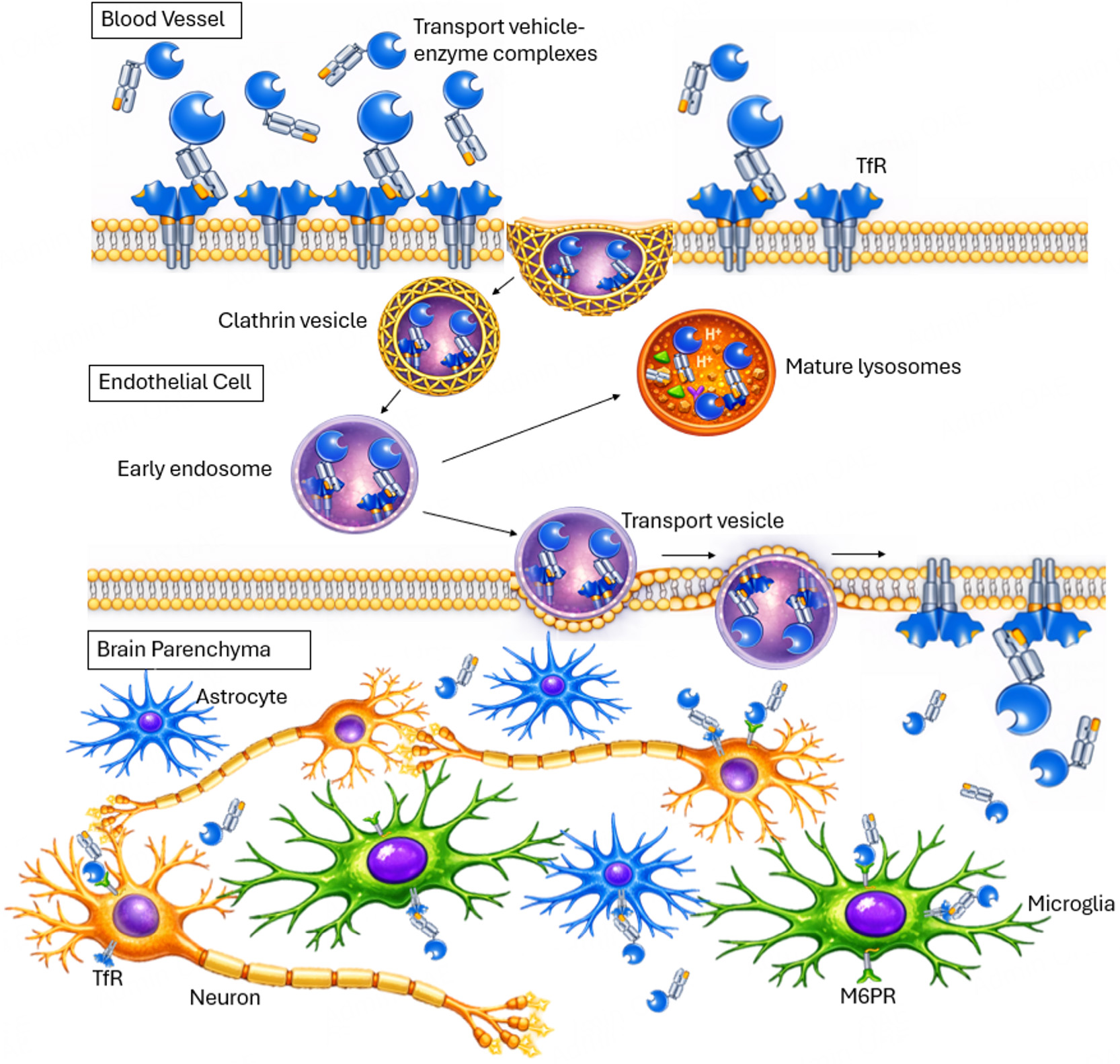
Figure 1. Mechanism of TfR-mediated ERT strategies. Following transcytosis, neuronal cells take up the TfR-ERT complexes via M6PRs and TfRs. TfR: Transferrin receptor; M6PR: mannose-6-phosphate receptor; ERT: enzyme replacement therapy; TfR-ERT: transferrin receptor-mediated enzyme replacement therapy.
Currently, two clinical strategies - pabinafusp alfa[7,8] and tividenofusp alfa-eknm[1] - have been implemented to fuse IDS enzymes. Pabinafusp alfa (JR-141) is a first-generation, bivalent TfR-binding, full anti-TfR monoclonal antibody approved in Japan (2021) for weekly intravenous infusion at 2 mg/kg. Reduction of HS by pabinafusp alfa is comparable to that of Elaprase (Elaprase®, Shire Human Genetic Therapies, Inc., Cambridge, MA, USA) in the periphery, while CSF HS levels are significantly reduced by week 52 but often remain above normal in many patients. Pabinafusp alfa leverages TfR-mediated transcytosis to cross the BBB and deliver IDS directly to CNS compartments. In the Phase 2/3 study, this mechanism produced robust CNS substrate clearance, with significant reductions in CSF HS, alongside parallel reductions in systemic GAGs. Despite this strong biochemical response, neurological outcomes were more variable, with 21/28 patients showing stabilization or improvement, reflecting partial rescue of neurocognitive trajectories. Long-term follow-up indicates that early initiation enhances CNS benefit, consistent with a mechanism in which timely lysosomal correction prevents irreversible neuronal injury. Safety remained favorable, with mild-to-moderate infusion reactions similar to those with conventional ERT. The key limitation is the disconnect between efficient biochemical correction and more modest functional recovery, highlighting the challenge of reversing established neurodegeneration even with effective BBB transport[8].
In contrast, tividenofusp alfa-eknm (DNL310) is a next-generation fusion of IDS enzymes via a platform called transport vehicle cargo. The transport vehicle is an engineered Fc fragment that binds to TfR monovalently and with lower affinity, thereby improving transcytosis over lysosomal degradation[4]. Mechanistically, bivalent TfR binding, as seen with pabinafusp alfa, allows simultaneous binding of two TfR molecules, inducing receptor crosslinking. This crosslinking diverts TfR from its normal recycling pathway toward endolysosomal compartments, resulting in intracellular retention, receptor downregulation, and limited transcytosis. Consistent with this, multiple studies demonstrate that high-affinity or multivalent TfR antibodies enhance lysosomal trafficking and reduce receptor availability, leading to poor brain penetration and sequestration within brain endothelial cells. Monovalent, lower-affinity TfR engagement by tividenofusp alfa-eknm avoids receptor clustering, supports transient binding, and preserves TfR recycling. This promotes efficient transcytosis and significantly improves CNS exposure[5,9-11]. The strong biochemical and mechanistic evidence for tividenofusp alfa-eknm strengthens its position as the first FDA-approved BBB-crossing ERT for weekly intravenous infusion at 15 mg/kg. There was a significant reduction of GAGs by tividenofusp alfa-eknm in the periphery and normalization of urine HS in the majority of patients, as well as nearly complete correction of CSF HS levels by week 24, which was sustained through week 153 (see Table 1).
Brain-penetrating TfR-targeting proteins to facilitate enzyme transcytosis across the BBB in LSDs
| Indication | Therapeutic domain | Fusion protein targeting TfR | Ref. |
| Hurler syndrome (MPS I) | α-L-Iduronidase (IDUA) | Lepunafusp alfa (JR-171): IDUA fused to Fab fragment of humanized anti-human TfR antibody | NCT04227600[15,16] |
| Hunter syndrome (MPS II) | Iduronate-2-sulfatase (IDS) | Pabinafusp alfa (JR-141): IDS fused to humanized anti-human TfR antibody | [8,17] |
| Hunter syndrome (MPS II) | Iduronate-2-sulfatase (IDS) | Tividenofusp alfa-eknm (AVLAYAH™; DNL310, ETV:IDS); IDS fused to engineered TfR-binding Fc fragment | NCT05371613 NCT06075537 NCT04251026[18,19] |
| Pompe disease | Acid α-glucosidase (GAA) | Anti-TfR-GAA fusions | [20] |
| Pompe disease | Acid α-glucosidase (GAA) | DNL952 (ETV:GAA): GAA fused to engineered TfR-binding Fc fragment | NCT07354724 |
| Sanfilippo syndrome Type A (MPS IIIA) | Sulfoglucosamine sulfohydrolase (SGSH) | DNL126 (ETV:SGSH): SGSH fused to engineered TfR-binding Fc fragment | NCT06181136 |
| Sanfilippo syndrome Type A (MPS IIIA) | Sulfoglucosamine sulfohydrolase (SGSH) | cTfRMAb-SGSH: IgG-SGSH fusion protein | [21] |
By comparison, intrathecal idursulfase-IT bypasses the BBB by direct CSF administration and produces strong biochemical activity, achieving ~72% CSF GAG reduction at 52 weeks in the Phase 2/3 trial. However, the study did not meet its primary cognitive endpoint (P = 0.5669), and clinical responses were variable, with a signal of greater benefit in younger patients (< 6 years). Long-term extension data indicate that treatment is generally well tolerated but is limited by the need for invasive intrathecal delivery systems and associated procedural risks[12]. A biomarker analysis from the same Muenzer-led trial linked baseline neurofilament light chain levels and CSF substrate burden to clinical outcomes, reinforcing the idea that earlier intervention may be critical[13]. Overall, idursulfase-IT provides reliable improvement in CSF biomarkers but yields more modest and inconsistent neurocognitive benefit [Table 2].
CNS-targeted enzyme delivery in MPS II: clinical, biochemical, and safety comparison
| Feature | Pabinafusp alfa (bivalent TfR IgG)[8] | IT-idursulfase [12,22] | Tividenofusp alfa-eknm (monovalent TfR Fc) [1] |
| Delivery | IV, BBB transcytosis via TfR (bivalent, high affinity) Weekly IV infusion | Direct CNS delivery via intrathecal administration Repeated lumbar puncture or implanted intrathecal device | IV, BBB transcytosis via TfR (monovalent, affinity-tuned) Weekly IV infusion |
| CNS exposure | Receptor-mediated transcytosis, but with potential endothelial trapping | Bypasses BBB entirely via CSF delivery | Optimized transcytosis with reduced receptor crosslinking |
| CSF biomarker effect (HS/GAG) | Significant reduction (P < 0.001) | ~72% reduction in CSF GAGs | ~90%-93% reduction; near normalization in most patients |
| Peripheral biomarker effect | Strong (serum, urine GAG reduction comparable to standard ERT) | Maintained via concomitant IV ERT | Strong (normalization of urine GAGs in majority) |
| Neurocognitive outcomes | Modest stabilization/improvement; heterogeneous response | Primary endpoint not met; possible benefit in younger patients | Stabilization/improvement in adaptive behavior (emerging data) |
| Durability | Sustained biochemical and clinical benefits in long-term data | Long-term tolerability shown; efficacy remains limited | Sustained biomarker normalization and clinical stability in extension studies |
| Safety | Generally well tolerated; mild-moderate infusion reactions | Generally tolerable, but invasive procedures add risk | Infusion reactions/ hypersensitivity manageable |
| Key limitations | Possible endothelial trapping; moderate clinical CNS benefit | Invasive delivery; limited clinical efficacy despite biochemical effect | Clinical benefit still under confirmation; long-term outcomes pending |
| Combination therapy potential | First-generation BBB shuttle (approved in Japan) Possible synergy with other CNS-directed approaches | CNS-directed approach Could complement systemic therapies for rapid CSF correction | Next-generation BBB shuttle (optimized design) Explicitly positioned for combination strategies |
Both applications have demonstrated infusion-related immune reactions, which should be considered in future implementations. From our perspective, several mechanistic questions remain unresolved. Not all lysosomal enzymes can be fused at the C-terminus due to the proximity of their catalytic or structural domains, necessitating N-terminal fusion instead. For example, the IDS enzyme is connected to the hinge region of the Fc fragment at the C-terminus. As a result, it is uncertain how an engineered Fc fragment with transferrin-binding capability would behave if the N-terminus of other enzymes were fused to its C-terminus. Specifically, could such an orientation alter the Fc’s TfR-binding angle and consequently affect cellular uptake? Furthermore, it remains to be determined whether such configurations could inadvertently promote crosslinking between infused cargo during circulation. Another concern is the size of the cargo being infused; some lysosomal enzymes are larger or tend to form dimers in the bloodstream. When these enzymes are linked to engineered transferrin-binding Fc fragments, their overall molecular size increases considerably, potentially impeding TfR-mediated internalization. Additionally, extending this strategy to other LSDs raises questions regarding the role of the hinge region. While Fc monomers are stabilized through disulfide bonds within the hinge region and homodimer-promoting interactions at the CH3-CH3 interface, which maintain dimer stability even in the absence of the hinge, it remains uncertain whether removing the hinge would preserve the correct structural orientation necessary for TfR engagement or whether such modifications might impair the function of the fusion construct. Overall, although the IDS-based approach shows promise relative to current therapeutic approaches, further investigation and optimization are required to adapt this strategy for broader application to other LSDs.
AN INTEGRATIVE APPROACH TO GENE AND CELL THERAPIES
Although ERT has demonstrated clinical efficacy, its impact on LSDs remains limited by a short circulating half-life, restricted biodistribution to challenging tissues such as the CNS and skeletal system, and the necessity for lifelong, high-burden weekly or biweekly infusions. Despite advances in ERT through TfR-binding Fc engineering, many fundamental limitations persist. Gene and cell therapies may address these constraints by enabling sustained, endogenous enzyme production, cross-correction, and, depending on the platform, direct delivery to the CNS and other tissues or prolonged systemic secretion. Consequently, these emerging modalities offer the potential for more durable, physiological, and comprehensive anatomical correction compared to ERT alone, thereby establishing a strong rationale for the integration or combination of these innovative TfR-ERT strategies to optimize therapeutic outcomes in LSDs.
In addition to gene and cell therapies, combination approaches may further enhance therapeutic recovery. TfR-ERT or similarly designed enzymes could be used as pre-treatment until stable expression is achieved via gene/cell therapy. Early TfR-ERT-like administrations would reduce accumulated storage materials, thereby creating a more favorable biochemical environment for subsequent gene/cell therapies to correct the disease pathology at the functional level. In clinical practice, children who receive HSCT at an early age have limited opportunities for re-transplantation if the initial graft provides only partial correction. The second HSCT carries substantially higher risks if the first graft fails, particularly in skeletal dysplasias such as MPS IVA. This limitation underscores the need for alternative strategies, such as engineered ERTs, that can be administered safely when needed and do not require additional conditioning. Saikia et al.[14] demonstrated the potential of a combination therapy using HSCT with AAV-mediated gene delivery in MPS IVA mice. Although the mechanisms may differ from TfR-ERT, their findings highlight that combinatorial approaches can achieve near-complete correction of skeletal pathology[14].
To date, various approaches, including ERT, HSCT, AAV vectors, lentiviral vectors, and CRISPR/Cas9, have been explored primarily as standalone interventions delivering a single therapeutic gene. However, these monotherapies have predominantly resulted in slower disease progression rather than achieving functional correction, especially in challenging-to-reach tissues such as the brain and bone. In this context, the TfR-ERT platform exemplifies a versatile strategy that can be incorporated into any gene or cell therapies to maximize overall therapeutic efficacy in LSDs and other diseases.
DECLARATIONS
Authors’ contributions
Wrote the draft, Created Figure 1: Celik B
Revised and edited the manuscript: Celik B, Baya G, Tomatsu S
Created Tables 1 and 2: Baya G
All authors have read and agreed to the published version of the manuscript.
Availability of data and materials
Not applicable.
AI and AI-assisted tools statement
During the preparation of this manuscript, the AI tool Microsoft Copilot (version 149.0.4022.66, released 2026-06-11) was used solely for language editing and image drawing. The tool did not influence the study design, data collection, analysis, interpretation, or the scientific content of the work. All authors take full responsibility for the accuracy, integrity, and final content of the manuscript.
Financial support and sponsorship
None.
Conflicts of interest
All authors declared that there are no conflicts of interest.
Ethical approval and consent to participate
Not applicable.
Consent for publication
Not applicable.
Copyright
© The Author(s) 2026.
REFERENCES
1. Muenzer J, Burton BK, Harmatz P, et al. An intravenous brain-penetrant enzyme therapy for mucopolysaccharidosis II. N Engl J Med. 2026;394:39-50.
2. Denali Therapeutics. Press Release. Denali therapeutics announces U.S. FDA approval of AVLAYAHTM (tividenofusp alfa-eknm) for treatment of hunter syndrome (MPS II). 2026. Available from: https://investors.denalitherapeutics.com/node/11606/pdf [Last accessed on 23 Sep 2026].
3. U.S. Food and Drug Administration. FDA news release. FDA approves drug to treat neurologic manifestations of hunter syndrome. 2026. Available from: https://www.fda.gov/news-events/press-announcements/fda-approves-drug-treat-neurologic-manifestations-hunter-syndrome [Last accessed on 23 Sep 2026].
4. Kariolis MS, Wells RC, Getz JA, et al. Brain delivery of therapeutic proteins using an Fc fragment blood-brain barrier transport vehicle in mice and monkeys. Sci Transl Med. 2020;12:eaay1359.
5. Arguello A, Mahon CS, Calvert ME, et al. Molecular architecture determines brain delivery of a transferrin receptor-targeted lysosomal enzyme. J Exp Med. 2022;219:e20211057.
6. Fukatsu T, Morio H, Furihata T, Sonoda H. Transferrin receptor-targeting property of pabinafusp alfa facilitates its uptake by various types of human brain-derived cells in vitro. Front. Drug Deliv. 2023;3:1082672.
7. Okuyama T, Eto Y, Sakai N, et al. Iduronate-2-sulfatase with anti-human transferrin receptor antibody for neuropathic mucopolysaccharidosis II: a phase 1/2 trial. Mol Ther. 2019;27:456-64.
8. Okuyama T, Eto Y, Sakai N, et al. A phase 2/3 trial of pabinafusp alfa, IDS fused with anti-human transferrin receptor antibody, targeting neurodegeneration in MPS-II. Mol Ther. 2021;29:671-9.
9. Bonvicini G, Singh S, Sandersjöö L, Sehlin D, Syvänen S, Andersson KG. The effects of dose, valency, and affinity on TfR-mediated brain delivery in vivo. Fluids Barriers CNS. 2025;22:36.
10. Bien-Ly N, Yu YJ, Bumbaca D, et al. Transferrin receptor (TfR) trafficking determines brain uptake of TfR antibody affinity variants. J Exp Med. 2014;211:233-44.
11. Niewoehner J, Bohrmann B, Collin L, et al. Increased brain penetration and potency of a therapeutic antibody using a monovalent molecular shuttle. Neuron. 2014;81:49-60.
12. Muenzer J, Burton BK, Harmatz P, et al. Intrathecal idursulfase-IT in patients with neuronopathic mucopolysaccharidosis II: results from a phase 2/3 randomized study. Mol Genet Metab. 2022;137:127-39.
13. Argueta C, Brekk OR, Wang S, et al. A link between baseline neurofilament light chain and primary substrate accumulation in cerebrospinal fluid, and clinical outcomes in patients with MPS II from a phase 2/3 clinical trial and extension study of intrathecal idursulfase. Mol Genet Metab. 2025;144:109055.
14. Saikia S, Celik B, Khan S, Tomatsu S. The complementary strength of the AAV9 gene therapy in hematopoietic stem cells transplanted into MPS IVA mice. Mol Genet Metab. 2026;147:109607.
15. Harmatz P, Giugliani R, Martins AM, et al. α-L-iduronidase fused with humanized anti-human transferrin receptor antibody (lepunafusp alfa) for mucopolysaccharidosis type I: a phase 1/2 trial. Mol Ther. 2024;32:609-18.
16. Kida S, Koshimura Y, Yoden E, et al. Enzyme replacement with transferrin receptor-targeted α-L-iduronidase rescues brain pathology in mucopolysaccharidosis I mice. Mol Ther Methods Clin Dev. 2023;29:439-49.
17. Yamamoto R, Yoden E, Tanaka N, et al. Nonclinical safety evaluation of pabinafusp alfa, an anti-human transferrin receptor antibody and iduronate-2-sulfatase fusion protein, for the treatment of neuronopathic mucopolysaccharidosis type II. Mol Genet Metab Rep. 2021;27:100758.
18. Arguello A, Meisner R, Thomsen ER, et al. Iduronate-2-sulfatase transport vehicle rescues behavioral and skeletal phenotypes in a mouse model of Hunter syndrome. JCI Insight. 2021;6:e145445.
19. Ullman JC, Arguello A, Getz JA, et al. Brain delivery and activity of a lysosomal enzyme using a blood-brain barrier transport vehicle in mice. Sci Transl Med. 2020;12:eaay1163.
20. George K, Riley R, Zhou S, et al. Novel transferrin receptor-mediated enzyme replacement therapy efficiently treats myogenic and neurogenic aspects of Pompe disease in mice. Mol Ther Methods Clin Dev. 2025;33:101547.
21. Boado RJ, Lu JZ, Hui EK, Pardridge WM. Reduction in brain heparan sulfate with systemic administration of an IgG trojan horse-sulfamidase fusion protein in the mucopolysaccharidosis type IIIA mouse. Mol Pharm. 2017;15:602-8.
Cite This Article
 Open Access
How to Cite
Celik B, Baya G, Tomatsu S. Receptor-mediated brain delivery in MPS II: a platform turning point for rare disease therapeutics. Rare Dis Orphan Drugs J. 2026;5:31. https://dx.doi.org/10.20517/rdodj.2026.20
Download Citation
If you have the appropriate software installed, you can download article citation data to the citation manager of your choice. Simply select your manager software from the list below and click on download.
Export Citation File
Type of Import
Tips on Downloading Citation
Citation Manager File Format
Type of Import
Direct Import: When the Direct Import option is selected (the default state), a dialogue box will give you the option to Save or Open the downloaded citation data. Choosing Open will either launch your citation manager or give you a choice of applications with which to use the metadata. The Save option saves the file locally for later use.
Indirect Import: When the Indirect Import option is selected, the metadata is displayed and may be copied and pasted as needed.
About This Article
Copyright

Data & Comments
Data
0










Comments
Comments must be written in English. Spam, offensive content, impersonation, and private information will not be permitted. If any comment is reported and identified as inappropriate content by OAE staff, the comment will be removed without notice. If you have any queries or need any help, please contact us at [email protected].