

fig2
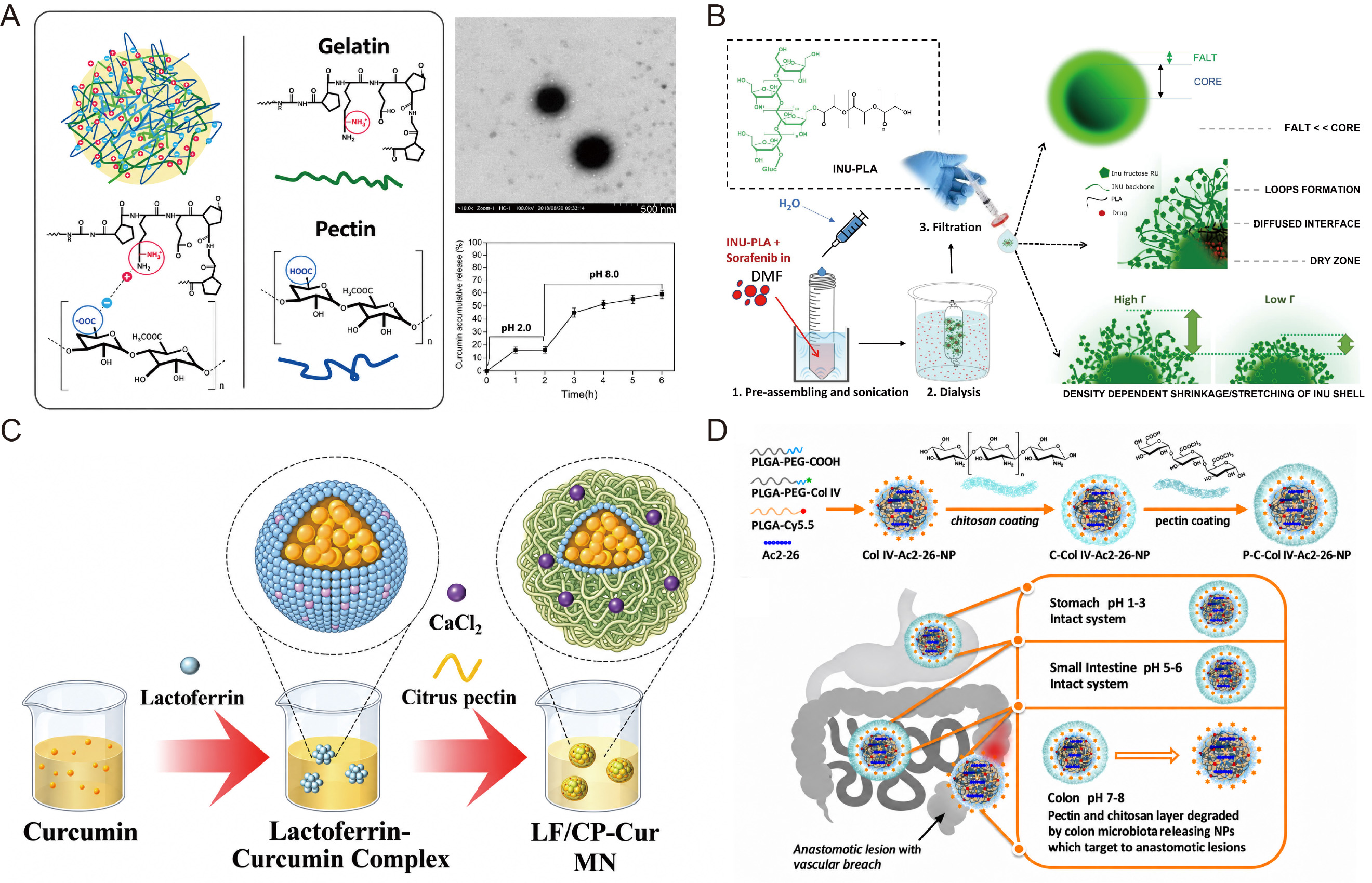
Figure 2. Representative construction and oral delivery architectures of inulin- and pectin-containing nanosystems. (A) Pectin-type B gelatin polyelectrolyte complexes formed through electrostatic interactions for curcumin loading, showing nanoscale morphology and pH-dependent drug release under simulated gastrointestinal conditions[51]. (A) is adapted from Ref.[51], under CC BY 4.0 License; (B) Amphiphilic inulin-poly (D,L-lactide) (INU-PLA) graft copolymers assembled into core-shell nanoparticles for sorafenib loading, with the inulin-rich surface layer governed by INU surface density[41]. (B) is adapted from Ref.[41], under CC BY 4.0 License; (C) Curcumin-loaded lactoferrin/citrus-pectin core-shell microgel nanoparticles (LF/CP-Cur MN) prepared by lactoferrin-curcumin complex formation, pectin incorporation, and Ca2+-mediated consolidation for IBD therapy[52]. (C) is adapted from Ref.[52], under CC BY 4.0 License; (D) Layer-by-layer pectin/chitosan-coated, collagen-IV-targeted PLGA nanoparticles encapsulating the pro-resolving peptide Ac2-26 (P-C-Col IV-Ac2-26 NPs), designed to remain intact during upper gastrointestinal transit and undergo microbiota-mediated shell degradation in the colon[53]. (D) is adapted from Ref.[53], under CC BY 4.0 License. Ac2-26: Annexin A1-derived peptide Ac2-26; Col IV: collagen IV; CP: citrus pectin; Cy5.5: cyanine 5.5; DMF: dimethylformamide; FALT: fixed aqueous layer thickness; INU: inulin; LF: lactoferrin; MN: microgel nanoparticle; NP: nanoparticle; PEG: polyethylene glycol; PLA: poly (D,L-lactide); PLGA: poly (lactic-co-glycolic acid); IBD: inflammatory bowel disease.