

fig3
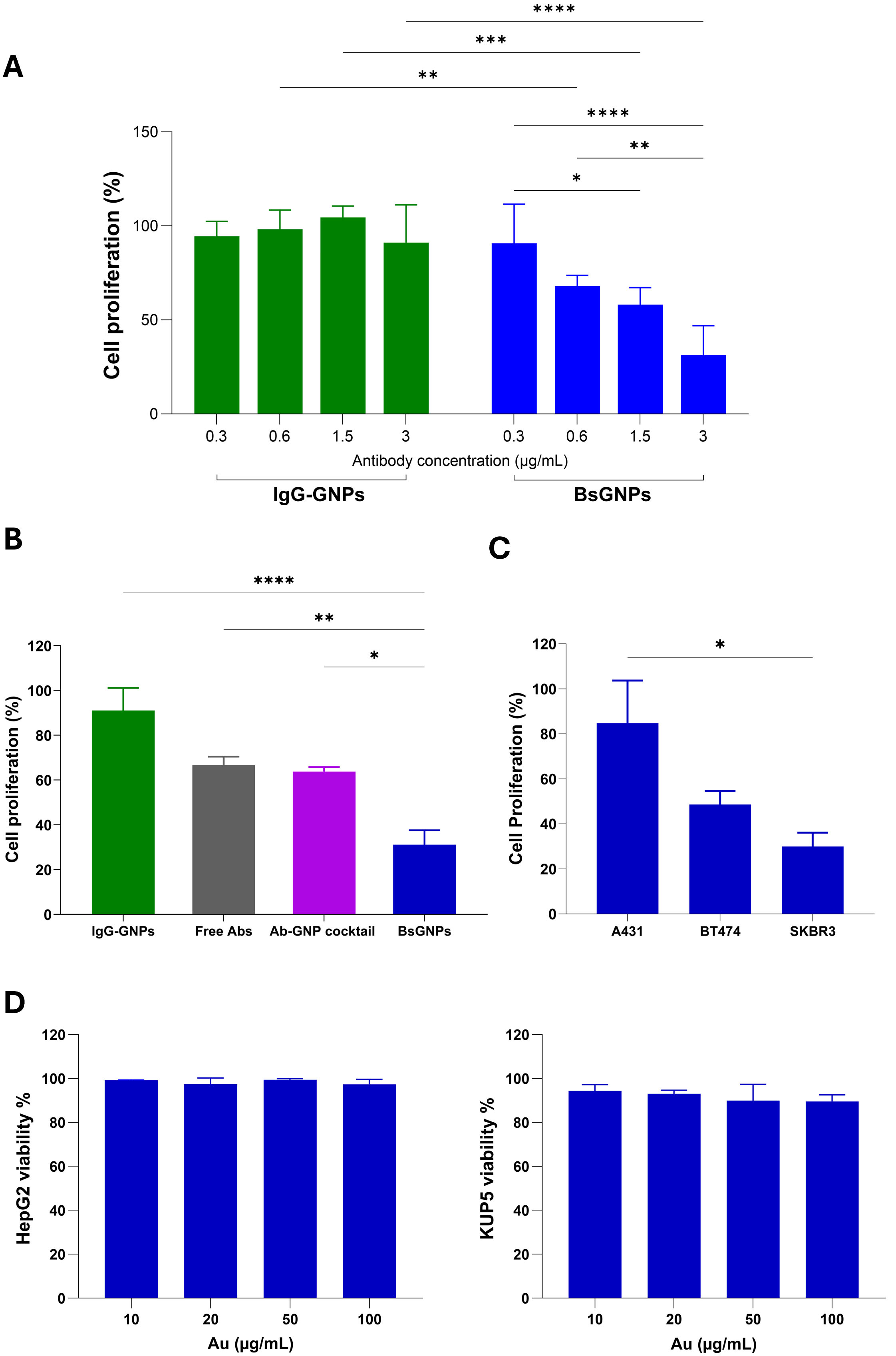
Figure 3. In vitro antiproliferative activity and cytotoxicity of BsGNPs. (A) SKBR3 cells were incubated with IgG-GNPs or BsGNPs at increasing concentrations (0.3, 0.6, 1.5, or 3 µg/ml of bound antibody) for 6 days; proliferation was normalized to untreated controls (100%). Statistical significance was assessed by two-way ANOVA followed by Holm-Šídák’s multiple-comparisons test. Significance was seen between BsGNPs and IgG-GNPs at matched concentrations of 0.6, 1.5, and 3 µg/mL, and within the BsGNP group between 0.3 and 1.5 µg/mL, 0.3 and 3 µg/mL, and 0.6 and 3 µg/mL. *P < 0.05, ** P < 0.01, *** P < 0.001, **** P < 0.0001. Mean ± SD, n = 4 biological replicates; n = 3 technical replicates per biological replicate; (B) Cell proliferation after treatment with BsGNPs, IgG-GNPs, free trastuzumab and pertuzumab, or a single-antibody cocktail of trastuzumab-conjugated GNPs and pertuzumab-conjugated GNPs (Ab-GNP cocktail), at the equivalent antibody dose of 3 µg/mL. BsGNPs significantly reduced SKBR3 cell proliferation compared to the other treatments. * P < 0.05, ** P < 0.01, **** P < 0.0001; one-way ANOVA with Tukey’s post hoc. Data shown as percentage of the untreated control (mean ± SD of n=3 biological replicates; n = 3 technical replicates per biological replicate); (C) Cell proliferation in HER2-positive breast cancer cell lines BT-474 and SKBR3 relative to low HER2-expressing A431 cells after treatment with BsGNPs (at 3 µg/mL bound antibody; one-way ANOVA with Tukey’s post hoc; * P < 0.05; mean ± SD of n=3 biological replicates, n = 3 technical replicates per biological replicate); (D) Cytotoxicity assays in HepG2 and KUP5 cells. Cells were treated with BsGNPs at gold concentrations of 10, 20, 50, or 100 μg/mL for 48 h, and viability was determined by MTT assay. Viability of BsGNP-treated groups was normalized to that of untreated control cells. No significant changes in viability were found (one-way ANOVA with Tukey’s post hoc; mean ± SD of n = 3 biological replicates; n = 3 technical replicates per biological replicate). IgG-GNP: immunoglobulin G-conjugated gold nanoparticle; BsGNP: bispecific gold nanoparticle; KUP5: Mouse Kupffer cell line; ANOVA: analysis of variance; SD: standard deviation; HepG2: human hepatocellular carcinoma cells.