

The gut microbiome as an emerging modifier of cardiovascular toxicity from cancer therapy
 0


 Download PDF
INTRODUCTION
Cancer therapy-related cardiovascular toxicity (CTRCT) is a leading cause of non-cancer mortality among survivors, who face an approximately 40% higher risk of developing cardiovascular disease compared with the general population[1]. Risk is concentrated in defined treatment settings, including anthracycline-based regimens in breast cancer and lymphoma, immune checkpoint inhibitors (ICIs) in melanoma, lung and renal cell carcinoma, HER2-targeted and vascular endothelial growth factor (VEGF)-pathway therapies, and thoracic radiotherapy for breast cancer, lung cancer, and Hodgkin lymphoma[2]. The traditional framework for understanding CTRCT centers on direct myocardial injury, including oxidative stress, mitochondrial dysfunction, and immune-mediated damage[3,4]. While these mechanisms are well established, they incompletely explain the marked interindividual variability in cardiotoxicity risk and fail to identify modifiable biological targets for prevention. The gut microbiome, increasingly recognized as a central regulator of systemic inflammation, immune homeostasis, and metabolic function, represents a plausible but currently unproven modifier of this variability.
Existing reviews have addressed gut-heart axis mechanisms in cancer therapy-related cardiac dysfunction with emphasis on chemotherapy and metabolite biomarkers[1], or have examined the microbiome principally in relation to antitumor efficacy and immune-related adverse events (irAEs)[5-7]. This Perspective adopts a complementary approach: the evidence is graded separately for each therapy class, the extrapolation of general irAE microbiome signatures to ICI-associated myocarditis is critically examined, and the interdependence of the cardiovascular, oncologic, and infectious consequences of microbiome modulation is addressed.
MECHANISTIC BASIS OF THE GUT-HEART AXIS
The gut microbiome exerts substantial influence on cardiovascular health through several interconnected pathways [Figure 1]. Microbial metabolites, including short-chain fatty acids (SCFAs), trimethylamine N-oxide (TMAO), and phenylacetylglutamine (PAGln), modulate endothelial function, systemic inflammation, and myocardial metabolism[1,8]. Intestinal barrier integrity, maintained by commensal bacteria, prevents translocation of lipopolysaccharides (LPS) and other endotoxins that drive low-grade systemic inflammation, a recognized contributor to atherosclerosis and heart failure[9,10]. The microbiome also shapes immune cell differentiation and function, including regulatory T cell (Treg) populations critical for cardiac immune tolerance[11]. Disruption of any of these axes: metabolic, barrier, or immunological, may lower the threshold for cardiovascular injury in the setting of cancer therapy. These pathways have been characterized predominantly in non-oncology cardiovascular cohorts and in experimental models, and their behavior during cancer therapy has not been directly examined.
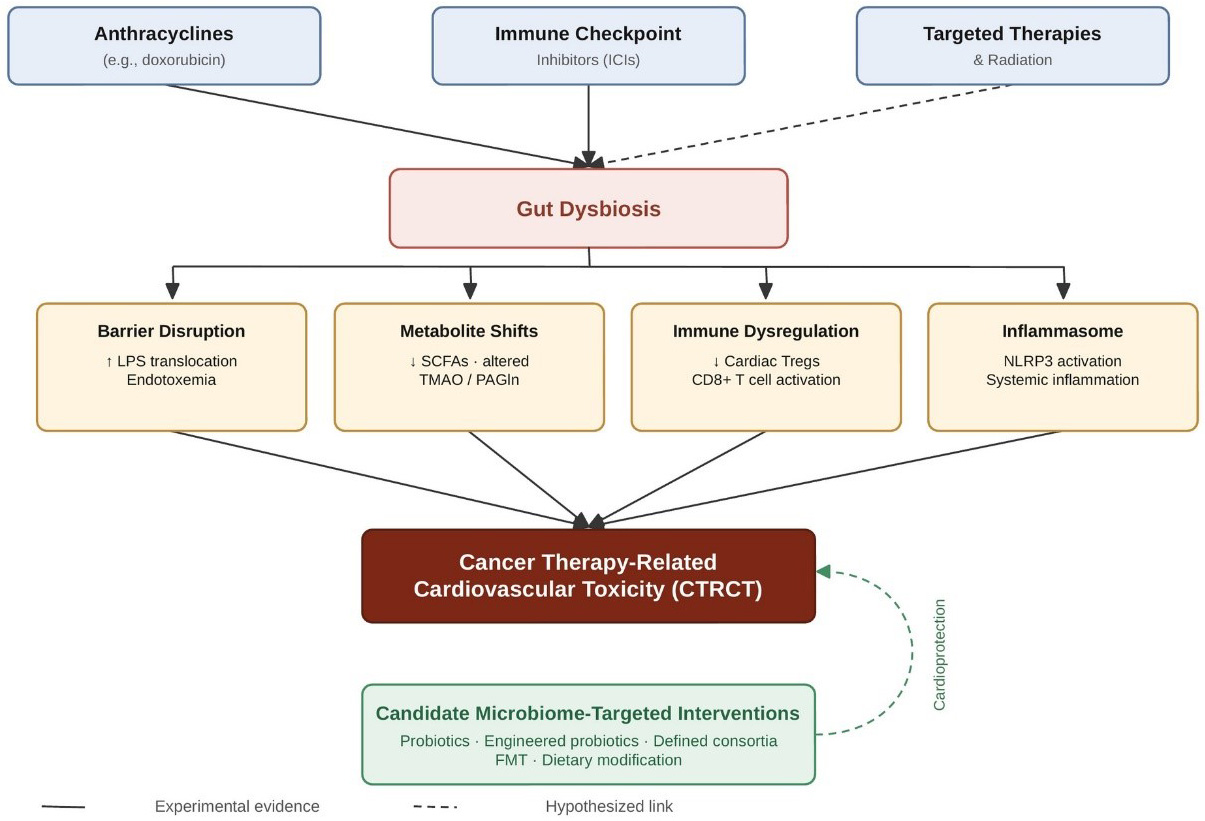
Figure 1. Proposed gut-heart axis pathways linking cancer therapies to CTRCT and candidate microbiome-guided interventions. Pathways shown are hypothesized on the basis of preclinical and mechanistic data and have not been validated against cardiovascular endpoints in humans. SCFA: Short-chain fatty acid; TMAO: trimethylamine N-oxide; PAGln: phenylacetylglutamine; CD8+: Cluster of differentiation 8; NLRP3: NOD-like receptor family pyrin domain containing 3; Treg: regulatory T cell; FMT: fecal microbiota transplantation.
EVIDENCE BY THERAPY CLASS
Anthracyclines. Doxorubicin, the prototypical anthracycline, induces significant gut dysbiosis in rodent models, characterized by depletion of SCFA-producing genera and expansion of LPS-producing pathobionts such as Escherichia-Shigella[9,12]. This dysbiosis compromises intestinal barrier integrity, elevates circulating endotoxin levels, and amplifies myocardial oxidative stress and inflammation[10,13]. The NLRP3 inflammasome appears to mediate the gut-heart connection in doxorubicin cardiotoxicity, with NLRP3 knockout attenuating both cardiac damage and microbiota alterations in murine models[14]. Fecal microbiota transplantation (FMT) from healthy donors to doxorubicin-treated mice restores microbial diversity, reduces endotoxemia, and improves cardiac function, indicating that in these models the microbiome is not merely a bystander but a contributor to anthracycline cardiotoxicity[13]. The gut microbiota-derived metabolite PAGln has also demonstrated cardioprotective effects against doxorubicin injury, suggesting that specific microbial metabolites may serve as both biomarkers and therapeutic agents[8]. However, whether these preclinical outcomes translate to clinical benefit is unclear because the human evidence is currently limited and dominated by small cohorts of doxorubicin-treated patients with breast cancer[1]. Although these studies demonstrated association of LPS translocation with elevated TNF-α, and baseline serum TLR4 with subsequent cardiotoxicity[1], these findings should be considered hypothesis-generating because no prospective human study has demonstrated that baseline or treatment-emergent microbiome features predict anthracycline cardiotoxicity independently of cumulative dose and conventional cardiovascular risk factors.
Immune checkpoint inhibitors. ICI-associated myocarditis, though rare (incidence 0.3%-1.7%), carries mortality rates exceeding 30%-50% in patients treated for melanoma, non-small cell lung cancer, and renal cell carcinoma[15,16]. The pathogenesis involves clonal expansion of cytotoxic Cluster of differentiation 8 (CD8+) T cells recognizing shared cardiac and tumor antigens, particularly α-myosin heavy chain[16,17]. A contributory role for the gut microbiome has been proposed[18,19] and is supported by experimental data in rodents, although it is not established in patients. In melanoma-bearing mice, PD-1 inhibition induced gut dysbiosis with concurrent reduction of intracardiac Tregs; antibiotic-mediated microbiota depletion in the same model attenuated myocardial injury, lowered serum CK-MB and cardiac troponin I, and restored Treg populations, with tumor volume comparable to that of PD-1 inhibitor-treated controls[11]. This constitutes interventional rather than observational evidence, although the absence of an antibiotic-only control group limits interpretation. In clinical cohorts, higher baseline abundance of pathobionts and depletion of Ruminococcaceae during ICI therapy are associated with severe irAEs[20]; these cohorts, however, treat irAEs as a composite endpoint dominated by colitis, dermatitis, and endocrinopathy, and do not include myocarditis among their endpoints.
Microbial predictors of ICI-associated myocarditis have therefore not been established. Extrapolation from composite irAE signatures is unlikely to resolve this question. At an incidence below 2%, cohorts powered to detect microbiome associations with common irAEs contain too few myocarditis events to support a myocarditis-specific signal. Myocarditis is also mechanistically distinct from the barrier-dependent mucosal toxicities that predominate in these composite endpoints, arising instead from antigen-specific T cell cross-reactivity against myocardium[21]. Determining whether the microbiome modifies myocarditis risk will require dedicated multicenter cohorts with cardiac phenotyping and myocarditis as a prespecified endpoint.
Targeted therapies and radiation. HER2-targeted agents impair cardiomyocyte survival signaling, VEGF-pathway inhibitors produce hypertension and thrombosis through endothelial dysfunction, and thoracic radiotherapy causes coronary disease, myocardial fibrosis, and valvular injury with latency extending over years to decades[2]. Although less extensively studied, targeted therapies and radiation also alter gut microbial composition with persistent changes in diversity and function[1]. These perturbations may contribute to the chronic cardiovascular risk observed in long-term cancer survivors through sustained low-grade inflammation and metabolic dysregulation, although no study has linked such changes to cardiovascular outcomes in patients receiving targeted therapy or radiation. Due to limited evidence in these classes, the findings should be considered hypothesis-generating.
TRANSLATIONAL CONSIDERATIONS
The translational potential of microbiome science in cardio-oncology requires that oncologic and cardiovascular endpoints be considered separately. A recent meta-analysis of 22 studies (3,274 patients) demonstrated that probiotic supplementation during ICI therapy improved progression-free survival [Hazard ratio (HR) 0.63, P < 0.0001] and overall survival (HR 0.53, P < 0.00001), while interventions using either probiotics or FMT were associated with increased objective response rates [Odds ratio (OR) 1.62, P = 0.006][22]. FMT has shown safety and efficacy in ICI-refractory melanoma and is being explored in treatment-naïve patients across tumor types[5]. These are oncologic endpoints derived largely from observational data and do not demonstrate cardioprotection; no clinical study has evaluated a microbiome-targeted intervention against a prespecified cardiovascular endpoint during cancer therapy.
Cardiovascular evidence remains preclinical. In preclinical cardiotoxicity models, engineered probiotics such as bioinspired peroxisome-engineered Escherichia coli Nissle 1917 have demonstrated the ability to restore intestinal barrier function, remodel microbial communities, and improve cardiac function in chronic doxorubicin models[23]. Bacterial exopolysaccharides from Weissella cibaria similarly reduced doxorubicin-induced endotoxemia and cardiac inflammation by suppressing LPS-producing pathobionts[9]. Both represent single-organism or single-metabolite strategies, whereas cancer therapy depletes multiple microbial functional guilds concurrently, particularly fiber-fermenting SCFA producers, while expanding Gram-negative pathobionts; restoration of a single taxon therefore addresses only part of this ecological shift. Defined multi-strain consortia designed to reconstitute SCFA production, bile-acid conversion, and competitive exclusion of pathobionts concurrently represent a more plausible strategy, and offer reproducibility and regulatory advantages over whole-stool FMT, the composition of which varies between donors[7]. Such consortia also permit deliberate exclusion of taxa associated with bacteremia risk. No consortium of this type has been evaluated against cardiovascular endpoints during cancer therapy.
Two further constraints will determine the feasibility of clinical translation. The first is safety. Live biotherapeutic agents carry a recognized risk of bacteremia and fungemia in immunocompromised hosts, and FMT has been implicated in fatal multidrug-resistant bacteremia in an immunocompromised recipient[24]. Patients receiving cytotoxic chemotherapy are frequently neutropenic and commonly have indwelling central venous catheters and chemotherapy-induced mucosal barrier injury, a combination in which translocation risk is greatest; cardioprotective intent does not mitigate this risk, and interventions evaluated in immunocompetent rodents cannot be assumed to be transferable. Dietary fiber modification, prebiotics, and metabolite supplementation may prove more tractable than live organisms in this population. The second is that microbiome modulation is not organ-specific. Microbial features associated with enhanced ICI response overlap with those associated with increased irAE risk[6,25]; an intervention adopted for cardioprotection could therefore attenuate antitumor efficacy, while one adopted to enhance tumor response could increase immune toxicity, potentially including myocarditis. Trials of microbiome-targeted cardioprotection during immunotherapy must accordingly be powered for tumor response and immune toxicity in addition to cardiovascular endpoints. This interdependence, rather than cardioprotection considered in isolation, constitutes the central translational problem.
LIMITATIONS AND RESEARCH PRIORITIES
Several limitations constrain the framework outlined above. Most fundamentally, no prospective human study has demonstrated that any microbiome feature predicts CTRCT independently of established determinants, including cumulative anthracycline dose, baseline cardiac function, age, and conventional cardiovascular risk factors. Until this threshold is met, the microbiome cannot be characterized as an established modifier of cardiovascular risk in this setting, and the proposition that pre-therapy microbiome profiling could identify patients at heightened cardiovascular risk, with probiotics, dietary modification, or FMT deployed as cardioprotective strategies, remains a hypothesis requiring formal testing rather than a near-term clinical prospect.
Microbial effects are also unlikely to be uniform across the settings in which CTRCT occurs. Differences in baseline gut microbiome composition and metabolic background across tumor types, in the mechanisms by which therapies perturb microbial communities, and in patient factors including diet, concomitant medications, geography, and renal function may all modify microbiome-cardiotoxicity associations[1]. Associations observed in one cancer-therapy pairing therefore cannot be assumed to generalize to another.
Specific constraints apply to radiation. The latency of radiation-associated cardiovascular disease, frequently exceeding a decade, is longer than the follow-up of any existing microbiome cohort, which limits causal inference. In addition, gut microbial disruption following radiotherapy has been characterized principally after abdominal and pelvic treatment, whereas radiation-associated cardiotoxicity arises from thoracic fields in which the gastrointestinal tract lies largely outside the treatment volume; any gut-mediated contribution would therefore require a systemic rather than a direct mucosal mechanism, which has not been tested. Several critical gaps must be addressed to advance this field. First, prospective multicenter cohorts are required in which cardiovascular events are prespecified endpoints rather than secondary observations, with serial stool and plasma sampling to a standardized protocol, harmonized sequencing and metabolomic pipelines, and cardiac phenotyping sufficient to detect subclinical dysfunction; such cohorts must record and adjust for antibiotic exposure, dietary intake, proton pump inhibitor use, and renal function, each of which independently alters microbial composition or metabolite interpretation. Second, the analytic question must be framed incrementally, addressing whether microbiome features add predictive information beyond established risk models rather than whether they correlate with toxicity in isolation. Third, the specificity of microbiome-cardiovascular interactions must be disentangled from broader irAE biology; whether gut dysbiosis drives cardiac-specific toxicity through distinct pathways or represents a shared vulnerability across organ systems remains unclear[21]. Fourth, intervention trials should evaluate microbiome-targeted strategies against cardiovascular endpoints rather than relying on extrapolation from oncologic efficacy data, and should be powered to detect effects on tumor response and immune toxicity. Fifth, cohorts should be stratified by tumor type and treatment regimen rather than pooled across cardio-oncology. Finally, multi-omics integration combining metagenomics, metabolomics, and immunophenotyping, together with standardization of microbiome assessment methodology across cardio-oncology trials, is a prerequisite for reproducible and clinically meaningful findings[25].
CONCLUSION
The gut-heart axis represents a biologically plausible and potentially modifiable contributor to cardiovascular risk during cancer therapy. The strength of supporting evidence differs substantially by therapy class. For anthracyclines and immune checkpoint inhibitors, interventional experiments in rodents have shown that modifying the microbiota alters cardiac injury, establishing a causal contribution in those models; for targeted therapies and radiation, the evidence remains conjectural. Across all three classes, however, human data are confined to small cohorts and associative endpoints, and no prospective study has demonstrated independent prediction of cardiovascular toxicity. These distinctions should not be collapsed into a single claim regarding cancer therapy as a whole. Whether the microbiome proves to be a clinically actionable axis in cardio-oncology will depend on evidence that is not yet available, and the principal contribution of the framework outlined here is to specify what that evidence would need to demonstrate.
DECLARATIONS
Authors’ contributions
Made substantial contributions to the conception and design, and drafted and critically revised the manuscript: Yusuf IA
Contributed to literature review, critical revision of the manuscript for important intellectual content: Okwah MN, Adolalom TO, Itua JA, Oladeji O, Adeleye A
All authors read and approved the final version of the manuscript for publication.
Availability of data and materials
Not applicable.
AI and AI-assisted tools statement
Not applicable.
Financial support and sponsorship
None.
Conflicts of interest
All authors declared that there are no conflicts of interest.
Ethical approval and consent to participate
Not applicable.
Consent for publication
Not applicable.
Copyright
© The Author(s) 2026.
REFERENCES
1. Chan NSL, Cross C, Bowen J, et al. The gut-heart axis in cardio-oncology. Cardiovasc Res. 2026;122:1573-88.
2. Lyon AR, López-Fernández T, Couch LS, et al.; ESC Scientific Document Group. 2022 ESC Guidelines on cardio-oncology developed in collaboration with the European Hematology Association (EHA), the European Society for Therapeutic Radiology and Oncology (ESTRO) and the International Cardio-Oncology Society (IC-OS). Eur Heart J. 2022;43:4229-361.
3. Bhutani V, Varzideh F, Wilson S, Kansakar U, Jankauskas SS, Santulli G. Doxorubicin-induced cardiotoxicity: a comprehensive update. J Cardiovasc Dev Dis. 2025;12:207.
4. Narasimhulu CA, Imaralu O, Khan M, Singla DK. Interplay of oxidative stress and inflammatory mechanisms in doxorubicin-induced cardiomyopathy. Am J Physiol Heart Circ Physiol. 2026;331:H619-36.
5. Barragan-Carrillo R, Zengin ZB, Pal SK. Microbiome Modulation for the Treatment of Solid Neoplasms. J Clin Oncol. 2025;43:2734-8.
6. Gao YQ, Tan YJ, Fang JY. Roles of the gut microbiota in immune-related adverse events: mechanisms and therapeutic intervention. Nat Rev Clin Oncol. 2025;22:499-516.
7. Hajjar R, Mars RAT, Kashyap PC. Harnessing the microbiome for cancer therapy. Nat Rev Microbiol. 2026;24:392-407.
8. Huang J, Hou X, Zhou N, et al. Novel Protective role for gut microbiota-derived metabolite PAGln in doxorubicin-induced cardiotoxicity. Cardiovasc Drugs Ther. 2026;40:65-80.
9. Hou J, Ren J, Abbas S, et al. Targeting the gut-heart axis: dextran from gut-derived Weissella cibaria alleviates doxorubicin-induced cardiotoxicity by attenuating low-grade endotoxemia. J Agric Food Chem. 2025;73:33084-98.
10. Tonon CR, Pereira AG, Ferreira NF, et al. The gut-heart axis and its role in doxorubicin-induced cardiotoxicity: a narrative review. Microorganisms. 2025;13:855.
11. Cao H, Dai H, Li S, et al. Abnormal gut microbiota may cause PD-1 inhibitor-related cardiotoxicity via suppressing regulatory T cells. Sci Rep. 2025;15:20547.
12. Huang J, Wei S, Jiang C, et al. Involvement of abnormal gut microbiota composition and function in doxorubicin-induced cardiotoxicity. Front Cell Infect Microbiol. 2022;12:808837.
13. An L, Wuri J, Zheng Z, Li W, Yan T. Microbiota modulate doxorubicin induced cardiotoxicity. Eur J Pharm Sci. 2021;166:105977.
14. Yin J, You Y, Mao J, Qi J, Zhang X, Hong Y. NLRP3 inflammasome regulates doxorubicin-induced cardiotoxicity by modulating the abundance of gut microbiota. Toxicol Appl Pharmacol. 2025;502:117455.
15. Reyes F, Buehning F, Lerchner T, et al. Cardiovascular toxicity from immune checkpoint inhibitor therapy: an inflammatory continuum. Br J Pharmacol 2026.
16. Jo W, Sun V, Čiháková D. Immune mechanisms of viral, autoimmune, and immune checkpoint inhibitor-associated myocarditis. Immunol Rev. 2026;338:e70111.
17. Huang J, Xu X, Jin Y, et al. Mechanisms and biomarkers of immune checkpoint inhibitor-associated myocarditis: from T cell imbalance to multicellular crosstalk. Front Immunol. 2026;17:1752354.
18. Chen Z, Li G, Tang X, Liu X. Cardiovascular adverse events associated with Immune checkpoint inhibitors from the perspective of gut microecology: potential roles and research advances of the gut microbiota. J Cardiovasc Pharmacol. 2026;88:104-14.
19. Huang Z, Mei X, Zhou Y. The gut microbiota: an emerging therapeutic target for ICI-associated myocarditis. Front Cell Infect Microbiol. 2026;16:1752485.
20. Verheijden RJ, van Eijs MJM, Paganelli FL, et al.; UNICIT-consortium. Gut microbiome and immune checkpoint inhibitor toxicity. Eur J Cancer. 2025;216:115221.
21. Gong J, Neilan TG, Zlotoff DA. Mediators and mechanisms of immune checkpoint inhibitor-associated myocarditis: insights from mouse and human. Immunol Rev. 2023;318:70-80.
22. Hu S, Luo C, Wan S, et al. Modulating the gut microbiome to enhance cancer immunotherapy: a systematic review and meta-analysis of probiotics and FMT as adjuncts. BMC Cancer. 2026;26.
23. Wang S, Fan X, Zhang C, et al. Oral bioinspired peroxisome-engineered probiotics for modulating gut microbiota homeostasis and alleviating cardiac chemotherapy toxicity. Adv Sci (Weinh). 2026;13:e19344.
24. DeFilipp Z, Bloom PP, Torres Soto M, et al. Drug-resistant E. coli bacteremia transmitted by fecal microbiota transplant. N Engl J Med. 2019;381:2043-50.
Cite This Article
 Open Access
How to Cite
Yusuf IA, Okwah MN, Adolalom TO, Itua JA, Oladeji O, Adeleye A. The gut microbiome as an emerging modifier of cardiovascular toxicity from cancer therapy. Microbiome Res Rep. 2026;5:30. https://dx.doi.org/10.20517/mrr.2026.70
Download Citation
If you have the appropriate software installed, you can download article citation data to the citation manager of your choice. Simply select your manager software from the list below and click on download.
Export Citation File
Type of Import
Tips on Downloading Citation
Citation Manager File Format
Type of Import
Direct Import: When the Direct Import option is selected (the default state), a dialogue box will give you the option to Save or Open the downloaded citation data. Choosing Open will either launch your citation manager or give you a choice of applications with which to use the metadata. The Save option saves the file locally for later use.
Indirect Import: When the Indirect Import option is selected, the metadata is displayed and may be copied and pasted as needed.
About This Article
Copyright

Data & Comments
Data
0









Comments
Comments must be written in English. Spam, offensive content, impersonation, and private information will not be permitted. If any comment is reported and identified as inappropriate content by OAE staff, the comment will be removed without notice. If you have any queries or need any help, please contact us at [email protected].