



Intestinal microbiota in nursery pigs: comments on anatomical location, spatial niches, and approaches to data interpretation
 0
0 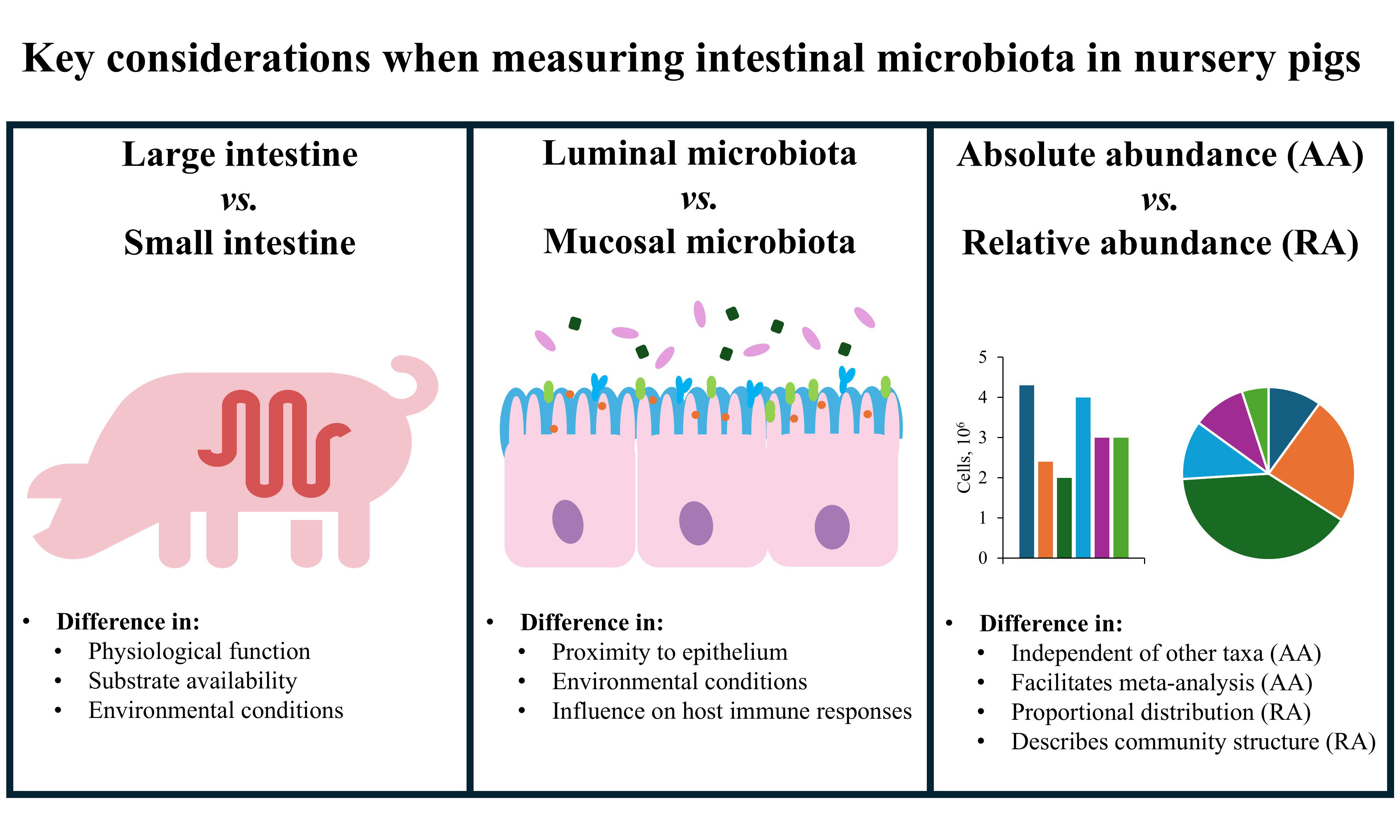
INTRODUCTION
In monogastric animals, the intestine is the primary site of food digestion and nutrient absorption, making intestinal function a key determinant of health and growth. Consequently, intestinal health has become a major focus within animal nutrition research[1,2]. Increasingly, this work has emphasized the complexity of microbiota-host-immune interactions and the role of the intestinal microbiota in regulating intestinal function[3,4]. This commentary aims to highlight key considerations for evaluating the intestinal microbiota in nursery pigs, with particular emphasis on anatomical location, spatial microbial niches, and methodological approaches to data interpretation. Specifically, this commentary discusses the need for a multifaceted approach to understand the role of the intestinal microbiota in nursery pigs.
SIGNIFICANCE OF THE SMALL INTESTINAL MICROBIOTA
A substantial proportion of studies evaluating the intestinal microbiota in monogastrics rely on fecal samples[5,6], which primarily represent luminal microbial populations of the large intestine. This approach offers practical advantages, including reduced invasiveness and decreased cost. Additionally, because microbial density is greatest in the large intestine, these microbial populations are used to assess microbial diversity and function[7,8]. However, in nursery pigs, the relevance of the large intestinal microbiota is less than that of the small intestinal microbiota. Young animals consume highly digestible diets, which reduces the amount of substrates reaching the large intestine. Furthermore, although the microbiota of the large intestine is important for long-term health, its relevance in production systems that prioritize short-term growth performance is low[9].
In contrast, the small intestine is the primary site of nutrient digestion and absorption[9], directly influencing feed efficiency and growth. The small intestinal microbiota plays a critical role in the development of intestinal structure, digestive function, and immune maturation[10]. At weaning, pigs undergo a rapid transition from a milk-based diet to solid feed, which drives significant shifts in microbial populations[11]. This period of instability can allow the expansion of opportunistic or pathogenic bacterial populations that are otherwise suppressed by a stable commensal community. Beyond its role in digestion, the small intestine contains a large proportion of the body’s immune cells and serves as a point of communication between the external environment and the host immune system[12,13]. Interactions with the microbiota can be beneficial, such as promoting immune tolerance and anti-inflammatory signaling, or harmful, such as activating cascades of inflammatory signaling that damage intestinal tissue. These immune responses can also repartition nutrients away from growth and toward maintenance of immune function, thereby reducing production efficiency.
It has been well documented that the microbial composition varies along the length of the gastrointestinal tract in pigs[14-16]. Changes in substrate availability and environmental conditions result in distinct differences in the microbial communities of the small and large intestine. Therefore, microbial measurements obtained from these regions should be evaluated independently, and in the context of understanding intestinal health in newly weaned pigs, it would be advantageous to examine the microbiota of the small intestine.
FUNCTIONAL DIFFERENCES BETWEEN LUMINAL AND MUCOSAL MICROBIOTA
Within the intestine, the intestinal microbiota can broadly be categorized as being luminal or mucosal[17]. The luminal microbiota is associated with digesta and is primarily involved in nutrient metabolism and fermentation. In contrast, the mucosal microbiota exists in close proximity to the intestinal epithelium and directly interacts with host enterocytes and immune cells. These spatial differences are accompanied by distinct environmental conditions. The mucosal layer provides a stable environment, with the support of mucin as a nutrient source and physical barrier, whereas the luminal environment is more dynamic and is heavily influenced by changes in substrate availability[18]. Oxygen gradients further differentiate these communities, leading to distinct differences in the microbial populations within the luminal and mucosal microbiota[19]. Given their proximity to the intestinal epithelium, the mucosal microbiota has a greater influence on host immune responses. As such, their evaluation is particularly important when investigating mechanisms related to intestinal health and immune function.
ABSOLUTE AND RELATIVE ABUNDANCE: INTERPRETIVE CONSIDERATIONS
In addition to spatial considerations, methodological approaches to microbial data analysis play an important role in its interpretation. Relative abundance is commonly used to describe microbial composition[3-5,14-16], however, it is inherently compositional and should be interpreted with caution. Changes in the relative abundance of one taxon may reflect shifts in another taxa, rather than true changes in population size[20]. In contrast, absolute abundance provides a direct measure of microbial quantity and is not influenced by the proportional distribution of other taxa[21,22]. This approach is particularly valuable when identifying biologically meaningful changes in specific populations or when outliers may distort relative interpretation. Furthermore, absolute abundance facilitates more reliable comparisons across studies, whereas relative abundance data are often difficult to compare due to differences in overall community structure. For these reasons, incorporating absolute abundance alongside relative abundance interpretations can strengthen the biological significance of microbiome data.
CONCLUSION
The evaluation of the intestinal microbiota in nursery pigs can help in unraveling the relationships among the diet, the intestinal microbiota, and the host. Although a practical approach, reliance on fecal samples as a proxy for the entire gastrointestinal tract overlooks the functional and compositional differences that occur along the length of the gastrointestinal tract, particularly in the small intestine, where nutrient digestion, absorption, and immune interactions are critical to animal performance. Similarly, failing to distinguish between luminal and mucosal microbial populations limits accurate interpretation of direct microbiota-host interactions. Methodological limitations, notably the exclusive use of relative abundance data, can obscure meaningful biological changes and complicate comparisons across studies. Incorporating both the absolute and relative abundance measures provides a more complete view of compositional dynamics within the microbiota. Collectively these considerations highlight the need for more intentional and targeted approaches to evaluating the intestinal microbiota in the context of nursery pig nutrition.
DECLARATIONS
Acknowledgments
The authors appreciate all former and current members of Kim Lab at North Carolina State University for their technical support.
Authors’ contributions
Conceptualization of the manuscript: Kim SW
Literature review: Gormley AR, Garavito-Duarte Y, Son, J
Writing of the manuscript: Gormley AR, Garavito-Duarte Y, Son, J, Kim SW
Figure: Gormley AR, Garavito-Duarte Y, Son, J
Review and editing of the manuscript: Gormley AR, Garavito-Duarte Y, Son, J, Kim SW
Availability of data and materials
Not applicable.
AI and AI-assisted tools Statement
Not applicable.
Financial support and sponsorship
This work was supported by North Carolina Agricultural Foundation (Raleigh, NC, USA) and USDA-NIFA Hatch (Washington DC, USA). The Real Pork Scholars Fellowship (National Pork Board, Des Moines, IA) supports Gormley AR.
Conflicts of interest
Kim SW is a Senior Editor of the journal Microbiome Research Reports. Kim SW was not involved in any steps of editorial processing, notably including reviewers’ selection, manuscript handling and decision making. The other authors declare that there are no conflicts of interest.
Ethical approval and consent to participate
Not applicable.
Consent for publication
Not applicable.
Copyright
© The Author(s) 2026.
REFERENCES
1. Rostagno MH. Managing intestinal health in farm animals: a critical view. In: Kogut, MH, Zhang G, Editors. Gut microbiota, immunity, and health in production animals. The microbiome of humans, animals, plants, and the environment. Switzerland: Springer, Cham; 2022. pp. 1-12.
2. Ducatelle R, Goossens E, Eeckhaut V, Van Immerseel F. Poultry gut health and beyond. Animal Nutrition. 2023;13:240-8.
3. Zhao X, Jiang L, Fang X, et al. Host-microbiota interaction-mediated resistance to inflammatory bowel disease in pigs. Microbiome. 2022;10:115.
4. Gomes MDS, Duarte ME, Saraiva A, De Oliveira LL, Teixeira LM, Rocha GC. Effect of antibiotics and low-crude protein diets on growth performance, health, immune response, and fecal microbiota of growing pigs. J Anim Sci. 2023;101:skad357.
5. Sandrini S, Perricone V, Cremonesi P, et al. Yeast mixture supplementation modulates faecal microbiota and ileum morphology of weaning pigs. animal. 2024;18:101275.
6. Kousar S, Chand N, Naz S, et al. In vitro and in vivo effects of methanolic extract of dietary ginger (Zingiber officinale) and onion (Allium cepa) supplementation on growth performance and fecal microbiota in Escherichia coli infected broiler chickens. Livestock Science. 2024;281:105416.
7. Knudsen KEB, Jensen BB, Hansen I. Digestion of polysaccharides and other major components in the small and large intestine of pigs fed on diets consisting of oat fractions rich in β-D-glucan. Br J Nutr. 2007;70:537-56.
8. Regassa A, Nyachoti CM. Application of resistant starch in swine and poultry diets with particular reference to gut health and function. Animal Nutrition. 2018;4:305-10.
9. Pluske JR, Hampson DJ, Williams IH. Factors influencing the structure and function of the small intestine in the weaned pig: a review. Livest Prod Sci. 1997;51:215-36.
11. Frese SA, Parker K, Calvert CC, Mills DA. Diet shapes the gut microbiome of pigs during nursing and weaning. Microbiome. 2015;3:28.
13. Mowat AM, Agace WW. Regional specialization within the intestinal immune system. Nat Rev Immunol. 2014;14:667-85.
14. Crespo-piazuelo D, Estellé J, Revilla M, et al. Characterization of bacterial microbiota compositions along the intestinal tract in pigs and their interactions and functions. Sci Rep. 2018;8:12727.
15. Kelly J, Daly K, Moran AW, Ryan S, Bravo D, Shirazi‐beechey SP. Composition and diversity of mucosa‐associated microbiota along the entire length of the pig gastrointestinal tract; dietary influences. Environ Microbiol. 2017;19:1425-38.
16. Gresse R, Chaucheyras Durand F, Dunière L, Blanquet-diot S, Forano E. Microbiota composition and functional profiling throughout the gastrointestinal tract of commercial weaning piglets. Microorganisms. 2019;7:343.
17. Daniel N, Lécuyer E, Chassaing B. Host/microbiota interactions in health and diseases - time for mucosal microbiology! Mucosal Immunol. 2021;14:1006-16.
18. Luis AS, Hansson GC. Intestinal mucus and their glycans: a habitat for thriving microbiota. Cell Host Microbe. 2023;31:1087-100.
19. Zong W, Friedman ES, Allu SR, et al. Disruption of intestinal oxygen balance in acute colitis alters the gut microbiome. Gut Microbes. 2024;16:2361493.
20. Aitchison J. The Statistical Analysis of Compositional Data. J. R. STAT. SOC. B. 1982;44:139-60.
21. Zaramela LS, Tjuanta M, Moyne O, Neal M, Zengler K. synDNA - a synthetic DNA spike-in method for absolute quantification of shotgun metagenomic sequencing. mSystems. 2022;7:e00447-22.
Cite This Article
 Open Access
How to Cite
Download Citation
Export Citation File:
Type of Import
Tips on Downloading Citation
Citation Manager File Format
Type of Import
Direct Import: When the Direct Import option is selected (the default state), a dialogue box will give you the option to Save or Open the downloaded citation data. Choosing Open will either launch your citation manager or give you a choice of applications with which to use the metadata. The Save option saves the file locally for later use.
Indirect Import: When the Indirect Import option is selected, the metadata is displayed and may be copied and pasted as needed.
About This Article
Copyright

Data & Comments
Data
0









Comments
Comments must be written in English. Spam, offensive content, impersonation, and private information will not be permitted. If any comment is reported and identified as inappropriate content by OAE staff, the comment will be removed without notice. If you have any queries or need any help, please contact us at [email protected].