

fig5

Advances on triply periodic hyperbolic surface structures: from biological inspiration to artificial self-assembly

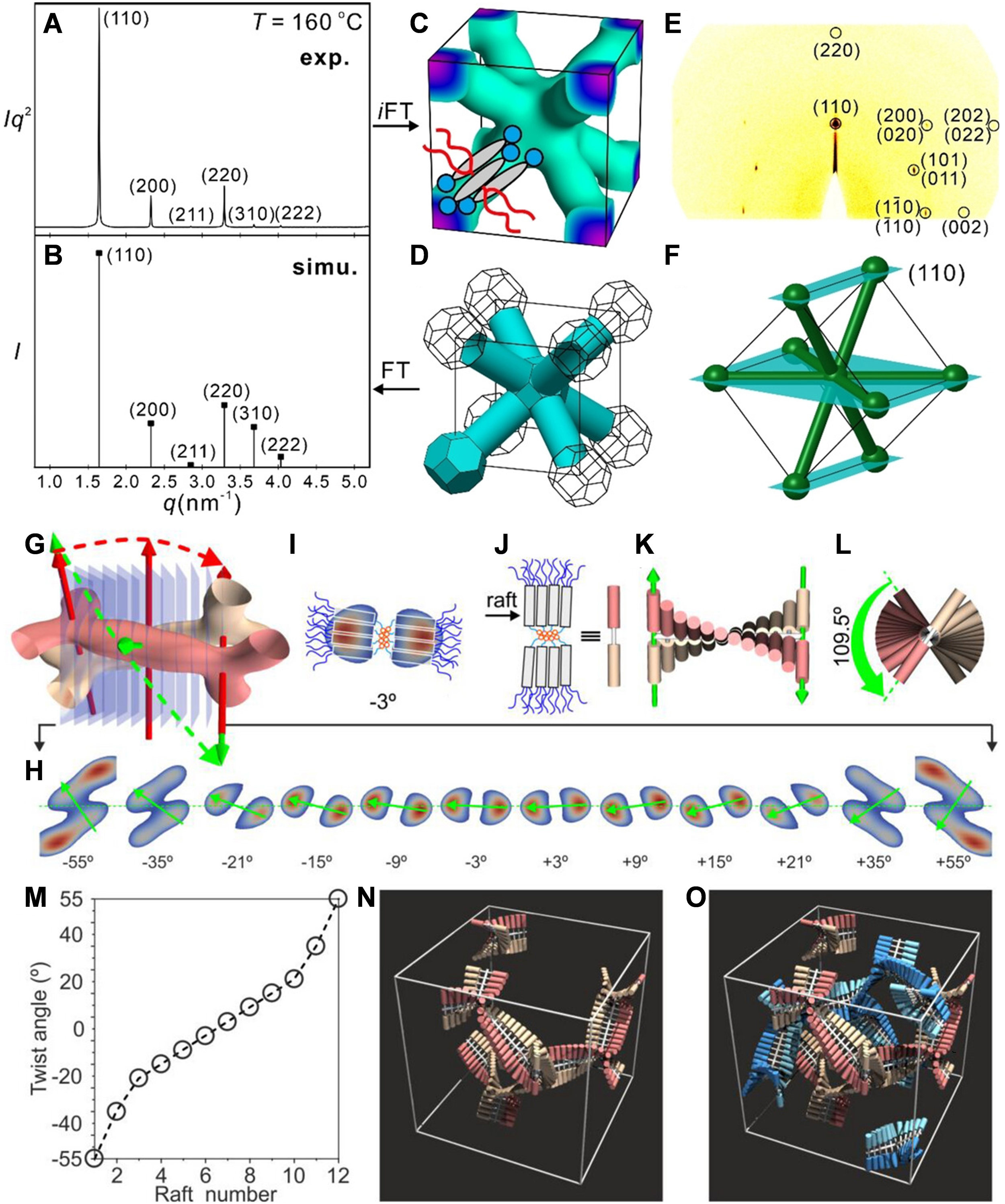
Figure 5. (A-F) SAXS/grazing-incidence SAXS (GISAXS) analysis and structural model of the body-centered cubic phase based on the I-WP minimal surface. (A and B) Experimental (A) and simulated (B) SAXS powder diffractograms; (C) Electron density map reconstructed from (A); (D) Geometric model used to calculate diffraction intensities; (E) Experimental GISAXS pattern, with the [110] axis perpendicular to the substrate; (F) Model of the infinite networks in an Im$$ \overline{3} $$m unit cell intersected by horizontal (110) planes. (A-F) Reproduced under the terms of the CC BY-NC 4.0 License[25]. Copyright 2020, The Authors; (G-O) Electron density slices of the double-helical segments in the 4NG phase and the supertwist model. (G) Slices of the two strands of a segment of the LH network. The green dashed line traces the 109.5° twist of the molecules between the junctions. The red dashed line traces the twist of the network itself, defined by the -70.5° dihedral angle between the junctions (red arrows). (H) Twelve slices from (G), showing high-electron-density regions; the small green arrows connecting the two electron density maxima define the azimuthal angle, listed below each slice. The change in azimuthal angle between rafts gives the twist angle of the molecules. (I) A schematic molecular structure superimposed on the -3° slice. (J) The model simplified to a dumbbell for tracing the trajectory of each chain in three-dimensional space. (K) Molecular supertwists forming a DG segment between two three-way junctions. (L) Top view of the supertwisted segment. (M) Line plot of azimuthal angle versus slice number, showing the variation of azimuthal angle along the segment. (N) Dumbbell model of the unit cell, showing two interwoven networks. (O) Full four-network model. (G-O) Reproduced under the terms of the CC BY 4.0 License[24]. Copyright 2025, The Authors. SAXS: Small-angle X-ray scattering; DG: double gyroid; 4NG: four-network gyroid; LH: left-handed; I-WP: I-graph-Wrapped Package graph.

