

fig11

Advances on triply periodic hyperbolic surface structures: from biological inspiration to artificial self-assembly

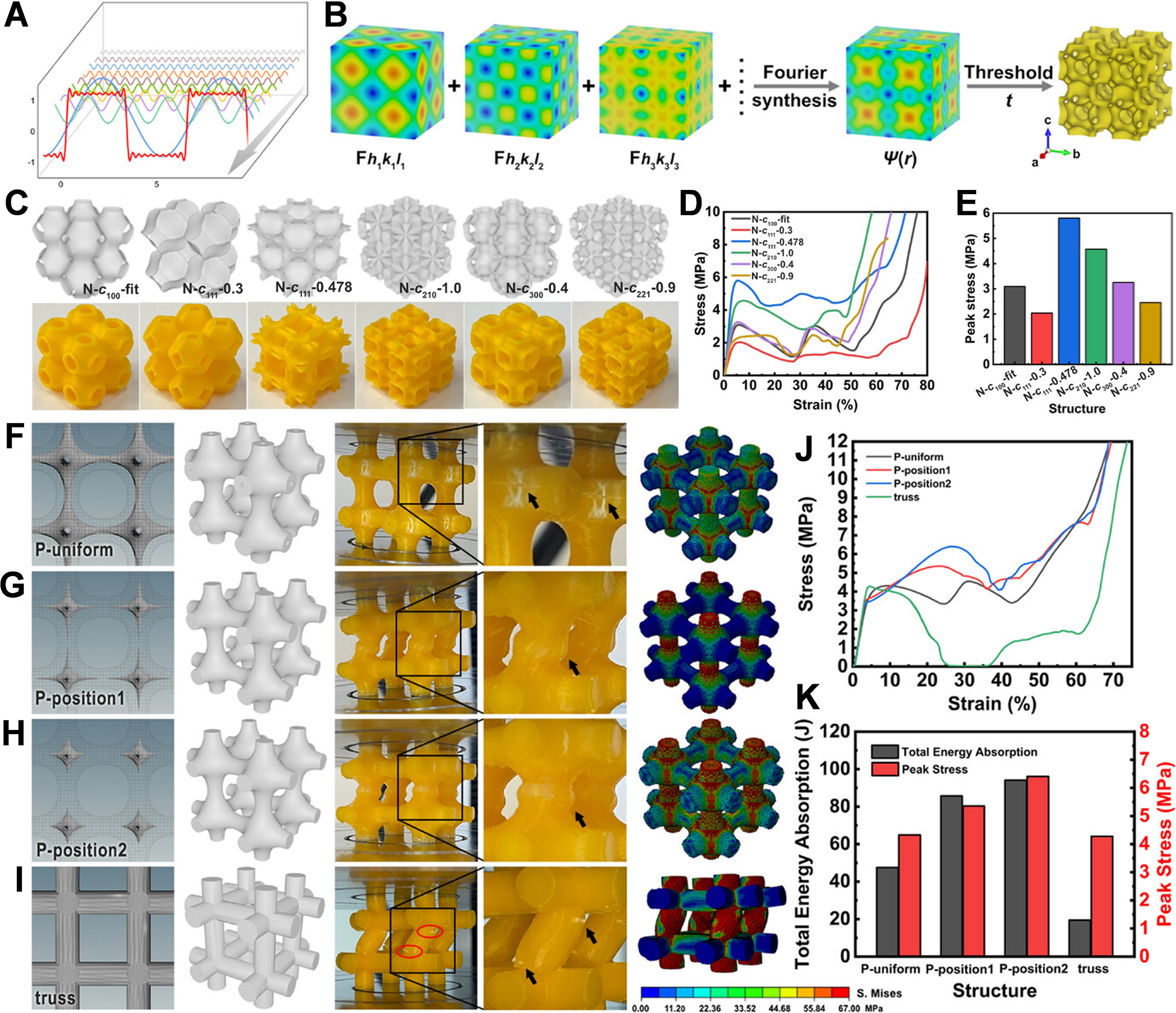
Figure 11. (A) Schematic drawing of the principle of Fourier synthesis; (B) Construction of TPHS structures; (C) Various structures were constructed based on Pm$$ \overline{3} $$m symmetry by adjusting corresponding Fourier components; (D) Stress-strain curves and (E) peak stress of each structure in (C); (F-K) Structural mechanics optimization through the regulation of surface curvature and position based on Fourier synthesis; (F-I) show the models and deformation mechanisms of P structure with uniform wall thickness (F), optimized P structure with the nodes relatively thickened (G), optimized P structure with the struts relatively thickened (H) and the traditional truss structure (I); The solid and shaded parts represent the inner and outer walls of the structure, respectively. The black arrows in the enlarged images indicate where the deformation occurs; (J) Stress-strain curves of these structures; (K) Values of peak stress and total energy absorption extracted from the stress-strain curves. This figure is reproduced under the terms of the CC BY 4.0 License[30]. Copyright 2025, The Authors. TPHS: Triply periodic hyperbolic surface.

