

fig4
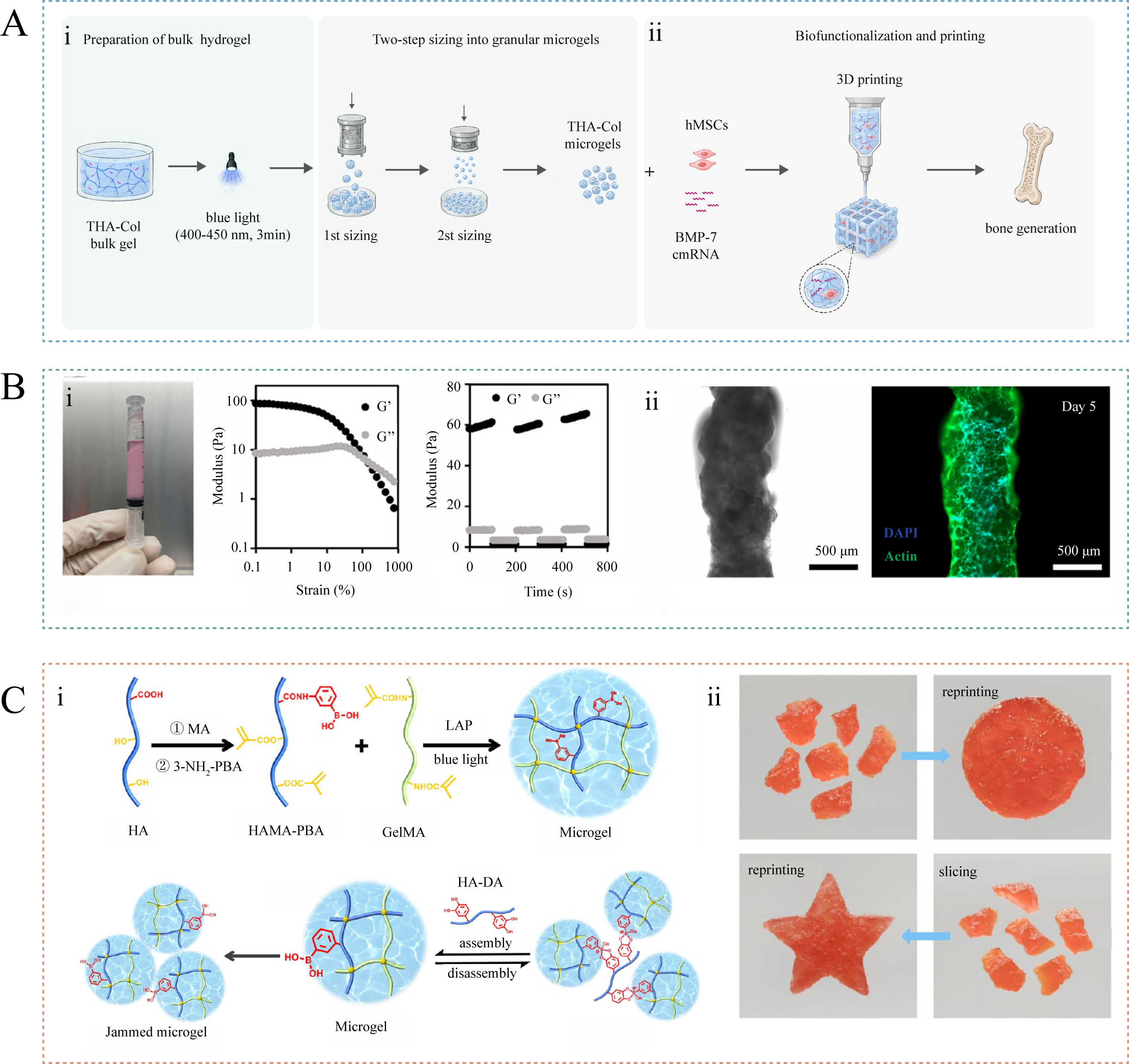
Figure 4. Collagen-containing and collagen-relevant microgel-based inks for three-dimensional printing and tissue assembly. (A) Preparation process (i) and printed product (ii) of a 3D printable particulate hydrogel based on THA-Col. Figure 4A is newly drawn by the authors based on the fabrication principle reported by Ref.[52]. No original figure elements were reused; (B) Printability (i) and cell-laden printing capability (ii) of collagen-based Collagen-GAG Microgel. Figure 4B is adapted in part from Ref.[34]. Reused under the terms of the Creative Commons Attribution License (CC BY); (C) Synthesis (i) and reprintability (ii) of DC-MA bioink. Dynamic covalent bonding between dopamine-modified HA and phenylboronic acid ester enables high printability, self-healing, and reprintability without secondary crosslinking. Figure 4C is adapted in part with permission from Ref.[106]. Copyright 2022, American Chemical Society. THA-Col: Tyramine-modified hyaluronic acid-collagen; 3D: three-dimensional; DAPI: 4',6-diamidino-2-phenylindole; MA: methacrylic anhydride; HA-DA: dopamine-modified hyaluronic acid; GelMA: methacrylated gelatin; LAP: lithium phenyl-2,4,6-trimethylbenzoylphosphinate; HAMA-PBA: phenylboronic acid-modified methacrylated hyaluronic acid: DC-MA: dynamic cross-linked microgel assembly;