

fig7
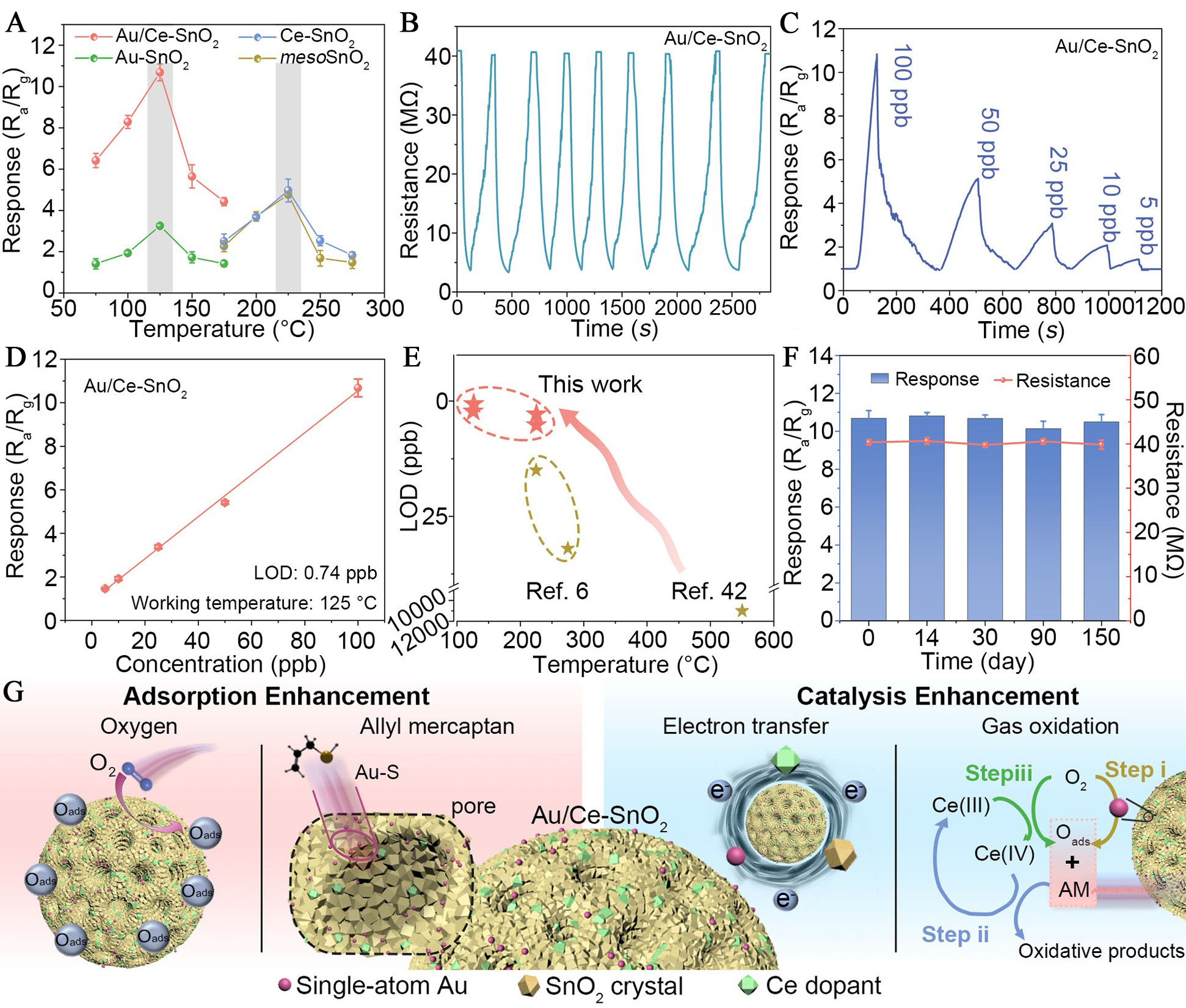
Figure 7. Gas-sensing characteristics and mechanistic understanding of Au/Ce-SnO2 toward allyl mercaptan; (A) Sensor responses of Au/Ce-SnO2, Au-SnO2, Ce-SnO2, and mesoporous SnO2 (mesoSnO2) to 100 ppb allyl mercaptan across a temperature range of 75-275 °C; (B) Response-recovery repeatability of the Au/Ce-SnO2 sensor upon cyclic exposures to 100 ppb allyl mercaptan; (C) Dynamic sensing curves and (D) corresponding response values of Au/Ce-SnO2 for allyl mercaptan concentrations from 5 to 100 ppb; (E) Evaluation of the anti-interference performance of the Au/Ce-SnO2 sensor. Ethanol and acetone were used as interfering gases at equal concentrations. AM represents 100 ppb allyl mercaptan; Mix-1, Mix-2, and Mix-3 refer to mixtures containing 100 ppb AM with 8, 16, and 32 ppm interfering gases, respectively; (F) Long-term operational stability of Au/Ce-SnO2 evaluated over a five-month period; (G) Schematic illustration of the proposed synergistic sensitization mechanism, involving Au-mediated selective adsorption and Ce-induced interfacial electron modulation. Oads denotes surface-adsorbed oxygen species. Reproduced with permission from Ref.[60]. Copyright 2024, Royal Society of Chemistry. LOD: Limit of detection; AM: allyl mercaptan; Ra/Rg: resistance in air/resistance in test gas.