

Rational integration of cascade catalysis and single-particle engineering for advanced gas sensing
 0
0 
Abstract
This commentary highlights a significant advancement in sensing materials through the engineering of core-shell nanoparticles, specifically the CoSnO3@mCeO2 structure. Inspired by enzymatic cascade catalysis, spatial compartmentalization and optimized functionality within a single nanoparticle was successfully achieve. The study reveals how integrating p-type and n-type materials enhances charge transfer kinetics and gas sensing performance. The tandem catalytic reforming-oxidation pathway for acetone detection exemplifies this paradigm's potential to improve sensitivity and selectivity in gas sensing applications. This work offers a strategic framework for developing intelligent sensor systems, with implications for medical diagnostics and environmental monitoring, underscoring the importance of single-particle-level functional integration in advancing nanomaterial design.
Keywords
Recent advances in nanomaterials synthesis have enabled unprecedented precision in the design and manipulation of nanostructures at the single-particle level. Multiple functional modules can now be deliberately integrated within an individual nanoparticle with well-defined spatial organization, driving innovations across diverse fields such as drug delivery[1], nanorobotics[2], and nanoreactors[3]. In chemical sensing, such single-particle engineering plays a particularly critical role in constructing high-quality chemical sensor devices. The high uniformity and regular morphology of nanoparticles facilitate the fabrication of homogeneous sensing layers with consistent thickness and excellent electrode contact, which in turn improves device reproducibility and signal stability[4,5]. Beyond structural regularity, integrating multiple functional components within an individual nanoparticle maximizes interfacial coupling and active site accessibility, thus optimizing the gas-solid interfacial reactivity. Such multi‐component nanoarchitectures offer a powerful platform that bridges the gap between novel nanomaterial design and the scalable manufacturing of integrated circuit (IC)-compatible intelligent sensing systems.
In a recent publication in Advanced Materials, Xue et al. represented a significant achievement that marked a strategic advance in the nanoscale design of sensing materials[6]. Inspired by enzymatic cascade catalysis [Figure 1A], they engineered a single-particle-level sensing platform (CoSnO3@mCeO2), featuring a p-type CoSnO3 core functionally integrated with an n-type mesoporous CeO2 (mCeO2) catalytic shell [Figure 1B and C]. The synthesis, achieved via an interfacially confined co-assembly strategy, yielded highly uniform core-shell nanoparticles [Figure 1D and E]. Such structural uniformity underpins the fabrication of sensing layers with consistent electronic properties, which is an essential prerequisite for achieving reliable device performance. Moreover, the authors demonstrated remarkable synthetic control, enabling systematic modulation of mesostructural geometry and shell thickness. This tunability is critical for improving gas diffusion and enhancing active site accessibility, thus leading to optimal sensing performance. The selection of core-shell components is both conceptually and strategically insightful. The mCeO2 shell, engineered with abundant oxygen vacancies, serves as a highly active nanoreactor in which the mesochannels promote efficient diffusion, adsorption, and dissociation of gas molecules. From an electronic structure perspective, the intimate contact between n-type CeO2 and p-type CoSnO3 establishes abundant p-n heterojunctions, inducing strong electronic coupling and a built-in electric field. This interfacial design accelerates charge transfer kinetics, markedly amplifying the resistance modulation upon gas exposure.
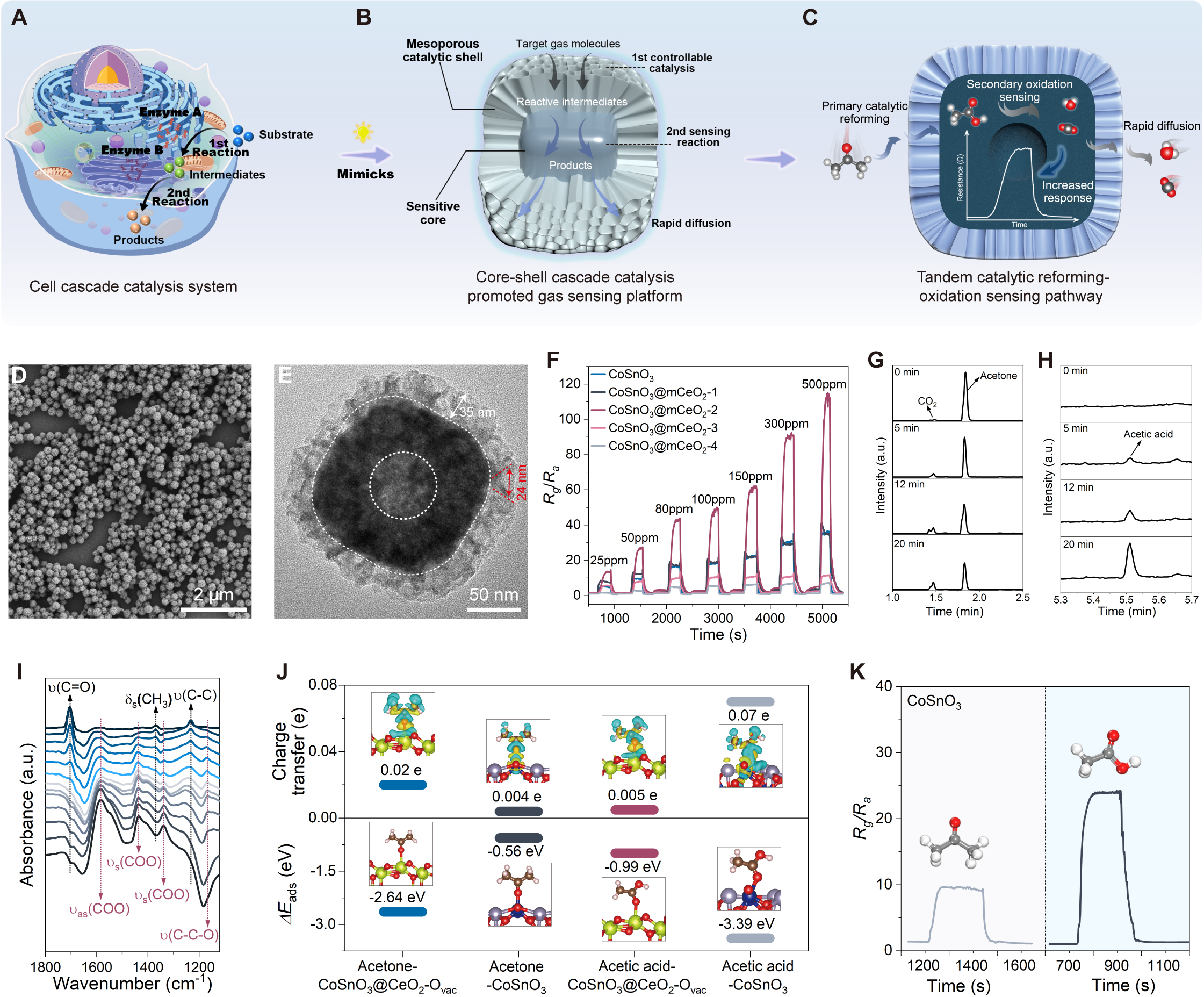
Figure 1. Single-particle-level gas-sensing platform based on biomimetic cascade catalysis. (A-C) Schematic of the multienzyme cascade catalysis system (A); biomimetic core-shell cascade catalysis promoted gas sensing platform (B); and the proposed tandem catalytic reforming-oxidation sensing mechanism of acetone detection (C); (D and E) Field emission scanning electron microscopy (FESEM) image (D) and trans mission electron microscopy (TEM) image of CoSn(OH)6@mCe(OH)x (E); (F) Dynamic response-recovery curves of CoSnO3 and CoSnO3@mCeO2-based sensors toward acetone; (G and H) Time-dependent gas chromatography mass spectrometry (GC-MS) of reaction products in retention time windows of 1.0-2.5 min (G) and 5.3-5.7 min (H); (I) In situ diffuse reflectance infrared Fourier transform spectroscopy (DRIFTS) tracking acetone oxidation over CoSnO3@mCeO2-2 from 20 to 260 °C; (J) Calculated charge transfer and adsorption energies (ΔEads) for acetone and acetic acid on CoSnO3 and CoSnO3@CeO2-Ovac surfaces; (K) Comparative sensing responses of CoSnO3 to acetone and acetic acid. Rg: The sensor’s resistance in the target gas; Ra: the sensor’s resistance in the target air; Ovac: oxygen vacancy.
The core-shell CoSnO3@mCeO2 represents an effective implementation of the enzyme-inspired cascade catalysis concept, achieving spatial compartmentalization and sequential functionality within a single particle. Using acetone, a key biomarker for diabetes, as a model analyte, Xue et al. systematically elucidated the mechanism underlying the enhanced sensing response [Figure 1F]. Through in situ spectroscopy combined with theoretical calculations [Figure 1G-J], they presented compelling evidence for a tandem catalytic reforming-oxidation sensing pathway [Figure 1C]. In this process, acetone is first catalytically converted into acetic acid intermediates inside the mCeO2 shell. These intermediates subsequently diffuse to the CoSnO3 core, where the surface exhibits a stronger affinity and a markedly higher response toward acetic acid than toward the parent acetone molecule [Figure 1K]. They also demonstrated that this tandem catalytic enhancement mechanism extended beyond acetone to other volatile organic compounds, such as formaldehyde, xylene, and benzene, underscoring the versatility of the proposed single-particle core-shell catalytic sensing platform.
Overall, by transcending conventional composition optimization, Xue et al. establish a conceptual framework for designing intelligent sensing units through single-particle-level functional integration and enzyme-inspired cascade catalysis. Through the masterful combination of synthetic control, mechanistic elucidation, and performance enhancement, this work provides a strategic roadmap for developing next-generation, IC-compatible sensor systems, opening promising avenues for practical applications spanning from non-invasive medical diagnostics to environmental monitoring. Beyond gas sensing, such single-particle core-shell nanoarchitectures also hold broad promise in areas including heterogeneous catalysis, electrochemical energy conversion, and biomedical diagnostics. The ability to spatially compartmentalize multiple functionalities within an individual particle enables controlled reaction sequencing, enhanced interfacial coupling, and minimized diffusion losses of reactive intermediates. These shared structure-function principles suggest that single-particle-level functional integration may serve as a general design paradigm for advanced nanomaterials across diverse application domains.
DECLARATIONS
Authors’ contributions
Writing original draft and visualization: Wang, T.
Writing review & editing: Jin, H.
Availability of data and materials
Not applicable.
Financial support and sponsorship
The authors acknowledge financial support for this research from the National Natural Science Foundation of China (Grant Nos. 62227815, 62571313) and the Major Science and Technology Task Project in Ningbo City (Grant No. 2022Z096).
Conflicts of interest
Jin, H. is a Senior Editorial Board Member of the journal Micro Nano Science. Jin, H. was not involved in any steps of the editorial process, including reviewers’ selection, manuscript handling, or decision-making. The other author declares that there are no conflicts of interest.
Ethical approval and consent to participate
Not applicable.
Consent for publication
Not applicable.
Copyright
© The Author(s) 2026.
REFERENCES
1. Zhao, T.; Chen, L.; Liu, M.; et al. Emulsion-oriented assembly for Janus double-spherical mesoporous nanoparticles as biological logic gates. Nature. Chem. 2023, 15, 832-40.
2. Kim, J.; Mayorga-Burrezo, P.; Song, S. J.; et al. Advanced materials for micro/nanorobotics. Chem. Soc. Rev. 2024, 53, 9190-253.
3. Ma, Y.; Guo, P.; Ma, B.; et al. Paddle-like self-stirring nanoreactors with multi-chambered mesoporous branches for enhanced dual-dynamic cascade reactions. Nat. Nanotechnol. 2025, 20, 897-906.
4. Deng, Y.; Chen, K.; Luo, W.; Zou, Y.; Deng, Y. Tailoring chemiresistive nanomaterials toward integrated circuit compatible fabrication of gas sensors. Adv. Mater. 2025, e08411.
5. Deng, Y.; Chen, K.; Xie, W.; et al. On-chip construction of hierarchically macro-/mesoporous cerium oxide/Pt gas sensitive film for ultrasensitive detection of trace oxygen. Interdiscip. Mater. 2025, 4, 585-98.
Cite This Article
 Open Access
How to Cite
Download Citation
Export Citation File:
Type of Import
Tips on Downloading Citation
Citation Manager File Format
Type of Import
Direct Import: When the Direct Import option is selected (the default state), a dialogue box will give you the option to Save or Open the downloaded citation data. Choosing Open will either launch your citation manager or give you a choice of applications with which to use the metadata. The Save option saves the file locally for later use.
Indirect Import: When the Indirect Import option is selected, the metadata is displayed and may be copied and pasted as needed.
About This Article
Copyright

Data & Comments
Data
0





Comments
Comments must be written in English. Spam, offensive content, impersonation, and private information will not be permitted. If any comment is reported and identified as inappropriate content by OAE staff, the comment will be removed without notice. If you have any queries or need any help, please contact us at [email protected].