

fig1
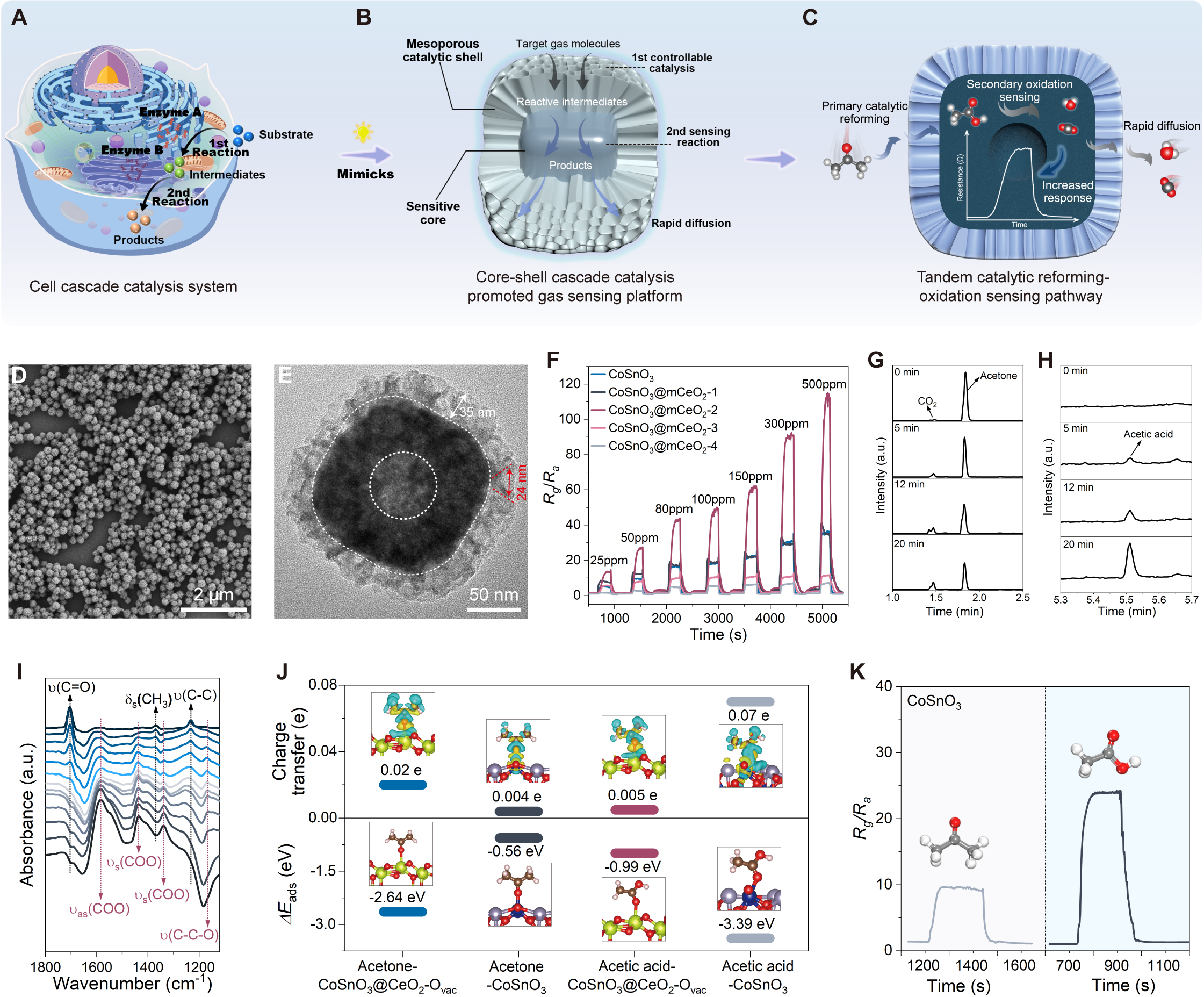
Figure 1. Single-particle-level gas-sensing platform based on biomimetic cascade catalysis. (A-C) Schematic of the multienzyme cascade catalysis system (A); biomimetic core-shell cascade catalysis promoted gas sensing platform (B); and the proposed tandem catalytic reforming-oxidation sensing mechanism of acetone detection (C); (D and E) Field emission scanning electron microscopy (FESEM) image (D) and trans mission electron microscopy (TEM) image of CoSn(OH)6@mCe(OH)x (E); (F) Dynamic response-recovery curves of CoSnO3 and CoSnO3@mCeO2-based sensors toward acetone; (G and H) Time-dependent gas chromatography mass spectrometry (GC-MS) of reaction products in retention time windows of 1.0-2.5 min (G) and 5.3-5.7 min (H); (I) In situ diffuse reflectance infrared Fourier transform spectroscopy (DRIFTS) tracking acetone oxidation over CoSnO3@mCeO2-2 from 20 to 260 °C; (J) Calculated charge transfer and adsorption energies (ΔEads) for acetone and acetic acid on CoSnO3 and CoSnO3@CeO2-Ovac surfaces; (K) Comparative sensing responses of CoSnO3 to acetone and acetic acid. Rg: The sensor’s resistance in the target gas; Ra: the sensor’s resistance in the target air; Ovac: oxygen vacancy.

