

fig6
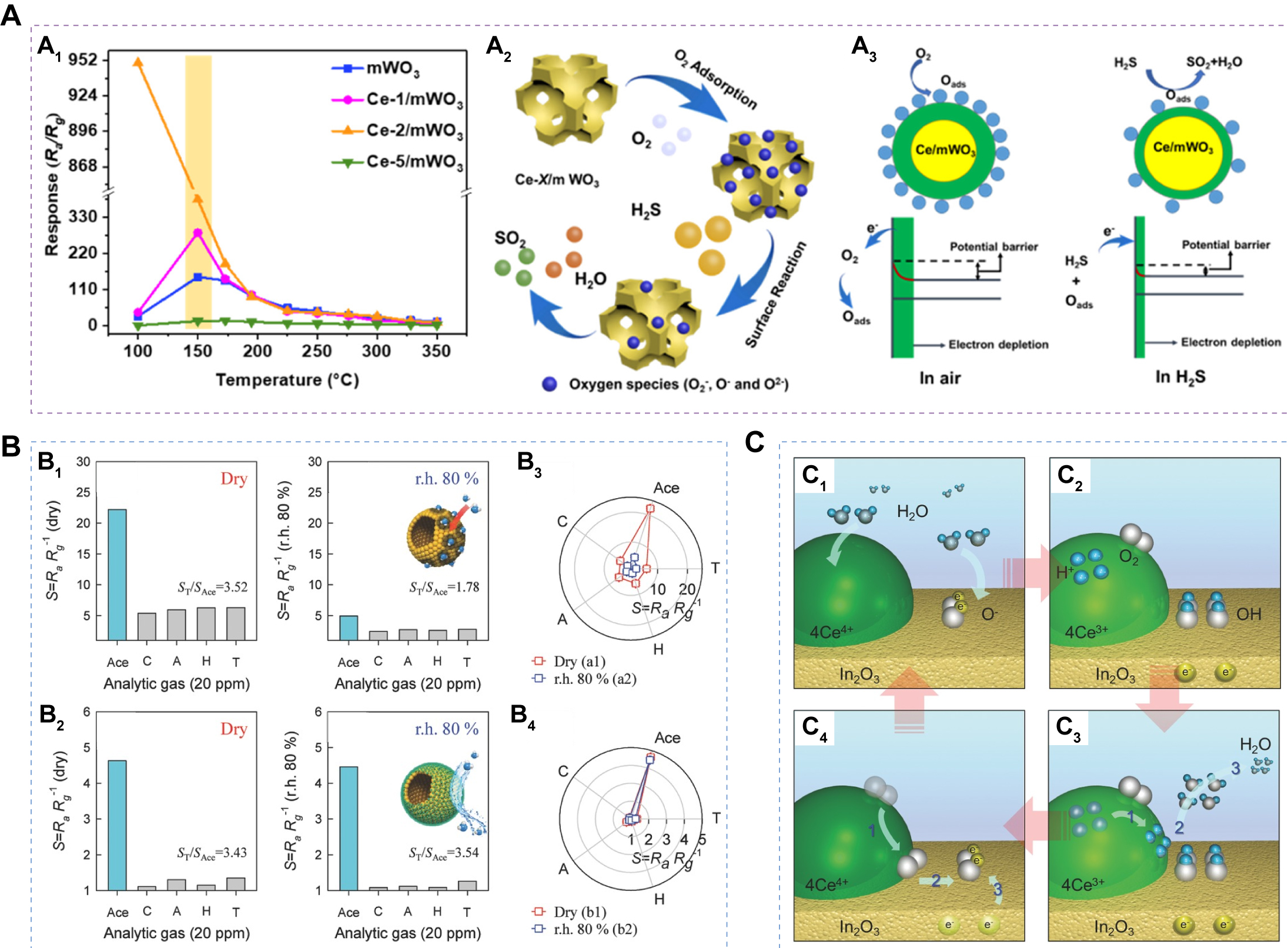
Figure 6. (A) Sensing responses of the Ce-X/mWO3 sensor to 50 ppm H2S at various temperatures (A1); Sensing mechanism of Ce-X/mWO3-based gas sensors for H2S detection (A2). Energy band structure and electron-transfer process of Ce-X/mWO3 sensitive material exposure in air and H2S-air mixture (A3). Figure 6A is quoted with permission from Liu et al.[127];( B) Gas responses of pure In2O3 (B1) and 11.7 Ce-In2O3 (B2) hollow spheres exposed to 20 ppm acetone (Ace), CO (C), ammonia (A), H2 (H), and toluene (T) at 450 °C in dry and humidity (r.h. 80%); Polar plots of gas responses of pure In2O3 (B3)and 11.7 Ce-In2O3 (B4) hollow spheres exposed to various reducing gases in dry (red) and r.h. 80% (blue). C: Self-refreshing of the In2O3 sensing surface by the CeO2 nanoclusters. Water vapor inflow (C1), chemisorption (C2), desorption (C3), and oxygen ion regeneration (C4). Figure 6B and C is quoted with permission from Yoon et al.[132]. ppm: Parts-per-million.