


Deformable reinforcing particles facilitate the development of novel metal matrix composites
 0
0 
Abstract
Conventional rigid reinforcing particles in metal matrix composites (MMCs) typically induce limited or single-level hetero-deformation induced (HDI) strengthening and hardening effect, thereby restricting the further enhancement of mechanical properties. We propose to incorporate deformable reinforcing particles (e.g., medium-/high-entropy materials) into metallic matrices to overcome the above limitation, and verify the feasibility in the laser powder bed fusion of VNbMoTa-reinforced Inconel 625 composites. The VNbMoTa particles demonstrated superior storage capacity for geometrically necessary dislocations, triggering significant HDI effects and resulting in excellent room- and elevated-temperature tensile properties. It is encouraging that the HDI effect arises between the deformable particles and the matrix, distinct from the current method of generating HDI effects among different parts of the matrix. This innovative strategy enlightens that deformable reinforcing particles are conducive to activating multi-level HDI effects in MMCs through coordinated interactions among reinforcing particles and matrix for better mechanical properties.
Keywords
HDI STRENGTHENING AND HARDENING AND ITS ACHIEVEMENT IN METAL MATRIX COMPOSITES
Heterostructured materials represent an emerging class of advanced materials characterized by architectured heterogeneous zones with substantial mechanical and/or functional property contrasts[1,2]. These materials typically demonstrate superior performance compared to their homogeneous counterparts, primarily attributed to the well-documented hetero-deformation induced (HDI) strengthening and hardening mechanisms[3]. While metal matrix composites (MMCs) inherently belong to this material category, they exhibit remarkably limited HDI contributions, with yield strength predominantly governed by the rule of mixtures. This limitation primarily originates from the inadequate geometrically necessary dislocation (GND) accumulation capacity within constrained hard zones (e.g., reinforcing particles in MMCs). Crucially, conventional non-deformable reinforcing particles, such as TiC[4,5], TiB2[6,7], Y2O3[8,9], demonstrate negligible GND storage capability, fundamentally restricting the HDI strengthening and hardening potential.
To achieve substantial HDI strengthening and hardening in MMCs, prevailing strategies focus on leveraging reinforcing particles to modify matrix microstructures, thereby creating architectured heterostructures with alternating soft/hard domains. For instance, it is well known that TiBw particles can refine the grain structure of titanium alloys. Liu et al. engineered a bimodal grain structure in Ti-6Al-4V composites by strategically controlling the spatial distribution of nano-TiBw particle clusters[10]. This approach yielded distinct coarse-grained (5.8 μm average) and fine-grained (42.3 μm average) regions, resulting in a dual-phase composite exhibiting synergistic strength-ductility enhancement, which surpassed both monolithic matrices and homogeneous composites through activated HDI mechanisms. Furthermore, parametric optimization revealed that reducing cluster diameters (< 15% size reduction) and inter-cluster spacing (> 30% density increase) further improved room-temperature tensile properties. However, this microstructure-driven paradigm predominantly exploits matrix-mediated HDI effects while underutilizing the intrinsic deformation compatibility between reinforcing particles and the matrix - a critical yet overlooked avenue for multi-level HDI activation.
HIGH-STRENGTH, PLASTICALLY DEFORMABLE PARTICLE-REINFORCED METAL MATRIX COMPOSITES
Recently, we proposed a strategy to induce a remarkable HDI strengthening effect through deformation incoordination between reinforcing particles and the matrix. The key to the strategy was to choose high-strength reinforcing particles with excellent GND storage capacity. We confirmed the validity of the aforementioned strategy in the selective laser melting of nickel-based composite material[11]. Given that nickel-based superalloys are typically utilized under high-temperature conditions, the selected reinforcing particles need to possess outstanding high-temperature mechanical properties while maintaining a good GNDs storage capacity. Simultaneously, to guarantee a favorable interface bonding, we hold the view that the elements constituting the reinforcing particles should preferably be the strengthening elements of nickel-based superalloys. Based on the above deliberations, we ultimately selected the VNbMoTa high-entropy alloy (HEA) as the reinforcing particle. The matrix was chosen as Inconel 625 superalloy. The VNbMoTa-Ni interface demonstrated a two-layer feature, with one layer being BCC-typed HEA and the other layer being composed of alternatively distributed Laves particles and nano-scale grains, as shown in Figure 1A. Surprisingly, the introduction of the deformable VNbMoTa largely suppressed the softening behavior of the Inconel 625 superalloy at 650 °C, making the elevated-temperature tensile properties comparable to the room-temperature tensile properties as shown in Figure 1B. The two-layer interface was quite robust with no cracking after both room- and high-temperature tensile tests, as shown in Figure 1C. Remarkable HDI strengthening contribution was induced by the strong and ductile VNbMoTa particle and the soft matrix, resulting in excellent room-temperature tensile properties, as shown in Figure 1B and D. The outstanding inhibition effect on the high-temperature softening behavior and the significant HDI strengthening contribution caused by the reinforcing particle and matrix are difficult to observe in the MMCs reinforced with non-deformable particles.
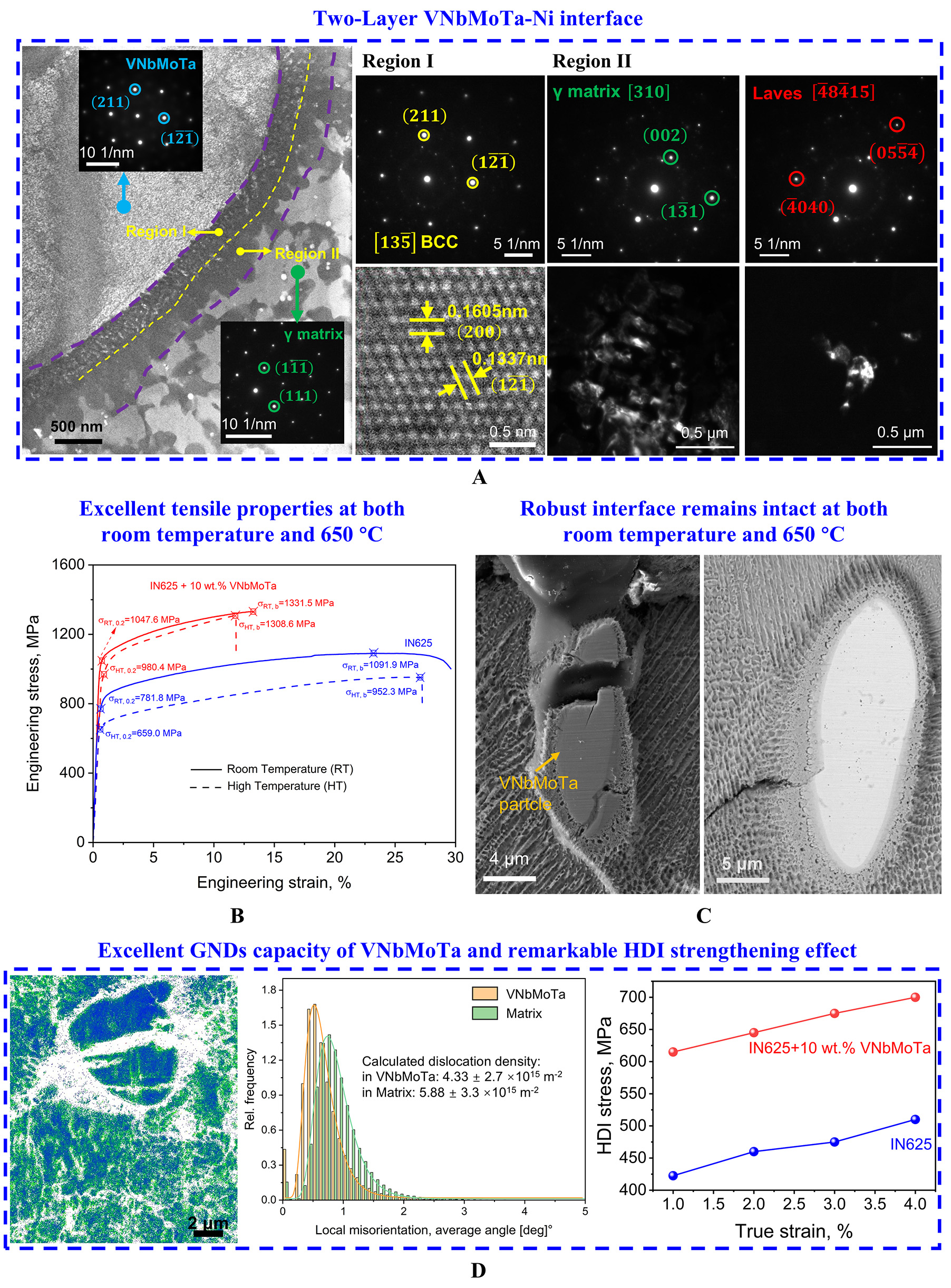
Figure 1. Additive manufacturing of VNbMoTa reinforced Inconel 625 superalloy. (A) Two-layer VNbMoTa-Ni interface; (B) Excellent room- and high-temperature tensile properties; (C) Robust interface with no cracking after both room- and high-temperature tensile tests; (D) Excellent GNDs capacity of deformable VNbMoTa particle and significant HDI stress induced by hard VNbMoTa and soft matrix. This figure is quoted with permission from Sui et al.[11].
It should be noted that utilizing HEAs as reinforcements is not unprecedented. Currently, significant research focuses on HEA-reinforced MMCs[12-14], with matrices encompassing aluminum alloys[15-23], copper alloys[24,25], magnesium alloys[26-28], steels[29-32], and titanium alloys[33-36], as summarized in Table 1. However, these studies exhibit several limitations that contrast with our previous work. First, reinforcement selection is predominantly limited to CoCrNiFe-series HEAs, which possess melting points comparable to steels and lower than those of titanium alloys. Consequently, in melting-solidification-based forming processes, it is often challenging to retain a significant volume fraction of HEA reinforcements. For example, CoCrNiFe-series HEA particles are rarely observed in laser powder bed fusion (LPBF)-fabricated steel matrix composites[30-32]. Second, additive manufacturing (AM) is less commonly employed for fabricating such MMCs. This limitation is significantly influenced by the first point, as AM is inherently a melting-based process. Third, the matrix materials are typically restricted to low-melting-point alloys (e.g., aluminum alloys), with insufficient consideration given to high-melting-point alloys, particularly nickel-based superalloys.
HEA reinforced metal matrix composites
| Matrix | HEA reinforcement | Forming process | Ref. |
| Aluminum alloys | AlCoCrFeNi | Friction stir processing | [15] |
| CoFeNiCrTi0.4Al0.6 | Ball milling, hot pressing, hot extrusion | [16] | |
| CoCrFeMnNi | Stir-squeeze casting | [17] | |
| Al0.5CoCrFeNi | Stir casting | [18] | |
| Al0.8CoCrFeNi | Friction stir processing | [19] | |
| CrNiCuAlFe | Ball milling, spark plasma sintering | [20] | |
| FeCoNi1.5CrCu | Static pressing | [21] | |
| AlCoCrFeNi2.1 | Friction stir processing | [22] | |
| CoCrFeNi | Friction deposition | [23] | |
| Copper alloys | FeCoNiCrAl | Friction stir processing | [24] |
| TiZrNbTa | Ball milling, spark plasma sintering | [25] | |
| Magnesium alloys | Al0.5CoCrFeNi2 | Ball milling, spark plasma sintering | [26] |
| CoCrFeNiMoTi | Multi-pass friction stir processing | [27] | |
| Al4CrFeMnTi0.25 | Stir casting | [28] | |
| Steels | AlCoCrFeNi | Sintering | [29] |
| FeCoNiCr | Laser powder bed fusion | [30] | |
| FeCoNiAlTi | Selective laser melting | [31] | |
| FeCoNiAlTi | Laser powder bed fusion | [32] | |
| Titanium alloys | CoCrFeCuTi | Microwave sintering | [33] |
| CoCrFeNiMo0.2 | Hot pressing sintering | [34] | |
| FeCoNiCr | Spark plasma sintering | [35] | |
| Al0.5CoCrFeNi | Discharge plasma sintering | [36] |
Our previous investigation addressed the current research gap: the additive manufacturing of HEA-reinforced nickel matrix composites. Conventional CoCrNiFe-series HEA particles are incompatible with this system due to their melting points being comparable to the nickel matrix, hindering their effective retention during additive manufacturing. Consequently, screening suitable HEA reinforcements represents a primary distinction of our research. The VNbMoTa HEA was selected based on three critical criteria: high melting point (~2,500 °C), plastic deformability, and superior mechanical properties, particularly at elevated temperatures. A second key distinction is that our study, for the first time, demonstrates the triggering of the HDI strengthening between the plastically deformable VNbMoTa reinforcements and the matrix. Although the HDI strengthening effect in our previous study remains single-level, employing plastically deformable reinforcements enables the potential achievement of multi-level HDI strengthening in metal matrix composites (MMCs).
SINGLE- AND MULTI-LEVEL HDI STRENGTHENING AND HARDENING
We believe that the strategy is very promising in the field of developing novel MMCs with multi-level HDI strengthening and hardening effects and will attract widespread attention within the MMC research community.
Conventional HDI strengthening and hardening effects predominantly operate at a single level
Since the concept of heterostructured materials was proposed, researchers have developed various types, including lamellar structures[37], voxelized structures[38,39], gradient structures[40], core-shell structures[41], and multi-phase structures[42]. Although these heterogeneous structures enhance material performance, the HDI strengthening and hardening effects they induce remain confined to a single level. For example, Tan et al. utilized laser-aided additive manufacturing to fabricate voxelized hetero-structured steel[39], and the resulting HDI strengthening and hardening originated from the interaction between the alternatively deposited 420 stainless steel and C300 martensitic steel, as illustrated in Figure 2A. Similarly, Wu et al. produced a heterogeneous lamella structure in eutectic high entropy alloy through cold rolling followed by annealing[37]. The significant HDI strengthening and hardening effect arose from the interaction between the fine-grain regions and the coarse-grain regions, as shown in Figure 2B. Likewise, Wang et al. fabricated a harmonic (core-shell) structure in Ti-6Al-4V alloy using spark plasma sintering[41]. They achieved HDI strengthening via the interaction between fine-grain regions (average size: 5 μm) and coarse-grain regions (average size:
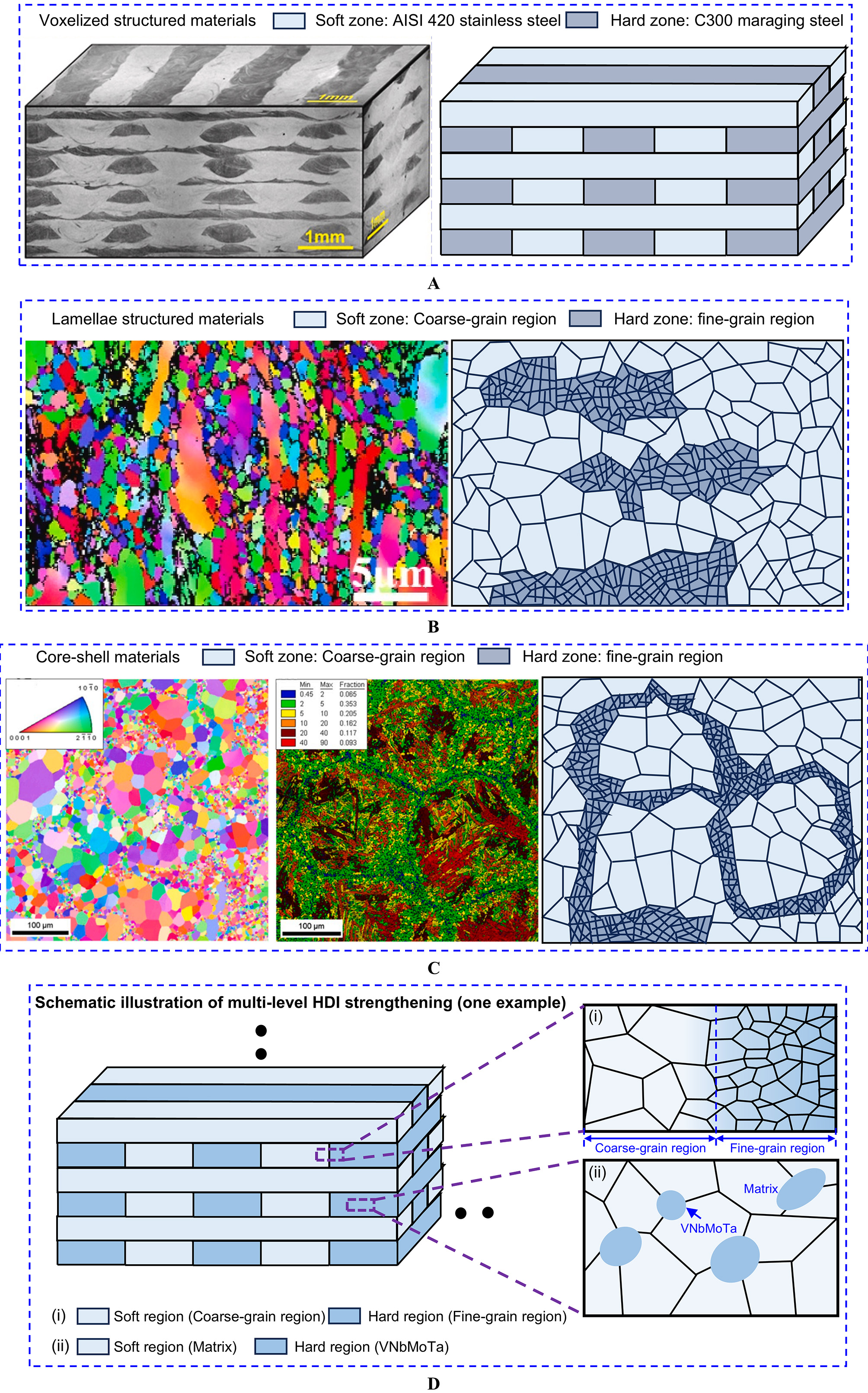
Figure 2. HDI strengthening effect in different heterostructured materials. (A) Voxelized structured material[39] (This figure is quoted with permission from Elsevier); (B) Lamellae structured material[37] (This figure is quoted with permission from Elsevier); (C) Core-shell material[41] (This figure is quoted with permission from Elsevier); (D) One example of multi-level HDI strengthening effect.
Multi-scale heterogeneous microstructures do not inherently produce multi-level HDI strengthening and hardening effects
The multi-scale heterostructures reported to date typically combine grain heterogeneity with second-phase particle heterogeneity. For instance, Dasari et al. developed a heterogeneous microstructure in an
High-performance, plastically deformable reinforcements are essential for achieving multi-level HDI strengthening and hardening
As established in prior analysis, the fundamental limitation impeding multi-level HDI effects resides in the difficult-to-deform nature of conventional second-phase/reinforcement particles, which prevents their heterogeneity from generating HDI effects. Our previous study directly addresses this limitation[11]. We demonstrate that when high-strength, deformable reinforcements (e.g., VNbMoTa HEA) are employed, HDI strengthening is triggered between the particles and the matrix. This particle-matrix interaction establishes the foundation for realizing multi-level HDI effects. Figure 2D exemplifies one such composite structure. In this design, the multi-level HDI strengthening can be induced through both the interaction between fine-grain and coarse-grain regions and the interaction between the VNbMoTa particles and the matrix.
Multi-level HDI strengthening and hardening are applicable to other composite systems
Although the multi-level HDI strengthening mechanism was proposed based on a VNbMoTa HEA-reinforced nickel matrix composite, it is suggested that this mechanism remains applicable to other composite systems. The critical factor lies in the selection of suitable reinforcement. The following three criteria are proposed for developing similar metal matrix composites: (1) The plastically deformable reinforcing particles must exhibit superior target mechanical properties compared to the matrix, as this is fundamental for generating HDI strengthening and hardening; (2) The reinforcing particles must remain stable during the forming process. For methods like powder sintering, the melting point of the reinforcement is less critical. However, for melt-solidification processes, a significant melting point difference (>1,000 °C) between reinforcement and matrix is preferable to ensure a wide processing window and substantial microstructural adjustability; (3) The reinforcement-matrix interface requires meticulous design, as not all high-strength, plastically deformable reinforcements can effectively trigger the HDI strengthening mechanism. For instance, in Ti particle-reinforced Al or Mg matrix composites, brittle phases typically form at the Ti-Al or Ti-Mg interface[46-49], hindering effective load transfer and limiting the HDI strengthening. This limitation motivated the selection of HEA as the reinforcement in our previous study[11]. HEAs generally possess broad compositional ranges, increasing the likelihood of forming a compatible new HEA material at the HEA-metal interface, thereby promoting strong bonding and effective load transfer. It should be emphasized that HEAs represent one promising, but not the exclusive, class of reinforcing materials capable of inducing multi-level HDI strengthening. We believe that these criteria are considered essential for designing composites where reinforcement-matrix interactions are leveraged to achieve significant multi-level HDI contributions.
CONCLUSION
In a short summary, deformable particles, especially strong and ductile medium/high-entropy alloys, are promising reinforcing materials. They are able to induce multi-level HDI strengthening and hardening effects, which contribute to developing novel metal matrix composites with better performances to meet different application requirements.
DECLARATIONS
Authors’ contributions
Conceptualization and study design: Sui, S.
Data curation, formal analysis, and investigation: Qi, Y.; Qi, J.
Administrative and technical support: Ma, D.
Manuscript writing, review, and editing: Sui, S.; Qi, Y.; Qi, J.; Xu, C.
Project administration and supervision: Sui, S.; Xu, C.
Availability of data and materials
Not applicable.
Financial support and sponsorship
This work was supported by the National Natural Science Foundation of China (Grant No. 52305419), the Aeronautical Science Foundation Funded by the Chinese Aeronautical Establishment (Grant No. 2022Z0490T6001), and the International Science and Technology Cooperation Program of Shaanxi Province (Grant No. 2023-GHZD-50).
Conflicts of interest
All authors declared that there are no conflicts of interest.
Ethical approval and consent to participate
Not applicable.
Consent for publication
Not applicable.
Copyright
© The Author(s) 2026.
REFERENCES
2. Zhu, Y.; Ameyama, K.; Anderson, P. M.; et al. Heterostructured materials: superior properties from hetero-zone interaction. Mater. Res. Lett. 2021, 9, 1-31.
3. Zhu, Y.; Wu, X. Perspective on hetero-deformation induced (HDI) hardening and back stress. Mater. Res. Lett. 2019, 7, 393-8.
4. Lee, T.; Jeong, W.; Chung, S.; Ryu, H. J. Effects of TiC on the microstructure refinement and mechanical property enhancement of additive manufactured Inconel 625/TiC metal matrix composites fabricated with novel core-shell composite powder. J. Mater. Sci. Technol. 2023, 164, 13-26.
5. Lv, Y.; Liu, Y.; Zhang, Q.; et al. Hot corrosion behavior of a novel TiC/GTD222 nickel-based composite prepared by selective laser melting. Mater. Charact. 2023, 205, 113245.
6. Zhao, M.; Song, J.; Tang, Q.; et al. Laser powder bed fusion of Inconel 718-based composites: effect of TiB2 content on microstructure and mechanical performance. Opt. Laser. Technol. 2023, 167, 109596.
7. Tekoglu, E.; Bae, J. S.; Kim, H. A.; et al. Superior high-temperature mechanical properties and microstructural features of LPBF-printed In625-based metal matrix composites. Mater. Today. 2024, 80, 297-307.
8. Luu, D. N.; Zhou, W.; Nai, S. M. L. Influence of nano-Y2O3 addition on the mechanical properties of selective laser melted Inconel 718. Mater. Sci. Eng. A. 2022, 845, 143233.
9. Hu, Z.; Guan, K.; Qian, Z.; Dong, J.; Wu, J.; Ma, Z. Simultaneous enhancement of strength and ductility in selective laser melting manufactured 316L alloy by employing Y2O3 coated spherical powder as precursor. J. Alloys. Compd. 2022, 899, 163262.
10. Liu, L.; Li, S.; Pan, D.; et al. Loss-free tensile ductility of dual-structure titanium composites via an interdiffusion and self-organization strategy. Proc. Natl. Acad. Sci. USA. 2023, 120, e2302234120.
11. Sui, S.; Qi, J.; Ma, D.; et al. Additive manufacturing of ultrastrong and ductile nickel matrix composites via hetero-deformation induced strengthening. Int. J. Extrem. Manuf. 2025, 7, 045003.
12. Pandey, V.; Seetharam, R.; Chelladurai, H. A comprehensive review: discussed the effect of high-entropy alloys as reinforcement on metal matrix composite properties, fabrication techniques, and applications. J. Alloys. Compd. 2024, 1002, 175095.
13. Kumar, D.; Seetharam, R.; Ponappa, K. A review on microstructures, mechanical properties and processing of high entropy alloys reinforced composite materials. J. Alloys. Compd. 2024, 972, 172732.
14. Kareem, S. A.; Anaele, J. U.; Aikulola, E. O.; Adewole, T. A.; Bodunrin, M. O.; Alaneme, K. K. Design and selection of metal matrix composites reinforced with high entropy alloys - functionality appraisal and applicability in service: a critical review. J. Alloys. Metall. Syst. 2024, 5, 100057.
15. Yang, X.; Zhang, H.; Dong, P.; Yan, Z.; Wang, W. A study on the formation of multiple intermetallic compounds of friction stir processed high entropy alloy particles reinforced Al matrix composites. Mater. Charact. 2022, 183, 111646.
16. Wan, B.; Lu, T.; Xu, X.; Jin, S.; Li, W.; Zhang, L. Achieving high strength and ductility in high-entropy alloy particle reinforced Al matrix composites with proper proportion of layered structures. Mater. Charact. 2023, 205, 113354.
17. Kumar, A.; Singh, A.; Suhane, A.; Singh, A. K.; Verma, P. K. Artificial age hardening behavior of a squeeze cast CoCrFeMnNi high entropy alloy reinforced 6082-aluminium matrix composite. Mater. Charact. 2023, 206, 113401.
18. Luo, K.; Wu, Y.; Xiong, H.; Zhang, Y.; Kong, C.; Yu, H. Enhanced mechanical properties of aluminum matrix composites reinforced with high-entropy alloy particles via asymmetric cryorolling. Trans. Nonferrous. Met. Soc. China. 2023, 33, 1988-2000.
19. Ravi, L.; Vanaraj, P. W.; Subathra, B.; Perumal, S.; Kumar, S.; kirana, R. Enhancing mechanical, and tribological properties of aluminum metal matrix composite reinforced with high entropy alloy using friction stir processing. Mater. Chem. Phys. 2025, 338, 130614.
20. Li, P.; Peng, K.; Wu, B.; Huang, H.; Zhang, Y.; Gao, M. Mechanical properties of Al-Si matrix composites synergistically reinforced by high-entropy alloy and SiC nanoparticles. J. Alloys. Compd. 2023, 939, 168762.
21. Li, G.; Wei, Y.; Wang, H.; et al. Microstructure and properties of FeCoNi1.5CrCup/Al high-entropy alloy strengthened aluminum matrix composites and finite element simulation. Mater. Today. Commun. 2023, 35, 106022.
22. Li, P.; Tong, Y.; Wang, X.; Sato, Y. S.; Dong, H. Microstructures and mechanical properties of AlCoCrFeNi2.1/6061-T6 aluminum-matrix composites prepared by friction stir processing. Mater. Sci. Eng. A. 2023, 863, 144544.
23. Karthik, G.; Panikar, S.; Ram, G. J.; Kottada, R. S. Additive manufacturing of an aluminum matrix composite reinforced with nanocrystalline high-entropy alloy particles. Mater. Sci. Eng. A. 2017, 679, 193-203.
24. Zhu, R.; Sun, Y.; Feng, J.; Gong, W.; Li, Y. Effect of microstructure on mechanical properties of FeCoNiCrAl high entropy alloys particle reinforced Cu matrix surface composite prepared by FSP. J. Mater. Res. Technol. 2023, 27, 2695-708.
25. Chen, J.; Xiang, T.; Bao, W.; et al. Novel strength-electrical conductivity synergy in Cu-based composites reinforced with TiZrNbTa high entropy alloy. Mater. Sci. Eng. A. 2023, 878, 145210.
26. Chiu, C.; Chang, H. H. Al0.5CoCrFeNi2 high entropy alloy particle reinforced AZ91 magnesium alloy-based composite processed by spark plasma sintering. Materials 2021, 14, 6520.
27. Ezatpour, H. R.; Jalalabadi, M.; Huo, Y.; Sazegaran, H. CoCrFeNiMoTi high-entropy alloy reinforced Mg matrix composites produced by multi-pass friction stir processing: focus on pin geometry, microstructure and mechanical properties. Trans. Indian. Inst. Met. 2024, 77, 3303-10.
28. Kumar, D.; Seetharam, R.; Ponappa, K. Investigation of microstructural and mechanical properties of Mg-HEA nanocomposite through ultrasonic assisted two step stir casting technique. In Proceedings of the International Conference on Sustainable Energy Technologies. Singapore; 2024; pp. 415-22.
29. Huang, Y.; Zhang, F.; Pan, X.; et al. Fabrication and evaluation of high-entropy alloy reinforced Fe bond diamond tool. J. Mater. Proc. Technol. 2024, 328, 118419.
30. Zhang, C.; Zhu, J.; Ji, C.; et al. Laser powder bed fusion of high-entropy alloy particle-reinforced stainless steel with enhanced strength, ductility, and corrosion resistance. Mater. Des. 2021, 209, 109950.
31. Zhang, X.; Yang, D.; Jia, Y.; Wang, G. Microstructure and nanoindentation behavior of FeCoNiAlTi high-entropy alloy-reinforced 316L stainless steel composite fabricated by selective laser melting. Materials 2023, 16, 2022.
32. Zhang, X.; Yang, D.; Jia, Y.; Wang, G.; Prashanth, K. G. Microstructure evolution and tensile property of high entropy alloy particle reinforced 316 L stainless steel matrix composites fabricated by laser powder bed fusion. J. Alloys. Compd. 2023, 965, 171430.
33. Ragunath, S.; Radhika, N.; Krishna, S. A.; Pramanik, A. Microstructural, electrochemical, and hot corrosion analysis of CoCrFeCuTi high entropy alloy reinforced titanium matrix composites synthesized by microwave sintering. Int. J. Lightweight. Mater. Manuf. 2025, 8, 141-55.
34. Yuan, Z.; Liu, H.; Ma, Z.; Ma, X.; Wang, K.; Zhang, X. Microstructure and properties of high entropy alloy reinforced titanium matrix composites. Mater. Charact. 2022, 187, 111856.
35. Tang, Y.; Zhang, F.; Xiong, Y.; Hu, Y.; Feng, H. Interface microstructure and strengthening mechanisms of medium-entropy alloy FeCoNiCr particle reinforced titanium composites. Mater. Sci. Eng. A. 2025, 935, 148359.
36. Yuan, Z.; Wang, K.; Li, S.; Jin, X.; Yu, Y.; Guo, M. Effect of sintering temperature on the properties of titanium matrix composites reinforced with Al0.5CoCrFeNi high-entropy alloy particles. Mater. Sci. Eng. A. 2024, 911, 146920.
37. Wu, H.; Xie, J.; Yang, H.; et al. Enhanced mechanical properties in a multi-level heterogeneous lamellar structure eutectic high entropy alloy fabricated by thermomechanical treatment. Mater. Sci. Eng. A. 2025, 937, 148405.
38. Tan, C.; Liu, Y.; Weng, F.; et al. Additive manufacturing of voxelized heterostructured materials with hierarchical phases. Addit. Manuf. 2022, 54, 102775.
39. Tan, C.; Chew, Y.; Weng, F.; et al. Laser aided additive manufacturing of spatially heterostructured steels. Int. J. Mach. Tools. Manuf. 2022, 172, 103817.
40. Ma, X.; Li, F.; Sun, Z.; et al. Achieving gradient martensite structure and enhanced mechanical properties in a metastable β titanium alloy. Metall. Mater. Trans. A. 2019, 50, 2126-38.
41. Wang, X.; Li, J.; Cazes, F.; Hocini, A.; Dirras, G. Numerical modeling on strengthening mechanisms of the harmonic structured design on CP-Ti and Ti-6Al-4V. Int. J. Plast. 2020, 133, 102793.
42. Li, Z.; Pradeep, K. G.; Deng, Y.; Raabe, D.; Tasan, C. C. Metastable high-entropy dual-phase alloys overcome the strength-ductility trade-off. Nature 2016, 534, 227-30.
43. Dasari, S.; Jagetia, A.; Chang, Y.; et al. Engineering multi-scale B2 precipitation in a heterogeneous FCC based microstructure to enhance the mechanical properties of a Al0.5Co1.5CrFeNi1.5 high entropy alloy. J. Alloys. Compd. 2020, 830, 154707.
44. Miao, X.; Liu, G.; Xu, C.; Wang, D.; Han, Z.; Zhang, G. Achieving strength and ductility synergy in (CoCrFeNi)94Ti2Al4 high entropy alloy with multi-scale heterogeneous microstructure. Intermetallics 2024, 164, 108107.
45. Ma, X.; Li, N.; Feng, T.; Xiao, L. Overcoming the strength-ductility trade-off in ω-phase strengthened metastable β titanium alloys via dual heterogeneous structure. Mater. Res. Lett. 2025, 13, 844-53.
46. Yang, C.; Li, X.; Li, C.; et al. Interface and strengthening mechanisms of Al matrix composites reinforced with in-situ CNTs grown on Ti particles. Mater. Des. 2023, 229, 111923.
47. Shao, Y.; Zhao, D.; Guo, W.; Lü, S.; Wu, S. Microstructure optimization of in-situ porous Ti particles reinforced Mg-Cu-Y metallic glass matrix composites via dealloying in metallic melt. Compos. Part. B. Eng. 2025, 296, 112263.
48. Ye, J.; Chen, X.; Luo, H.; et al. Microstructure, mechanical properties and wear resistance of Ti particles reinforced AZ31 magnesium matrix composites. J. Magnes. Alloy. 2022, 10, 2266-79.
Cite This Article
 Open Access
How to Cite
Download Citation
Export Citation File:
Type of Import
Tips on Downloading Citation
Citation Manager File Format
Type of Import
Direct Import: When the Direct Import option is selected (the default state), a dialogue box will give you the option to Save or Open the downloaded citation data. Choosing Open will either launch your citation manager or give you a choice of applications with which to use the metadata. The Save option saves the file locally for later use.
Indirect Import: When the Indirect Import option is selected, the metadata is displayed and may be copied and pasted as needed.
About This Article
Special Topic
Copyright

Data & Comments
Data
0










Comments
Comments must be written in English. Spam, offensive content, impersonation, and private information will not be permitted. If any comment is reported and identified as inappropriate content by OAE staff, the comment will be removed without notice. If you have any queries or need any help, please contact us at [email protected].