



High capacitive energy-storage in BNT-based Pb-free relaxors via dispersing strong long-range polarization within expanded lattice framework
 0
0 
Abstract
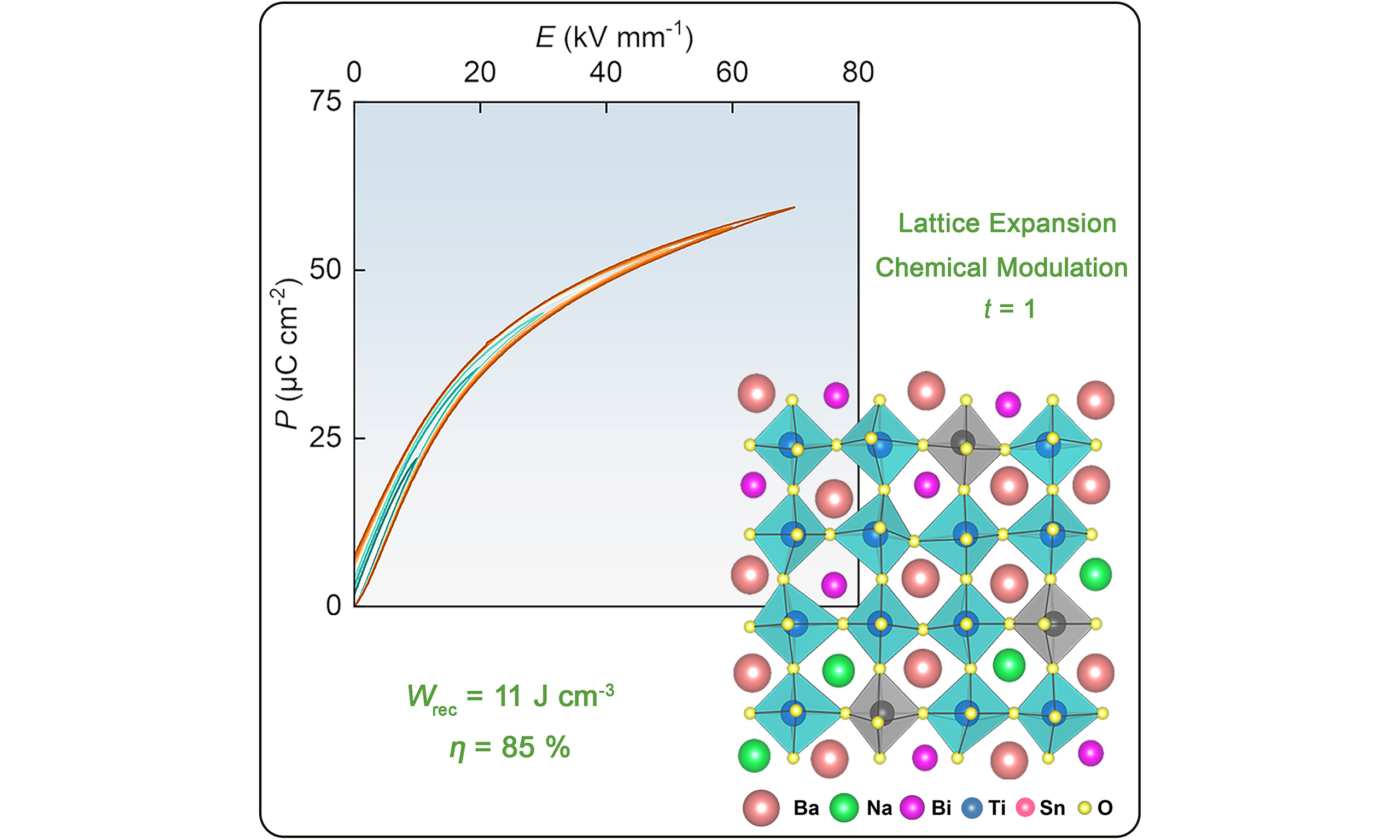
The development of Pb-free dielectric materials with high recoverable energy-storage density (Wrec) and efficiency (η) remains a critical challenge for cutting-edge pulsed-power technologies. Herein, we propose a rational structural and chemical design to stabilize a relaxor state with tolerance factor t = 1.0096 by coupling highly distorted ferroelectric matrix with lattice-expanded component. We can disperse the strong long-range polarization within an expanded lattice framework through incorporating BaSnO3 into Bi0.5Na0.5TiO3-BaTiO3 solid-solution with significant ferroelectric polarization, thereby achieving a synergistic optimization between the large intrinsic polarization and lattice structure. Neutron total scattering combined with Reverse Monte Carlo modeling, and atomic-resolution displacement mapping reveal Sn4+ disrupts strong long-range polarization via B-site chemical frustration, generating polar nanoclusters with intense local distortions. Concurrently, Ba2+-driven lattice expansion enhances polarization flexibility under electric fields. Notably, Bi3+-enriched nanoregions retain unit-cell polarization up to 60 μC·cm-2, confirming the coexistence of relaxor dynamics and strong local polar fluctuations. The optimized ceramic exhibits slim hysteresis loops with exceptional energy-storage performance (Wrec = 11 J·cm-3, η = 85%), and excellent charge-discharge behavior (WD = 7.0 J·cm-3 and PD = 688 MW·cm-3). This work establishes a paradigm for correlating microstructure and performance in Pb-free relaxors with high capacitive energy-storage.
Keywords
INTRODUCTION
With the growing trend toward functional integration, compact design and extended longevity, pulsed-power devices are required to transit toward environmentally-friendly compositions, miniaturized and lightweight configurations, and high-performances. Dielectric capacitors, owing to their ultrafast charge-discharge rates, exceptional power density, and outstanding operational stability, have emerged as indispensable components in high-power pulsed systems, such as grid frequency regulation, industrial lasers, new energy vehicles, and advanced electromagnetic weaponry[1-6]. However, as energy-storage units increasingly pursue miniaturization and high integration, their relatively low energy density has become a critical bottleneck hindering broader applications[7,8]. For dielectric capacitors, ideal energy-storage ceramics must first exhibit both high recoverable energy-storage density (Wrec) and high energy-storage efficiency (η). These properties are governed by the polarization-electric field (P-E) hysteresis behavior, as defined by,
Relaxor ferroelectrics (RFEs), with nanoscale polar heterogeneities that can rapidly respond to external electric fields, are widely considered as promising candidates to overcome above inverse relationship[10,13,20-22]. Recent advances, including via domain engineering[23,24], entropy tuning[2,13,25,26], and chemical framework design[17], have achieved significant breakthroughs in Pb-free RFEs[21,27,28]. Conventionally, RFEs are synthesized by incorporating various foreign ions into ferroelectric (FE) to disturb the long-range ferroelectric order[29-32]. However, the lack of systematic compositional design principles has led current research to rely largely on empirical trial-and-error approaches, rendering it challenging to simultaneously achieve an optimal trade-off between high Wrec and high η. This severely limits the rational design of high-performance dielectric capacitors for extreme-environment applications.
Herein, we propose a rational guidance for the Pb-free RFEs with outstanding capacitive energy-storage performance through local structure design and chemical modulation [Figure 1]. The enhancement of energy-storage density relies on a high Pm, which primarily originates from the moderate reorientation and extension of polarization vectors within the unit cell under an E[21]. Therefore, achieving high Pm hinges on constructing structural frameworks that host large intrinsic polarization vectors while providing sufficient spatial flexibility for polarization evolution. In perovskite structures, structural distortion (δ) is an indicator of the relative displacement of cations and anions within the lattice[33,34]. Among various Pb-free RFEs,
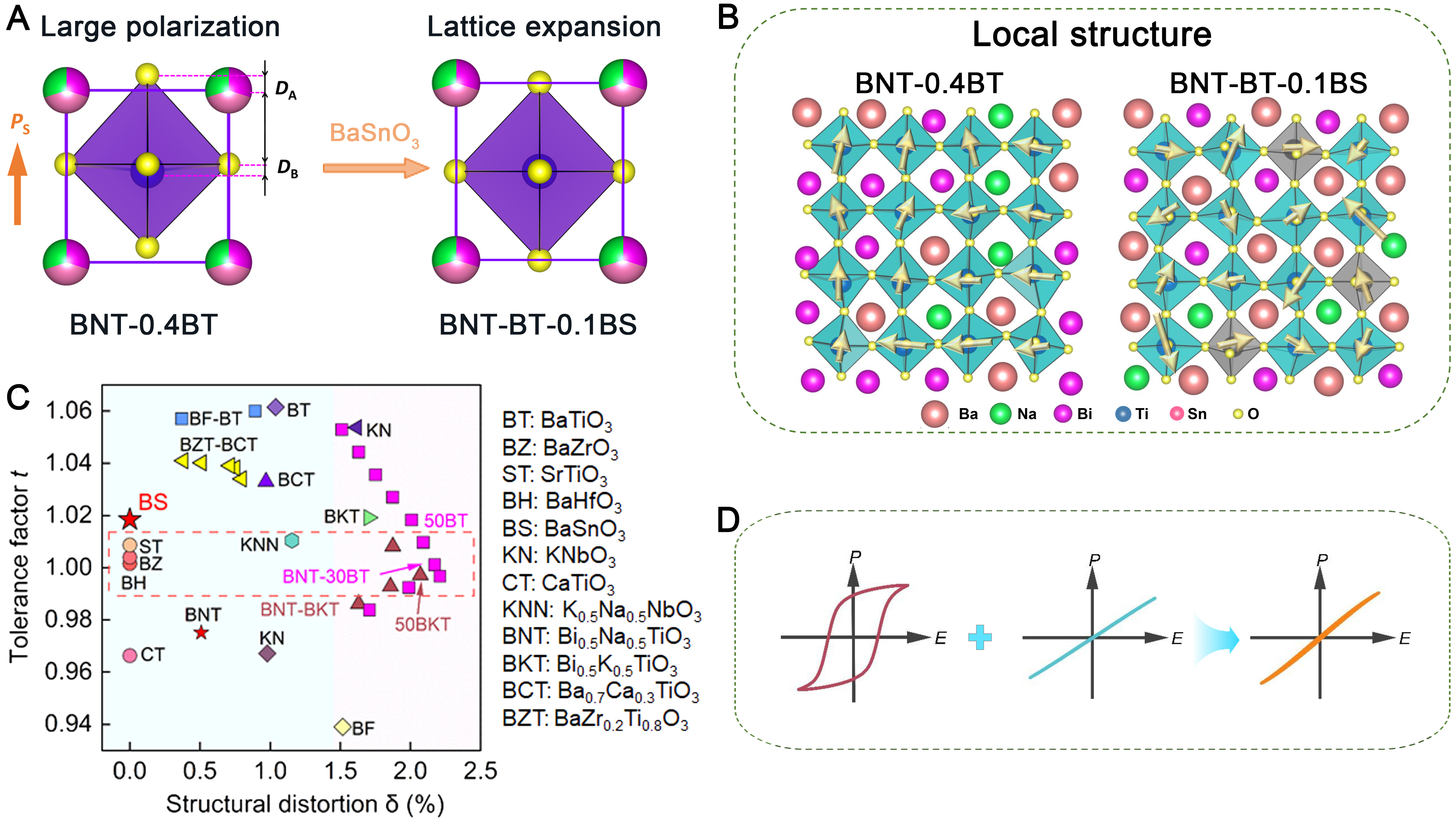
Figure 1. Local structure regulation and chemical design of energy-storage ceramics. (A) Structural evolution of BNT-BT perovskite after incorporating BS; (B) Schematic of the polar structure of BNT-0.4BT ferroelectric matrix and favorable BNT-BT-0.1BS RFEs; (C) Structural parameters of tolerance factor (t) and structural distortion (δ) for Pb-free perovskites; (D) Evolution of P-E loops. BNT: Bi0.5Na0.5TiO3; BT: BaTiO3; BS: BaSnO3; RFEs: relaxor ferroelectrics.
Based on above consideration, the paraelectric BaSnO3 (BS) is introduced as an end-member into the ferroelectric BNT-0.4BT matrix with a high structural distortion. On the one hand, the large ionic radius of Ba2+ (1.61 Å) plays a critical role in promoting unit-cell expansion [Figure 1A], providing enhanced spatial flexibility for ion displacement under an external E, resulting in an amplified local polarization heterogeneity. Moreover, Sn4+ ions regulate the chemical environment of B-site cations and induce oxygen octahedral distortion, which disrupts atomic ordering and suppresses the coherence of long-range polarization. This process introduces random field effects while retaining strong local intrinsic polarization [Figure 1B]. On the other hand, combination of BNT-0.4BT with t = 1.0076 and BS with t = 1.0184 construct global perovskite structure with t = 1.0096, ensuring the stable RFE state with a high η [Figure 1C and D]. Accordingly, the RFE system not only preserves the intrinsic polarization strength of ferroelectrics but also generates a high density of locally symmetric polar clusters through atomic disordering.
MATERIALS AND METHODS
The 0.6Bi0.5Na0.5TiO3-(0.4-x)BaTiO3-xBaSnO3 (x = 0, 0.06, 0.10, 0.12) ceramics were synthesized via conventional solid-state reaction method. The raw material consisted of oxide and carbonate powders: Bi2O3(99.99%, Aladdin), Na2CO3(99.99%, Aladdin), TiO2(99.9%, Aladdin), BaCO3(99%, Macklin), and SnO2(99%, Macklin). The dried reactant powders were weighed according to the stoichiometric ratio and ball milled in anhydrous ethanol for 24 h. The mixture was subsequently dried at 100 °C for 120 min. The dried precursor powders were calcined in ambient atmosphere at 800-850 °C for 2 h. The calcined powders were mixed with polyvinyl alcohol (PVA) binder for granulation, and pressed into pellets with a diameter of
The crystal structure was identified by the X-ray Diffractometer (Rigaku Smartlab3, Japan) with Cu Kalpha radiation at room temperature. Surface topography images of acid etched ceramic sample were captured by a field-emission scanning electron microscope (LEO1530, ZEISS SUPRA 55, Germany). Grain surface morphology, selected area electron diffraction (SAED), and high-resolution TEM images were acquired by an image aberration-corrected scanning transmission electron microscope (STEM, Titan ETEM G2, Thermo Fisher Scientific, USA) at the operating voltage of 300 kV. Atomic-scale high-angle annular dark-field (HAADF) phase images were acquired by a STEM (JEM-F200, JEOL, Japan) equipped with probe and image aberration correction operated at 200 kV. All STEM images were Fourier-filtered using a lattice mask to remove noise. The accurate positions of the A/B-site atomic columns were determined by fitting a two-dimensional Gaussian function, the angle and magnitude of polar displacements were calculated using a MATLAB script. The low electric field bipolar P-E loops at room temperature and frequency of 1 Hz were recorded by a ferroelectric tester (TF Analyzer 1000, aix ACCT, Germany) on bulk ceramics with a thickness of 0.5 mm and diameter of 10 mm. The dielectric temperature spectrum was tested by a dielectric spectrum measurement system (LDM-500, BALAB, China). The electrochemical impedance was measured with a precision impedance analyzer (4294A, Agilent, USA). The discharge characteristics, with an overdamped value of 13,000 Ω, were measured using Tongguo (TG) technology (CFD-003, Tongguo technology, China). The energy-storage properties were determined by measuring the unipolar P-E loops of the fatigued samples under 40 kV·mm-1 at 10 Hz (Radiant Technologies, USA). The neutron total scattering experiments were conducted at room temperature on the Spallation Neutron Source (SNS, Oak Ridge National Laboratory). The UV-Vis diffuse reflectance spectra (DRS) were recorded by a Persee T9S spectrophotometer (China), BaSO4 was used a reflectance standard.
The Bragg Rietveld refinement was done with GSAS-II software, using the neutron data from four banks (bank 2~5) to get the long-range average structure parameters. Reverse Monte Carlo (RMC) simulation was performed based on the RMCprofile software[35,36]. The 20×20×20 supercells of pseudocubic (Pm-3m) structure (about 80×80×80 Å3) containing 40,000 atoms and randomly distributed A-site atoms were established. In the RMC simulations, the Bragg intensities, G(r) and S(Q) data were fitted simultaneously under the bond valence sum and coordination constraints. A-site atoms were allowed to swap, and each RMC modelling was run to generate more than 103 move per atom to get converged. Detailed analysis of 3D polar displacements, unit-cell polar vectors, and polar projection can be referred to our previous works[21,22]. To get the statistical analysis results, 20 refined 3D atom configurations were merged together.
From the refined atom configurations, for each A site atoms (
For unit-cell polar vector calculation, one perovskite unit cell contains 8 A site atoms, 1 B site atom, and 6 O atoms. Firstly, the coordinates of 6 neighboring oxygen atoms (
Where the q indicates the ion charge, V is the perovskite unit-cell volume.
RESULTS AND DISCUSSION
The BNT-BT-xBS (x = 0, 0.06, 0.10, 0.12) Pb-free ceramic system was synthesized via a solid-state reaction method. For x = 0, a characteristic ferroelectric P-E loop with a high Pm of 24.1 μC·cm-2 and a large Pr of
Figure 2A displays the high-resolution transmission electron microscope (TEM) of BNT-BT-0.1BS ceramics, which shows a long-range average cubic structure [Figure 2B and C, Supplementary Figure 1C]. Moreover, the Inverse fast Fourier transform (IFFT) shows obvious local lattice distortions, revealing the existence of polar nanoregions (PNRs), rather than macroscopic ferroelectric domains. To further resolve the polar structural characteristics of the x = 0.10, atomic-resolution imaging along the [100]c was performed via HAADF-STEM. The positions and relative intensities of A/B-site atoms were precisely determined using two-dimensional Gaussian function fitting, and atomic displacement vectors were calculated by quantifying the deviation of B-site atoms from the center of their four nearest-neighbor A-site atoms. The atomic displacement vector maps illustrate both the magnitude (arrow’s length) and directional correlation (arrow’s color) of local displacements. Obviously, the polar clusters with size of approximately 2-5 nm are observed [Figure 2D]. These clusters corresponding to T, rhombohedral (R), and/or orthogonal (O) structures are interconnected via weaker displacements with low symmetries [Figure 2E-G], confirming the coexistence of local structural distortions within the long-range cubic framework. This observation is further supported by the diverse c/a ratios [Figure 2H]. Despite the average pseudo-cubic symmetry of the x = 0.10, the local distortions reach up to 8% [Figure 2H], highlighting the beneficial role of lattice expansion and structural mismatch in enhancing the local polarization. The intensity of atomic columns in HAADF images is proportional to the atomic number (Z)[38]. As shown in Figure 2I, distinct intensity variations reflect local compositional fluctuations, where weaker-intensity regions correspond to Na-rich domains (ZNa = 11), and stronger-intensity regions arise from Bi-rich domains (ZBi = 83). This atomic chemical inhomogeneity is the main reason for the local polarization fluctuations and structural distortions, which are beneficial for the increment in Pm and decrement in hysteresis loss, thereby advancing the energy-storage performance.
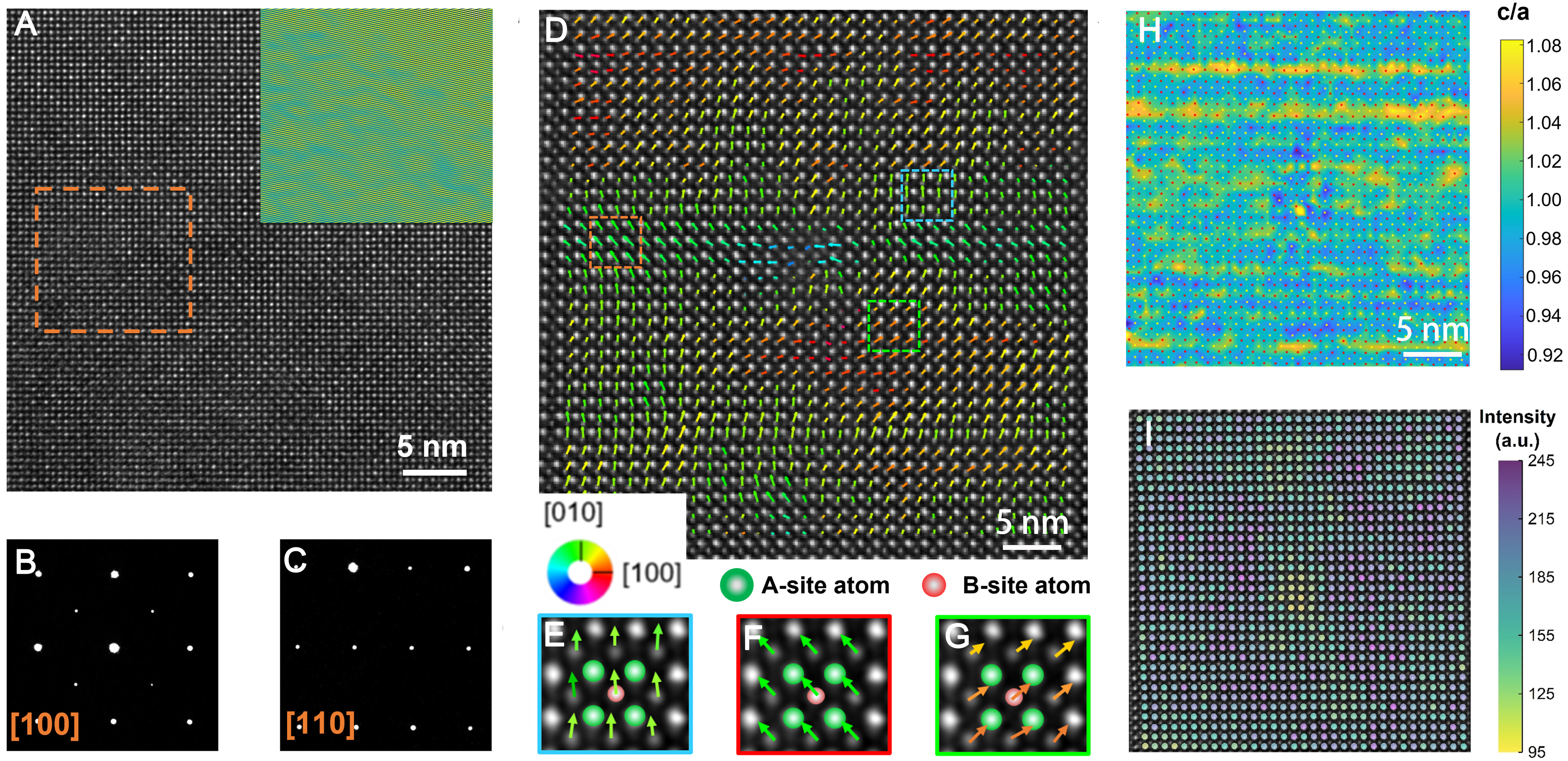
Figure 2. Microscopic structure of BNT-BT-0.1BS ceramic observed by electron microscopy. (A) High-resolution TEM image and corresponding IFFT pattern in the inset; (B and C) SAED patterns along the [001]c and [110]c directions; (D) HAADF-STEM image recorded along the [100]c direction and the corresponding atomic displacement vector mapping; (E-G) Enlarged B-site displacement vectors of the boxed region in (D). Corresponding (H) c/a ratio, and (I) atomic intensity mapping of (D). BNT: Bi0.5Na0.5TiO3; BT: BaTiO3; BS: BaSnO3; TEM: transmission electron microscope; IFFT: inverse fast Fourier transform; SAED: selected area electron diffraction; HAADF-STEM: high-angle annular dark-field scanning transmission electron microscopy.
The atomic displacement derived from the HAADF-STEM in Figure 2 reveals only a two-dimensional distribution, lacking the access to ion-specific polarity information. However, the atomic pair distribution function (PDF) based on the neutron total scattering can reveal the influence of chemical composition on local structural evolution and the role of foreign ions in constructing polar structures[39,40]. Furthermore, a three-dimensional atomic model can be established using the Reverse Monte Carlo (RMC) algorithm, achieving enhanced structural precision through joint refinement of neutron real-space PDF G(r), reciprocal-space scattering function S(Q), and Bragg diffraction data [Figures 3A-C][35,41,42]. The polyhedral network in perovskite oxides provides a reference framework for calculating the local and nanoscale structures [Figure 3D]. Figure 3E and F illustrate the stereographic projections of atomic polar displacements along the [001]c. Bi3+ ions exhibit strong preferential polar displacements along the T-direction accompanied by relatively weaker R-directional preferences. This similar polarization behavior is also reported in other Bi-based compounds[19-21]. In contrast, Ti4+ displacement vectors display pronounced directional disorder.
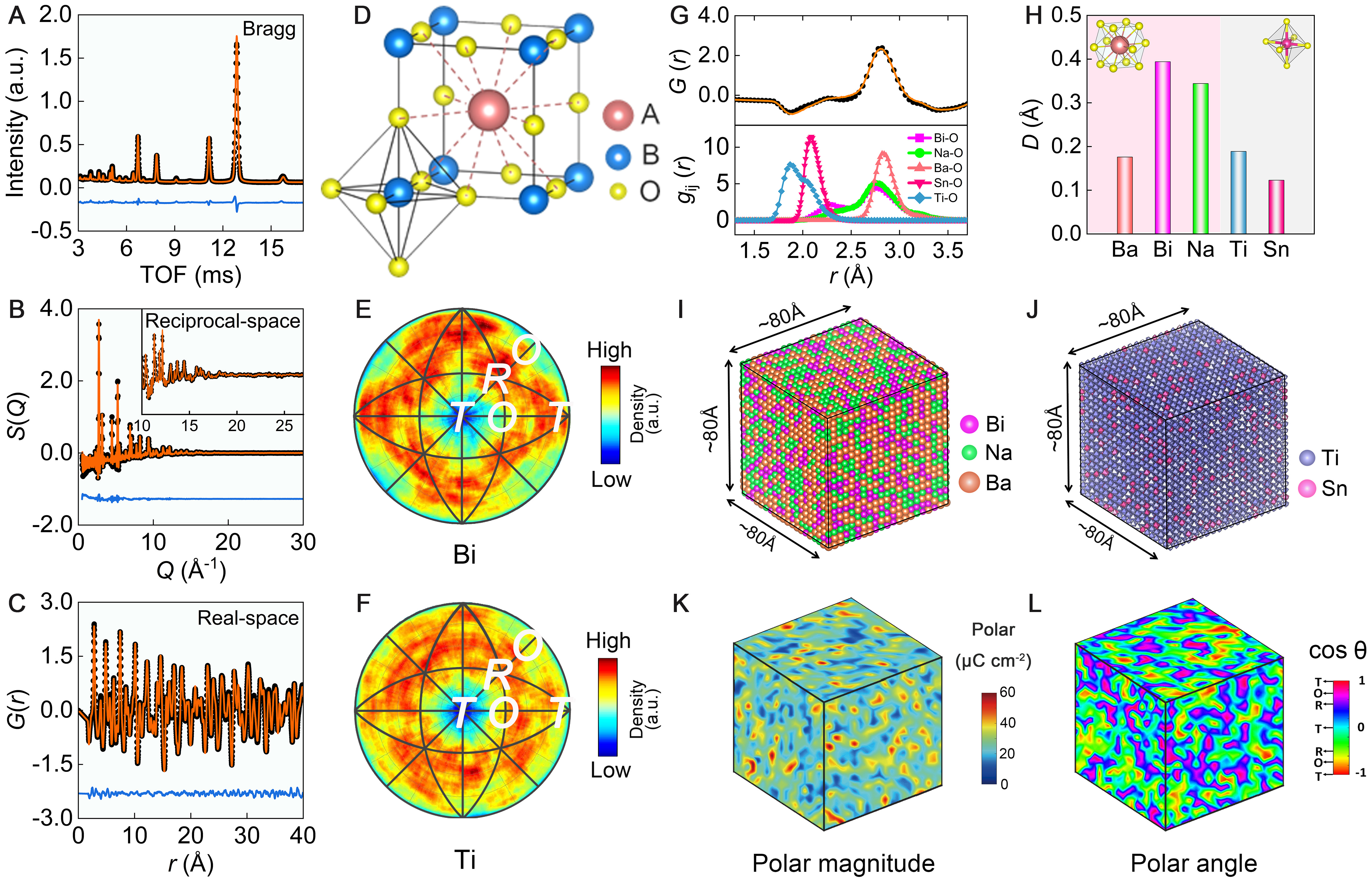
Figure 3. Local structures of BNT-BT-0.1BS refined by RMC fitting and neutron total scattering. (A-C) Fitting results of neutron scattering data, including Bragg data, S(Q) and G(r); (D) Perovskite ABO3 structure with a polyhedral network; (E and F) Stereographic projections of atomic polar displacement vectors along the [001]c direction; (G) Experimental and calculated pair distribution functions G(r) and correlation analysis of nearest-neighbor atomic pairs within the range of 1.3-3.7 Å; (H) Average amplitude of polar displacements; (I and J) Three-dimensional distribution images of A-site and B-site atoms, respectively; (K and L) Three-dimensional polar amplitude and polar angle distributions, respectively. BNT: Bi0.5Na0.5TiO3; BT: BaTiO3; BS: BaSnO3; RMC: reverse Monte Carlo; TOF: time of flight.
To further disclose the symmetry/asymmetry distribution of oxygen atoms around distinct elements, element-specific A/B-O PDFs are extracted and presented in Figure 3G. The pronounced splitting of the Bi-O pair originates from the strong hybridization between Bi 6s2 lone-pair electrons and O 2p orbitals, while the asymmetric peak of the Na-O pair is attributed to the steric hindrance effect induced by the small ionic radius of Na+. Moreover, the Sn-O pair does not exhibit noticeable splitting but shifts relative to the Ti-O peak, indicating that Sn4+ incorporation disrupts long-range coherence of local polar displacements, driving an order-to-disorder transition without significantly reducing displacement magnitudes. This evolution manifests macroscopically as enhanced relaxor ferroelectric behavior and a diffuse dielectric response. Calculated average polarization displacement parameters (D) for A/B-site ions are 0.18, 0.39, 0.34, 0.19, and 0.12 Å for Ba2+, Bi3+, Na+, Ti4+, and Sn4+, respectively [Figure 3H]. Combined analysis of A/B-site chemical heterogeneity and unit-cell polarization vectors [Figure 3I-L], it is found that the incorporation of BS effectively disrupts the long-range ferroelectric domains and facilitates the formation of strong polar nanoclusters with coexistence of T, R and O symmetries [Figure 3L], consistent with atomic displacement in Figure 2D. Notably, the high polarization displacement of Bi3+ in the ferroelectric matrix is largely retained in the relaxor state. Accordingly, in regions enriched with Bi3+, the unit-cell polarization magnitude reaches as high as ~60 μC·cm-2 [Figure 3K], demonstrating significant local polar fluctuations. These results confirm the feasibility of local structure design and chemical modulation through the coupling of ferroelectric units with high structural distortion and polar units with lattice expansion. This strategy is crucial for achieving high polarization, slim hysteresis behavior, and exceptional energy storage performance.
Based on the local structure and rational chemical design, BNT-BT-0.1BS ceramic presents remarkable energy-storage performance. As illustrated in Figure 4A, BNT-BT-0.1BS ceramic consistently exhibits slim P-E loops with low Pr and high Pm over a wide electric field range of 10-70 kV·mm-1. Notably, benefiting from the electro-polarization effect, a high Pm of 35.5 μC·cm-2 is achieved at 20 kV·mm-1. As the applied field increases from 20 kV·mm-1 to the breakdown field (EB = 70 kV·mm-1), Pm rises significantly from 35.5 to
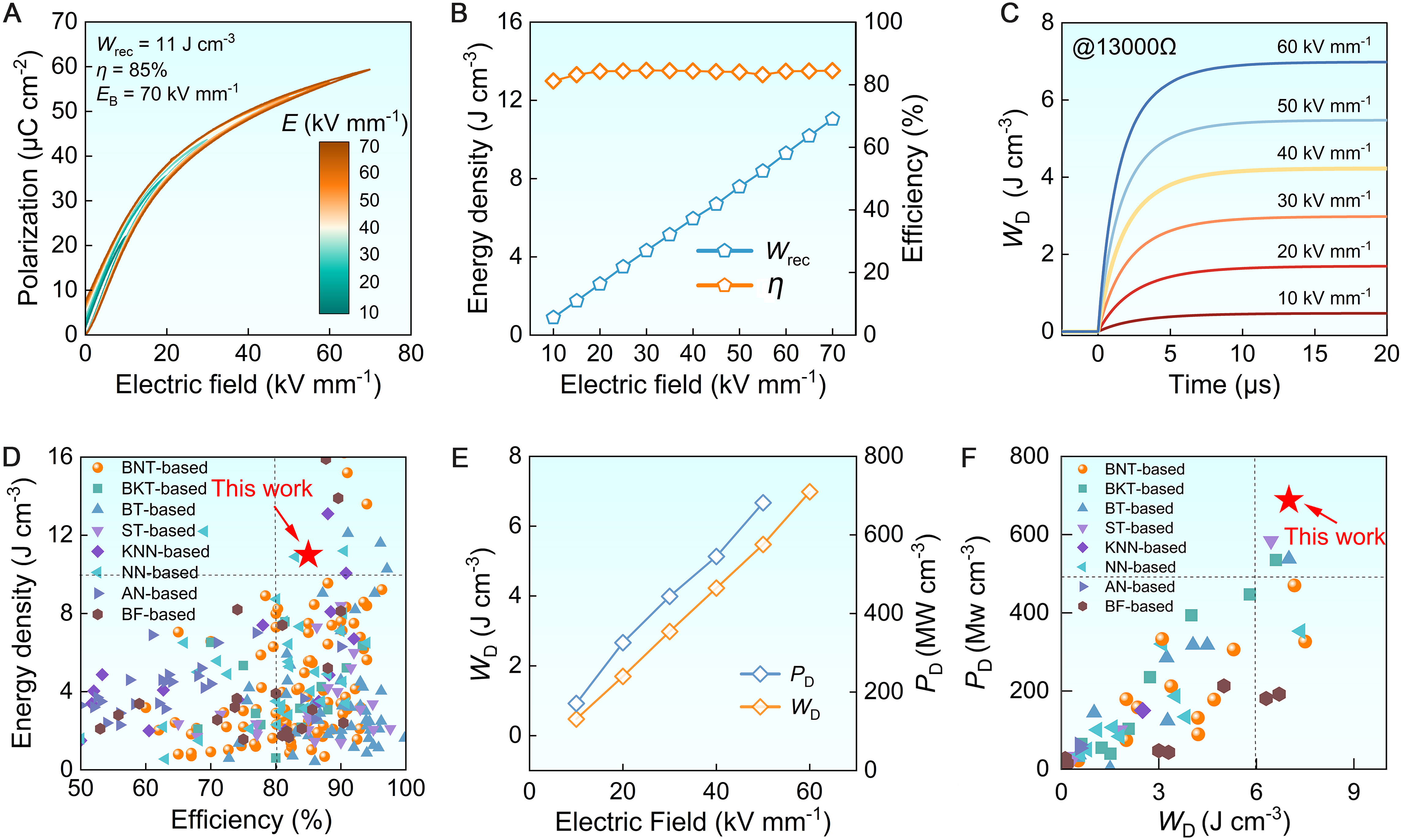
Figure 4. Energy-storage performance of BNT-BT-0.1BS ceramics. (A) Unipolar P-E loops under different electric fields, and (B) corresponding Wrec and η; (C) Variation of WD with time under different electric fields; (D) Comparison of Wrec and η with reported Pb-free bulk ceramics; (E) Comparison of PD and WD with reported Pb-free bulk ceramics; (F) WD and PD under different electric fields. BNT: Bi0.5Na0.5TiO3; BT: BaTiO3; BS: BaSnO3; BKT: Bi0.5K0.5TiO3; ST: SrTiO3; KNN: K0.5Na0.5NbO3; NN: NaNbO3; AN: AgNbO3; BF: BiFeO3.
Excitingly, BNT-BT-0.1BS ceramic sample exhibits an ultranarrow hysteresis loop, along with a high Pm of
Such superior energy-storage performance mainly originates from the synergistic contributions of multiple factors, including high Pm, low Pr, slim hysteresis, and high EB. The high Pm is ascribed to the large structural distortion induced strong local polar clusters, and enhanced polarization flexibility stemming from Ba2+-driven lattice expansion. The reduced Pr and slim hysteresis stem from the modification of the B-site chemical environment by Sn4+, which introduces random fields by disturbing atomic order and suppressing long-range polarization correlations. The high EB achieved in this study originates from the synergistic optimization of the material’s microstructure and electrical properties. First, the ceramic samples exhibit a highly dense microstructure (relative density > 93%) and a uniformly distributed fine-grained structure
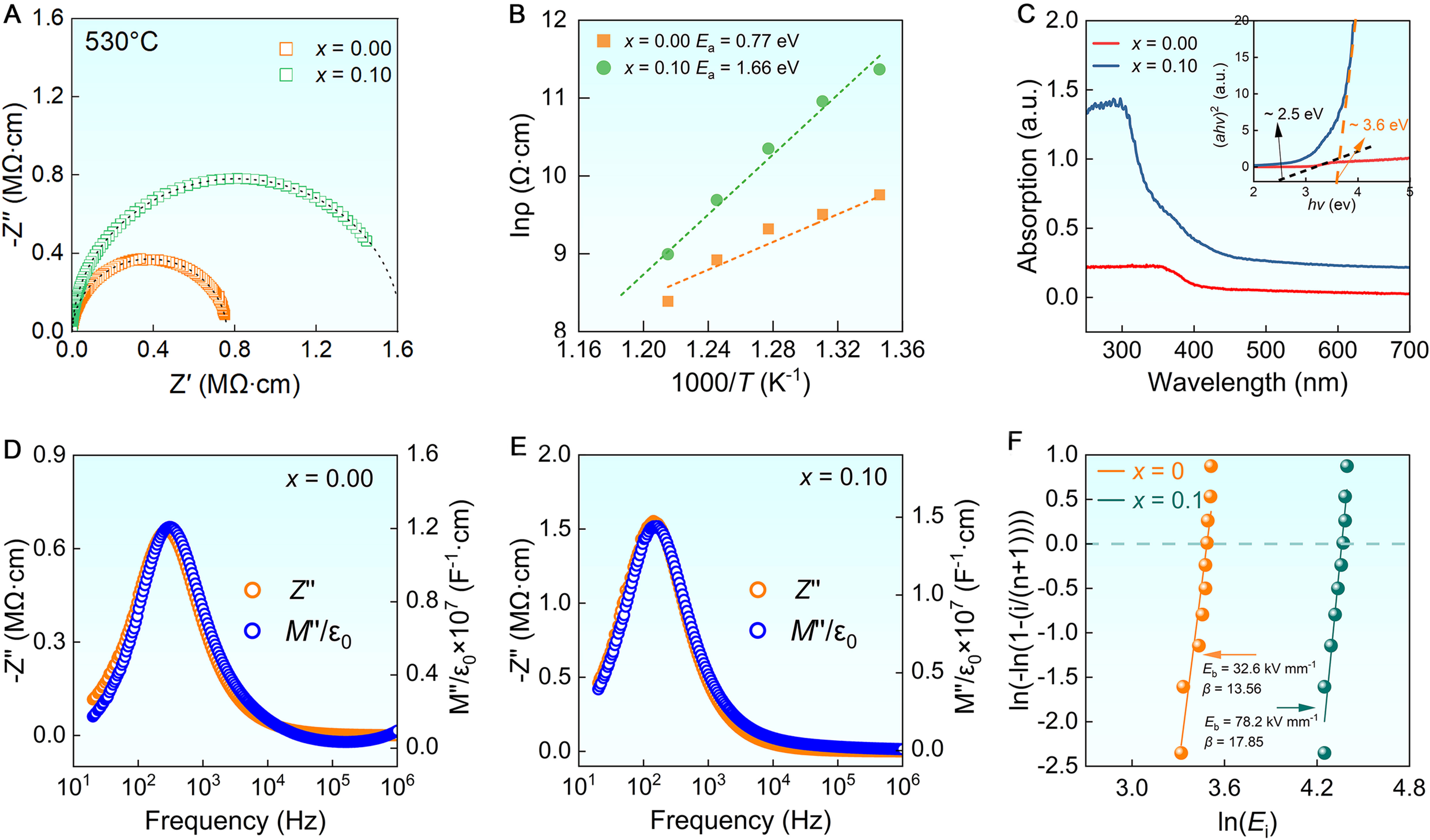
Figure 5. Electrical microstructures of BNT-BT-xBS ceramics. (A) Impedance profiles at 530 °C of x = 0, 0.10; (B) Activation energy (Ea) of x = 0, 0.10; (C) UV-Vis absorption spectrum of x = 0, 0.10 with calculated band gap (Eg); (D and E) Spectroscopic plots of Z'' and M'' spectra at 530 °C of x = 0 and 0.10; (F) Weibull distribution of the EB for x = 0, 0.10. BNT: Bi0.5Na0.5TiO3; BT: BaTiO3; BS: BaSnO3; UV-Vis: ultraviolet-visible.
The stability in energy-storage performance is also crucial for the usage of dielectric capacitors in the harsh environment. Interestingly, BNT-BT-0.1BS ceramic exhibits excellent frequency reliability, temperature stability, and fatigue resistance under 40 kV·mm-1 [Figure 6]. Evidently, all the obtained P-E loops are narrow, with a stable Wrec ~ 6.44 ± 0.17 J·cm-3 and a low variation of η within 1.4% under various frequencies from 1 to 200 Hz [Figure 6A and B]. When the accumulative cycling number reaches to 106, both Wrec and η show a slight variation within 1%, suggesting excellent fatigue resistance [Figure 6C and D]. Simultaneously, the ceramic also presents high thermal stability from RT to 140 °C, with Wrec ~ 6.55 ± 0.12 J·cm-3 and η variation < 2.1% [Figure 6E and F]. All these show the application potential of BNT-BT-0.1BS in the field of energy-storage capacitors.
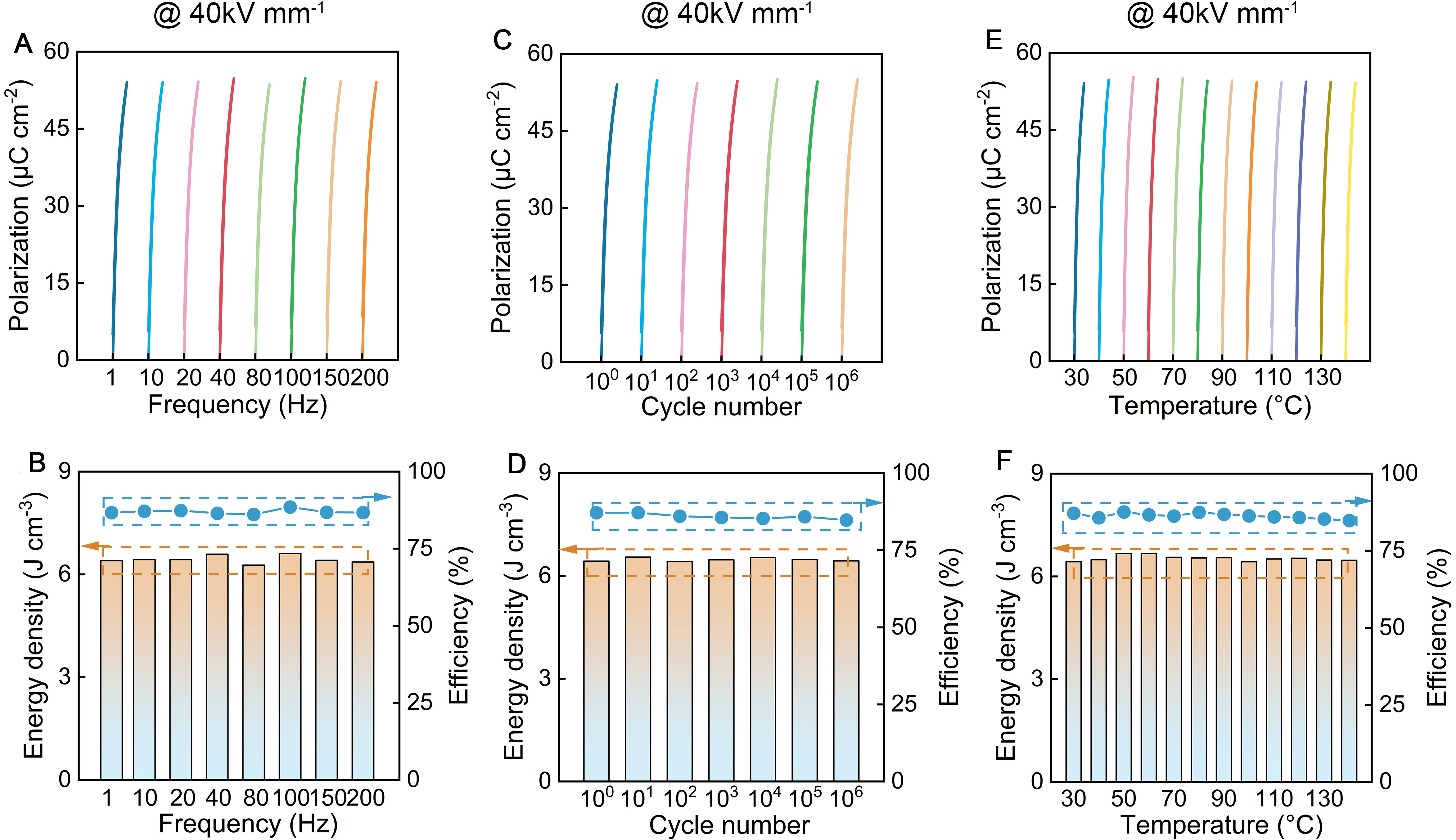
Figure 6. Stability in energy-storage performance for BNT-BT-0.1BS ceramics. (A and B) frequency-, (C and D) cycling number- and (E and F) temperature-dependent unipolar P-E curves and corresponding Wrec and η at 40 kV·mm-1. BNT: Bi0.5Na0.5TiO3; BT: BaTiO3; BS: BaSnO3.
CONCLUSIONS
This work demonstrates a rational design strategy for high-performance Pb-free RFEs by coupling lattice-expanding Ba2+ and order-disrupting Sn4+ in BNT-BT ceramics, providing a novel pathway for the rational design of high-performance lead-free energy-storage materials. The key innovations are: Firstly, a novel compositional design principle based on the synergistic regulation of t and δ was proposed and validated, enabling the coexistence of strong intrinsic polarization and enhanced relaxor characteristics. Secondly, the atomic-scale mechanism of synergy between “lattice expansion for enhanced polarization flexibility” and “B-site chemical frustration for breaking long-range order” was unraveled. Neutron total scattering and atomic-resolution STEM confirmed the formation of strong polar nanoclusters (2-5 nm) with intense local polarization up to ~60 μC·cm-2, featuring a mixture of rhombohedral, tetragonal, and orthorhombic symmetries. Thirdly, a breakthrough in comprehensive energy-storage performance was achieved. The optimized ceramic exhibits not only a high recoverable energy density (11 J·cm-3) and high efficiency (85%), but also superior discharge capability (power density of 688 MW·cm-3), high breakdown strength (~70 kV·mm-1), and excellent stability over frequency, temperature, and cycling. This strategy holds promise for extension to other ferroelectric systems and offers a material foundation for developing practical energy-storage devices with high energy density, high efficiency, and high power output.
DECLARATIONS
Authors’ contributions
Experiment, characterization: Zhu, Z.; Zha, Y.; Wang, S.; Luo, Z.
Investigation, methodology: Zhu, Z.; Luo, H.
Wring origin draft: Zhu, Z.; Zhang, J.; Luo, H.
Writing-review and editing: Zhu, L. F.; Liu, H.
Supervision: Liu, L.; Zhang, G.
Funding acquisition: Zhang, J.; Liu, H.
Availability of data and materials
Data supporting the findings of this study are available from the corresponding author upon reasonable request.
AI and AI-assisted tools statement
Not applicable.
Financial support and sponsorship
This work was supported by the National Natural Science Foundation of China (Nos. 22471013 and 12374085).
Conflicts of interest
All authors declared that there are no conflicts of interest.
Ethical approval and consent to participate
Not applicable.
Consent for publication
Not applicable.
Copyright
© The Author(s) 2026.
Supplementary Materials
REFERENCES
1. Cheema, S. S.; Shanker, N.; Hsu, S.; et al. Giant energy storage and power density negative capacitance superlattices. Nature 2024, 629, 803-9.
2. Zhang, M.; Lan, S.; Yang, B. B.; et al. Ultrahigh energy storage in high-entropy ceramic capacitors with polymorphic relaxor phase. Science 2024, 384, 185-9.
3. Yang, L.; Kong, X.; Li, F.; et al. Perovskite lead-free dielectrics for energy storage applications. Prog. Mater. Sci. 2019, 102, 72-108.
4. Li, J.; Shen, Z.; Chen, X.; et al. Grain-orientation-engineered multilayer ceramic capacitors for energy storage applications. Nat. Mater. 2020, 19, 999-1005.
5. Li, Q.; Chen, L.; Gadinski, M. R.; et al. Flexible high-temperature dielectric materials from polymer nanocomposites. Nature 2015, 523, 576-9.
6. Yang, B.; Zhang, Y.; Pan, H.; et al. High-entropy enhanced capacitive energy storage. Nat. Mater. 2022, 21, 1074-80.
7. Wang, G.; Lu, Z.; Li, Y.; et al. Electroceramics for high-energy density capacitors: current status and future perspectives. Chem. Rev. 2021, 121, 6124-72.
8. Jang, J.; Choi, S. Reduced dimensional ferroelectric domains and their characterization techniques. Microstructures 2024, 4, 2024016.
9. Yan, F.; Qian, J.; Lin, J.; Ge, G.; Shi, C.; Zhai, J. Ultrahigh energy storage density and efficiency of lead-free dielectrics with sandwich structure. Small 2023, 20, 2306803.
10. Jayakrishnan, A.; Silva, J.; Kamakshi, K.; et al. Are lead-free relaxor ferroelectric materials the most promising candidates for energy storage capacitors? Prog. Mater. Sci. 2023, 132, 101046.
11. Kim, J.; Saremi, S.; Acharya, M.; et al. Ultrahigh capacitive energy density in ion-bombarded relaxor ferroelectric films. Science 2020, 369, 81-4.
12. Liu, Y.; Zhang, Y.; Wang, J.; et al. Ultrahigh capacitive energy storage through dendritic nanopolar design. Science 2025, 388, 211-6.
13. Zha, J.; Liu, J.; Yang, Y.; et al. High energy storage performance of (1-x)Ba0.5Sr0.5TiO3-xK0.5Na0.5NbO3 ceramics via a combined strategy of fine grains and multiphase polar nanoregions. Chem. Eng. J. 2024, 486, 150441.
14. Zhao, L.; Liu, Q.; Gao, J.; Zhang, S.; Li, J. F. Lead-free antiferroelectric silver niobate tantalate with high energy storage performance. Adv. Mater. 2017, 29, 1701824.
15. Ji, H.; Wang, D.; Bao, W.; et al. Ultrahigh energy density in short-range tilted NBT-based lead-free multilayer ceramic capacitors by nanodomain percolation. Energy. Storage. Mater. 2021, 38, 113-20.
16. Yao, F.; Yuan, Q.; Wang, Q.; Wang, H. Multiscale structural engineering of dielectric ceramics for energy storage applications: from bulk to thin films. Nanoscale 2020, 12, 17165-84.
17. Xi, K.; Liu, J.; Song, B.; et al. Boosting energy storage performance in negative temperature coefficient linear-like dielectrics via composite modulation in the superparaelectric state. J. Eur. Ceram. Soc. 2024, 44, 1588-96.
18. Zhang, M.; Zhu, M.; Chang, Z.; et al. Achieving excellent energy storage performance of K1/2Bi1/2TiO3-based ceramics via multi-phase boundary and bandgap engineering. Chem. Eng. J. 2023, 473, 145314.
19. Pan, H.; Lan, S.; Xu, S.; et al. Ultrahigh energy storage in superparaelectric relaxor ferroelectrics. Science 2021, 374, 100-4.
20. Liu, Z.; Peng, H.; Lu, T.; et al. Harnessing multisite high-entropy architecture for ultrahigh energy storage multilayer capacitors. J. Am. Chem. Soc. 2025, 147, 41620-8.
21. Liu, H.; Sun, Z.; Zhang, J.; et al. Chemical design of Pb-free relaxors for giant capacitive energy storage. J. Am. Chem. Soc. 2023, jacs.3c02811.
22. Chen, Y.; Zhu, Z.; Zhu, L.; et al. Giant capacitive energy-storage in BaTiO3-based fine-grained relaxors via local polarization enhancement. Adv. Mater. 2025, 37, 2420566.
23. Qi, H.; Xie, A.; Tian, A.; Zuo, R. Superior energy-storage capacitors with simultaneously giant energy density and efficiency using nanodomain engineered BiFeO3-BaTiO3-NaNbO3 lead-free bulk ferroelectrics. Adv. Energy. Mater. 2019, 10, 1903338.
24. Pan, H.; Li, F.; Liu, Y.; et al. Ultrahigh-energy density lead-free dielectric films via polymorphic nanodomain design. Science 2019, 365, 578-82.
25. Wang, X.; Song, X.; Fan, Y.; et al. Lead-free high permittivity quasi-linear dielectrics for giant energy storage multilayer ceramic capacitors with broad temperature stability. Adv. Energy. Mater. 2024, 14, 2400821.
26. Qi, H.; Chen, L.; Deng, S.; Chen, J. High-entropy ferroelectric materials. Nat. Rev. Mater. 2023, 8, 355-6.
27. Long, C.; Zhou, W.; Song, H.; et al. Simultaneously realizing ultrahigh energy storage density and efficiency in BaTiO3-based dielectric ceramics by creating highly dynamic polar nanoregions and intrinsic conduction. Acta. Mater. 2023, 256, 119135.
28. Yang, F.; Bao, Y.; Zeng, B.; et al. Excellent energy storage properties in ZrO2 toughened Ba0.55Sr0.45TiO3-based relaxor ferroelectric ceramics via multi-scale synergic regulation. Chem. Eng. J. 2024, 493, 152624.
29. Li, D.; Meng, X.; Zhou, E.; et al. Ultrahigh energy density of antiferroelectric PbZrO3-based films at low electric field. Adv. Funct. Mater. 2023, 33, 2302995.
30. Pan, H.; Ma, J.; Ma, J.; et al. Giant energy density and high efficiency achieved in bismuth ferrite-based film capacitors via domain engineering. Nat. Commun. 2018, 9, 1813.
31. Cao, W.; Lin, R.; Hou, X.; et al. Interfacial polarization restriction for ultrahigh energy-storage density in lead-free ceramics. Adv. Funct. Mater. 2023, 33, 2301027.
32. Ding, Y.; Li, P.; He, J.; et al. Simultaneously achieving high energy-storage efficiency and density in Bi-modified SrTiO3-based relaxor ferroelectrics by ion selective engineering. Compos. Part. B. Eng. 2022, 230, 109493.
33. Corker, D. L.; Glazer, A. M.; Whatmore, R. W.; Stallard, A.; Fauth, F. A neutron diffraction investigation into the rhombohedral phases of the perovskite series. J. Phys. Condens. Matter. 1998, 10, 6251-69.
34. Wang, K.; Li, J. Analysis of crystallographic evolution in (Na,K)NbO3-based lead-free piezoceramics by x-ray diffraction. Appl. Phys. Lett. 2007, 91, 262902.
35. Tucker, M. G.; Keen, D. A.; Dove, M. T.; Goodwin, A. L.; Hui, Q. RMCProfile: reverse Monte Carlo for polycrystalline materials. J. Phys. Condens. Matter. 2007, 19, 335218.
36. Krayzman, V.; Levin, I.; Woicik, J. C.; Bridges, F. Correlated rattling-ion origins of dielectric properties in reentrant dipole glasses BaTiO3-BiScO3. Appl. Phys. Lett. 2015, 107, 192903.
37. Datta, K.; Margaritescu, I.; Keen, D.; Mihailova, B. Stochastic polarization instability in PbTiO3. Phys. Rev. Lett. 2018, 121, 137602.
38. Pennycook, S. J.; Boatner, L. A. Chemically sensitive structure-imaging with a scanning transmission electron microscope. Nature 1988, 336, 565-7.
40. Keen, D. A. Total scattering and the pair distribution function in crystallography. Crystallogr. Rev. 2020, 26, 143-201.
41. Zhang, Y.; Eremenko, M.; Krayzman, V.; Tucker, M. G.; Levin, I. New capabilities for enhancement of RMCProfile: instrumental profiles with arbitrary peak shapes for structural refinements using the reverse Monte Carlo method. J. Appl. Crystallogr. 2020, 53, 1509-18.
42. Wang, L.; Qi, H.; Deng, S.; et al. Design of superior electrostriction in BaTiO3-based lead-free relaxors via the formation of polarization nanoclusters. InfoMat 2022, 5, e12362.
43. Ogihara, H.; Randall, C. A.; Trolier-mckinstry, S. High-energy density capacitors utilizing 0.7 BaTiO3-0.3 BiScO3 ceramics. J. Am. Ceram. Soc. 2009, 92, 1719-24.
Cite This Article
 Open Access
How to Cite
Download Citation
Export Citation File:
Type of Import
Tips on Downloading Citation
Citation Manager File Format
Type of Import
Direct Import: When the Direct Import option is selected (the default state), a dialogue box will give you the option to Save or Open the downloaded citation data. Choosing Open will either launch your citation manager or give you a choice of applications with which to use the metadata. The Save option saves the file locally for later use.
Indirect Import: When the Indirect Import option is selected, the metadata is displayed and may be copied and pasted as needed.
About This Article
Copyright

Data & Comments
Data
0










Comments
Comments must be written in English. Spam, offensive content, impersonation, and private information will not be permitted. If any comment is reported and identified as inappropriate content by OAE staff, the comment will be removed without notice. If you have any queries or need any help, please contact us at [email protected].