


An effective index for high-performance piezoelectrics
 0
0 
Abstract
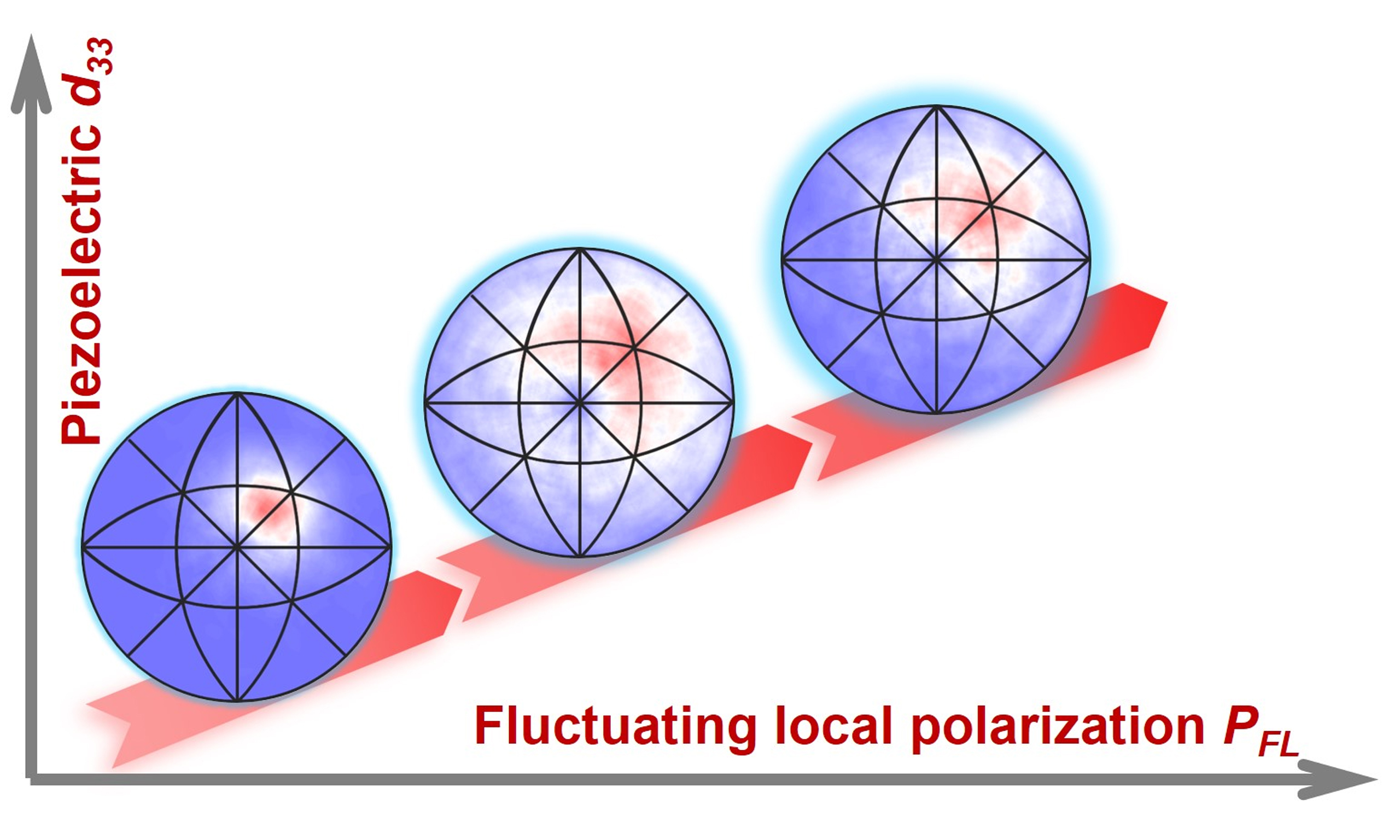
Piezoelectric materials have been attracting wide research interest for decades due to their ability to interconvert mechanical and electrical energy. Various mechanisms from different perspectives have been proposed to explain high piezoelectricity; however, a unified framework across diverse perovskite piezoelectric systems remains elusive. Yao et al. introduced a concept termed fluctuating local polarization (FLP) as an effective index for high piezoelectricity in perovskite ferroelectrics. FLP describes the composition-dependent piezoelectric performance in individual solid solutions and also accounts for high piezoelectricity across distinct systems. The FLP metric integrates the magnitude of local electric dipoles and the disorder of their orientations. This concept does not supersede traditional viewpoints but rather rationalizes them under a common microscopic index: local polarization flexibility. FLP is not merely an explanatory fingerprint of high piezoelectricity; it can also serve as a practical reference for engineering the next generation of ferroelectric materials.
Keywords
Piezoelectric materials, capable of interconverting mechanical energy and electrical energy, are vital components in modern electromechanical devices and have been attracting significant interest in both technological applications and fundamental research[1,2]. Since the discovery of the perovskite Pb(Zr,Ti)O3 (PZT) system in the 1950s, various perovskite solid-solution systems with high piezoelectricity have been developed. These include Pb-based systems, such as PZT-derived ternary systems and Pb(Mg1/3Nb2/3)O3-PbTiO3 (PMN-PT)-based system[3,4], as well as Pb-free alternatives, notably (K,Na)NbO3 (KNN)-based[5-7] and BaTiO3 (BT)-based systems[8]. Meanwhile, the mechanism underlying high piezoelectricity has long been a core focus of research. During the past decades, various mechanisms from different perspectives have been proposed to explain the high piezoelectricity. One frequently-discussed mechanism involves the coexistence of multiple ferroelectric phases (e.g., rhombohedral, tetragonal, and orthorhombic) at morphotropic or polymorphic phase boundaries (MPBs/PPBs), which enhances the piezoelectricity by providing richer polarization variants and enabling facile domain switching[9,10]. The low-symmetry monoclinic phase is recognized to enable smooth and continuous polarization rotation, thereby generating large lattice contributions to piezoelectric response[11-13]. Nanodomains, characterized by high-density domain walls with improved mobility, act as extrinsic contributions that further increase piezoelectricity[14]. Furthermore, local structural heterogeneity, macroscopically manifested as a frequency-dependent diffusive phase transition, has been elucidated to play an important role in enhancing both dielectric and piezoelectricity[2,15,16]. Although current theories and observed phenomena can explain high piezoelectricity in specific systems, a unified framework applicable across diverse perovskite piezoelectric materials elusive.
Recently, Yao et al.[1] introduced the concept of fluctuating local polarization (FLP) as an effective index for high piezoelectricity in perovskite ferroelectrics. FLP is defined as a metric integrating two key factors: the magnitude of local electric dipoles and their orientations. In practice, FLP is calculated by summing the nominal charge-weighted average polar displacement (charge × <D>, where <D> denotes the average displacement vector) of each A-site and B-site ion, multiplied by a disorder parameter (ξ) that quantifies the spread of polarization direction [Figure 1A]. A high FLP value thus indicates a ferroelectric material with both large local dipole moments and a broad distribution of dipole orientations. Yao et al.[1] determined FLP for 16 representative perovskite compositions, including classical Pb-based and Pb-free ceramics, by performing neutron total scattering experiments combined with reverse Monte Carlo modeling, which captured atom-associated local polar displacement vectors. This approach provides a statistical picture of polarization directions across the entire material, rather than focusing on isolated microdomains. They found a strong positive correlation between FLP and the macroscopic piezoelectric coefficient d33[1]. Higher FLP corresponds to higher d33 values [Figure 1B]. Increasing FLP involves introducing greater diversity in local polarization states with various orientations while preserving substantial dipole magnitudes.
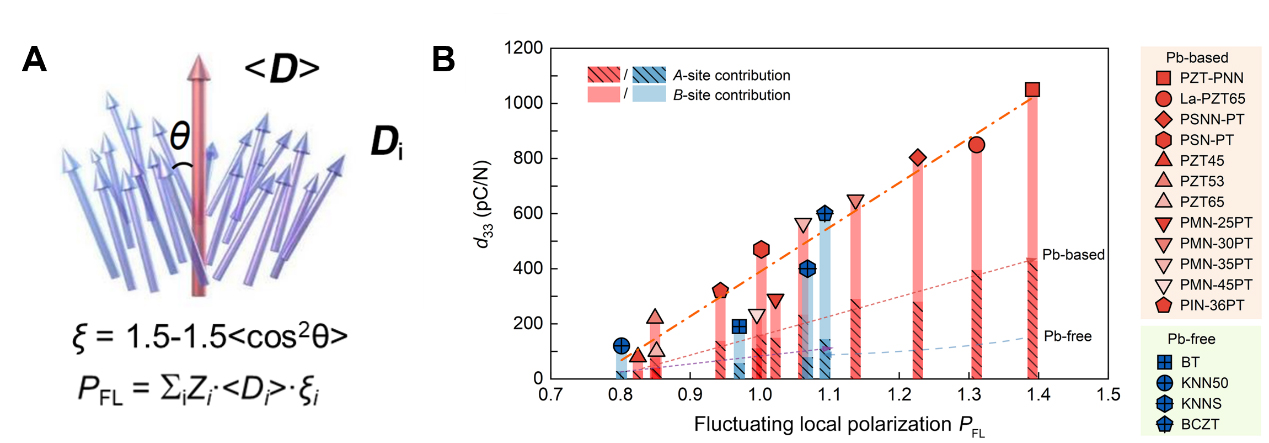
Figure 1. (A) Illustration of the method for quantifying orientation disorder and fluctuating local polarization PFL. <D> denotes the average displacement vector, and represents the angular deviation of each individual vector Di from the average direction; (B) Relationship between piezoelectric coefficient d33 and fluctuating local polarization PFL. Reproduced from Ref.[1] under the CC BY 4.0 license. PZT: Pb(Zr,Ti)O3; PMN: Pb(Mg1/3Nb2/3)O3; BT: BaTiO3; KNNS: K0.48Na0.52Nb0.955Sb0.045O3; KNN50: (K0.5Na0.5)NbO3; BCZT: 0.5(Ba0.7Ca0.3)TiO3-0.5Ba(Zr0.2Ti0.8)O3; PSNN-PT: 0.14Pb(Sc0.5Nb0.5)O3-0.52Pb(Ni1/3Nb2/3)O3-0.34PbTiO3; PSN: Pb(Sc0.5Nb0.5)O3; PNN: Pb(Ni1/3Nb2/3)O3.
Beyond individual cases, the FLP concept provides a broader mechanistic framework that can reconcile previously proposed mechanisms. For instance, compositions at MPBs/PPBs with mixed ferroelectric phases inherently contain multiple permissible polarization directions, broadening the distribution of local polarization vectors. This diversity in polarization states corresponds to a higher FLP, yielding an elevated d33. Similarly, the monoclinic phase - with polarization oriented within its monoclinic plane and featuring 24 polarization variants - also increases the diversity of local polarization vectors. Nanoscale polarization disorder in relaxor ferroelectrics and the higher fraction of domain walls in soft ferroelectrics, enabled by nanodomains, contribute extrinsic flexibility to the polarization configuration, further increasing FLP. On the other hand, the FLP concept helps explain why Pb-free alternatives generally exhibit lower piezoelectricity than Pb-based counterparts. In BT- and KNN-based Pb-free systems, relatively lower
While FLP is a powerful atomic-scale index, it is important to recognize its limitations. The macroscopic piezoelectric properties of a ceramic are not determined solely by atomic-scale polarization; they are also influenced by microstructural factors spanning the nano- to macro-scale. The current FLP model primarily characterizes intrinsic, atomic-level polarization fluctuations. Consequently, materials with identical FLP values may still exhibit different measured d33 if their microstructures differ. A high FLP is therefore a strongly favorable factor for achieving high piezoelectricity, but it is not the sole determinant. Caution is advised in over-interpreting FLP in isolation, and future refinements could integrate FLP with microstructural descriptors, such as grain and domain structure parameters, to develop a more comprehensive predictive framework for piezoelectric performance.
The FLP concept proposed by Yao et al.[1], as an effective descriptor, underpins enhanced piezoelectricity in both Pb-based and Pb-free ferroelectrics. By correlating the orientation disorder and magnitude of local electric dipole moments with macroscopic piezoelectric performance, FLP provides a deeper understanding of high piezoelectricity. This concept also explains other enhancement strategies, ranging from
DECLARATIONS
Authors’ contributions
Manuscript writing: Guo, J.
Manuscript review: Guo, J.; Nan, C. W.
All authors have read and agreed to the published version of the manuscript.
Availability of data and materials
Not applicable.
Financial support and sponsorship
None.
Conflicts of interest
All authors declared that there are no conflicts of interest.
Ethical approval and consent to participate
Not applicable.
Consent for publication
Not applicable.
Copyright
© The Author(s) 2026.
REFERENCES
1. Yao, Y.; Liu, H.; Hu, Y.; et al. Fluctuating local polarization: a generic fingerprint for enhanced piezoelectricity in Pb-based and Pb-free perovskite ferroelectrics. Nat. Commun. 2025, 16, 7442.
3. Li, F.; Wang, B.; Gao, X.; Damjanovic, D.; Chen, L. Q.; Zhang, S. Ferroelectric materials toward next-generation electromechanical technologies. Science 2025, 389, eadn4926.
4. Qiu, C.; Wang, B.; Zhang, N.; et al. Transparent ferroelectric crystals with ultrahigh piezoelectricity. Nature 2020, 577, 350-4.
5. Höfling, M.; Zhou, X.; Riemer, L. M.; et al. Control of polarization in bulk ferroelectrics by mechanical dislocation imprint. Science 2021, 372, 961-4.
6. Li, J.; Wang, K.; Zhu, F.; Cheng, L.; Yao, F.; Green, D. J. (K, Na) NbO3-based lead-free piezoceramics: fundamental aspects, processing technologies, and remaining challenges. J. Am. Ceram. Soc. 2013, 96, 3677-96.
7. Lv, X.; Zhu, J.; Xiao, D.; Zhang, X. X.; Wu, J. Emerging new phase boundary in potassium sodium-niobate based ceramics. Chem. Soc. Rev. 2020, 49, 671-707.
8. Fu, J.; Xie, A.; Li, T.; Zuo, R. Ultrahigh piezoelectricity in (Ba,Ca)(Ti,Sn)O3 lead-free compounds with enormous domain wall contribution. Acta. Materialia. 2022, 230, 117862.
9. Damjanovic, D. Contributions to the piezoelectric effect in ferroelectric single crystals and ceramics. J. Am. Ceram. Soc. 2005, 88, 2663-76.
10. Liu, H.; Chen, J.; Huang, H.; et al. Role of reversible phase transformation for strong piezoelectric performance at the morphotropic phase boundary. Phys. Rev. Lett. 2018, 120, 055501.
11. Noheda, B.; Cox, D. E.; Shirane, G.; Guo, R.; Jones, B.; Cross, L. E. Stability of the monoclinic phase in the ferroelectric perovskite PbZr1-xTixO3. Phys. Rev. B. 2000, 63, 014103.
12. Fu, H.; Cohen, R. E. Polarization rotation mechanism for ultrahigh electromechanical response in single-crystal piezoelectrics. Nature 2000, 403, 281-3.
13. Liu, H.; Chen, J.; Fan, L.; et al. Critical role of monoclinic polarization rotation in high-performance perovskite piezoelectric materials. Phys. Rev. Lett. 2017, 119, 017601.
14. Theissmann, R.; Schmitt, L. A.; Kling, J.; et al. Nanodomains in morphotropic lead zirconate titanate ceramics: On the origin of the strong piezoelectric effect. J. Appl. Phys. 2007, 102, 024111.
15. Gao, X.; Cheng, Z.; Chen, Z.; et al. The mechanism for the enhanced piezoelectricity in multi-elements doped (K,Na)NbO3 ceramics. Nat. Commun. 2021, 12, 881.
Cite This Article
 Open Access
How to Cite
Download Citation
Export Citation File:
Type of Import
Tips on Downloading Citation
Citation Manager File Format
Type of Import
Direct Import: When the Direct Import option is selected (the default state), a dialogue box will give you the option to Save or Open the downloaded citation data. Choosing Open will either launch your citation manager or give you a choice of applications with which to use the metadata. The Save option saves the file locally for later use.
Indirect Import: When the Indirect Import option is selected, the metadata is displayed and may be copied and pasted as needed.
About This Article
Copyright

Data & Comments
Data
0










Comments
Comments must be written in English. Spam, offensive content, impersonation, and private information will not be permitted. If any comment is reported and identified as inappropriate content by OAE staff, the comment will be removed without notice. If you have any queries or need any help, please contact us at [email protected].