



Tailoring the optical transfer function of nonlocal metasurfaces for targeted image processing via an automated inverse design framework
 0
0 Abstract
Nonlocal metasurfaces exhibit significant potential for advanced all-optical image processing by leveraging their exceptional capability to regulate spatial dispersion through precise tailoring of optical transfer functions (OTFs). However, the inverse design of specific OTFs remains challenging due to the inherently complex and highly nonlinear relationship between metasurface structural parameters and angular-dependent optical responses, which conventional empirical trial-and-error approaches struggle to address. To overcome this limitation, we propose an automated inverse design framework integrating a deep neural network acting as a forward predictor with Bayesian optimization. This framework enables automated OTF tailoring by optimizing metasurface structural parameters for targeted image processing operations at desired wavelengths within the 1,200-1,400 nm range. We validate the framework by designing nine dedicated silicon hollow brick metasurfaces: for each operational wavelength (1,250, 1,300, and 1,350 nm), three distinct devices are engineered to separately execute 2D second-order differentiation, 2D fourth-order differentiation, and 2D Gaussian high-pass filtering in transmission mode through targeted OTF engineering. These inversely designed nonlocal metasurfaces achieve a numerical aperture close to 0.4 and serve as fundamental components for edge detection and image sharpening. This intelligent, automated design paradigm dramatically accelerates the design process and significantly expands the scope of achievable functionalities for optical computing metasurfaces, paving the way for more sophisticated all-optical information processing systems.
Keywords
INTRODUCTION
The relentless pursuit of faster, more efficient computation has increasingly shifted to photonic platforms[1-3]. Optical computing provides a compelling alternative to digital electronics by exploiting inherent advantages including massive parallelism, ultralow latency, and minimal energy dissipation. In particular, all-optical image processing, such as optical differentiation and spatial filtering, enables direct manipulation of optical wavefronts for critical tasks such as edge detection and image sharpening without optoelectronic conversion[4-7]. These capabilities form the critical foundation for emerging technologies spanning autonomous navigation, biomedical diagnostics, and augmented/virtual reality systems.
Traditionally, manipulating images in the spatial frequency domain relied on bulky 4f optical systems. Fourier optics principles dictate that such systems - employing paired lenses and a spatial filter - can perform optical image processing[8]. However, their inherent bulk impedes compact integration and miniaturization. The advent of metasurfaces, defined as subwavelength nanostructure arrays, has revolutionized nanophotonics and emerged as a transformative platform for image processing[9,10]. One class of metasurfaces is “local” metasurfaces, which modulate the optical wavefront by spatially varying the geometry or composition of individual meta-atoms across the surface. Implementing these as direct spatial filters in a 4f system remains bulky due to the long 4f distance and will be limited by paraxial approximation[11]. In contrast, nonlocal metasurfaces exploit collective resonances arising from interactions between identical meta-atoms[12-16]. This results in a spatially invariant response that directly modulates the Fourier components (angular spectrum) of the incident light. This unique property enables direct optical transfer function (OTF) engineering, allowing nonlocal metasurfaces to be seamlessly integrated as compact, lightweight elements at the input or output planes of various optical systems. Furthermore, their geometric uniformity makes them inherently compatible with scalable, high-throughput fabrication techniques (e.g., interference lithography and nanoimprint lithography), offering a significant practical advantage.
These compelling benefits - compactness, direct Fourier space manipulation, and fabrication scalability - position nonlocal metasurfaces as a transformative platform for real-time, all-optical image processing[17-20]. A wide variety of metastructures have been designed to perform optical analog computation[6,21]. However, a fundamental challenge impedes their widespread adoption: the complex, high-dimensional, and highly nonlinear relationship between the metasurface structure (e.g., unit cell geometry, periodicity, material) and its resulting angular optical response (the OTF). The design process has predominantly relied on manual, intuition-driven approaches, which are inherently limited in achieving on-demand inverse design for specific image processing tasks. This conventional paradigm is often inefficient and struggles to navigate the complex, highly nonlinear design space of nonlocal metasurfaces.
Recently, the introduction of deep neural networks (DNNs) has led to a significant change in the research paradigm of metasurfaces, greatly enhancing the design efficiency and diversity of metasurfaces[22-25]. In contrast to the conventional empirical trial-and-error approaches, the DNN learns the complex, nonlinear mappings between the structural parameters and optical responses, enabling highly accurate prediction of the optical responses and inverse design of desired metasurfaces. For example, Li et al. proposed physics-empowered forward and inverse DNN models to design dielectric meta-atoms with controllable multipole responses, avoiding time-consuming numerical simulations[26]. Chi et al. created a neural network-assisted end-to-end framework for gradient-based global optimization of multifunctional meta-optics, achieving full light-field control[27]. This approach outperforms fragmented design strategies by efficiently utilizing constrained parameter spaces for multi-wavelength-polarization holography. DNNs provide a powerful tool for efficiently designing metasurfaces with diverse functionalities. Moreover, integrating DNNs with intelligent optimization algorithms such as Bayesian optimization (BO) provides a framework for systematically navigating high-dimensional, non-convex design spaces using probabilistic surrogate models, efficiently finding global optima[28]. The synergistic integration of these techniques has already yielded breakthroughs in designing metasurfaces for perfect optical chirality. The self-consistent framework[28] that combines BO with convolutional neural networks to optimize optical properties of metallic nanostructures, establishing an efficient platform for property calculation and manipulation.
Here, we establish an automated inverse design framework for tailoring the OTF of a nonlocal metasurface, which integrates a DNN with BO. The DNN is pretrained to provide highly accurate predictions of the angular transmission spectrum of the nonlocal metasurface, while BO intelligently navigates the optimization of metasurface structural parameters based on the DNN-calculated results. Through this framework, we efficiently inverse design 2D second-order optical differentiator, 2D fourth-order optical differentiator and 2D Gaussian high-pass filter at the desired wavelengths of 1,250, 1,300 and 1,350 nm, respectively. These nonlocal metasurfaces achieve a numerical aperture (NA) close to 0.4 and serve as fundamental components for edge detection and image sharpening. This automated, intelligent design paradigm dramatically enhances the efficiency of designing optical computing metasurfaces, transcends the limitations of conventional approaches, and significantly expands the scope of achievable, complex optical functionalities. It paves the way for the realization of highly sophisticated, compact, and efficient all-optical information processing systems directly at the wavefront.
MATERIALS AND METHODS
Numerical simulations of the nonlocal metasurface
Numerical simulations are performed using the finite element method (COMSOL Multiphysics, Stockholm, Sweden) to calculate the angular transmission coefficients of the nonkocal metasurface[29]. The periodic systems are modelled using unit cells with periodic boundary conditions. The silica substrate and silicon material are set to be lossless dielectric layers, with refractive indices of 1.45 and 3.48, respectively. Moreover, it should be noted that all figures in this manuscript were generated based on simulation data from COMSOL Multiphysics and computational data from our inverse design model processed in Spyder (Python).
Automated inverse design framework
An automated inverse design framework integrating a DNN with BO is proposed for the optimization of a targeted nonlocal metasurface. The DNN, consisting of fully connected layers, is pretrained with the numerical data obtained from COMSOL to predict the OTFs of a nonlocal metasurface. Based on the calculated results of DNN, BO navigates the structural parameter space to achieve target OTFs at desired wavelengths.
RESULTS AND DISCUSSION
Description of the automated inverse design framework
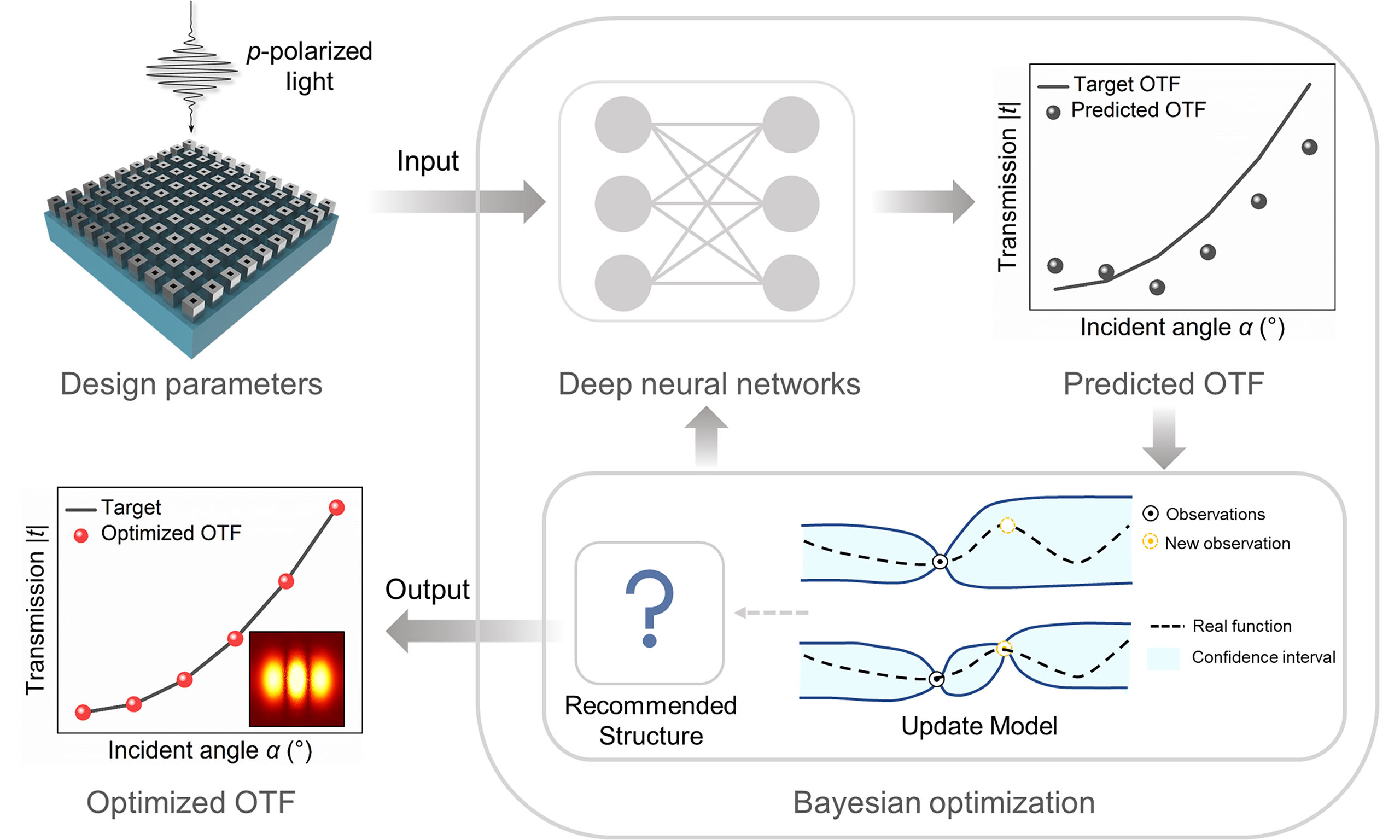
The automated inverse design framework for tailoring the OTF of nonlocal metasurfaces, integrating a DNN-based forward prediction model with BO, is illustrated in Figure 1. The DNN is pretrained to accurately predict the angular transmission spectrum of nonlocal metasurfaces [Figure 1A-C]. BO then navigates the structural parameter space to achieve user-specified OTFs at target wavelengths based on the calculated results of DNN [Figure 1D and E]. The metasurface comprises a periodic array of silicon hollow bricks exhibiting C4 symmetry (four-fold rotation symmetry) on a silica substrate. Key geometric parameters of the metasurface include internal hole edge length W, brick edge length L, unit cell period P, and fixed brick height H = 450 nm. Angular transmission spectra |tpp(α)| (simplified as |t(α)|) are characterized under p-polarized illumination across 1,200-1,400 nm wavelengths and incident angles (α) of 0°-25°, where p on the first and second subscripts denotes the polarization of the incident and transmitted light, respectively. Crucially, the metasurface OTF is derived from its angular transmission spectrum |t(α)| (see details in
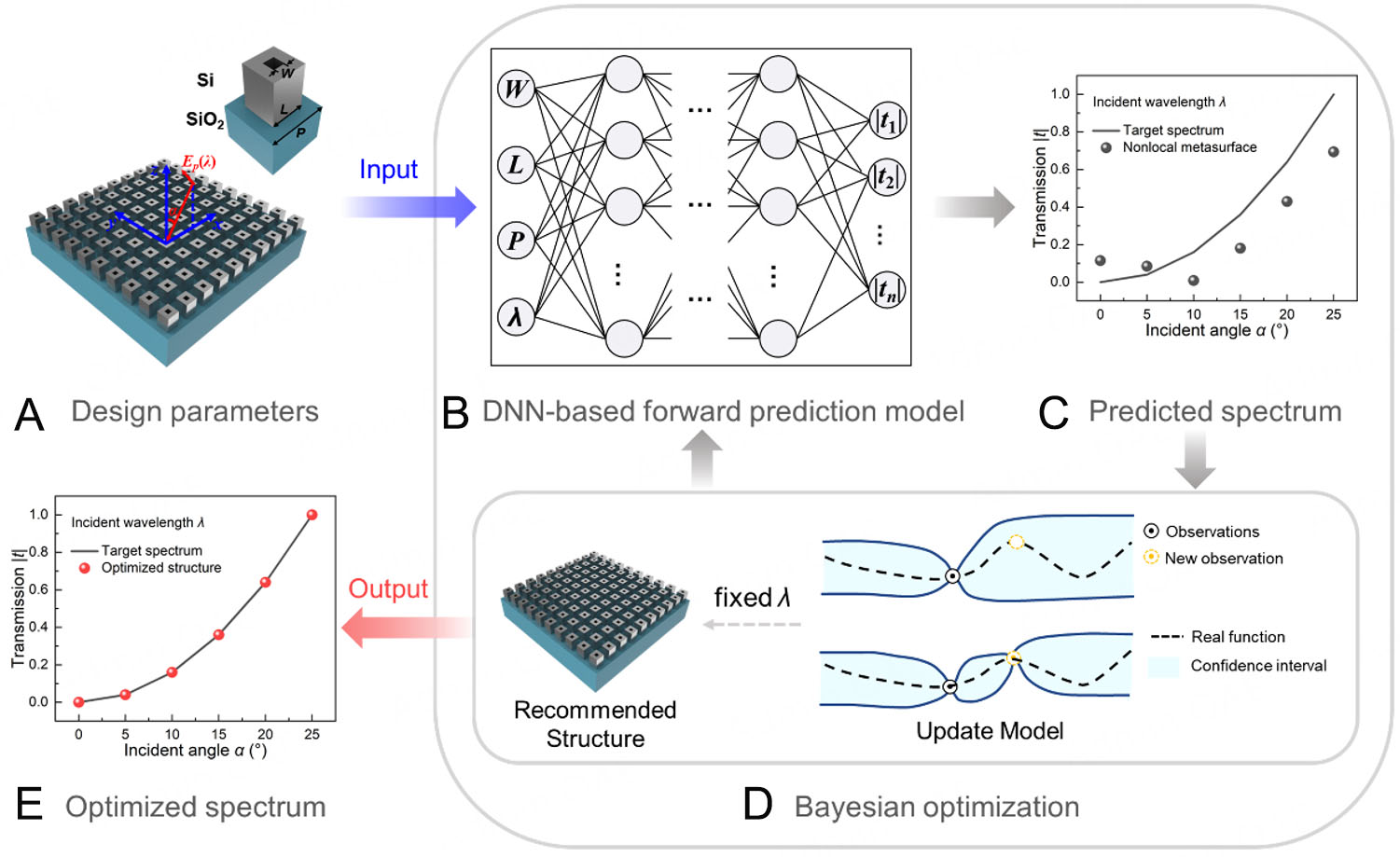
Figure 1. Schematics of the automated inverse design framework for tailoring the OTF of nonlocal metasurface. (A) Design parameters of the nonlocal metasurface. (B) Schematics of the DNN-based forward prediction model. (C) Predicted angular transmission spectrum of the nonlocal metasurface via DNN. (D) Schematics of the BO method. Recommended structural parameters from BO at fixed λ. (E) Optimized angular transmission spectrum of the nonlocal metasurface via BO.
The DNN input vector [W, L, P, λ] encompasses structural parameters and operating wavelength λ, while its output vector [|t1|, |t2|, ..., |tn|] (n, number of incident angles) provides transmission magnitudes at discrete incident angles. The four parameters selected for optimization - hole edge length (W), brick edge length (L), unit cell period (P), and wavelength (λ) - were chosen based on their critical roles: λ is fundamental for on-demand inverse design at specific target wavelengths, whereas W, L, and P are the key geometric dimensions that directly govern the meta-atoms' spectral response via Mie scattering theory, thereby determining the resulting OTF [Supplementary Figures 1 and 2]. Pretrained DNN enables rapid computation of angular transmission spectra for design parameter sets. The BO module evaluates parameter-spectrum pairs at fixed λ, iteratively recommending improved structural parameters to the DNN. Through successive optimization cycles, metasurface configurations satisfying target spectral responses are obtained. This framework establishes an on-demand design platform for image-processing metasurfaces.
DNN-based forward prediction model
The DNN-based forward prediction model employs a fully connected architecture comprising an input layer, four hidden layers, and an output layer (see details in Supplementary Note 2). It establishes a complex mapping relationship between nonlocal metasurface design parameters [W, L, P, λ] and angular transmission spectra [|t1|, |t2|, ..., |tn|]. The training data of the DNN is calculated by the COMSOL Multiphysics software using the finite element method (see Materials and Methods). A dataset of 57,645 distinct combinations of design parameters and angular transmission spectra is utilized to train and validate the DNN. The selection scheme for design parameters is as follows: the internal hole edge length W is in the range of 120-160 nm with an interval of 10 nm, the brick edge length L is in the range of 340-400 nm with an interval of 1 nm, the unit cell period P is in the range of 560-640 nm with an interval of 10 nm, and the incident wavelength λ is in the range of 1,200-1,400 nm with an interval of 10 nm. Moreover, the transmission spectra under different incident angles (α is in the range of 0°-25° with an interval of 5°) corresponding to each design parameter combination are obtained by COMSOL. To better evaluate the training performance of the DNN, the ratio of the training set, validation set and test set is set to 6:2:2. The performance of DNN is trained by minimizing the mean square error (MSE) loss between the predicted spectrum and the simulated spectrum. As shown in Figure 2A, the training loss and validation loss decreased rapidly and maintained a good degree of overlap, eventually stabilizing at the order of magnitude of 10-6 after training 600 epochs. Besides, the test loss is also as low as 2.9 × 10⁻⁶, indicating a good training process. Consider the loss distribution of the test data, as shown in Figure 2B, 96% of test samples achieve MSE loss < 1 × 10⁻⁵, with all samples maintaining MSE loss
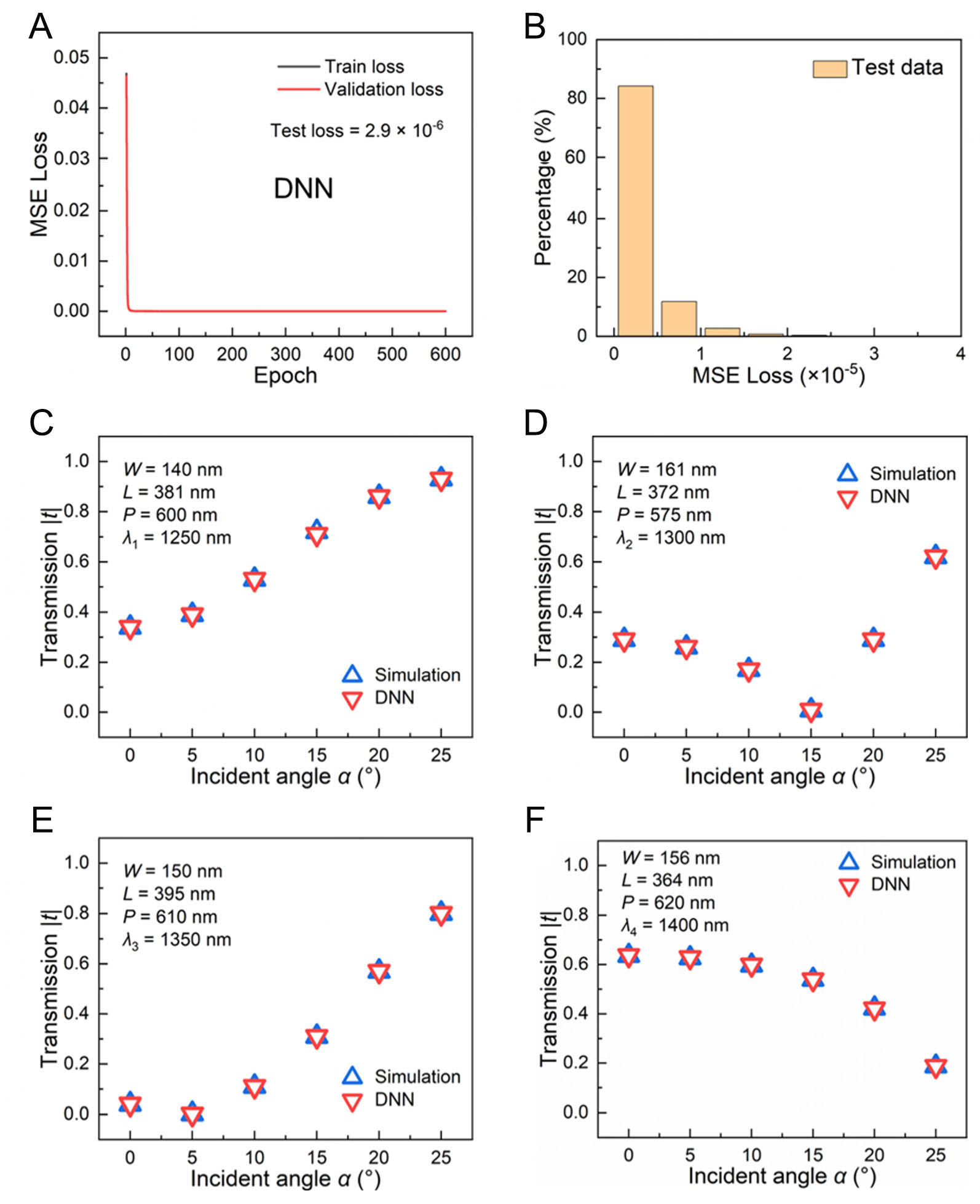
Figure 2. Forward prediction performance of the DNN. (A) Train loss, validation loss and test loss of the DNN. (B) Histogram of the MSE loss on test dataset for DNN. (C-F) Predicted performance of the DNN with four randomly selected design parameter combinations.
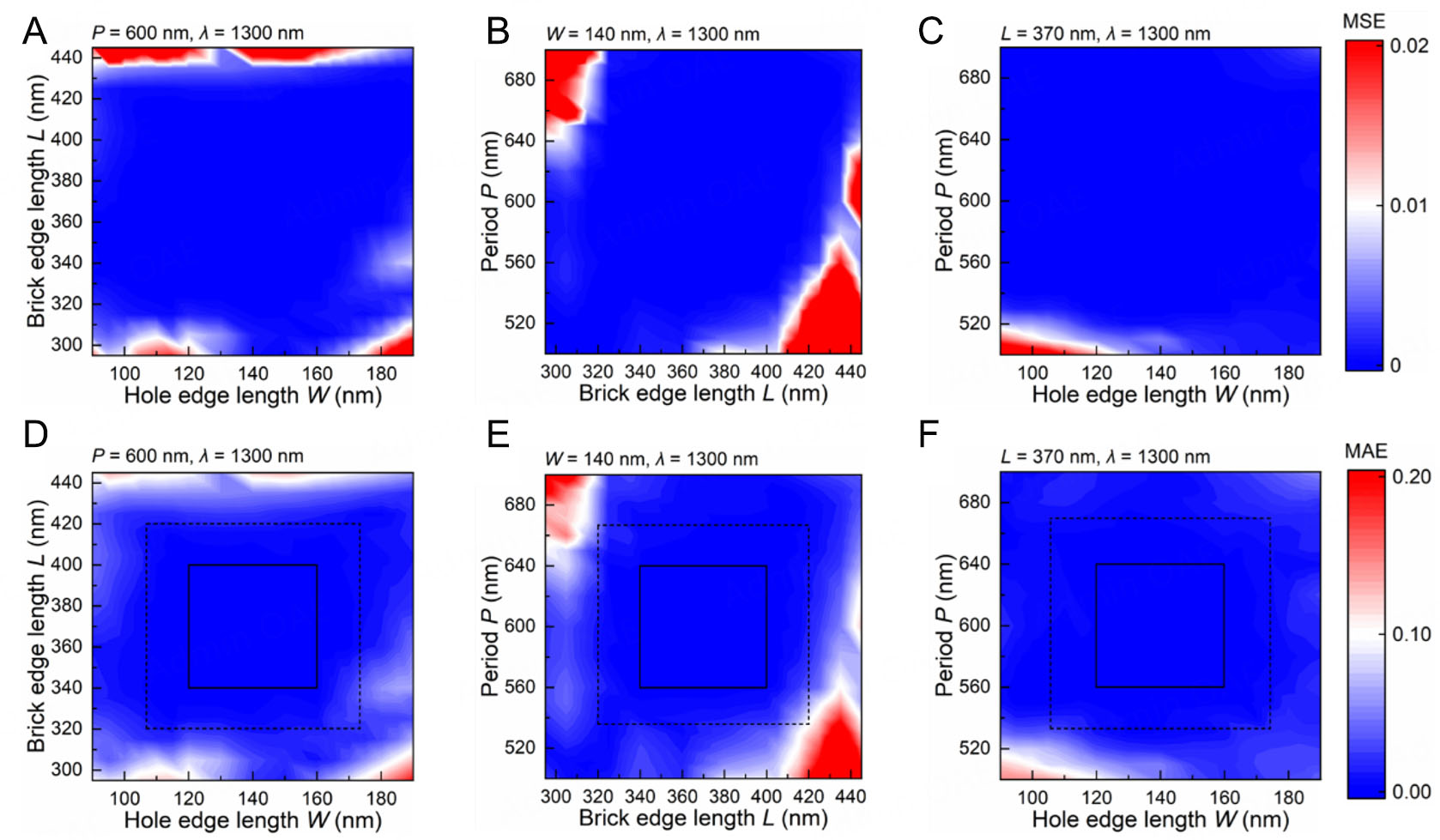
Figure 3. Evaluation of the DNN model's generalization performance. The MSE distribution of the DNN model within (A) the W and L parameter space, (B) the L and P parameter space and (C) the W and P parameter space, respectively. The MAE distribution of the DNN model within (D) the W and L parameter space, (E) the L and P parameter space and (F) the W and P parameter space, respectively.
Recommendation of the nonlocal metasurface via BO
BO is a global optimization method used for black-box function optimization, and it is particularly suitable for computing expensive objective functions. BO is based on Bayesian theorem, which models the objective function by constructing a surrogate model (such as Gaussian Process), and uses the acquisition function to guide sampling, thereby efficiently finding the global optimal solution. In this work, BO is employed to recommend optimized structural parameters at fixed operation wavelength λ based on the current state of DNN model. By using the desired transmission angle spectrum as the objective function, and based on
Quantitative comparison between the proposed automated inverse design framework and the traditional trial-and-error method
| With DNN + BO | With traditional trial-and-error method | Ratio | |
| One-time forward prediction | 0.03 s | 24 s | 800 |
| Inverse design of metasurface | 20 s | 10,000 simulations (66.7 h) | 12,000 |
Automated inverse design of optical differentiators
To demonstrate the automated inverse design performance of this framework, we carried out the inverse design of nonlocal metasurface-based optical differentiators with different orders at desired operation wavelengths, which are difficult for conventional empirical trial-and-error approaches. In the spatial frequency domain, the target angular transmission spectrum of the optical differentiator conforms to the following OTF t(kx,ky):
where kx and ky are wavevectors in the x and y directions, respectively, and m is the order of optical differentiator[7]. Owing to the C4 symmetry of the employed nonlocal metasurface, this framework can implement both 2D second-order and fourth-order optical differentiators. Without loss of generality, we consider an azimuthal angle of 0° under p-polarized incident light in transmission mode. The corresponding OTFs for these differentiators are given by:
where k is the wavevector of incident light (see details in Supplementary Note 1)[14]. The transmission coefficient of second-order differentiator exhibits a quadratic relationship with the incident angle, while the fourth-order differentiator is related to the incident angle in a fourth-power relationship.
To demonstrate the working principle of the automated inverse design framework, we evaluate the optimization process of the second-order optical differentiator at the desired operation wavelength of
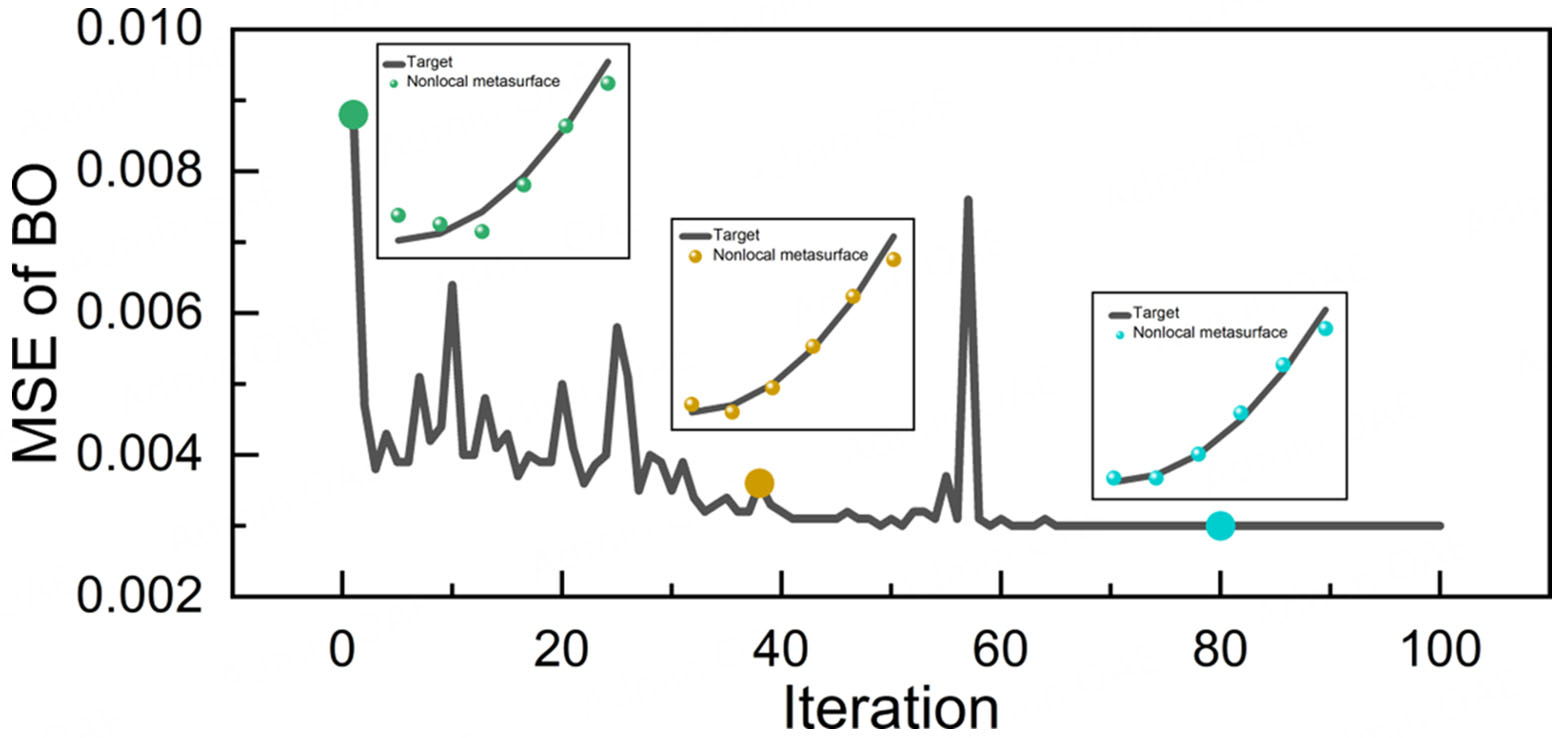
Figure 4. The optimization process of the BO-based framework. Inset: Angular transmission spectra of three intermediate structures during the optimization process.
By employing the automated inverse design framework, second-order and fourth-order optical differentiators at desired operation wavelengths of 1,250, 1,300 and 1,350 nm, respectively, are all accurately achieved [Figure 5], which exhibits an excellent inverse design capability (structural parameters of these nonlocal metasurface-based optical differentiators can be seen in Supplementary Table 2). Our automated inverse design framework enables rapid, on-demand design of multi-order optical differentiators at target wavelengths.
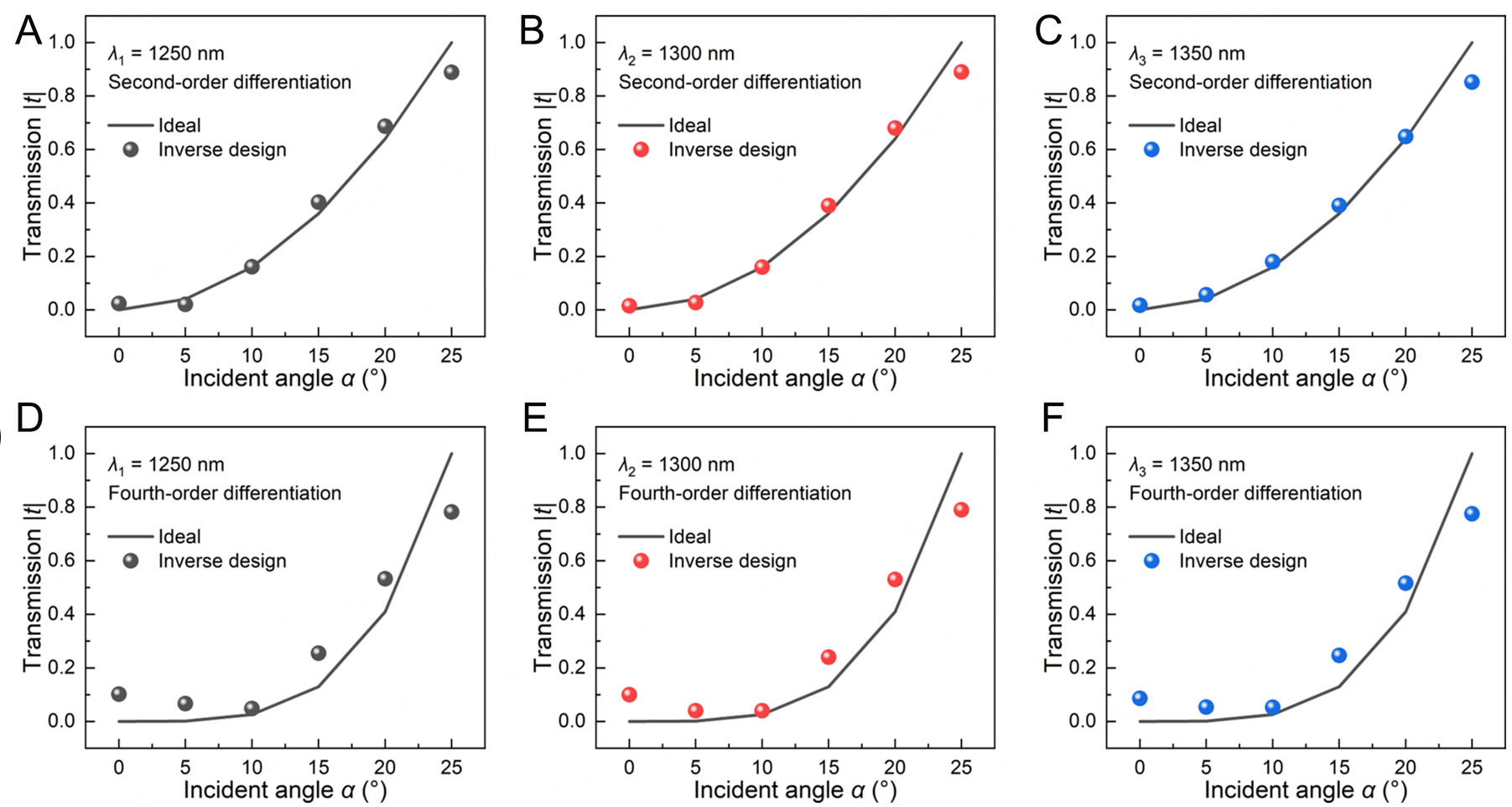
Figure 5. Automated inverse design of nonlocal metasurface-based optical differentiators. (A-C) Inverse design of second-order optical differentiators at desired operation wavelengths of 1,250, 1,300 and 1,350 nm, respectively. (D-F) Inverse design of fourth-order optical differentiators at desired operation wavelengths of 1,250, 1,300 and 1,350 nm, respectively.
To verify the 2D isotropic angular response of these nonlocal metasurface-based optical differentiators under p-polarization, we analyze transmission coefficients for arbitrary wavevectors across azimuthal angles (φ) at
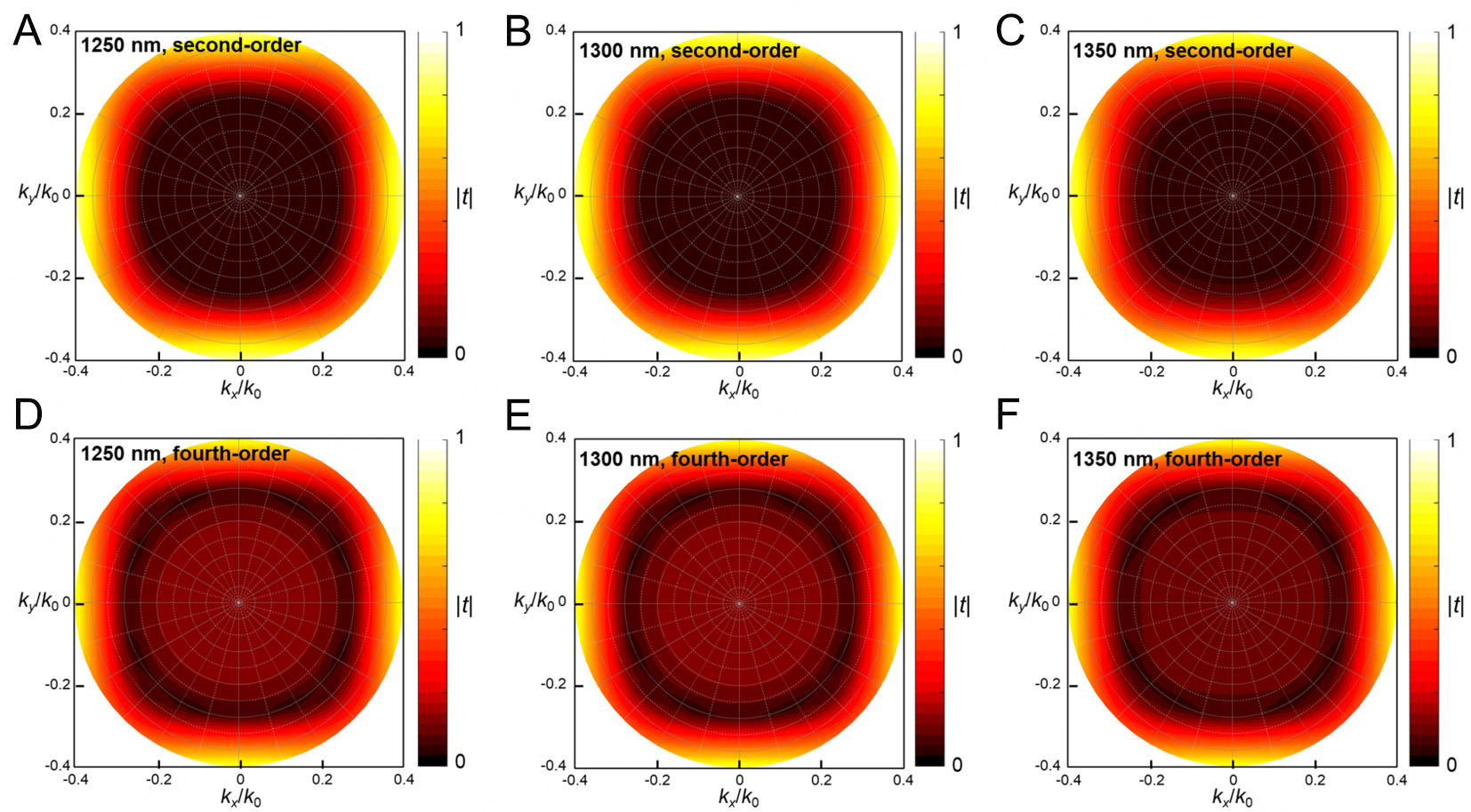
Figure 6. 2D isotropic angular responses of the nonlocal metasurface-based optical differentiators. (A-C) 2D transmission coefficients of second-order optical differentiators at desired operation wavelengths of 1,250, 1,300 and 1,350 nm, respectively. (D-F) 2D transmission coefficients of fourth-order optical differentiators at desired operation wavelengths of 1,250, 1,300 and 1,350 nm, respectively.
To further evaluate the optical differentiation performance of inverse-designed nonlocal metasurfaces, we simulated normally incident Gaussian beams on 20 × 20-pixel silicon hollow-brick metasurface arrays. Second-order differentiators transform the incident beam into a 1D horizontal lattice with three lobes in the normalized |Ex| distribution [Figure 7A-C], while fourth-order differentiators generate five-lobe lattice patterns [Figure 7D-F]. These results align with theoretical predictions and experimental benchmarks[10], confirming successful implementation of second- and fourth-order differentiation. The inverse-designed metasurfaces thus function as effective analog optical differentiators.
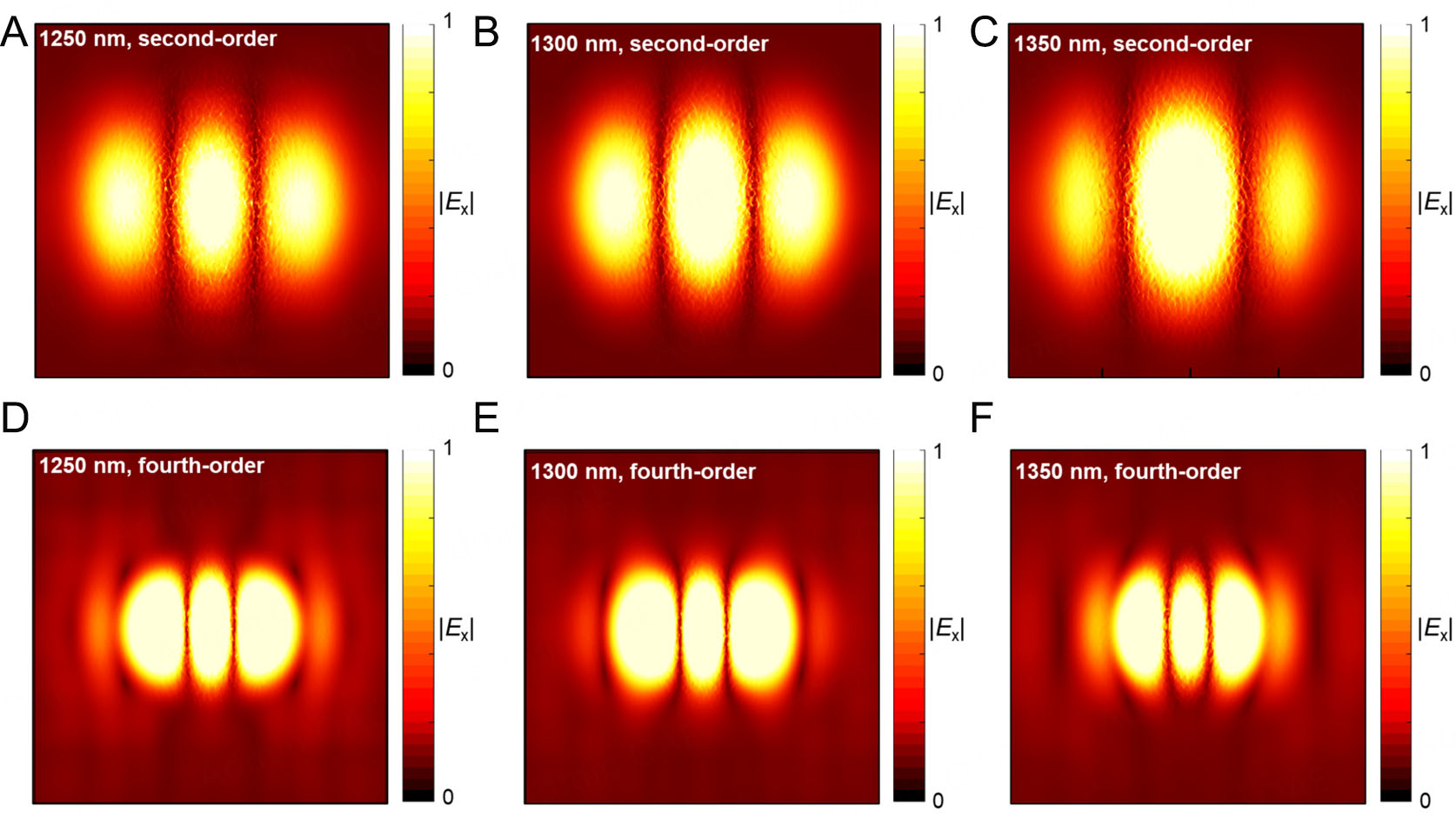
Figure 7. Nonlocal metasurface-based optical differential operations for Gaussian beam. (A-C) Normalized electric field |Ex| distributions of second-order optical differentiators under the normal incidence of Gaussian beam at 1,250, 1,300 and 1,350 nm, respectively. (D-F) Normalized electric field |Ex| distribution of fourth-order optical differentiators under the normal incidence of Gaussian beam at 1,250, 1,300 and 1,350 nm, respectively.
We further analyzed the experimental feasibility of the inverse-designed nonlocal metasurface. According to existing literature[14], the fabrication process for silicon-based metasurfaces generally includes (1) depositing a silicon thin film of predetermined thickness on a silica substrate using pulsed laser deposition (PLD); (2) forming corresponding photoresist mask patterns via electron-beam lithography (EBL); and (3) etching the desired metasurface structures using inductively coupled plasma (ICP) etching. Throughout this process, the main sources of experimental deviation are the electromagnetic parameters (i.e., complex refractive index) of the silicon thin film and structural fabrication tolerances.
To address these two major sources of error, we evaluated their impact on the final experimental outcomes through both experimental and simulation-based approaches.
We prepared silicon thin films on silica substrates using PLD and measured their complex refractive index via spectroscopic ellipsometry. As shown in Figure 8, the measured imaginary part of the refractive index is close to 0, while the real part is approximately 3.48 within the 1,200-1,400 nm wavelength range - highly consistent with the values used in our simulations (3.48 + 0i). According to the specifications of the EBL system (EBPG5200Plus) (see: https://raith.com/products/ebpg/), it supports high-resolution lithography down to below 5 nm. Assuming a 20% margin, the structural fabrication error is estimated to be within
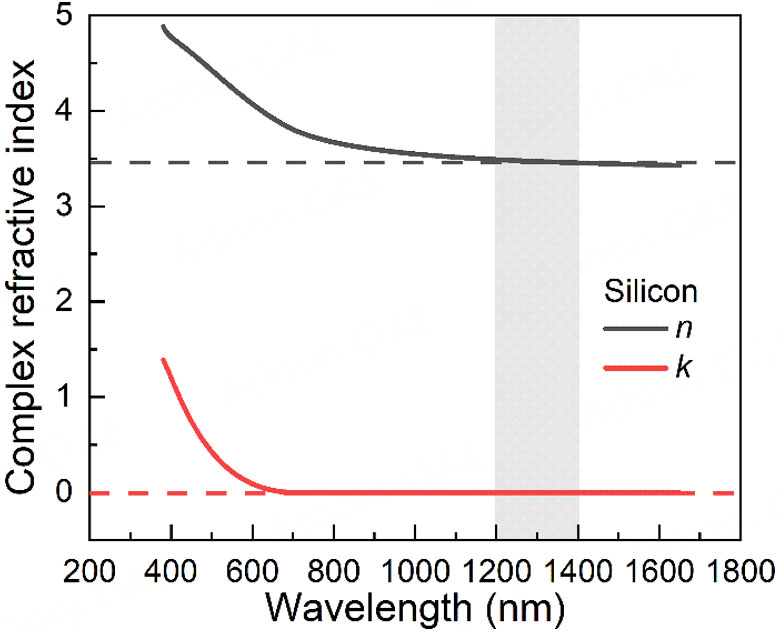
Figure 8. The complex refractive index of silicon film.
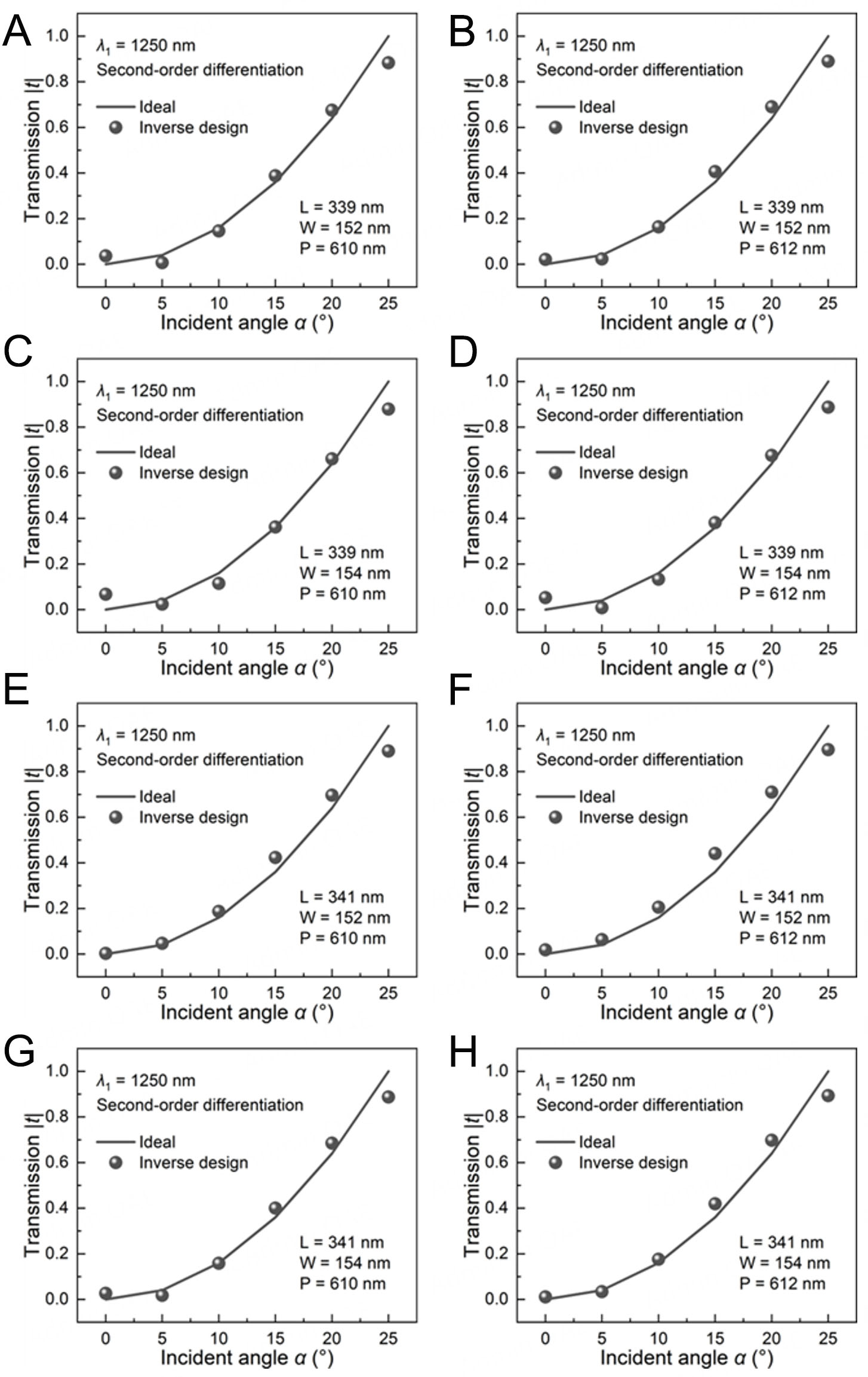
Figure 9. The OTFs of second-order differentiator at λ = 1250nm considering experimental deviations: (A) L = 339 nm, W = 152 nm,
Moreover, we have performed additional simulations to quantitatively evaluate the image processing capabilities of our designed second-order differentiator metasurface (optimized for 1,250 nm). We simulated the processing of a standard test image (a yellow rectangle on a blue background, with a size of 200 μm × 200 μm, illuminated by circularly polarized light, as shown in Figure 10A) by our metasurface. The process involved: Applying a 2D Fourier transform to the input image, multiplying the result by the simulated 2D OTF of the metasurface, and performing an inverse Fourier transform to obtain the processed output image, which is the light intensity distribution. The result, shown in Figure 10B, clearly demonstrates successful edge detection, where the boundaries of the rectangle are significantly enhanced. To quantify this performance, we calculated the edge-to-noise ratio, which reached a value of 27. This high ratio indicates a sharp and clear edge detection effect with a good signal-to-noise level. The minimum feature size that the metasurface can effectively process is fundamentally determined by its NA and the operating wavelength. It can be estimated using the classic resolution formula 0.61·λ/NA[14]. For our design (λ = 1,250 nm, NA = 0.4), this corresponds to a theoretical diffraction-limited feature size of approximately 1.9 µm.
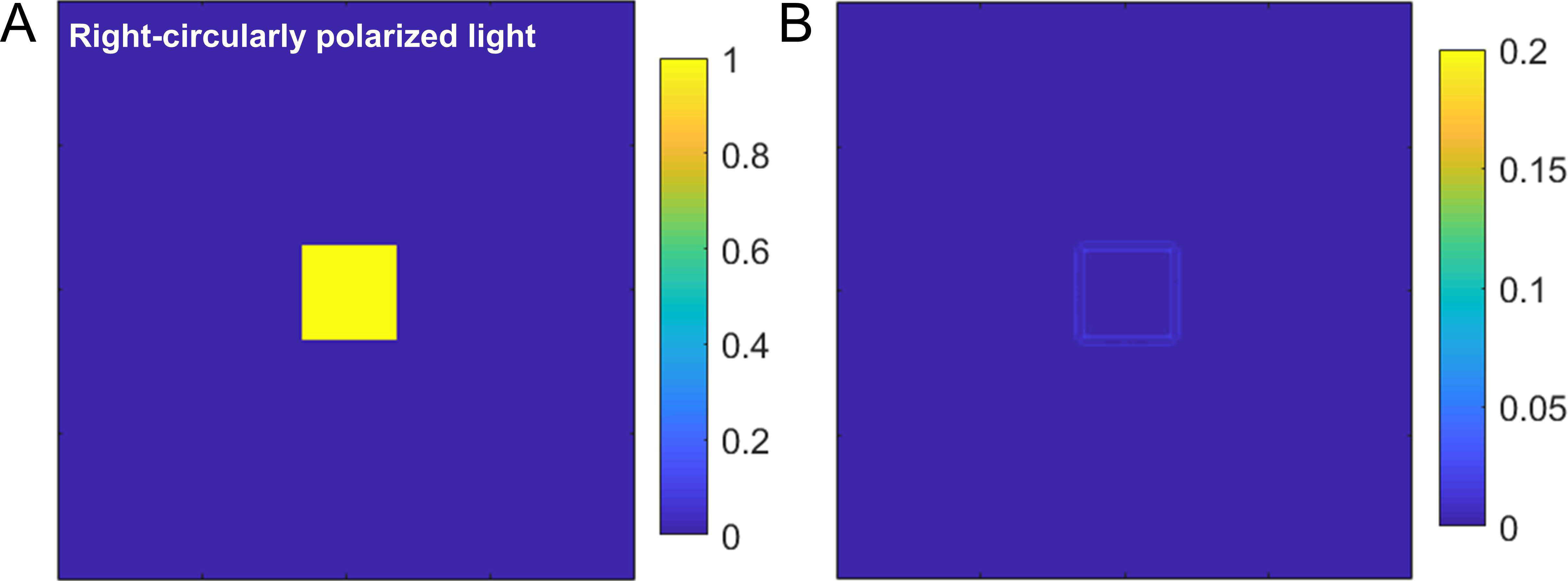
Figure 10. The theoretical image processing performance of the inverse designed second-order differentiator at λ = 1,250 nm, showing (A) the input test image (a yellow rectangle on a blue background) and (B) its theoretically processed output.
Automated inverse design of Gaussian high-pass filters
To further investigate the performance of the automated inverse design framework, Gaussian high-pass filters in transmission mode at desired wavelengths have been achieved by tailoring the OTF of nonlocal metasurfaces. In the spatial frequency domain, the target angular transmission spectrum of the Gaussian high-pass filter conforms to the following OTF t(u,v):
where u, v are spatial frequency in the x and y directions, respectively, D(u, v) is the distance from point
(see details in Supplementary Note 1)[31]. As shown in Figure 11A-C, the target angular transmission spectra of the Gaussian high-pass filters can be obtained according to Eq. (5). Using the target OTF as the objective function for BO, we can efficiently inverse design and obtain the required nonlocal metasurfaces at three desired operation wavelengths 1,250, 1,300 and 1,350 nm, respectively. As shown in Figure 11A-C, the angular transmission spectra of the metasurface obtained through the automated inverse design framework closely match the target OTF (structural parameters of these nonlocal metasurface-based Gaussian high-pass filters can be seen in Supplementary Table 2), which demonstrates an efficient and accurate inverse-design performance. Moreover, due to the C4 symmetry of the silicon hollow bricks, these nonlocal metasurface-based Gaussian filters exhibit 2D isotropic angular response under different azimuthal angles [Figure 11D-F].
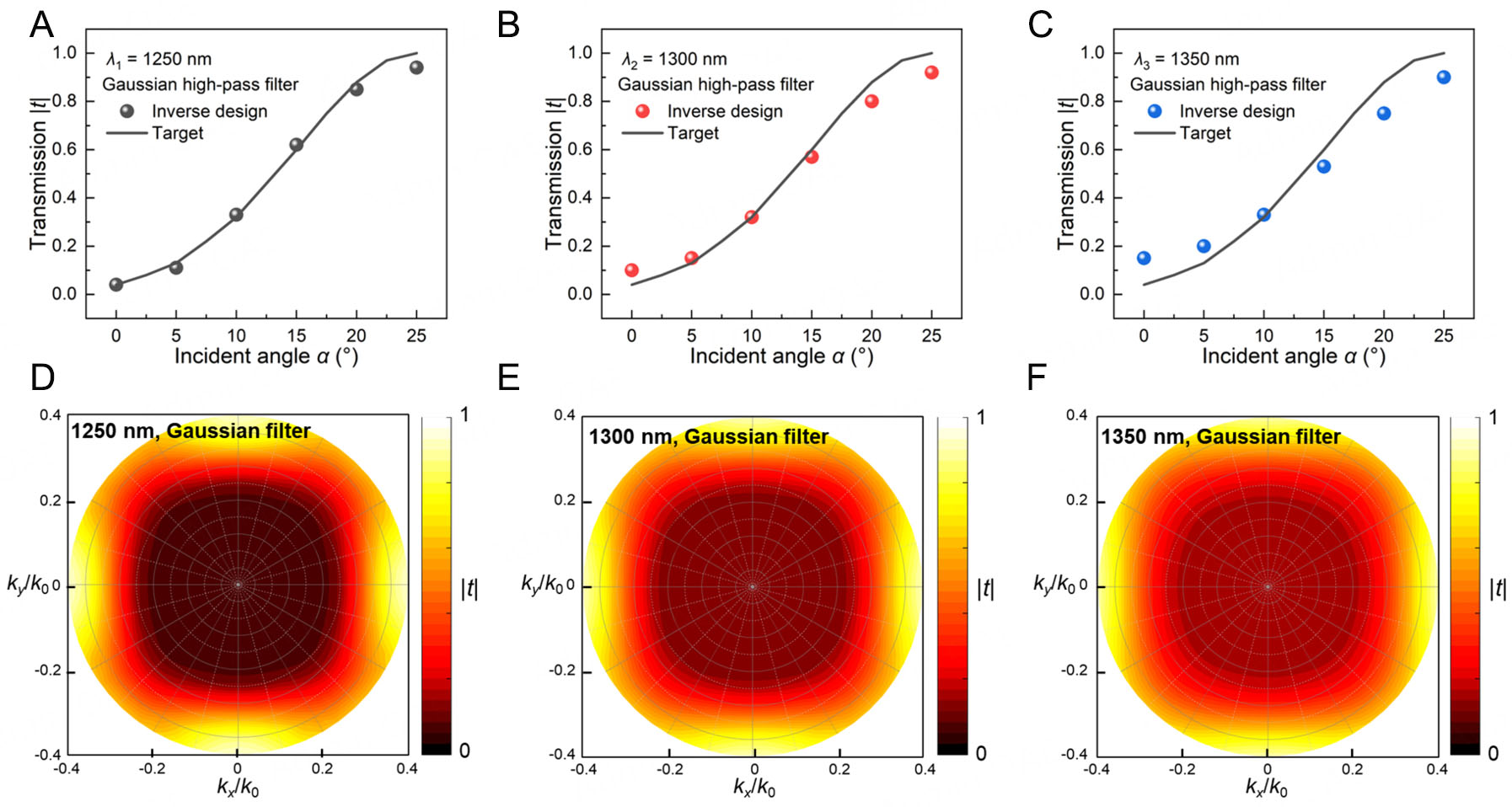
Figure 11. Automated inverse design of Gaussian high-pass filters. (A-C) Inverse design of nonlocal metasurface-based Gaussian high-pass filters at desired wavelengths of 1,250, 1,300 and 1,350 nm, respectively. (D-F) 2D isotropic angular responses of these Gaussian high-pass filters at desired wavelengths of 1,250, 1,300 and 1,350 nm, respectively.
Comparisons between different AI strategies for metasurface inverse design
Numerous studies have explored AI-aided inverse design of metasurfaces in the current literature. To further demonstrate the efficiency of our automated inverse design framework, Table 2 provides a performance comparison between existing approaches and our DNN + BO method. Existing AI methods for metasurface design can be broadly classified into discriminative models, such as the Tandem DNN, and generative models, such as Generative Adversarial Networks (GANs) and Variational Auto-Encoders (VAEs)[32-35]. Although both types of models offer high optimization efficiency once trained, they are often susceptible to convergence at local optima, which can compromise design precision. In contrast, our DNN+BO framework maintains high optimization efficiency and achieves superior design accuracy compared to standalone neural network models. As summarized in Table 2, our approach employs a dataset of 57,645 samples, attains a prediction accuracy (MSE) below 4.0 × 10⁻⁵, completes inverse design within 20 s, and achieves an average amplitude error (MAE) of 0.067 - highlighting a competitive balance among dataset scale, prediction accuracy, optimization speed, and design precision. The clear advantage of our proposed method stems from the integration of a well-trained forward neural network with BO. From a modeling perspective, the key benefits are as follows:
Performance comparison between different AI strategies for metasurface inverse design
| AI strategy | Dataset | Prediction accuracy (MSE) | Inverse design efficiency | Inverse design precision (MAE) | Reference |
| DNN + BO | 57,645 | < 4.0 × 10⁻⁵ | < 20 s | average amplitude error = 0.067 | This work |
| Tandem DNN | 25,000 | 5.0 × 10⁻³ | 0.05 s | frequency error < 2 nm | R[32] |
| GAN-based model | 69,000 | 1.0 × 10⁻³ | 0.3-36 s | amplitude error < 0.1 | R[33] |
| VAE-based model | 70,000 | 6.4 × 10⁻³ | 0.01 s | phase error < π/8 | R[34] |
| VAE-based model | 51,000 | 8.2 × 10⁻² | several mins | amplitude error < 0.1 | R[35] |
(1) The DNN is trained to learn the underlying physical laws governing the metasurface response - specifically, Maxwell’s equations and Mie scattering theory. This enables the model to capture highly nonlinear physical interactions between structural parameters and optical responses, providing a more reliable and generalizable forward model compared to interpolation-based or linear methods.
(2) The DNN serves as a fast and accurate surrogate model, replacing computationally expensive numerical simulations. When combined with BO, which efficiently balances exploration and exploitation via an acquisition function, the method rapidly converges to high-performance designs. This avoids unnecessary simulations in suboptimal regions - a common drawback of brute-force and gradient-free optimization techniques. This combination allows us to locate near-optimal structural designs efficiently, without exhaustively simulating all possible configurations.
Compared to standalone approaches such as the Tandem DNN or generative models, our method achieves better design efficiency and higher accuracy by leveraging the neural network’s fast inference and BO’s sample-efficient global optimization. This modeling synergy substantially reduces the computational cost while maintaining high performance, offering a more scalable and systematic approach to metasurface design. Furthermore, compared with a manually designed nonlocal metasurface, this automated inverse design framework highlights a significant advancement in operational wavelength flexibility and function diversity [Table 3]. Besides, the second-order differentiator metasurface maintains its targeted functionality over a bandwidth of approximately 21 nm centered around the design wavelength of 1,250 nm [Supplementary Figure 7].
Quantitative comparisons between the inverse designed nonlocal metasurfaces and other metasurface-based differentiators
| Metasurface | Wavelength | Function | NA | Transmission efficiency | Reference |
| Silicon-based metasurface | Any wavelength within 1,200-1,400 nm | Second-order differentiator | 0.4 | 0.77 | This work |
| Fourth-order differentiator | 0.4 | 0.61 | |||
| Gaussian high-pass filter | 0.4 | 0.85 | |||
| Phase-change metasurface | 1,050 nm | Second-order differentiator | 0.5 | 0.81 | R[12] |
| Silicon-based metasurface | 1,155 nm | Second-order differentiator | 0.4 | 0.76 | R[14] |
| Silicon-based metasurface | Bandwidths of 35 nm around | Second-order differentiator | 0.35 | 0.81 | R[19] |
| Silicon-based metasurface | 1,560 nm | Second-order differentiator | 0.35 | 0.81 | R[36] |
CONCLUSION
In conclusion, we have established an automated inverse design framework integrating DNN-based forward predictor with BO to tailor the OTF of nonlocal metasurfaces for targeted all-optical image processing. The DNN component serves as a high-accuracy forward model for angular transmission spectrum prediction, where 96% of test samples achieve MSE loss < 1 × 10⁻⁵, with all samples maintaining MSE loss < 4 × 10⁻⁵ on the test dataset. BO subsequently navigates the structural parameter space to achieve user-specified OTFs at desired wavelengths within the 1,200-1,400 nm range. Through this framework, we demonstrate precise OTF engineering on silicon hollow brick metasurfaces, realizing three key functionalities in transmission mode: 2D second-order differentiation, 2D fourth-order differentiation, and 2D Gaussian high-pass filtering at discrete operating wavelengths (1,250, 1,300, and 1,350 nm). These devices achieve NAs approaching 0.4 and enable effective edge detection and image sharpening. This paradigm shift from empirical design to intelligent automation dramatically accelerates metasurface development while expanding the functional horizon for optical computing applications.
DECLARATIONS
Authors’ contributions
Conception and design of the study: Tao, C.; Liu, C.; Bai, Y.; Li, B.; Zhou, J.
Numerical simulation: Tao, C.; Li, Y.; Qian, S.
Automated inverse design framework: Tao, C.; Han, W.; Wang, F.; Zhao, S.; Ren, F.
Data analysis and interpretation: Tao, C.; Liu, C.; Bai, Y.; Li, B.; Zhou, J.
Writing: Tao, C.; Liu, C.; Bai, Y.; Li, B.; Zhou, J.
All authors have reviewed and edited the manuscript and agreed to the submission.
Availability of data and materials
The original contributions presented in this study are included in the Supplementary Materials. Further inquiries can be directed to the corresponding authors.
AI and AI-assisted tools statement
Not applicable.
Financial support and sponsorship
This work was supported by the National Natural Science Foundation of China (No. 92463311), the Basic Research Program of Jiangsu (No. SBK2024100236), and the Jiangsu Funding Program for Excellent Postdoctoral Talent.
Conflicts of interest
All authors declared that there are no conflicts of interest.
Ethical approval and consent to participate
Not applicable.
Consent for publication
Not applicable.
Copyright
© The Author(s) 2026.
Supplementary Materials
REFERENCES
2. Xu, Z.; Zhou, T.; Ma, M.; Deng, C.; Dai, Q.; Fang, L. Large-scale photonic chiplet Taichi empowers 160-TOPS/W artificial general intelligence. Science 2024, 384, 202-9.
3. Hua, S.; Divita, E.; Yu, S.; et al. An integrated large-scale photonic accelerator with ultralow latency. Nature 2025, 640, 361-7.
4. Chamoli, S. K.; Jin, C.; Fan, Y.; et al. Nonlocal flat optics for size-selective image processing and denoising. Nat. Commun. 2025, 16, 4473.
5. Zhou, Y.; Zheng, H.; Kravchenko, I. I.; Valentine, J. Flat optics for image differentiation. Nat. Photonics. 2020, 14, 316-23.
6. Zangeneh-nejad, F.; Sounas, D. L.; Alù, A.; Fleury, R. Analogue computing with metamaterials. Nat. Rev. Mater. 2020, 6, 207-25.
7. Silva, A.; Monticone, F.; Castaldi, G.; Galdi, V.; Alù, A.; Engheta, N. Performing mathematical operations with metamaterials. Science 2014, 343, 160-3.
8. Goodman, J. W. Introduction to fourier optics; Englewood: Roberts and Company publishers; 2005. Available from: https://books.google.com/books?hl=en&lr=&id=ow5xs_Rtt9AC&oi=fnd&pg=PR7&dq=Introduction+to+Fourier+optics&ots=G_m2BK4GMK&sig=bQx1xvmNt3X_O9oHZZiuL1SM5KI#v=onepage&q=Introduction%20to%20Fourier%20optics&f=false [Last accessed on 20 Mar 2026].
9. Dorrah, A. H.; Capasso, F. Tunable structured light with flat optics. Science 2022, 376, eabi6860.
10. Qiu, X.; Zhang, J.; Fan, Y.; Zhou, J.; Chen, L.; Tsai, D. P. Metasurface enabled high-order differentiator. Nat. Commun. 2025, 16, 2437.
11. Tanriover, I.; Dereshgi, S. A.; Aydin, K. Metasurface enabled broadband all optical edge detection in visible frequencies. Nat. Commun. 2023, 14, 6484.
12. Yang, G.; Wang, M.; Lee, J. S.; et al. Nonlocal phase-change metaoptics for reconfigurable nonvolatile image processing. Light. Sci. Appl. 2025, 14, 182.
13. Chen, Y.; Fleury, R.; Seppecher, P.; Hu, G.; Wegener, M. Nonlocal metamaterials and metasurfaces. Nat. Rev. Phys. 2025, 7, 299-312.
14. Zhou, C.; Chen, Y.; Li, Y.; et al. Laplace differentiator based on metasurface with toroidal dipole resonance. Adv. Funct. Mater. 2024, 34, 2313777.
16. Kwon, H.; Sounas, D.; Cordaro, A.; Polman, A.; Alù, A. Nonlocal metasurfaces for optical signal processing. Phys. Rev. Lett. 2018, 121, 173004.
17. Kwon, H.; Cordaro, A.; Sounas, D.; Polman, A.; Alù, A. Dual-polarization analog 2D image processing with nonlocal metasurfaces. ACS. Photonics. 2020, 7, 1799-805.
18. Long, O. Y.; Guo, C.; Jin, W.; Fan, S. Polarization-independent isotropic nonlocal metasurfaces with wavelength-controlled functionality. Phys. Rev. Appl. 2022, 17, 024029.
19. Cotrufo, M.; Arora, A.; Singh, S.; Alù, A. Dispersion engineered metasurfaces for broadband, high-NA, high-efficiency, dual-polarization analog image processing. Nat. Commun. 2023, 14, 7078.
20. Chen, A.; Monticone, F. Dielectric nonlocal metasurfaces for fully solid-state ultrathin optical systems. ACS. Photonics. 2021, 8, 1439-47.
21. Abdollahramezani, S.; Hemmatyar, O.; Adibi, A. Meta-optics for spatial optical analog computing. Nanophotonics 2020, 9, 4075-95.
22. Qian, C.; Kaminer, I.; Chen, H. A guidance to intelligent metamaterials and metamaterials intelligence. Nat. Commun. 2025, 16, 1154.
23. Chen, M. K.; Liu, X.; Sun, Y.; Tsai, D. P. Artificial intelligence in meta-optics. Chem. Rev. 2022, 122, 15356-413.
24. Li, Z.; Pestourie, R.; Lin, Z.; Johnson, S. G.; Capasso, F. Empowering metasurfaces with inverse design: principles and applications. ACS. Photonics. 2022, 9, 2178-92.
25. Jiang, J.; Chen, M.; Fan, J. A. Deep neural networks for the evaluation and design of photonic devices. Nat. Rev. Mater. 2020, 6, 679-700.
26. Li, W.; Barati, Sedeh. H.; Tsvetkov, D.; et al. Machine learning for engineering meta‐atoms with tailored multipolar resonances. Laser. Photonics. Rev. 2024, 18, 2300855.
27. Chi, H.; Hu, Y.; Ou, X.; et al. Neural network-assisted end-to-end design for full light field control of meta-optics. Adv. Mater. 2025, 37, e2419621.
28. Li, Y.; Xu, Y.; Jiang, M.; et al. Self-learning perfect optical chirality via a deep neural network. Phys. Rev. Lett. 2019, 123, 213902.
29. Tao, C.; Liu, C.; Li, Y.; Qiao, L.; Zhou, J.; Bai, Y. Efficient excitation of acoustic graphene plasmons for sub-nanoscale infrared sensing. J. Opt. Soc. Am. B. 2024, 41, 2280.
30. An, S.; Fowler, C.; Zheng, B.; et al. A deep learning approach for objective-driven all-dielectric metasurface design. ACS. Photonics. 2019, 6, 3196-207.
31. Makandar, A.; Halalli, B. Image enhancement techniques using highpass and lowpass filters. Int. J. Comput. Appl. 2015, 109, 21-7.
32. Xu, L.; Rahmani, M.; Ma, Y.; et al. Enhanced light-matter interactions in dielectric nanostructures via machine-learning approach. Adv. Photon. 2020, 2, 1.
33. An, S.; Zheng, B.; Tang, H.; et al. Multifunctional metasurface design with a generative adversarial network. Adv. Opt. Mater. 2021, 9, 2001433.
34. Ma, W.; Xu, Y.; Xiong, B.; et al. Pushing the limits of functionality-multiplexing capability in metasurface design based on statistical machine learning. Adv. Mater. 2022, 34, e2110022.
35. Zhang, N.; Gao, F.; Wang, R.; et al. Deep-learning empowered customized chiral metasurface for calibration-free biosensing. Adv. Mater. 2025, 37, e2411490.
Cite This Article
 Open Access
How to Cite
Download Citation
Export Citation File:
Type of Import
Tips on Downloading Citation
Citation Manager File Format
Type of Import
Direct Import: When the Direct Import option is selected (the default state), a dialogue box will give you the option to Save or Open the downloaded citation data. Choosing Open will either launch your citation manager or give you a choice of applications with which to use the metadata. The Save option saves the file locally for later use.
Indirect Import: When the Indirect Import option is selected, the metadata is displayed and may be copied and pasted as needed.
About This Article
Special Topic
Copyright

Data & Comments
Data
0










Comments
Comments must be written in English. Spam, offensive content, impersonation, and private information will not be permitted. If any comment is reported and identified as inappropriate content by OAE staff, the comment will be removed without notice. If you have any queries or need any help, please contact us at [email protected].