



Impact of grain boundary segregation on piezoelectric performance of CaBi2Nb2O9 high-temperature piezoceramics
 0
0 
Abstract
Grain boundary segregation plays a critical role in determining the properties of polycrystalline materials, yet its influence on piezoelectric performance remains underexplored. In this work, bismuth layer-structured piezoceramic W6+-doped CaBi2Nb2O9 (WCBN) was chosen to investigate the effect of grain boundary segregation on the piezoelectric properties through multiscale structural characterization and phase-field simulations. The results reveal that improper grain boundary segregation can induce internal stress fields that restrict domain switching dynamics, leading to deterioration of the piezoelectric response. Therefore, a novel poling process was developed, which effectively alleviated the segregation-induced stress constraints and enhanced the piezoelectric coefficients by 180%. More importantly, optimizing the preparation process significantly enhances the mechanical properties, particularly increasing the fracture toughness of WCBN ceramics to 2.73 MPa m1/2, which is more than twice that of traditional Pb(Zr, Ti)O3 piezoceramics. These findings establish direct correlations between grain boundary segregation, internal stress, and domain switching behavior, providing fundamental insights for the design of piezoelectric materials that integrate both high piezoelectric and mechanical properties, which could be greatly beneficial to long-term stable operation in harsh environments with high temperatures and complex vibrations for bismuth layer-structured piezoceramics.
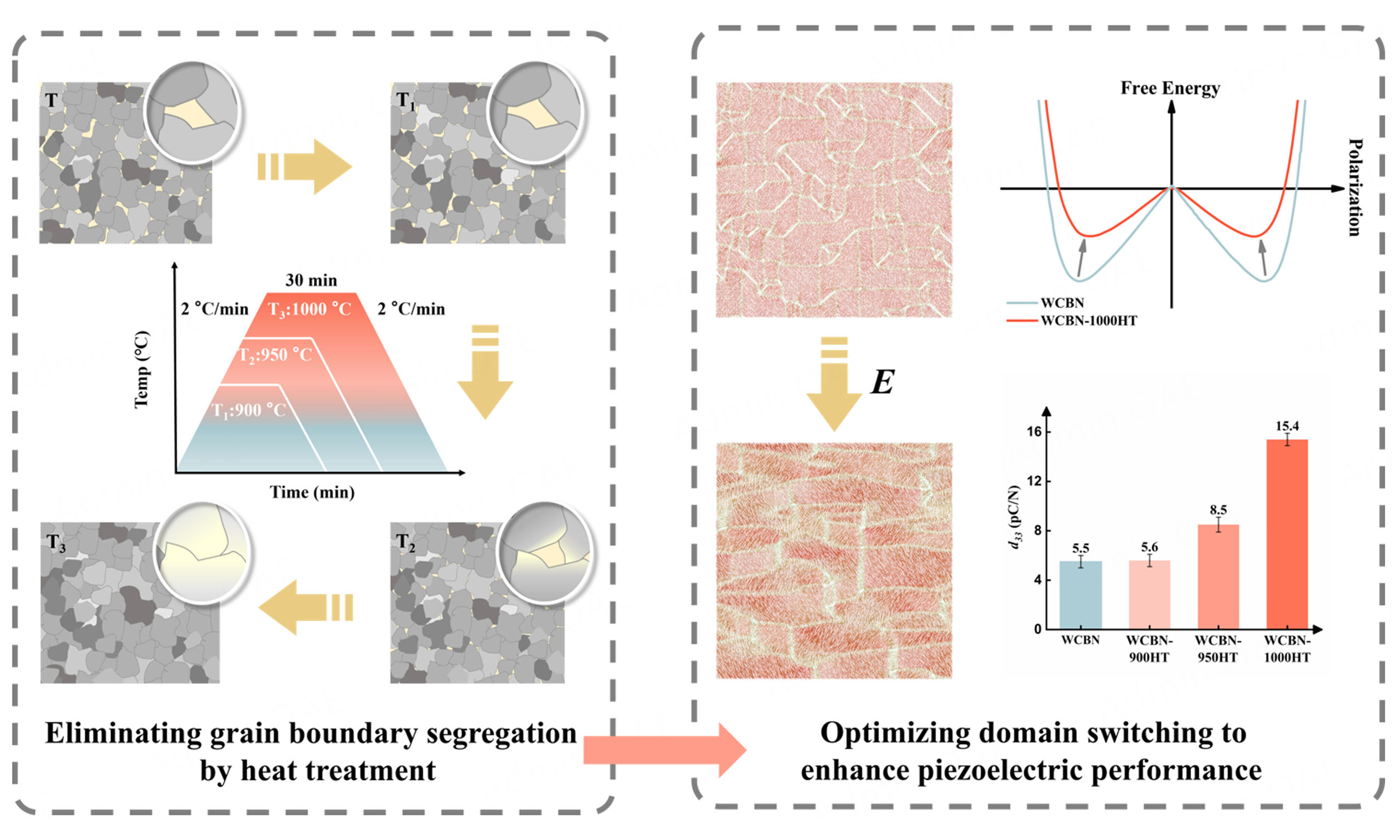
Keywords
INTRODUCTION
Grain boundary segregation significantly influences the properties and performance of polycrystalline materials during service. The selective enrichment of solute atoms at grain boundaries can facilitate the formation of functional interfacial phases, thereby enhancing material performance[1-4]. For example, in (Nb, Ba)-doped TiO2 ceramics, the segregation of Ba2+ ions at grain boundaries introduces localized transport barriers, enabling lower-voltage operation in TiO2 varistors[2]. In addition, in Nd-Fe-B-based magnets, the segregation of Nd and Cu has been shown to enhance domain wall pinning strength, resulting in a significant increase in the coercive field[4,5]. On the other hand, the microstructural inhomogeneity induced by grain boundary segregation can also inevitably deteriorate material properties. Specifically, in Mo-based alloys, oxygen segregation at grain boundaries reduces grain boundary cohesion, increasing the risk of embrittlement[6]. Similarly, the segregation of Al and O at grain boundaries in SiC ceramics reduces grain boundary scattering, resulting in a significant decrease in thermal conductivity[7]. The differences that cause this change in material properties are directly related to the structure and composition of the grain boundary complexions formed by segregation.
Piezoelectric materials, which enable the interconversion between mechanical and electrical energies, have been widely applied in various fields ranging from consumer electronics to high-end industries[8-12]. Over the past few decades, ionic doping has been extensively employed in various piezoelectric materials to enhance their piezoelectric properties[13-16]. For example, Li et al. achieved an ultrahigh piezoelectric coefficient of 1,500 pC/N in Sm-doped Pb(Mg1/3Nb2/3)O3-PbTiO3 ceramics[14]. However, it is noteworthy that much attention has been paid to the impact of dopant ions incorporated into the crystal lattice on piezoelectric properties, which leads to the fact that investigations about the grain boundary segregation in piezoelectric materials remain relatively scarce, and how grain boundary segregation influences piezoelectric performance is still unclear[17,18]. Therefore, understanding how grain boundary segregation affects piezoelectric material performance and how to eliminate it at the atomic scale is of great importance to modulating materials’ properties through grain boundary composition and structure.
Bismuth layer-structured piezoceramics (BLSPs) with high Curie temperatures (TC) are widely used in high-temperature environments such as aerospace and nuclear power industries. Among the reported BLSP materials, CaBi2Nb2O9 (CBN) exhibits the highest Curie temperature (TC ~ 943 °C) coupled with high resistivity, making it one of the most promising candidates for high-temperature applications (above
These results provide fundamental guidelines for understanding the action mechanism of grain boundary segregation and designing piezoelectric ceramics with high piezoelectric and mechanical performance, paving the way for practical applications.
MATERIALS AND METHODS
Sample preparation
CaBi2Nb1.975W0.025O9 (WCBN) ceramics were prepared by the conventional solid-phase reaction method using Bi2O3 (99.9%, Golden Time Chemical (Jiangsu) Co., Ltd., China), Nb2O5 (99.9%, Zhuzhou Chenchang Metal Co., Ltd., China), CaCO3 (99%, Aladdin Biochemical Technology Co., Ltd., China), and WO3 (99%, Sinopharm Chemical Reagent Co., Ltd., China) as raw materials. Firstly, the initial raw materials were ball-milled in an alcoholic grinding medium for 4 h, dried, and then calcined at 850 °C for
Structure characterization
High-resolution X-ray diffraction (HR-XRD, D8 Discover Davinci, Bruker, Germany) was used to measure the internal stress of ceramics. Synchrotron X-ray diffraction (synchrotron XRD) was performed on WCBN and WCBN-1000HT at the Australian Synchrotron using an incident X-ray wavelength of 1.00065 Å
Ex-situ electric field XRD
XRD was carried out using a Panalytical Aeris diffractometer with Cu Kα radiation in the 2θ range of
Property characterization
The DC resistance was characterized by employing a high-resistance measurement system (Model HRMS-1000, Partulab, Wuhan, China). The dielectric constant was measured from 50 to 980 °C using an impedance material analyzer (DMS-1000, Partulab, China) and a meter (Model E4990A; Keysight, USA). The d33 was measured with a d33 meter (Model ZJ-3; Institute of Acoustics) for samples subjected to heat treatment at different temperatures (for each type of ceramic, ten specimens were tested for d33, with five different positions measured on each specimen, and the average value was calculated). The fracture toughness KIC was determined using the following equation:
where E is the Young’s modulus, HV is the Vickers-hardness, a is half of the indentation length, and l is the length of the VIF-induced crack. The high-temperature fracture toughness test was conducted using the following parameters: a heating rate of 10 °C/min, a holding time of 10 min, and a loading rate of
Internal stress analysis
The internal stress in ceramics can be calculated using the sin2ψ method, as described by the following equation:
where θ0 is the Bragg’s angle at the diffraction peak without residual stress, θ is Bragg’s angle with residual stress, ψ is the tilting angle, E is the elastic modulus, and v is the Poisson’s ratio. In this work, the elastic modulus was set to 130 GPa, and the Poisson’s ratio to 0.3.
RESULTS AND DISCUSSION
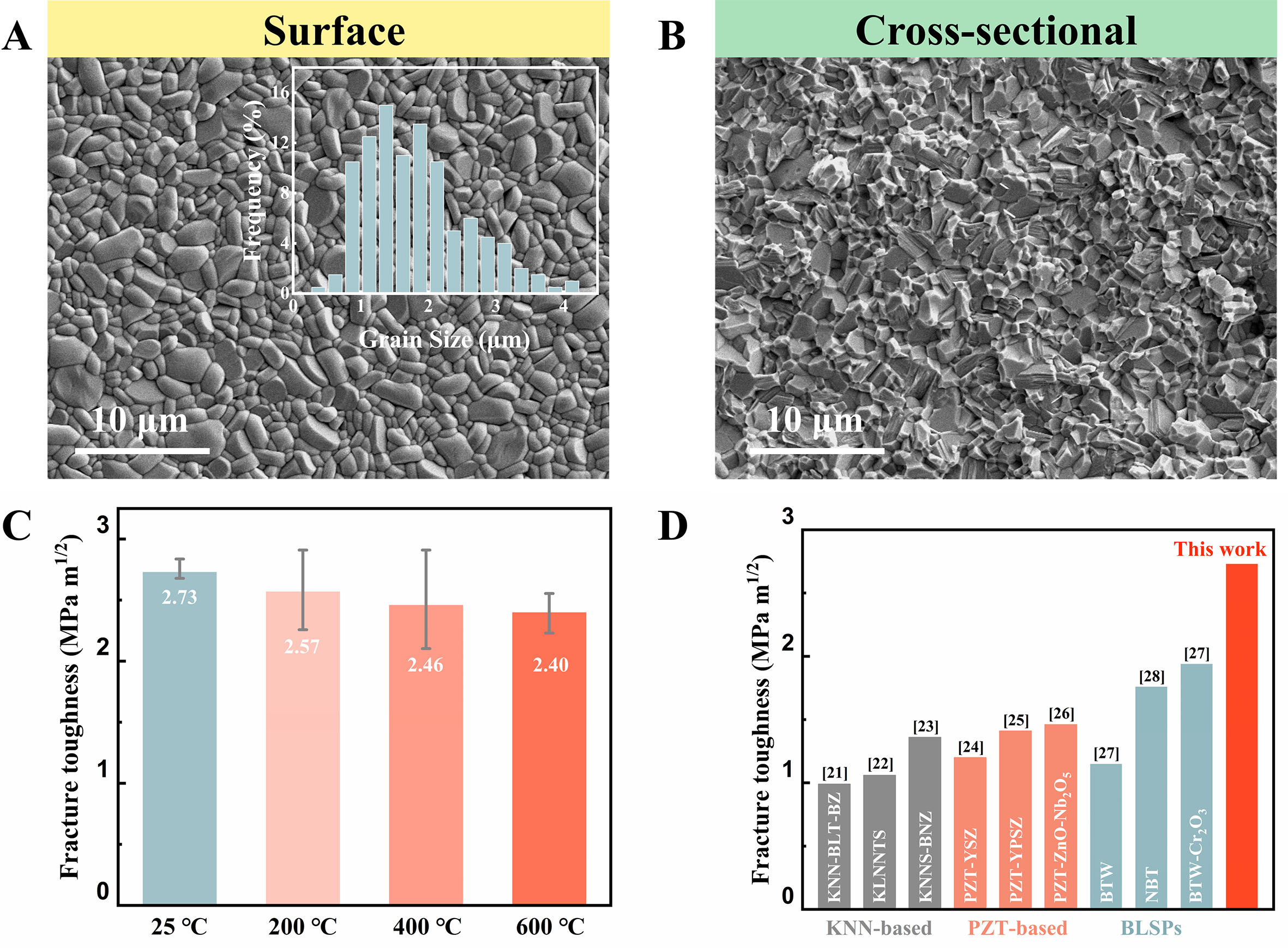
To reduce the risk of device failure caused by piezoelectric ceramics fracture at high temperatures, an optimized solid-phase reaction method was carried out to fabricate WCBN ceramics. This process substitutes conventional uniaxial pressing with isostatic pressing while achieving ceramic densification through a combined high oxygen partial pressure sintering environment. Figure 1A and B shows the SEM images and statistical grain size distribution data of WCBN ceramics. The results indicate that WCBN ceramics exhibit a homogeneous microstructure with high densification (relative density exceeding 99%), and no obvious pores were observed. Furthermore, evaluation of piezoelectric ceramics' resistance to high-temperature fragmentation through fracture toughness testing revealed that WCBN ceramics display an excellent room-temperature fracture toughness of 2.73 MPa·m1/2, which is two times that of traditional PZT piezoceramics and remains at 2.40 MPa·m1/2 even under 600 °C conditions [Figure 1C]. This performance is significantly superior to that of reported piezoelectric ceramic systems [Figure 1D], demonstrating its potential for long-term service in high-temperature devices.
To verify the compositional distribution of the W element, ECCI combined with EDS was first employed. After mechanical polishing and etching, the ECCI image of the WCBN ceramics surface reveals a significant amount of bright contrast from the secondary phase [Figure 2A]. Notably, this phase is also observed in cross-sectional views of the WCBN ceramics, which excludes the possibility that the secondary phase is only present on the surface [Supplementary Figure 1]. Line-scan profiling across the secondary phase in the ECCI image indicates that it results from the segregation of doped W and Bi elements [Figure 2A]. The HR-TEM image of lattice fringes in Figure 2B shows good crystal quality, indicating that the secondary phase is a crystalline phase rather than an amorphous phase. Furthermore, compositional distribution was further examined through STEM and EPMA testing at higher resolution. The experiment results are consistent with ECCI-EDS, showing significant segregation of W and Bi elements [Figure 2C and Supplementary Figure 2]. This phenomenon of grain boundary segregation is different from the previously reported penetration of dopant ions into the lattice of BLSPs[30-33]. The lack of understanding of the grain boundary complex of BLSFPs seriously restricts the design of high-performance piezoelectric materials.
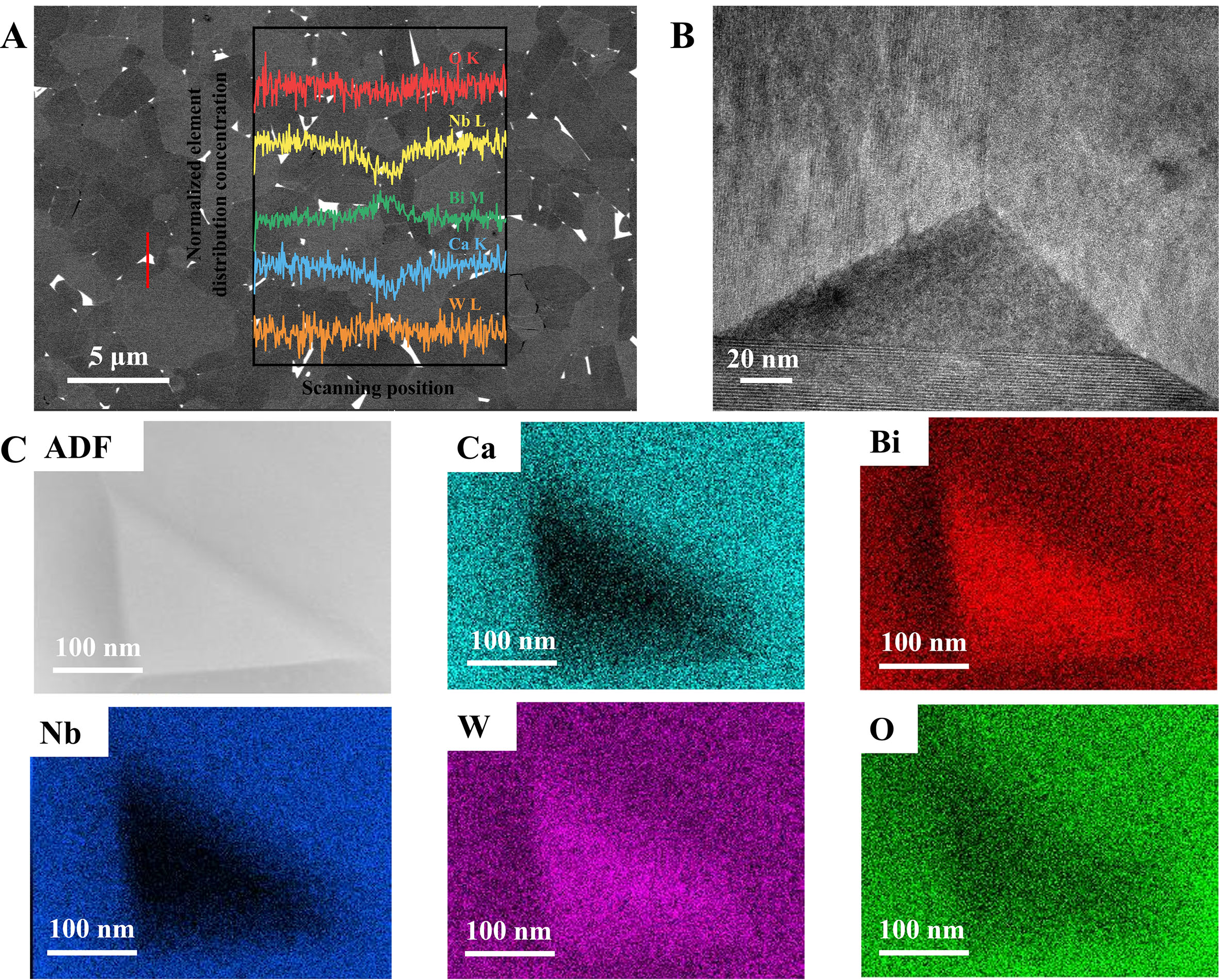
Figure 2. (A) ECCI image of the surface of WCBN ceramics. (B) TEM image at triangular grain boundaries. (C) Element concentration distribution at triangular grain boundaries.
Grain boundaries serve as the most active regions in a material’s microstructure. Changes in their interfacial states may affect the nucleation and growth of ferroelectric domains, thereby influencing piezoelectric performance[34,35]. This is evidenced in the macroscopic piezoelectric response, where the d33 reaches only
According to Fick’s Second Law of Diffusion and Arrhenius equation, the diffusion rate of ions
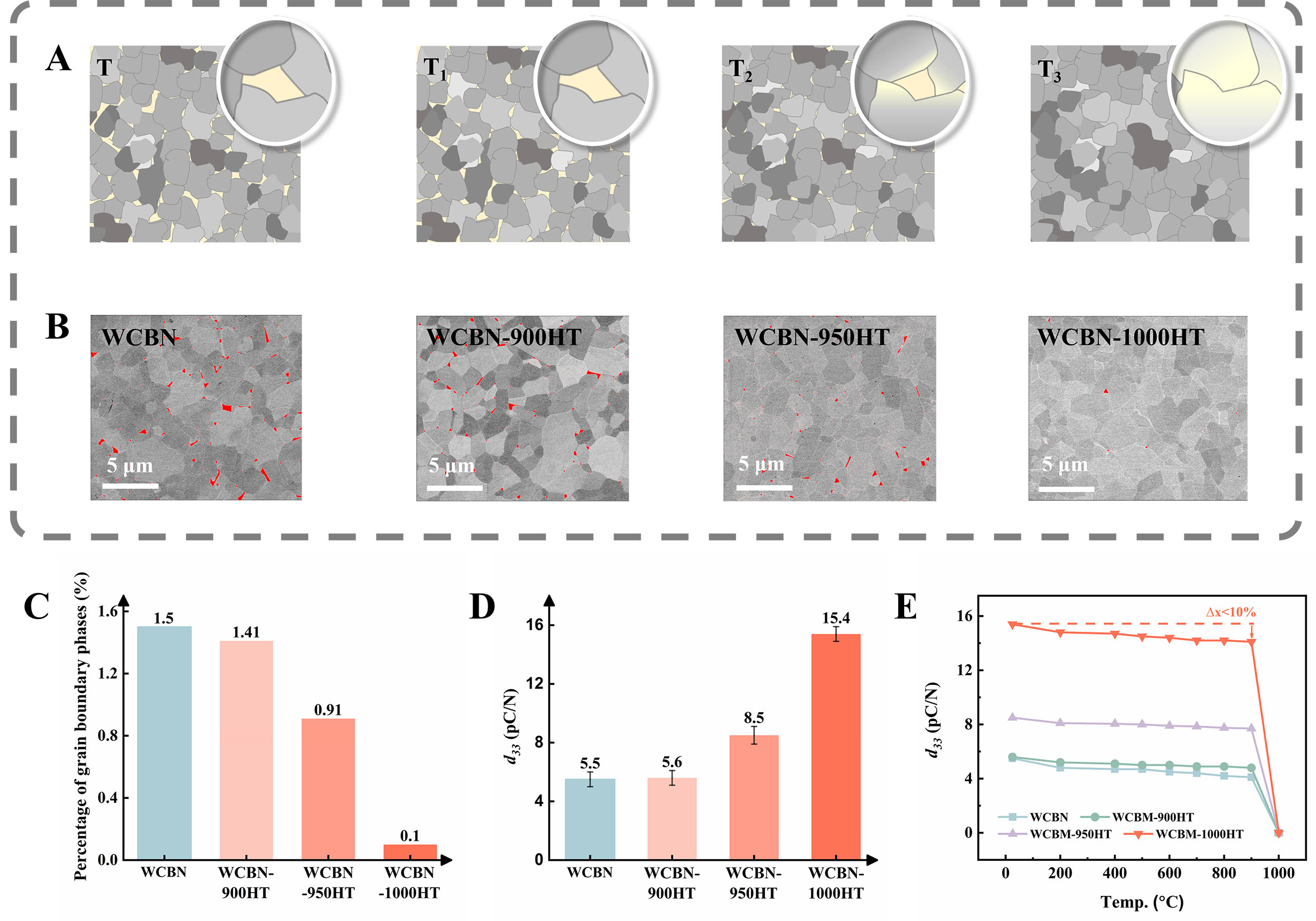
Figure 3. (A) Schematic illustration of grain boundary phase transformation. (B) ECCI images after heat treatment at different temperatures (the secondary phase indicated with RED). (C) The secondary phase area of the grain boundary after heat treatment at different temperatures. (D) The change in the d33 after heat treatment at different temperatures, and (E) the thermal depolarization behavior for the WCBN, WCBN-900HT, WCBN-950HT, and WCBN-1000HT ceramics.
Figure 3B presents the ECCI images of the surface of WCBN ceramics after heat treatment at different temperatures (the cross-sectional ECCI images were provided in Supplementary Figure 4). The secondary phase at the grain boundaries is indicated with red and quantified using ImageJ software as shown in
Figure 4A and B shows the domain switching behaviors of WCBN and WCBN-1000HT ceramics using ex-situ electric field X-ray diffraction (XRD). As the electric field increased, the (020) peak intensity of WCBN-1000HT ceramics gradually decreased, which resulted from domain rotation toward the (100) direction[36]. In contrast, WCBN ceramics show negligible changes. This phenomenon was further quantified by the intensity ratio of the (200) and (020) peaks in Figure 4C under an electric field of 16 kV/mm, where the I(200)/I(020) ratio of WCBN-1000HT ceramics reached 5.26, significantly higher than the value of 1.55 observed in WCBN ceramics. To further verify domain switching at the microscopic scale, piezoresponse force microscopy (PFM) measurements were performed under varying DC tip biases. Figure 4D shows that no significant domain switching occurs in WCBN ceramics when a voltage is applied. By comparison, WCBN-1000HT ceramics displayed significantly enhanced switching behavior, with a 20 V bias nearly achieving complete switching [Figure 4E].
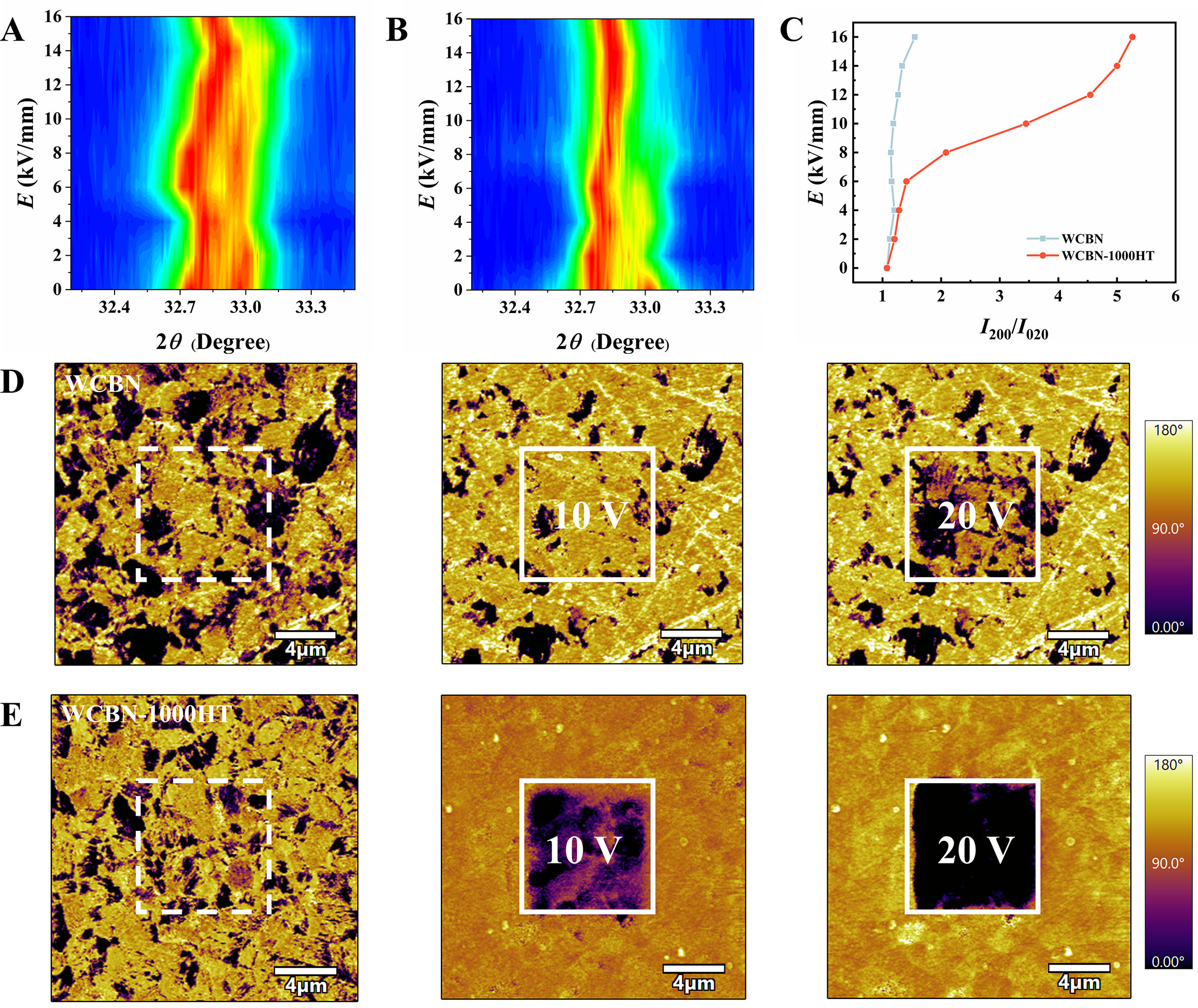
Figure 4. Ex-situ electric field XRD patterns of (A) WCBN and (B) WCBN-1000HT ceramics. (C) I200/I020 of the WCBN and WCBN-1000HT ceramics under ex-situ electric field. PFM phase images of the (D) WCBN and (E) WCBN-1000HT ceramics were measured under voltages of 10 and 20 V.
Notably, domain structure evolution before and after heat treatment was additionally investigated to determine its impact on piezoelectric properties. Figure 5A-D displays representative ferroelectric domain images of WCBN and WCBN-1000HT ceramics, along with the corresponding selected area electron diffraction patterns. By calibrating the diffraction patterns of domains A-D, their zone axes were identified as [100] for A and C, and [010] for B and D, respectively. Since these zone axes are perpendicular to each other, it can be inferred that both correspond to 90° domain walls. PFM phase images further confirm that both samples exhibit typical “island-shaped” domain structures [Figure 4D and E][33,37]. In summary, the enhancement of piezoelectric properties after high-temperature treatment is due to the reduction of grain boundary segregation, which facilitates domain switching, rather than changes in domain configuration.
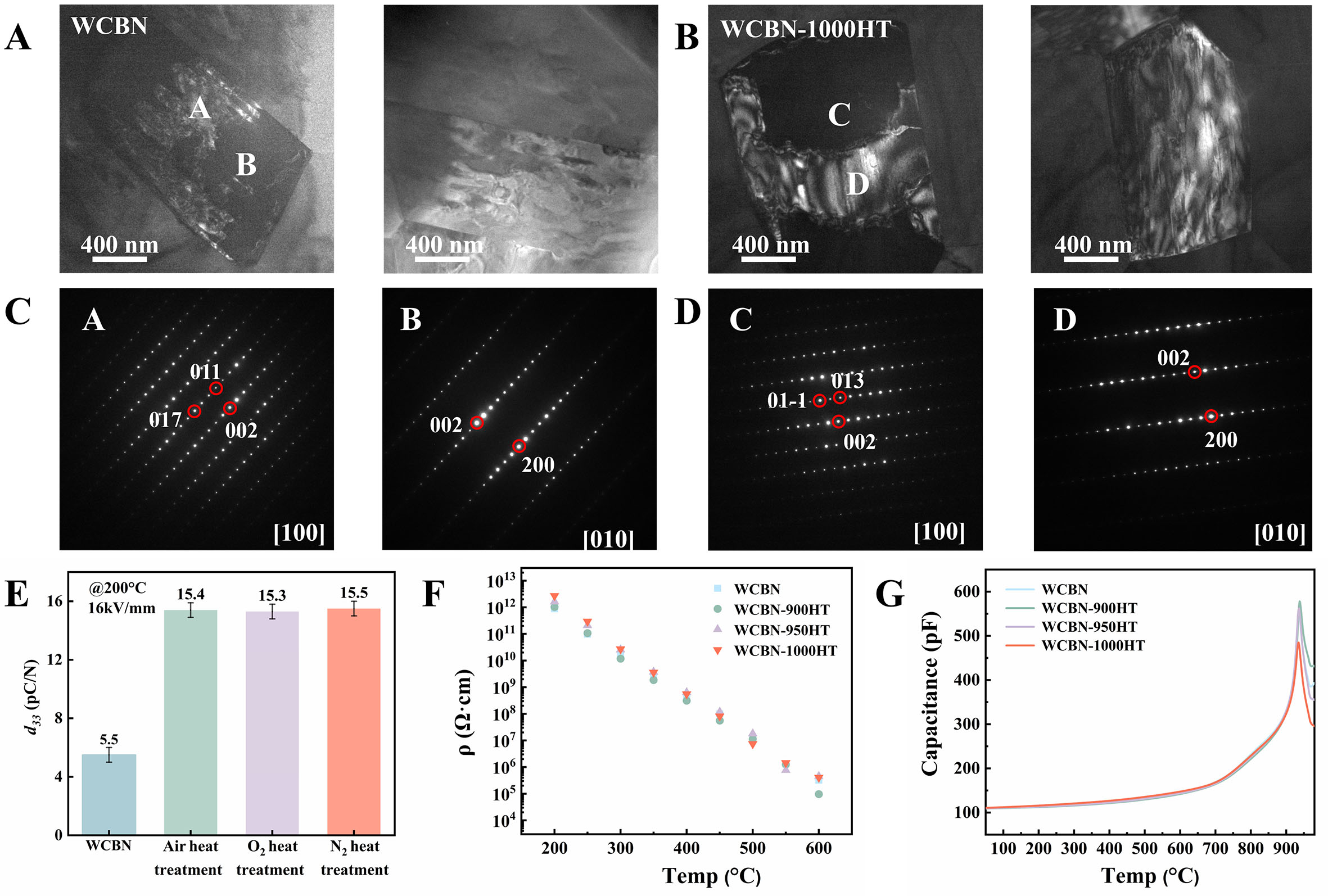
Figure 5. (A) TEM dark field images of WCBN ceramics. (B) TEM dark field images of WCBN-1000HT ceramics. (C) The diffraction patterns corresponding to A and B points in the (A). (D) The diffraction patterns corresponding to C and D points in the (B). (E) d33 after 1,000 °C heat treatment in different atmospheres. (F) Temperature-dependent DC resistivity. (G) Temperature-dependent capacitance.
So one question could be put forward: how does grain boundary segregation specifically inhibit domain switching? Up to now, three mechanisms have been reported: (1) oxygen vacancy pinning of domain walls[38,39]; (2) influence of high-resistivity/low-capacitor second phase on the poling electric field distribution[40]; and (3) stress-induced hindrance of domain wall motion[41,42].
X-ray photoelectron spectroscopy (XPS) was initially employed to analyze oxygen vacancy concentration changes in both WCBN and WCBN-1000HT ceramics. The O1s peaks were analyzed using XPS peak processing software. It was found that the oxygen vacancies and lattice oxygen in WCBN and WCBN-1000HT ceramics remained essentially unchanged, with values ranging between 0.21 and 0.22, suggesting that the influence of oxygen vacancies on domain switching can be disregarded
In this case, considering the lattice mismatch between the secondary phase and the main phase, the hindrance to domain switching in the present work may originate from the resulting internal stresses[43,44]. As shown in Figure 6A, synchrotron XRD analysis reveals a distinct (113) diffraction peak in WCBN ceramics, which does not belong to the primary phase but rather to the secondary Bi2WO6 phase. Consistent with ECCI results, the secondary phase disappeared after heat treatment at 1,000 °C. Rietveld refinement calculations yield the lattice parameters of the primary and secondary phases (primary phase: a = 5.472 Å,
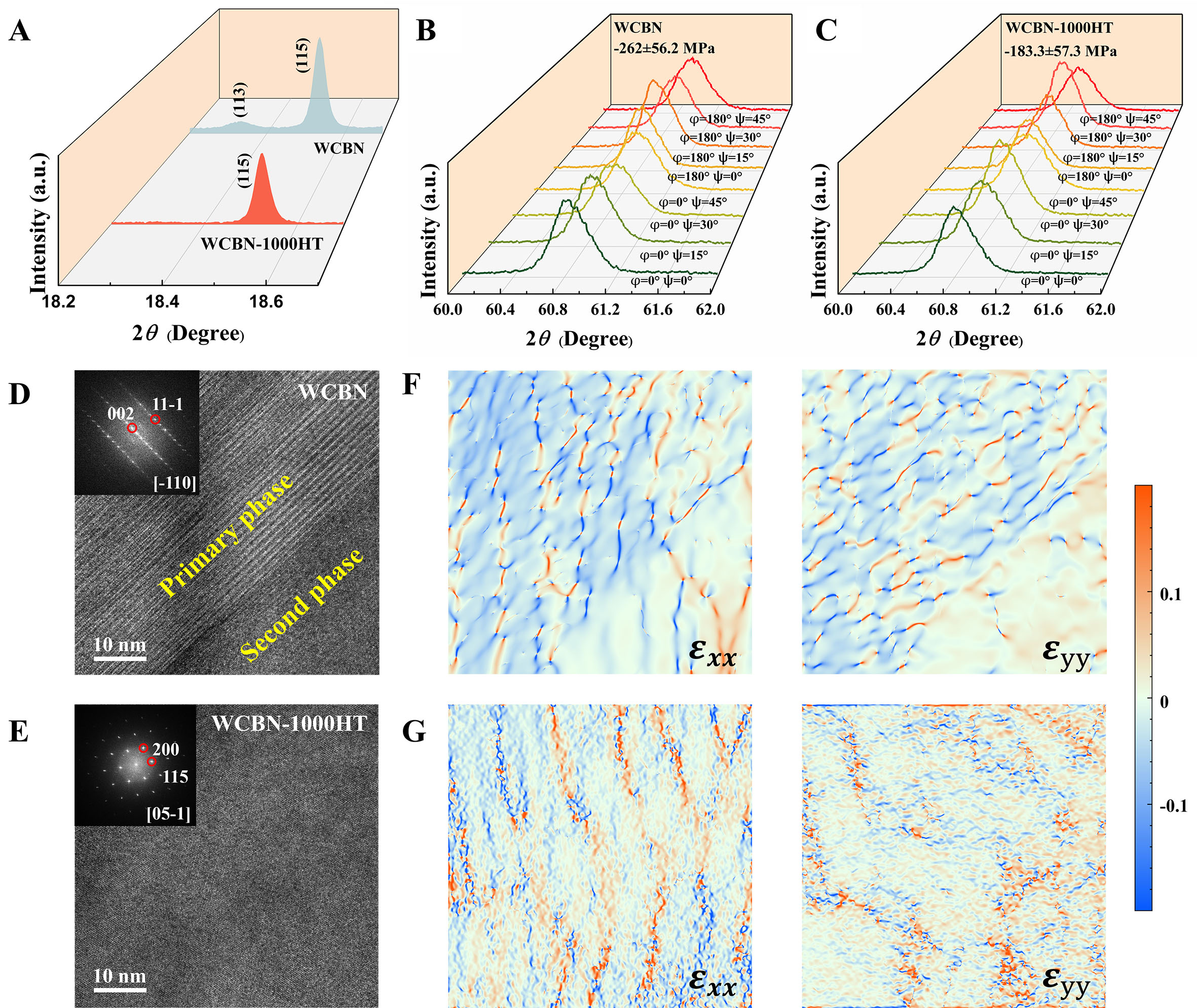
Figure 6. (A) Synchrotron XRD image. HR-XRD of (B) WCBN and (C) WCBN-1000HT ceramics at different incident angles. (D) HR-TEM of WCBN ceramics. (E) HR-TEM of WCBN-1000HT ceramics. (F) The GPA mapping of εxx and εyy corresponding to (D). (G) The GPA mapping of εxx and εyy corresponding to (E).
High-resolution XRD (HR-XRD) and high-resolution TEM (HR-TEM) were used to analyze the internal stress of WCBN and WCBN-1000HT ceramics from macroscopic and microscopic perspectives, respectively. Figure 6B and C shows the (2210) peak of WCBN and WCBN-1000HT ceramics at different incident angles (φ = 0°, 180°; ψ = 0°, 15°, 30°, 45°). The macroscopic stress was calculated using the least-squares fitting method. The results show that the macroscopic stress in WCBN-1000HT ceramics
Due to the mechanical distortion of the ferroelectric unit cell, the polarization direction of domains in piezoelectric ceramics can also be reoriented through stress-driven ferroelastic switching[46]. As shown in Figure 7A, in bismuth-layered ceramics, spontaneous polarization primarily occurs in the a-b plane[30]. When compressive stress is applied perpendicular to the a(b)-c plane, the polarization vector tends to align along the c-axis. This occurs because spontaneous polarization prefers to be perpendicular (or parallel) to compressive (or tensile) stress. In this case, compressive stress acts as a resistance, which hinders the polarization vector from switching within the a-b plane under an applied electric field. To further understand the impact of stress on domain switching, phase-field simulations were carried out to illustrate the evolution of domain structures and polarization vectors in WCBN and WCBN-1000HT ceramics under multi-field coupling conditions (refer to Supplementary Table 1 for the Landau coefficients). One thing that should be kept in mind is that this study only considers the internal stress caused by lattice mismatch in the a-b plane. This is because the lattice mismatch along the c-axis is relatively large, which would significantly increase the strain energy of the system and lead to structural instability[47,48]. WCBN and WCBN-1000HT are subjected to different external field conditions: both are exposed to a predefined electric field E0 along the [010] direction, while WCBN additionally experiences an isotropic strain of -0.1 (representing residual compressive stress). The Landau free energy curves indicate that, due to the release of compressive stress, WCBN-1000HT successfully lowers the domain switching energy barrier, facilitating a smoother switching pathway [Figure 7B]. Figure 7C illustrates the evolution of domain structures and polarization vectors in WCBN and WCBN-1000HT. In the absence of an external electric field, their initial domain configurations are highly similar, which aligns with the PFM observations in Figure 4D and E. Upon the application of an electric field along the [010] direction, the polarization vectors undergo reorientation, transitioning from the initial [1-10] and [-1-10] directions to [110] and [-110]. Furthermore, it is noteworthy that WCBN retains a considerable number of polarization vectors that fail to reorient along the electric field direction compared to WCBN-1000HT (see Supplementary Figure 8 for magnified details). This confirms that the internal stress induced by grain boundary segregation hinders domain switching under the applied electric field, thereby affecting the piezoelectric properties.
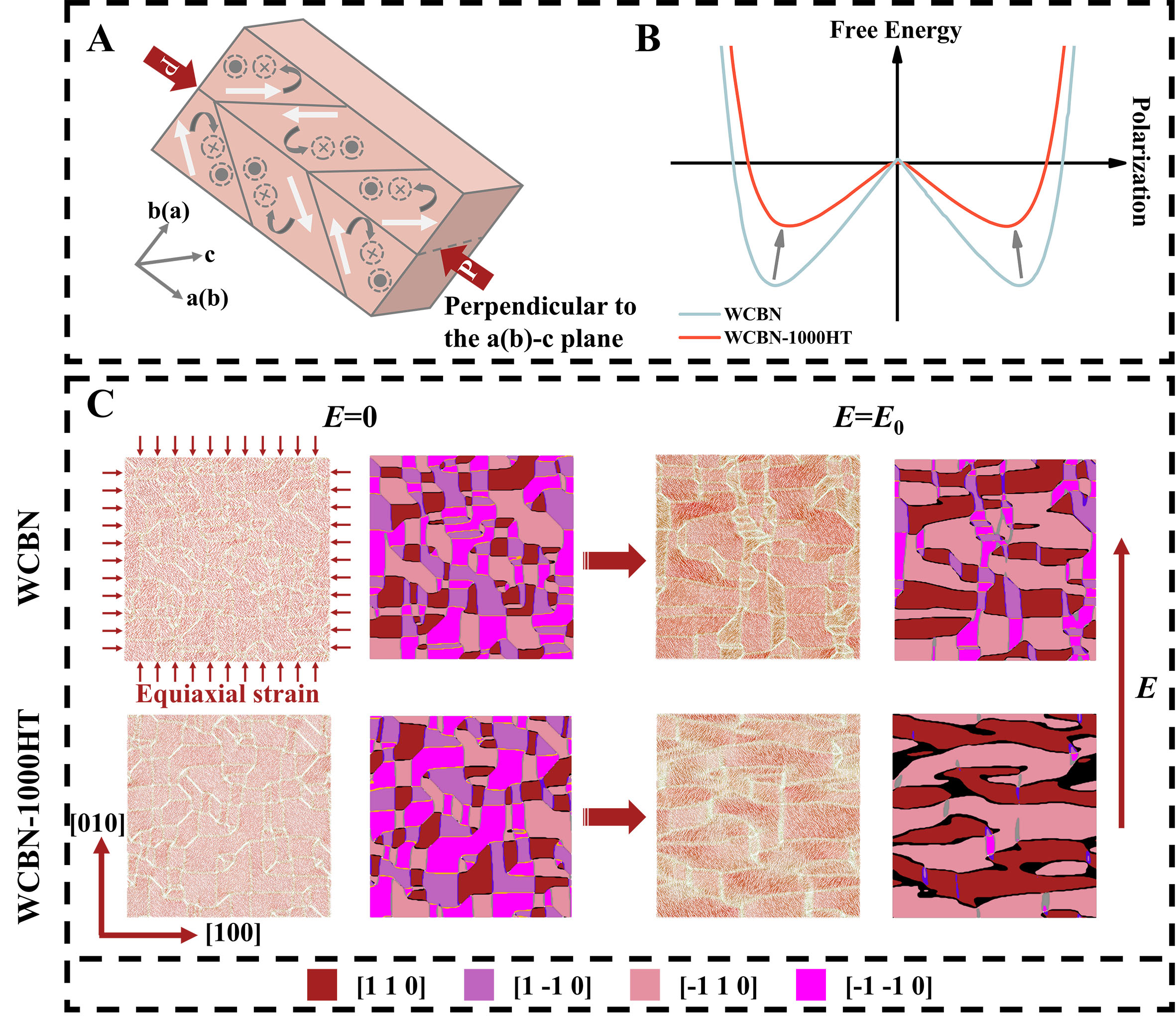
Figure 7. Phase-field simulations of WCBN and WCBN-1000HT ceramics: (A) The change of domain structure under stress. (B) Schematics of free energy vs. polarization. (C) Evolution of domain structure and polarization vector under multi-field coupling.
The evolution of domain structures and polarization vectors under a higher applied electric field was also simulated [Supplementary Figure 9]. When the electric field strength increases to 2E0, the polarization vectors in WCBN, originally oriented along the [1-10] and [-1-10] directions, almost completely switch to the [110] and [-110] directions, whereas those in WCBN-1000HT remain largely unchanged. Encouragingly, this phenomenon is also confirmed at the macroscopic level through the piezoelectric coefficient d33. Under a higher poling electric field (> 16 kV/mm), the d33 of WCBN ceramics reaches a maximum of 8.6 pC/N at
CONCLUSIONS
In summary, by optimizing the solid-phase reaction method, we have successfully obtained WCBN ceramics with excellent fracture toughness (2.73 MPa m1/2 at 25 °C and 2.4 MPa m1/2 at 600 °C). More importantly, we have elucidated the influence of grain boundary segregation on the piezoelectric properties of bismuth layer-structured ceramics and demonstrated how it can be mitigated at the microscale. Through multiscale structural characterization and phase-field simulations, we found that improper grain boundary segregation suppresses domain switching due to internal stress arising from lattice mismatch with the primary phase. Furthermore, we designed a novel poling process to tailor the grain boundary segregation state in WCBN ceramics, successfully enhancing the piezoelectric coefficient by 180% and achieving
DECLARATIONS
Acknowledgments
The authors sincerely thank Ms. Hongyu Li and Ms. Xiaolin Tai for their help in the testing work, which greatly facilitated the smooth progress of this research.
Authors’ contributions
Conception and design of the study: Zhou, Y.; Zhou, Z.
Data acquisition and analysis: Zhou, Y.; Zhang, Y.; Huang, J.; Liu, R.; Fu, Z.; Zhou, Z.
Data interpretation: Xu, F.; Shen, Z.; Zhou, Z.
Manuscript writing and revision: Zhou, Y.; Zhang, Y.; Huang, J.; Liu, R.
Supervision: Liang, R.; Zhou, Z.
Availability of data and materials
The raw data supporting the findings of this study are available within this Article and its
AI and AI-assisted tools statement
Not applicable.
Financial support and sponsorship
This work was supported by the National Key R&D Program of China (Grant No. 2022YFB3204000).
Conflicts of interest
All authors declared that there are no conflicts of interest.
Ethical approval and consent to participate
Not applicable.
Consent for publication
Not applicable.
Copyright
© The Author(s) 2026.
Supplementary Materials
REFERENCES
1. Desu, S. B.; Payne, D. A. Interfacial segregation in perovskites: IV, internal boundary layer devices. J. Am. Ceram. Soc. 1990, 73, 3416-21.
2. Yan, M. F.; Rhodes, W. W. Preparation and properties of TiO2 varistors. Appl. Phys. Lett. 1982, 40, 536-7.
3. Seaton, J.; Leach, C. Direct measurement of electrical and compositional inhomogeneities in PTC thermistors. J. Eur. Ceram. Soc. 2004, 24, 1217-20.
4. Sepehri-Amin, H.; Ohkubo, T.; Shima, T.; Hono, K. Grain boundary and interface chemistry of an Nd-Fe-B-based sintered magnet. Acta. Mater. 2012, 60, 819-30.
5. Li, W.; Ohkubo, T.; Hono, K. Effect of post-sinter annealing on the coercivity and microstructure of Nd-Fe-B permanent magnets. Acta. Mater. 2009, 57, 1337-46.
6. Zhang, G.; Chen, G.; Panwisawas, C.; et al. First-principles study of oxygen segregation and its effect on the embrittlement of molybdenum symmetrical tilt grain boundaries. Acta. Mater. 2023, 261, 119387.
7. Kinoshita, T.; Munekawa, S. Effect of grain boundary segregation on thermal conductivity of hot-pressed silicon carbide. Acta. Mater. 1997, 45, 2001-12.
8. Hu, J.; Chen, S.; Wang, L. A new insect-scale piezoelectric robot with asymmetric structure. IEEE. Trans. Ind. Electron. 2023, 70, 8194-202.
9. Yin, Y.; Zhao, P.; Xu, X.; et al. Piezoelectric analgesia blocks cancer-induced bone pain. Adv. Mater. 2024, 36, e2403979.
10. Cao, W.; Xie, S.; Liu, Y.; et al. Shear stress-triggered theranostic nanoparticles for piezoelectric-fenton-photodynamic thrombolysis and endogenous thrombus imaging. Adv. Funct. Mater. 2024, 34, 2312866.
11. Zheng, T.; Wu, J.; Xiao, D.; Zhu, J. Recent development in lead-free perovskite piezoelectric bulk materials. Prog. Mater. Sci. 2018, 98, 552-624.
12. Wei, H.; Wang, H.; Xia, Y.; et al. An overview of lead-free piezoelectric materials and devices. J. Mater. Chem. C. 2018, 6, 12446-67.
13. Xie, S.; Xu, Q.; Chen, Q.; Zhu, J.; Wang, Q. Realizing super-high piezoelectricity and excellent fatigue resistance in domain-engineered bismuth titanate ferroelectrics. Adv. Funct. Mater. 2024, 34, 2312645.
14. Li, F.; Lin, D.; Chen, Z.; et al. Ultrahigh piezoelectricity in ferroelectric ceramics by design. Nat. Mater. 2018, 17, 349-54.
15. Song, A.; Liu, Y.; Feng, T.; et al. Simultaneous enhancement of piezoelectricity and temperature stability in KNN-based lead-free ceramics via layered distribution of dopants. Adv. Funct. Mater. 2022, 32, 2204385.
16. Zou, J.; Song, M.; Zhou, X.; et al. Enhancing piezoelectric coefficient and thermal stability in lead-free piezoceramics: insights at the atomic-scale. Nat. Commun. 2024, 15, 8591.
17. Xiao, W.; Chen, Z.; Liu, X.; et al. Well-balanced performance achieved in PZT piezoceramics via a multiscale regulation strategy. Mater. Horiz. 2024, 11, 5285-94.
18. Zheng, M.; Hou, Y.; Ge, H.; Zhu, M.; Yan, H. Effect of NiO additive on microstructure, mechanical behavior and electrical properties of 0.2PZN-0.8PZT ceramics. J. Eur. Ceram. Soc. 2013, 33, 1447-56.
19. Fang, W.; Wu, J.; Qi, H.; et al. Synergy ascension of Piezoresponse and curie temperature in bismuth-layered ceramics via defect engineering. Acta. Mater. 2025, 293, 121108.
20. Wu, J.; Ma, X.; Zhou, D.; et al. High-entropy high-temperature high-piezoelectricity ceramics. Adv. Mater. 2025, 37, e2419134.
21. Subbarao, E. C. Crystal chemistry of mixed bismuth oxides with layer-type structure. J. Am. Ceram. Soc. 1962, 45, 166-9.
22. Li, Y.; Liu, Y.; Öchsner, P.; et al. Temperature dependent fracture toughness of KNN-based lead-free piezoelectric ceramics. Acta. Mater. 2019, 174, 369-78.
23. Yilmaz, E. D.; Mgbemere, H. E.; Özcoban, H.; Fernandes, R. P.; Schneider, G. A. Investigation of fracture toughness of modified (KxNa1−x)NbO3 lead-free piezoelectric ceramics. J. Eur. Ceram. Soc. 2012, 32, 3339-44.
24. Xi, K.; Hou, Y.; Yu, X.; Zheng, M.; Zhu, M. Excellent power generation and enhanced mechanical properties in PPT-structured Pb-free piezoceramics with ZrO2 inclusions. J. Mater. Chem. C. 2022, 10, 12359-66.
25. Huang, J.; Yao, M.; Lin, J.; Yao, X. Enhanced mechanical properties and excellent electrical properties of PZT piezoelectric ceramics modified by YSZ. Mater. Lett. 2022, 307, 131006.
26. Zhang, Z.; Yang, B.; Gu, W.; et al. Significantly toughened PZT-based piezoelectric ceramics simultaneously keeping excellent electrical properties via incorporating trace amount of yttria-partially-stabilized zirconia. Ceram. Int. 2022, 48, 35614-20.
27. Wang, D.; Cao, M.; Yuan, J.; et al. Enhanced piezoelectric and ferroelectric properties of Nb2O5 modified lead zirconate titanate-based composites. J. Am. Ceram. Soc. 2011, 94, 647-50.
28. Chen, Y.; Miao, C.; Xie, S.; et al. Fracture behaviors and ferroelastic deformation in W/Cr Co-Doped Bi4Ti3O12 ceramics. J. Am. Ceram. Soc. 2016, 99, 2103-9.
29. Jones, J. L.; Hoffman, M. R-curve and stress-strain behavior of ferroelastic ceramics. J. Am. Ceram. Soc. 2006, 89, 3721-7.
30. Luo, X.; Wang, M.; Yuan, X.; et al. Piezoelectricity in excess of 30 pC N-1 with a high Curie temperature of 950 °C in strongly textured CaBi2Nb2O9 ceramics. J. Mater. Chem. A. 2025, 13, 2121-30.
31. Long, C.; Xu, A.; Su, Z.; Ren, W.; Liu, L.; Ding, X. Achieving outstanding comprehensive performance with high piezoelectricity in CaBi2Nb2O9-based high-temperature piezoelectric ceramics via multi-field coupling strategy. J. Materiomics. 2025, 11, 100990.
32. Chen, N.; Wang, F.; Yang, X.; et al. Improved piezoelectric performance in CBN-based ceramic through triple-doping (Li, Bi, Ce) strategy. J. Eur. Ceram. Soc. 2024, 44, 116788.
33. Chen, J. N.; Pei, X. Z.; Liu, H. T.; et al. Superior piezoelectric performance in textured CaBi2Nb2O9 ferroelectric ceramics through rare-earth gadolinium doping and spark plasma sintering. ACS. Appl. Mater. Interfaces. 2024, 16, 60511-20.
34. Wang, J.; Shu, W.; Shimada, T.; Kitamura, T.; Zhang, T. Role of grain orientation distribution in the ferroelectric and ferroelastic domain switching of ferroelectric polycrystals. Acta. Mater. 2013, 61, 6037-49.
35. Li, H.; Wu, B.; Lin, C.; et al. Microscopic origin and relevant grain size effect of discontinuous grain growth in BaTiO3-based ferroelectric ceramics. J. Mater. Sci. Technol. 2023, 164, 119-28.
36. Xie, X.; Zhou, Z.; Gao, B.; Zhou, Z.; Liang, R.; Dong, X. Ion-pair engineering-induced high piezoelectricity in Bi4Ti3O12-based high-temperature piezoceramics. ACS. Appl. Mater. Interfaces. 2022, 14, 14321-30.
37. Zhu, K.; Song, B.; Ge, G.; et al. Construction of multi-domain coexistence enhanced piezoelectric properties of Bi0.5Na0.5TiO3-based thin films. J. Eur. Ceram. Soc. 2021, 41, 6456-64.
38. Zhang, R.; Zhao, Y.; Yang, B.; Zhao, S. Inhibition of oxygen vacancy derived from donor doping in relaxor ferroelectric films for improving dielectric energy storage. J. Phys. Chem. C. 2024, 128, 4395-403.
39. Zhang, J.; Wen, Y.; Hao, M.; et al. Enhanced properties of KNLN-BZ lead-free piezoelectric ceramics via three-step sintering. J. Mater. Sci. Mater. Electron. 2021, 32, 19778-85.
40. Zhang, Y.; Roscow, J.; Lewis, R.; et al. Understanding the effect of porosity on the polarisation-field response of ferroelectric materials. Acta. Mater. 2018, 154, 100-12.
41. Xia, F.; Yao, X. Postsintering annealing induced extrinsic dielectric and piezoelectric responses in lead-zinc-niobate-based ferroelectric ceramics. J. Appl. Phys. 2002, 92, 2709-16.
42. Achuthan, A.; Sun, C. T. Domain switching in ferroelectric ceramic materials under combined loads. J. Appl. Phys. 2005, 97, 114103.
43. Liu, Y.; Fan, J.; Qi, X.; Shen, B.; Zhang, R.; Yao, K. Adaptive ferroelectric states in KNN-based piezoceramics: Unveiling the mechanism of enhancing piezoelectric properties through multiple phase boundary engineering. Nano. Energy. 2024, 128, 109972.
44. Groppi, C.; Maspero, F.; Asa, M.; et al. Spontaneous pattern of orthogonal ferroelectric domains in epitaxial KNN films. J. Appl. Phys. 2023, 134, 204102.
45. Zhao, C.; Xing, Y.; Bai, P.; Hou, J.; Dai, X. Quantitative measurement of deformation field around low-angle grain boundaries by electron microscopy. Phys. B. Condens. Matter. 2008, 403, 1838-42.
46. Xie, K.; Peng, Q.; Li, Y.; Tan, C. Poling lead zirconate titanate ceramics with the assistance of stress. Ceram. Int. 2023, 49, 13339-46.
47. Kikuchi, T. Stability of layered bismuth compounds in relation to the structural mismatch. Mater. Res. Bull. 1979, 14, 1561-9.
Cite This Article
 Open Access
How to Cite
Download Citation
Export Citation File:
Type of Import
Tips on Downloading Citation
Citation Manager File Format
Type of Import
Direct Import: When the Direct Import option is selected (the default state), a dialogue box will give you the option to Save or Open the downloaded citation data. Choosing Open will either launch your citation manager or give you a choice of applications with which to use the metadata. The Save option saves the file locally for later use.
Indirect Import: When the Indirect Import option is selected, the metadata is displayed and may be copied and pasted as needed.
About This Article
Copyright

Data & Comments
Data
0










Comments
Comments must be written in English. Spam, offensive content, impersonation, and private information will not be permitted. If any comment is reported and identified as inappropriate content by OAE staff, the comment will be removed without notice. If you have any queries or need any help, please contact us at [email protected].