


Excellent energy storage performance in Bi0.5Na0.5TiO3 high-entropy relaxor ferroelectrics modified with multiple aliovalent B-site ions
 0
0 Abstract
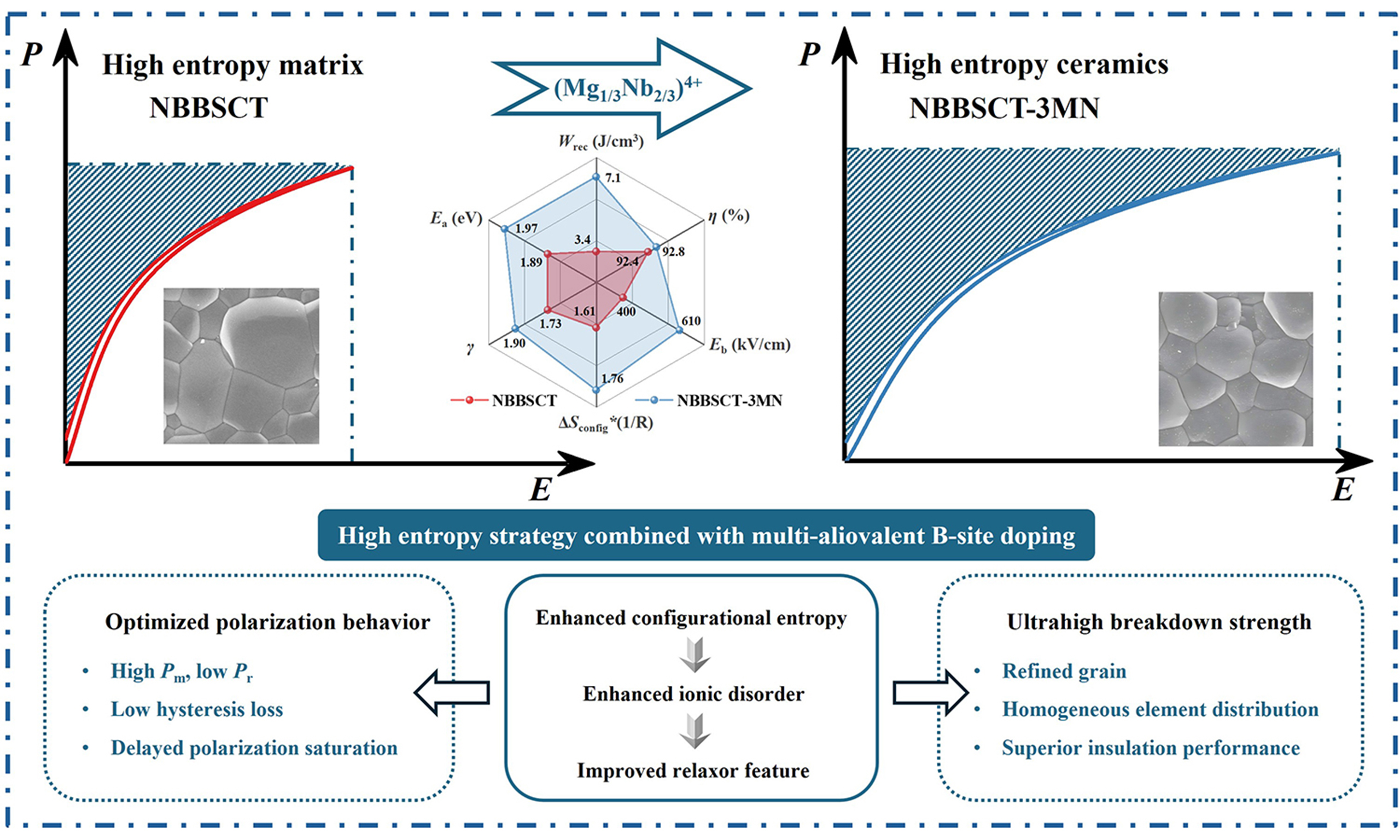
The Bi0.5Na0.5TiO3-based lead-free ceramics demonstrate significant potential as energy storage dielectric materials owing to their high polarization and satisfactory compatibility of multiple elements. In this study, multi-aliovalent B-site ions-doped (Na0.2Bi0.2Ba0.2Sr0.2Ca0.2)TiO3 (NBBSCT) high-entropy ceramics were prepared to enhance energy storage performance. The introduction of (Mg1/3Nb2/3)4+ (MN) dopants significantly increased configurational entropy, thereby promoting ionic disorder. Consequently, a high recoverable energy storage density (Wrec) of
Keywords
INTRODUCTION
Dielectric capacitors have attracted considerable attention in energy storage applications owing to their ultrahigh power density, rapid charge-discharge capability, and good temperature/frequency stability. Nevertheless, dielectric capacitors exhibit low energy density compared to current energy storage devices such as fuel cells, batteries, and supercapacitors. Consequently, significant efforts have been made to enhance their energy storage density to meet the requirements for device miniaturization and integration[1-3]. Generally, the energy storage properties of a dielectric material are evaluated by the recoverable energy density (Wrec) and energy storage efficiency (η), both of which can be calculated via the following formulas:[4]
where Wtol denotes total energy storage density, Pm is maximum polarization, Pr represents remnant polarization, and E is the applied electric field[4]. Clearly, low Pr, high Pm, and high breakdown strength (Eb) are critical parameters for achieving superior energy storage performance.
Compared with other dielectric categories, relaxor ferroelectrics (RFEs) exhibit superior energy storage potential due to their high Pm, low Pr, and narrow hysteresis[5]. In recent years, a series of high-performance RFE systems have been developed, such as Bi0.5Na0.5TiO3-based[6-8] and BaTiO3-based[5,9,10] systems. These distinctive properties originate from the presence of polar nanoregions (PNRs)[11]. The disruption of long-range ferroelectric order via ionic disorder has been established as an effective way to generate PNRs. The high-entropy strategy has been demonstrated to effectively amplify ionic disorder by constructing a single-phase solid solution of multiple elements, thereby enhancing the relaxor feature[12].
In contrast to the ceramics designed through conventional multi-component approaches, high-entropy ceramics (HECs) have a unique composition and structure[13,14]. Through the high-entropy effect, HECs extend the solubility limits of constituent elements, establishing a structural foundation for the stable incorporation of multiple elements[15,16]. The enhanced solubility limits can be explained from a structural perspective. The ordered anion sublattice creates similar surroundings among cation lattice sites, resulting in minimal site disparity and an abundance of quasi-equivalent sites[17]. These quasi-equivalent sites prevent the aggregation and segregation of elements at the atomic scale[15], which enhances multi-cation distribution homogeneity and promotes the formation of a single-phase solid solution[18]. Through high entropy design, the synergistic multi-element interactions optimize electrical properties by enhancing relaxor characteristics and increasing breakdown strength, leading to superior energy storage performance in HECs[19,20].
Bismuth sodium titanate (Bi0.5Na0.5TiO3, BNT) is recognized as a suitable matrix for HECs owing to its inherent advantages, including ease of synthesis and high polarization[21]. In our previous work[22], Zr4+ ions were introduced into the B-site of the high-entropy matrix (Na0.2Bi0.2Ba0.2Sr0.2Ca0.2)TiO3 (NBBSCT), which significantly enhanced relaxor behavior and achieved a high Wrec of 6.6 J/cm3 with an excellent η of 93% under 550 kV/cm. This demonstrates that enhancing the entropy of NBBSCT through B-site doping effectively optimizes the energy storage performance of the original high entropy structure. To further push the performance boundaries beyond the current limits, a modified high-entropy strategy is required to enhance configurational entropy (ΔSconfig), which is defined as follows[23]:
where R is the gas constant; N, M, and P represent the number of distinct ionic species occupying the A, B, and O sites in the ABO3 lattice, respectively; and Ai, Bj and Oq denote their molar fractions. The contribution of anions is excluded, with the entropy dominated by cationic disorder. Obviously, the most direct approach to increase ΔSconfig is to introduce the diversity of dopant ions. Notably, entropy quantifies the degree of disorder in a thermodynamic system[17]. The ΔSconfig, as a subset of thermodynamic entropy, can be enhanced by increasing ionic disorder, which is achievable not only through ionic diversity but also via ionic mismatch (e.g., radius/valence disparities)[24]. Consequently, substituting single isovalent ions with multiple aliovalent ions (e.g., Mg2+ and Nb5+) in the NBBSCT matrix can further boost both ΔSconfig and ionic disorder, thereby enhancing relaxor characteristics.
Based on the above considerations, aliovalent combination ions (Mg1/3Nb2/3)4+ (MN) were selected to substitute the B site of the high-entropy matrix NBBSCT in this work. The newly designed HECs,
MATERIALS AND METHODS
(Na0.2Bi0.2Ba0.2Sr0.2Ca0.2)[Ti1-x%(Mg1/3Nb2/3)x%]O3 (x is 0, 1, 2, 3 and 4, abbreviated as NBBSCT-xMN) ceramics were fabricated via conventional solid-state synthesis. The raw materials Na2CO3 (99.8%), Bi2O3 (99%), BaCO3 (99%), SrCO3 (99%), CaCO3 (99%), TiO2 (98%), MgO (99.9%), and Nb2O5 (99.9%) were precisely weighed according to stoichiometric calculations. The mixed powders were ball milled at 200 rpm for 12 h in anhydrous ethanol using zirconia balls as milling media. After drying, the precursor mixtures were calcined at 950-1,000 °C for 4 h. The calcined powders were ball milled with consistent parameters and subsequently dried. The milled powders were pressed into disks with 7 mm in diameter and 1 mm in thickness, followed by cold isostatic pressing at 300 MPa for 10 min. Finally, the green pellets were heated to 1,200-1,250 °C for
Phase structure characterization was conducted via X-ray diffraction (XRD, SmartLab-3 kW, Rigaku Ltd., Japan) employing Cu Kα radiation with a scanning range of 10-120° at 0.01° step size. Phase composition and structural parameters were resolved via Rietveld refinement using GSAS software. To further characterize the crystal structure, Raman spectroscopy was conducted using a laser confocal Raman micro spectroscope (LabRAM HR800, Horiba JobinYvo) with 532 nm excitation. The temperature-dependent dielectric properties were measured by a precision impedance analyzer (E4990A, Keysight, Bayan, America) with temperatures ranging from -100 to 400°C at various frequencies. The microstructure of the as-sintered samples was observed via a scanning electron microscope (SEM, Gemini Sigma 300, ZEISS, Germany) operated at 5 kV, with elemental distribution concurrently analyzed by Energy Dispersive Spectroscopy (EDS). Quantitative grain size distribution was statistically analyzed using Nano Measurer software through the intercept method. The breakdown electric field was measured using a voltage breakdown tester (RK2671AM, Meiruike Electronic Technology Co. Ltd, Shenzhen, China) with electric field ramping rates maintained within 100-300 V/s. The impedance spectra were measured by an electrochemical impedance spectrometer (1260AC and 1287AC, UK) in the temperature range of 625-725°C at 0.1 Hz-1 MHz. The P-E loops were characterized using a ferroelectric tester (TF Analyzer 3000, aixACCT, Germany) at 10 Hz. The discharge energy density and speed were evaluated using a capacitor charge-discharge test system (PK-CPR1801-10015, Polyk Technology, USA), employing a load resistance of
RESULTS AND DISCUSSION
Normally, a material is classified as high entropy material when ΔSconfig exceeds 1.5R[23]. Figure 1A illustrates the evolution of ΔSconfig, calculated using Equation (4). The addition of MN dopants increases ΔSconfig progressively from 1.61 to 1.80R, confirming all compositions as HECs. The XRD patterns of NBBSCT-xMN ceramics are shown in Figure 1B. All compositions exhibit single-phase perovskite structures without secondary phases, indicating MN is well dissolved within the high-entropy matrix. From the enlarged view of the diffraction peaks, the peak position gradually shifts to lower angles with the increase of MN content, attributed to the substitution of smaller Ti4+ (0.605 Å, CN = 6) by larger Mg2+ (0.72 Å, CN = 6) and Nb5+
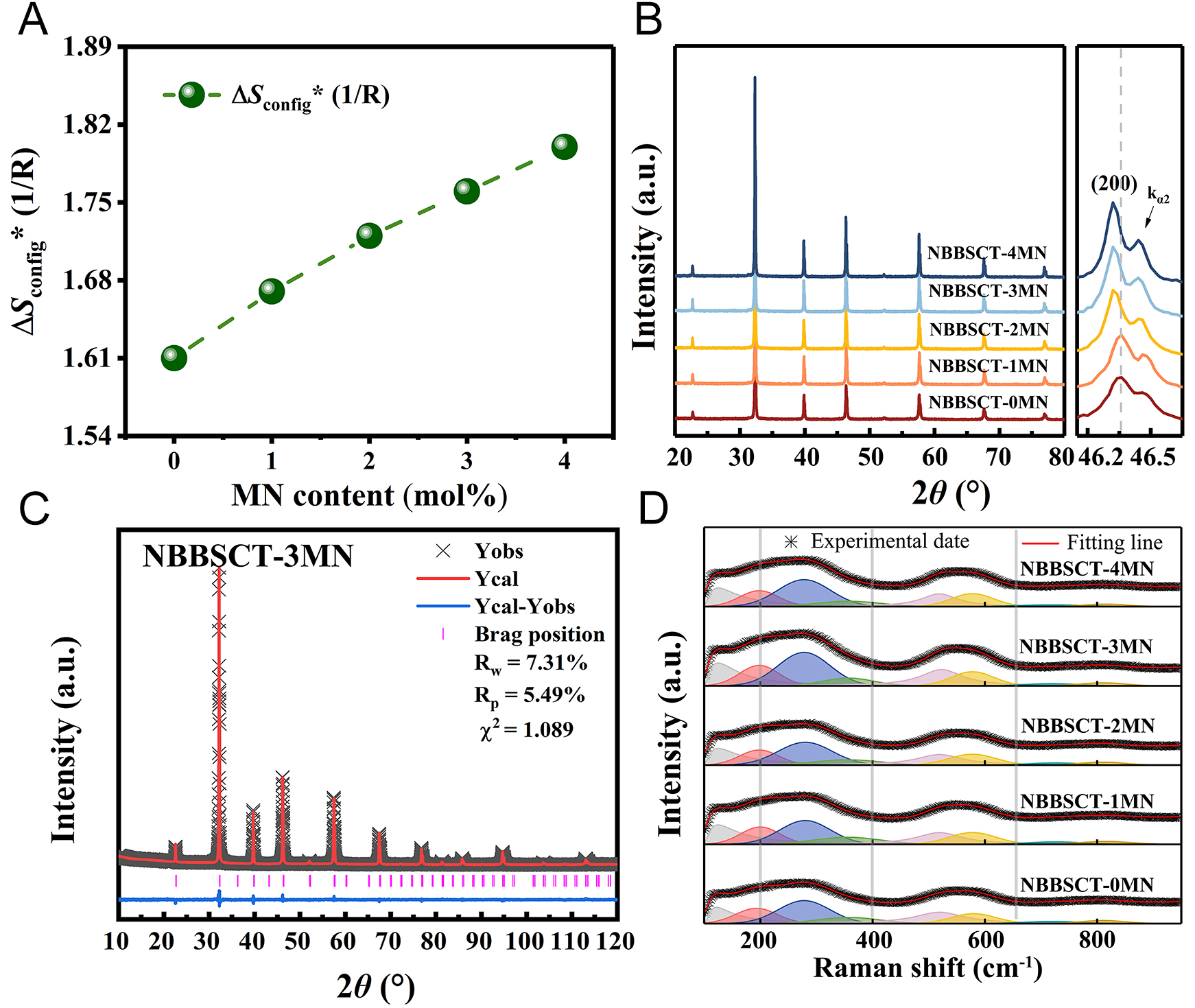
Figure 1. (A) Composition-dependent ΔSconfig for NBBSCT-xMN ceramics. (B) XRD patterns of NBBSCT-xMN ceramics with an enlarged view of the (200) diffraction peaks. (C) Rietveld refinement results for NBBSCT-3MN ceramics. (D) Raman spectra and fitting results for NBBSCT-xMN ceramics.
To illustrate the local ionic configuration changes, Raman spectra of NBBSCT-xMN ceramics were measured and deconvolved into eight Gaussian-Lorentzian peaks, as shown in Figure 1D. Based on vibrational mode assignments, the spectra are divided into four regions: < 200, 200-400, 400-650, and
Refined structural parameters of NBBSCT-xMN ceramics
| x | Space group | Lattice parameter (Å) | V (Å3) | R wp (%) | R p (%) | χ 2 |
| 0 | P4bm | a = 5.5349, b = 5.5349, c = 3.9158 | 119.961 | 7.45 | 5.76 | 1.256 |
| 1 | P4bm | a = 5.5359, b = 5.5359, c = 3.9174 | 120.052 | 7.40 | 5.63 | 1.074 |
| 2 | P4bm | a = 5.5375, b = 5.5375, c = 3.9179 | 120.136 | 7.04 | 5.26 | 1.034 |
| 3 | P4bm | a = 5.5387, b = 5.5387, c = 3.9186 | 120.210 | 7.31 | 5.49 | 1.089 |
| 4 | P4bm | a = 5.5403, b = 5.5403, c = 3.9187 | 120.283 | 6.94 | 5.20 | 1.052 |
Figure 2A-E displays the microstructure morphology and grain size distributions of all ceramic samples. All NBBSCT-xMN ceramics exhibit dense microstructures with grain sizes ranging from 1.0-2.0 μm. Figure 2F quantifies the average grain size across all compositions. The average grain size decreases progressively from 1.33 μm for NBBSCT-0MN ceramic to 1.00 μm for NBBSCT-2MN ceramic. This grain refinement originates from retarded atomic diffusion during sintering, caused by the increase of ΔSconfig[28]. Notably, NBBSCT-4MN ceramics exhibit abnormal grain growth, resulting from the elevated sintering temperature due to the high melting point of MN. This thermal condition accelerates atomic diffusion, thereby promoting abnormal grain growth[29]. To evaluate the elemental homogeneity, EDS mapping was performed on the NBBSCT-3MN ceramic, as shown in Figure 3. The constituent elements exhibit a uniform distribution without any detectable segregation. This directly confirms the homogeneous incorporation of dopant ions into the ceramic matrix. Such chemical homogeneity conforms to the characteristics of HECs. The combined effects of refined grain structure and homogeneous element distribution enhance breakdown strength, which lays the foundation for superior energy storage performance[30].
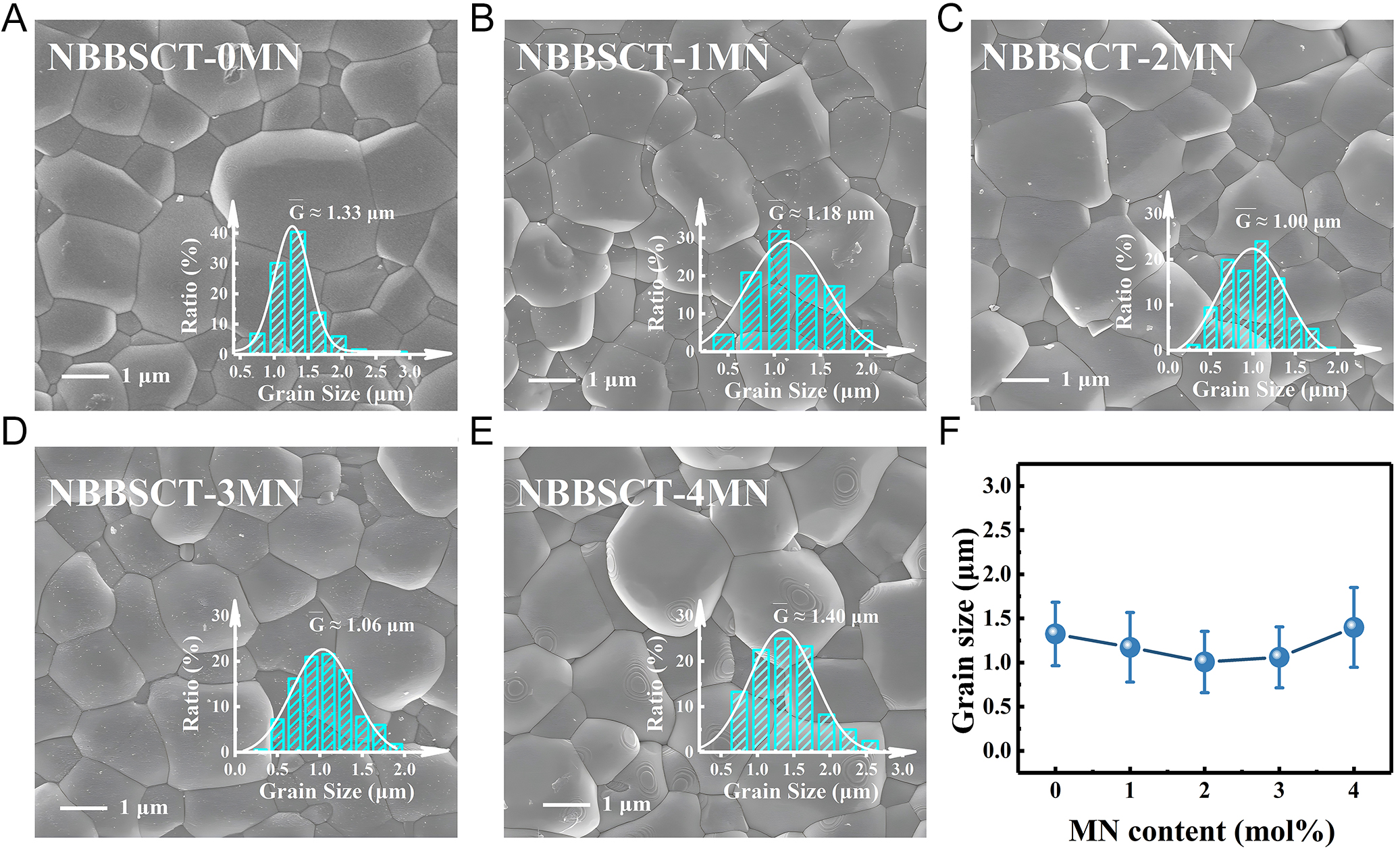
Figure 2. SEM images of (A) NBBSCT-0MN, (B) NBBSCT-1MN, (C) NBBSCT-2MN, (D) NBBSCT-3MN, and (E) NBBSCT-4MN ceramics. Insets present the corresponding grain size distributions. (F) Average grain size of all compositions.
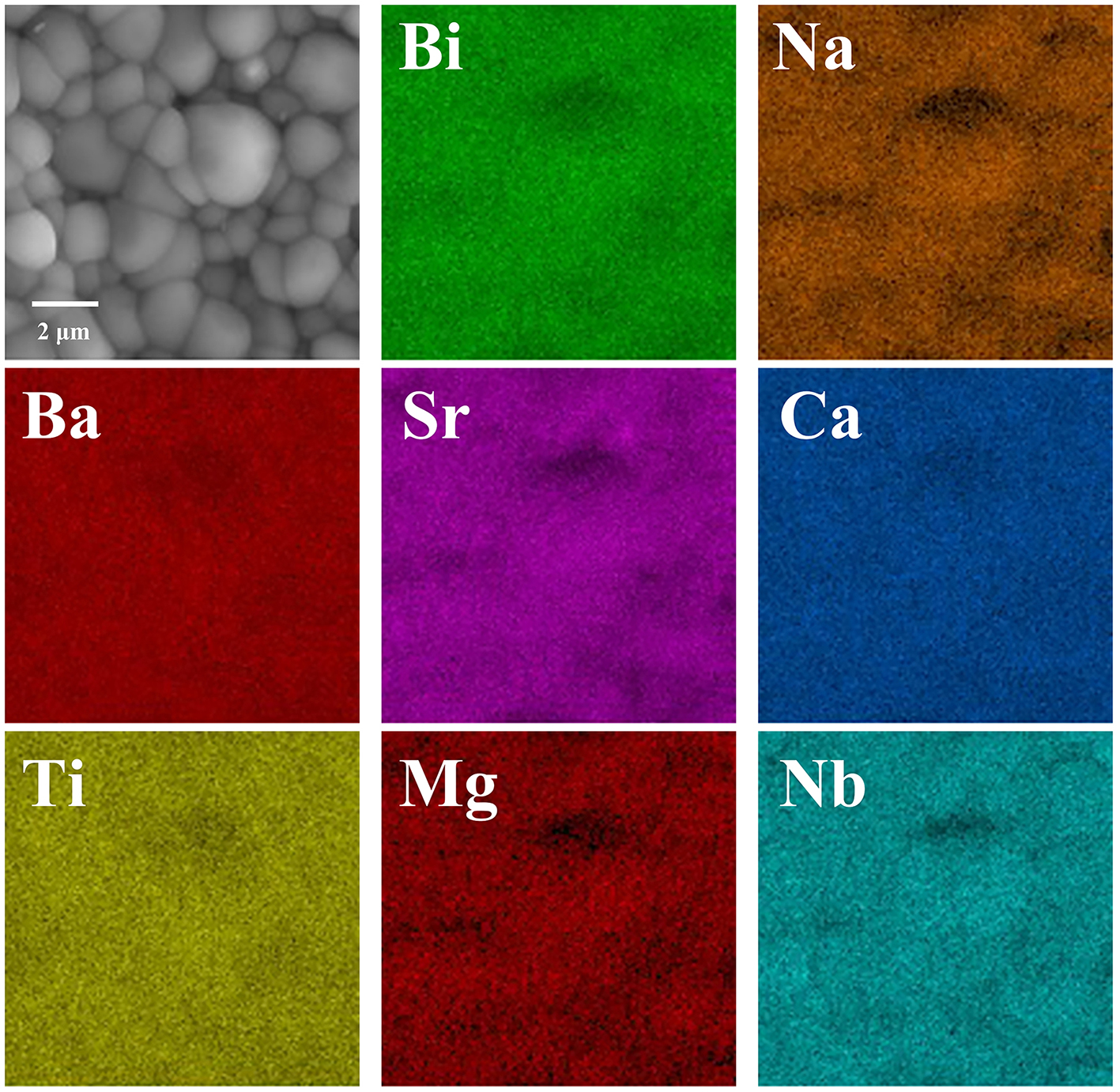
Figure 3. The EDS elemental mapping of NBBSCT-3MN ceramic.
The temperature-dependent dielectric permittivity (εr) and loss (tanδ) of NBBSCT-xMN ceramics are presented in Figure 4A-E. A distinct dielectric peak (labeled Tm) is observed for all compositions, indicating a phase transition from the FE to the paraelectric (PE) phase. Notably, the Tm peak exhibits pronounced frequency dispersion, shifting to higher temperatures with increasing frequency. This behavior is a defining characteristic of the RFEs. Furthermore, as the MN content increases, the Tm peak progressively broadens and shifts toward room temperature, accompanied by a reduction in dielectric maximum (εm), as summarized in Figure 4F. This collective evolution of Tm characteristics directly demonstrates diffuse phase transition behavior.
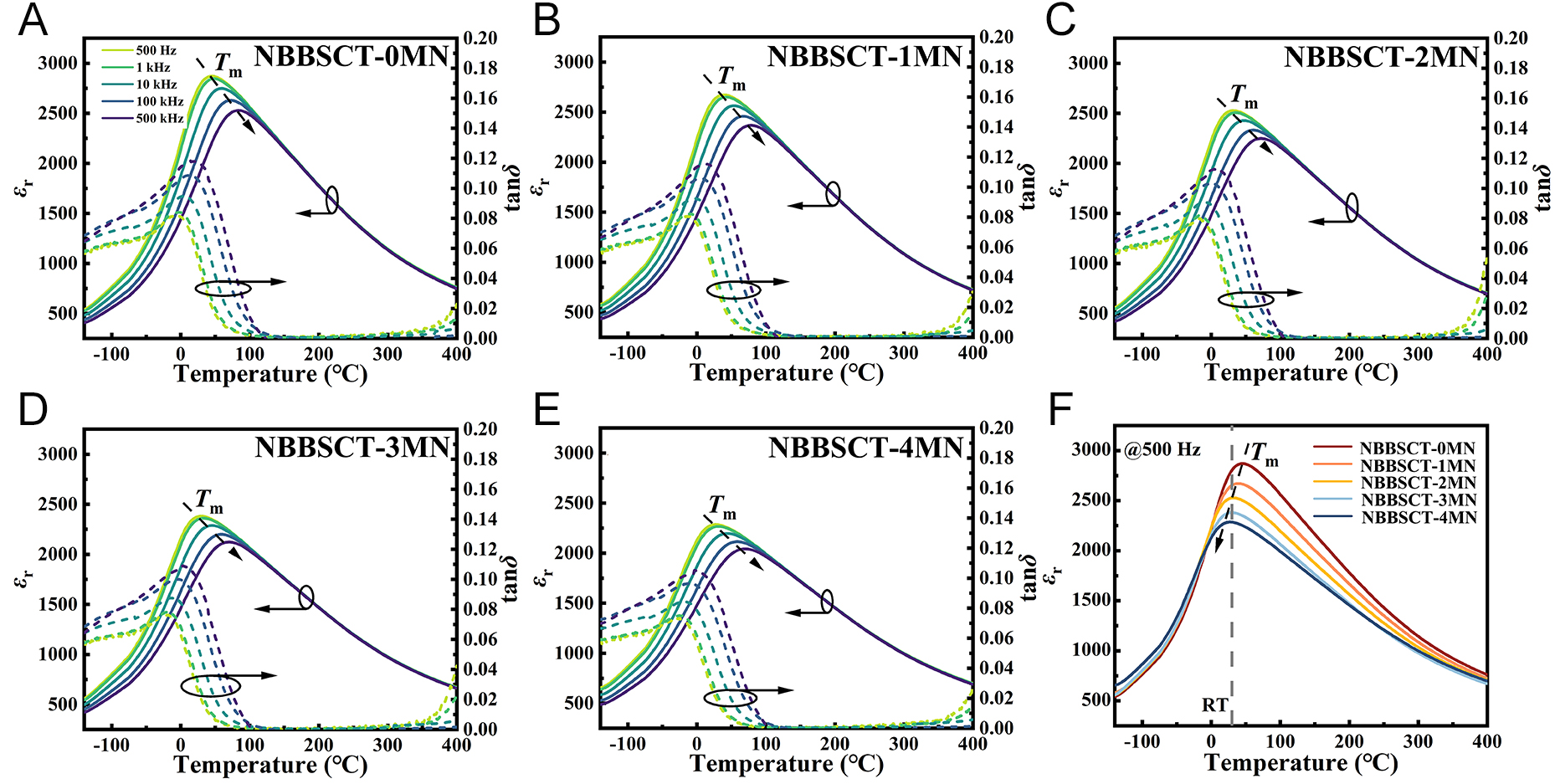
Figure 4. Temperature-dependent εr and tanδ for (A) NBBSCT-0MN, (B) NBBSCT-1MN, (C) NBBSCT-2MN, (D) NBBSCT-3MN, and (E) NBBSCT-4MN ceramics. (F) Composition dependence of εr at 500 Hz.
The degree of diffuse phase transition is quantified through normalized dielectric permittivity analysis [Figure 5A]. Two characteristic parameters, TR-L and TR-H (R = 1/2, 2/3), are defined to quantify the temperature intervals between Tm and TR (R = εr/εm) in the low- and high-temperature range[31,32]. Figure 5B reveals the progressive broadening of both TR-L and TR-H, indicating slow phase transition and enhanced phase transition diffuseness. This variation can be attributed to the random occupation of equivalent crystallographic sites by multiple cations, induced by the high-entropy effect[33,34]. To quantitatively evaluate the relaxor characteristics, the diffuseness parameter (γ) was determined using the modified Curie-Weiss law[35],
where Tc denotes the Curie-Weiss temperature. The value of γ typically ranges from 1 to 2, where a larger γ indicates enhanced relaxor behavior. Figure 5C presents the fitting lines based on Equation (5), in which high fitting factors are observed. It is interesting that high γ is observed in all ceramics, which increases from 1.73 for NBBSCT-0MN to 1.90 for NBBSCT-4MN ceramics with the increase in MN content, demonstrating a progressive enhancement of relaxor behavior. This conclusion is corroborated by the frequency dispersion (ΔT = Tm (1 MHz)-Tm (1 kHz))[31], which increases constantly from 39 to 48°C [Figure 5D]. These trends demonstrate that the high-entropy strategy effectively enhances the relaxor feature. The increased ΔSconfig via MN doping promotes structural disorder, thereby enhancing relaxor characteristics[12].
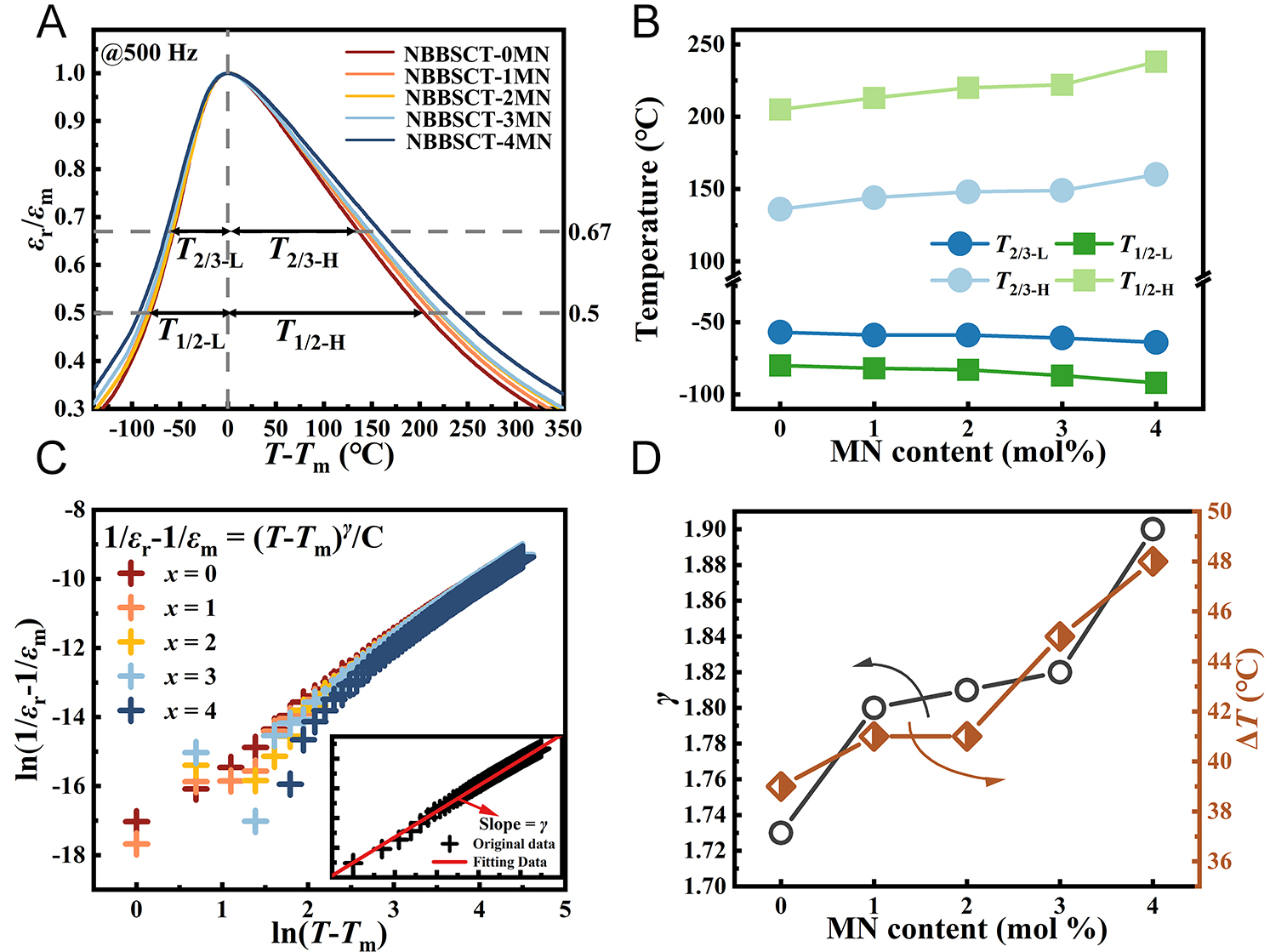
Figure 5. (A) εr/εm vs. T-Tm for all compositions. (B) Composition dependence of TR-L and TR-H (R = 1/2, 2/3). (C) ln(1/εr-1/εm) vs.
The Eb of NBBSCT-xMN ceramics was evaluated using Weibull distribution following the formulations:[36]
where n represents the total number of tested samples, and Ei denotes the Eb value of the i-th samples sorted in descending order[36]. Figure 6A displays strong linear correlation between ln(ln(1/(1-(i/(n+1))))) and
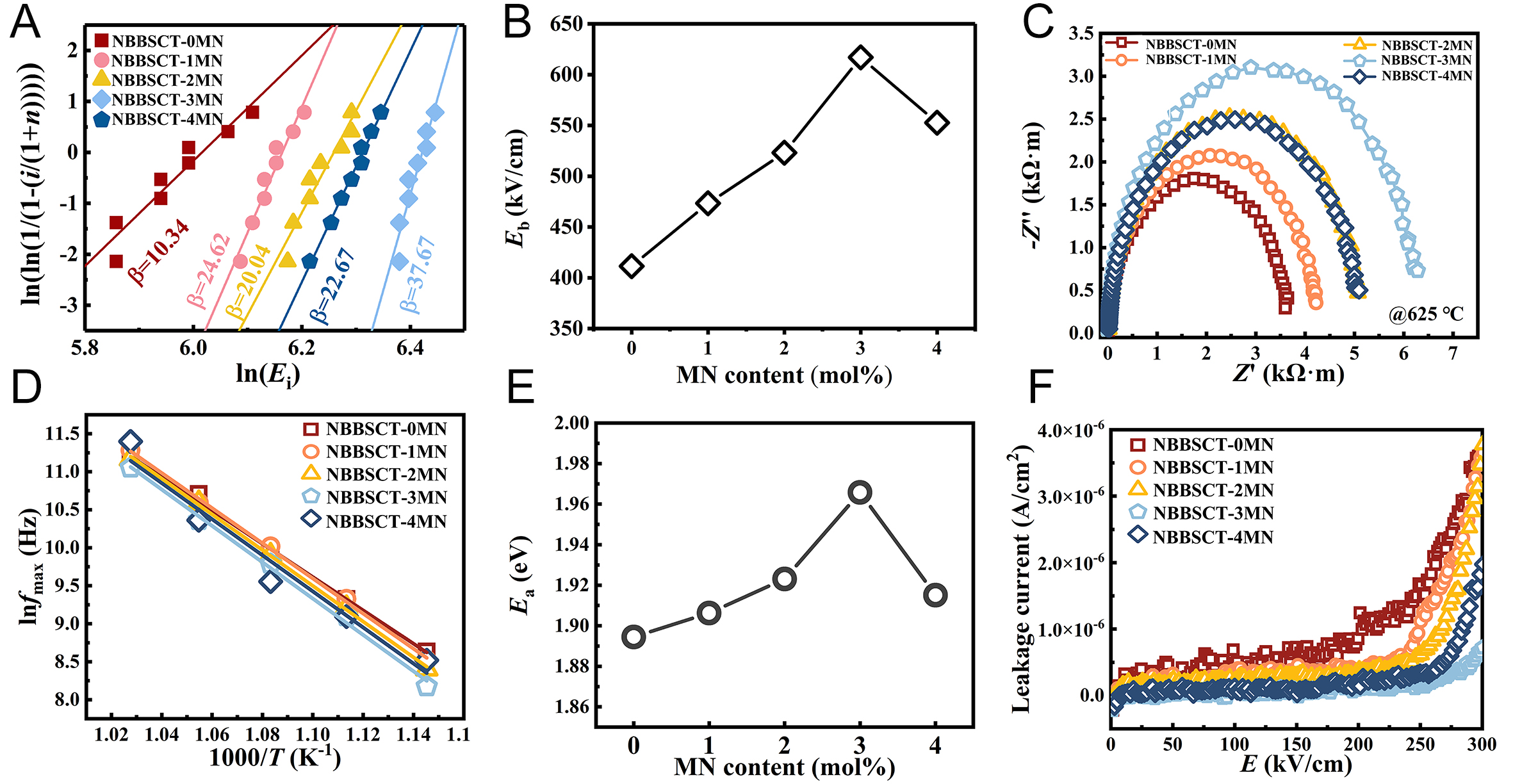
Figure 6. Electrical properties of NBBSCT-xMN ceramics. (A) Weibull distribution of Eb. (B) Composition dependence of Eb. (C) Complex impedance spectra at 625 °C. (D) Arrhenius lines of lnfmax vs. 1,000/T. (E) Composition dependence of Ea. (F) Leakage current density.
The P-E loops of all samples measured at 400 kV/cm are shown in Figure 7A. As the MN content increases, the delayed polarization saturation becomes progressively pronounced. Meanwhile, Pm decreases slightly from 36.7 to 33.8 μC/cm2, while Pr shows a marked reduction from 2.7 to 1.6 μC/cm2, favoring Wrec under electric fields. Furthermore, the NBBSCT-xMN ceramics exhibit slim P-E loops with low hysteresis loss, which is characteristic of RFEs. Combined with these characteristics, NBBSCT-3MN ceramics achieve the optimal energy storage performance with Wrec of 7.1 J/cm3 and η of 93% at the highest Eb of 610 kV/cm, as shown in Figure 7B and C. Figure 7D presents the P-E loops of NBBSCT-3MN ceramics under varying electric fields, with the corresponding energy storage parameters quantified in Figure 7E. Obviously, η exhibits electric field insensitivity, maintaining an ultrahigh level (> 90%) across all tested electric fields. Concurrently, the continuous substantial growth in Pm drives a nearly linear enhancement of Wrec with increasing electric field. Figure 7F compares the Wrec and η of NBBSCT-3MN ceramic with other lead-free bulk dielectrics, including BNT[8,26,38-41], NaNbO3 (NN)[36,42-47], AgNbO3 (AN)[29,48-54], and BaTiO3 (BT)[55-60] -based ceramics. Among these, NBBSCT-3MN ceramic demonstrates superior energy storage performance.
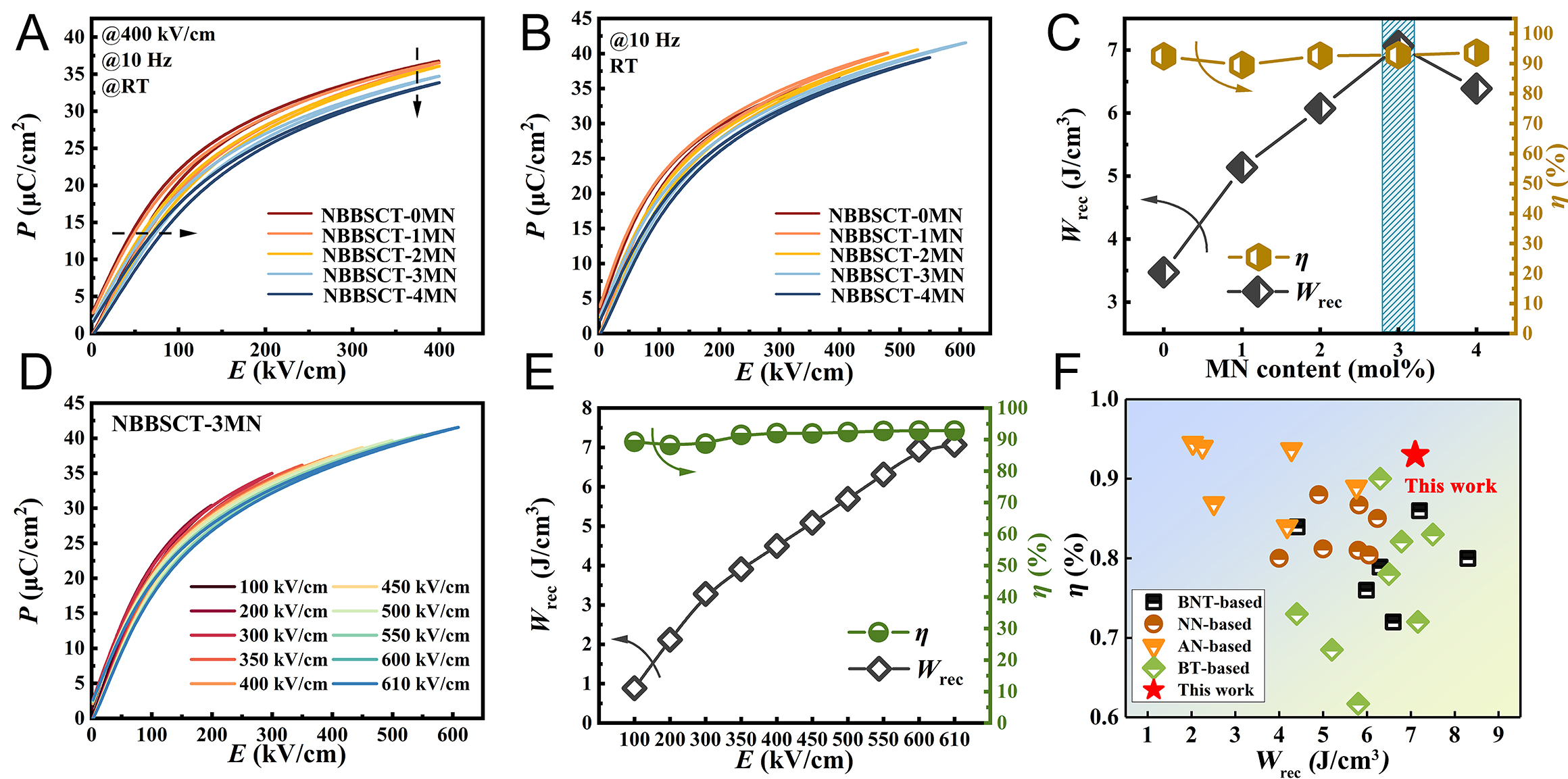
Figure 7. (A) P-E loops of all NBBSCT-xMN compositions under 400 kV/cm. (B) P-E loops measured at respective breakdown electric fields for each composition. (C) Composition-dependent energy storage properties. (D) Electric field dependence of P-E loops and (E) calculated Wrec and η for NBBSCT-3MN ceramics. (F) Comparison of Wrec and η between NBBSCT-3MN ceramic and reported lead-free perovskite bulk ceramics[8,26,36,38-47].
To evaluate the stability of NBBSCT-3MN ceramics in various operational conditions, the frequency- and temperature-dependent P-E loops were measured under 400 kV/cm. The P-E loops retain slim shapes across 1-200 Hz, with negligible variations in both Pm and Pr, as shown in Figure 8A. Therefore, Wrec exhibits excellent frequency stability, ranging from 4.2 to 4.4 J/cm3 with merely 3% fluctuation, as shown in Figure 8B. The η also maintains a high level remaining above 85%. Similarly, the P-E loops show minor variations but a gradual increase in hysteresis loss from room temperature to 120 °C [Figure 8C]. As a result, the Wrec and η exhibit temperature-induced variations below 10% and 20%, respectively, which confirms good thermal stability [Figure 8D].
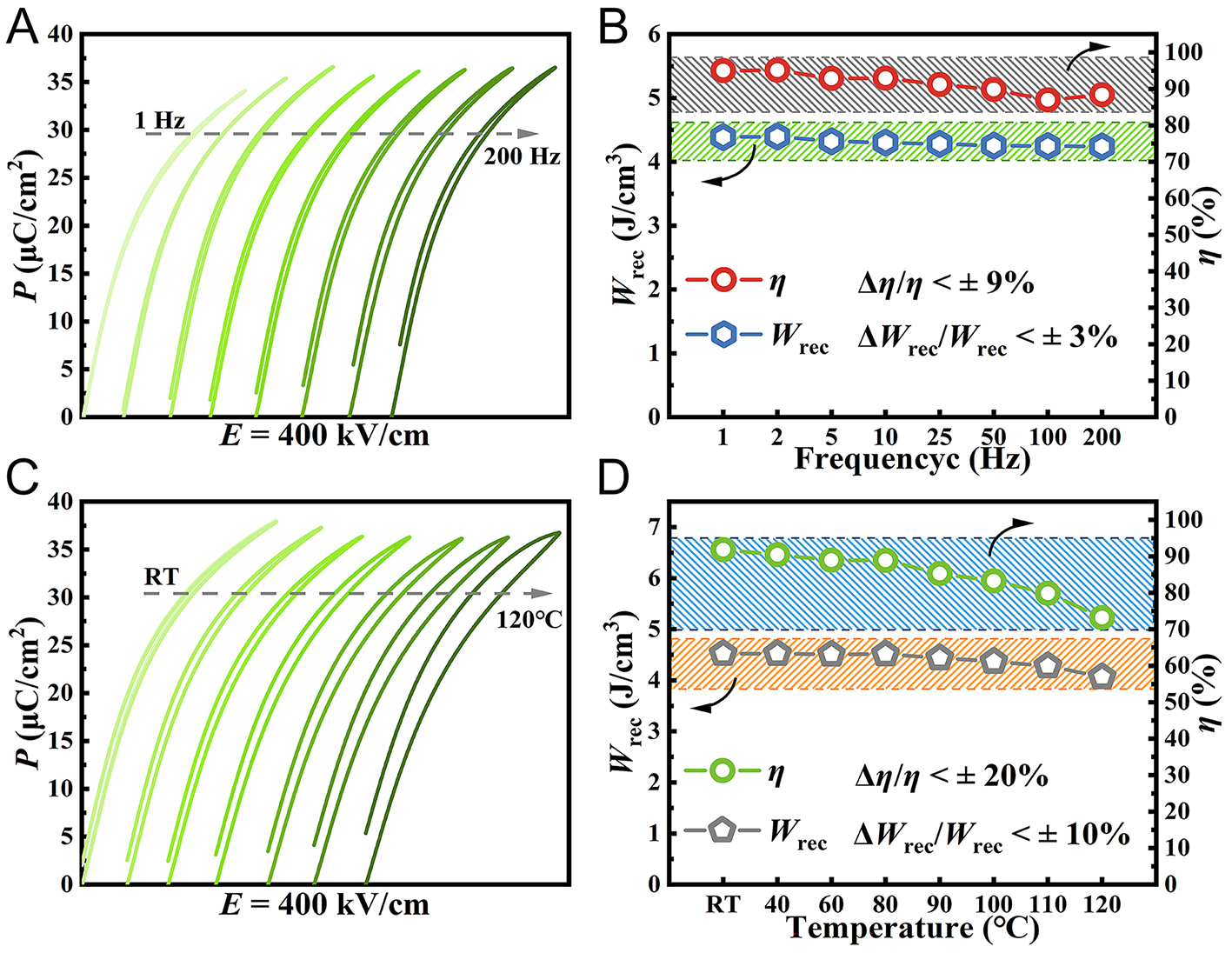
Figure 8. Operational stability of NBBSCT-3MN ceramics. (A) Frequency dependence of P-E loops and (B) the corresponding Wrec and η. (C) Temperature dependence of P-E loops and (D) the corresponding Wrec and η.
The charge-discharge performance serves as a critical metric for evaluating dielectric capacitors in practical applications. Figure 9A and B presents the discharge energy density (Wdis) and the discharge time (t0.9, defined as the time to release 90% of stored energy). Wdis increases rapidly and saturates within t0.9 less than 11 μs. Specifically, Wdis increases linearly from 1.0 to 6.9 J/cm3 with varying electric fields, showing excellent consistency with the calculated Wrec derived from the P-E measurement. Figure 9C and D shows the temperature-dependent charge-discharge performance from room temperature to 120 °C. Wdis reaches a plateau with a short t0.9 in less than 10 μs across the entire temperature range. The temperature-induced variation in Wdis remains below 10%, demonstrating exceptional thermal stability. These combined merits establish NBBSCT-3MN ceramic as a promising candidate for energy storage applications.
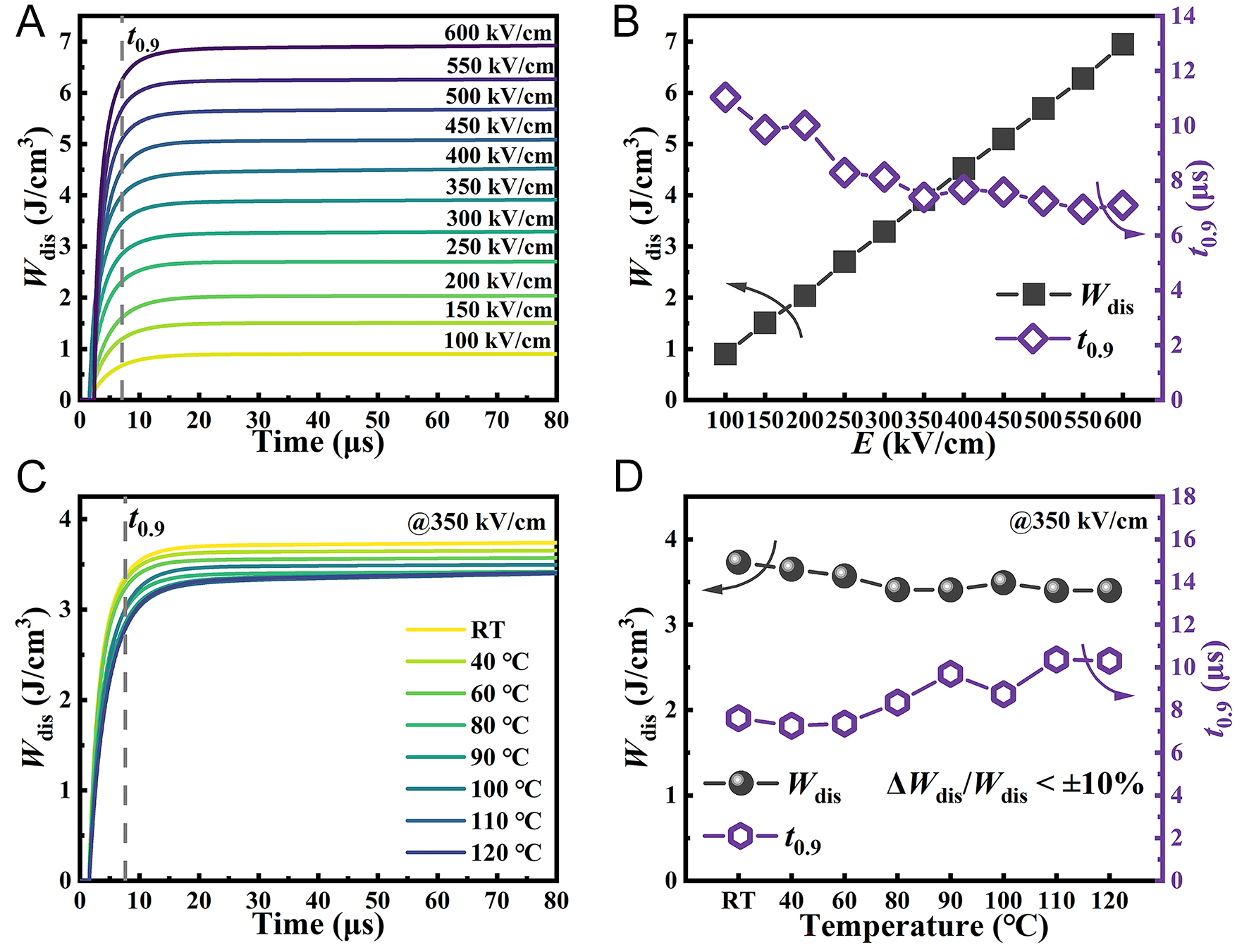
Figure 9. Charge-discharge performance of NBBSCT-3MN ceramics. (A) Time dependence of Wdis under varying electric fields, and (B) field-dependent Wdis and t0.9. (C) Time dependence of Wdis at various temperatures, and (D) temperature-dependent Wdis and t0.9.
CONCLUSIONS
Herein, by introducing aliovalent ions (Mg1/3Nb2/3)4+ into NBBSCT, a series of new high-entropy relaxor ferroelectric ceramics with compositions of (Na0.2Bi0.2Ba0.2Sr0.2Ca0.2)[Ti1-x%(Mg1/3Nb2/3)x%]O3 were successfully prepared. The phase structure maintained stability as the MN content increased, where ΔSconfig increased from 1.61 to 1.80R, resulting in enhanced frequency dispersion and diffuse phase transition. The NBBSCT-3MN ceramics exhibited a high Wrec of 7.1 J/cm3 and superior η of 93% at 610 kV/cm. Additionally, they exhibited excellent frequency stability in Wrec, showing less than 3% variation from 1 Hz to 200 Hz, while maintaining temperature stability with less than 10% variation from room temperature to 120 °C. Meanwhile, the ceramics delivered a rapid t0.9 of 11 μs and a high Wdis reaching 6.9 J/cm3. The excellent energy storage properties demonstrate that NBBSCT-3MN high entropy ceramics have great potential for energy storage capacitor applications.
DECLARATIONS
Authors’ contributions
Conception and design: Che, R.; Yang, K.; Luo, N.
Experiments, data collection and analysis, data curation: Che, R.; Yang, K.; You, W.
Writing of the original draft: Che, R.
Writing - review and editing: Cen, Z.; Luo, N.; Che, R.
Availability of data and materials
The data that support the findings of this study are available from the corresponding authors upon reasonable request.
Financial support and sponsorship
This work was financially supported by the Guangxi Natural Science Fund for Distinguished Young Scholars (Grant No. 2022GXNSFFA035034), National Natural Science Foundation of China (Grant No. 52472121), and Guangxi Bagui Youth Talent Training Program.
Conflicts of interest
All authors declared that there are no conflicts of interest.
Ethical approval and consent to participate
Not applicable.
Consent for publication
Not applicable.
Copyright
© The Author(s) 2025.
REFERENCES
1. Wang, G.; Lu, Z.; Li, Y.; et al. Electroceramics for high-energy density capacitors: current status and future perspectives. Chem. Rev. 2021, 121, 6124-72.
2. Zhang, H.; Wei, T.; Zhang, Q.; et al. A review on the development of lead-free ferroelectric energy-storage ceramics and multilayer capacitors. J. Mater. Chem. C. 2020, 8, 16648-67.
3. Yang, L.; Kong, X.; Li, F.; et al. Perovskite lead-free dielectrics for energy storage applications. Prog. Mater. Sci. 2019, 102, 72-108.
4. Adediji, Y. B.; Adeyinka, A. M.; Yahya, D. I.; Mbelu, O. V. A review of energy storage applications of lead-free BaTiO3-based dielectric ceramic capacitors. Energy. Ecol. Environ. 2023, 8, 401-19.
5. Zhao, P.; Wang, H.; Wu, L.; et al. High-performance relaxor ferroelectric materials for energy storage applications. Adv. Energy. Mater. 2019, 9, 1803048.
6. Long, C.; Su, Z.; Xu, A.; et al. Bi0.5Na0.5TiO3-based energy storage ceramics with excellent comprehensive performance by constructing dynamic nanoscale domains and high intrinsic breakdown strength. Nano. Energy. 2024, 124, 109493.
7. Xiong, X.; Liu, H.; Zhang, J.; et al. Ultrahigh energy-storage in dual-phase relaxor ferroelectric ceramics. Adv. Mater. 2024, 36, e2410088.
8. Zheng, Q.; Xie, B.; Wang, Q.; et al. Remarkable energy storage properties in (Bi0.5Na0.5)TiO3-based quasilinear relaxor ferroelectrics via superparaelectric regulation. Chem. Eng. J. 2024, 483, 149154.
9. Wang, W.; Yang, Y.; Qian, J.; et al. Advancing energy storage properties in barium titanate-based relaxor ferroelectric ceramics through a stagewise optimization strategy. Chem. Eng. J. 2024, 488, 151043.
10. Liu, D.; Wang, L.; Wang, X.; et al. Excellent energy storage performances for BaTiO3-based multilayer capacitors through synergistic high-entropy and superparaelectric-relaxor strategy. J. Materiomics. 2025, 11, 100860.
11. Huang, Y.; Shang, K.; Yang, Y.; et al. Ultrahigh energy storage capacities in high-entropy relaxor ferroelectrics. J. Mater. Chem. A. 2024, 12, 18224-33.
12. Gao, Y.; Song, Z.; Hu, H.; et al. Optimizing high-temperature energy storage in tungsten bronze-structured ceramics via high-entropy strategy and bandgap engineering. Nat. Commun. 2024, 15, 5869.
13. Peng, H. A.; Wu, T. T.; Liu, Z.; et al. High-entropy relaxor ferroelectric ceramics for ultrahigh energy storage. Nat. Commun. 2024, 15, 5232.
14. Miracle, D.; Senkov, O. A critical review of high entropy alloys and related concepts. Acta. Mater. 2017, 122, 448-511.
16. Wu, J.; Tan, H.; Qi, H.; et al. High energy storage performance in BiFeO3-based lead-free high-entropy ferroelectrics. Small 2024, 20, e2400997.
17. Jiao, Y.; Dai, J.; Fan, Z.; et al. Overview of high-entropy oxide ceramics. Mater. Today. 2024, 77, 92-117.
18. Xiang, H.; Xing, Y.; Dai, F.; et al. High-entropy ceramics: present status, challenges, and a look forward. J. Adv. Ceram. 2021, 10, 385-441.
19. Guo, J.; Yu, H.; Ren, Y.; et al. Multi-symmetry high-entropy relaxor ferroelectric with giant capacitive energy storage. Nano. Energy. 2023, 112, 108458.
20. Wang, C.; Cao, W.; Liang, C.; Zhao, H.; Wang, C. Equimolar high-entropy for excellent energy storage performance in Bi0.5Na0.5TiO3-based ceramics. Energy. Storage. Mater. 2024, 70, 103534.
21. Zhu, W.; Shen, Z.; Deng, W.; et al. A review: (Bi,Na)TiO3 (BNT)-based energy storage ceramics. J. Materiomics. 2024, 10, 86-123.
22. Yang, K.; Luo, G.; Ma, L.; et al. Excellent energy storage performance in Bi0.5Na0.5TiO3-based lead-free high-entropy relaxor ferroelectrics via B-site modification. J. Adv. Ceram. 2024, 13, 345-53.
23. Sarkar, A.; Velasco, L.; Wang, D.; et al. High entropy oxides for reversible energy storage. Nat. Commun. 2018, 9, 3400.
24. Luo, H.; Sun, Z.; Zhang, J.; et al. Outstanding energy-storage density together with efficiency of above 90% via local structure design. J. Am. Chem. Soc. 2024, 146, 460-7.
25. Chen, F.; Yang, L.; Feng, H.; et al. An ultrahigh energy storage efficiency and recoverable density in Bi0.5Na0.5TiO3 with the modification of Sr0.85La0.1TiO3 viscous polymer process. J. Materiomics. 2024, 10, 566-77.
26. Che, Z.; Ma, L.; Luo, G.; et al. Phase structure and defect engineering in (Bi0.5Na0.5)TiO3-based relaxor antiferroelectrics toward excellent energy storage performance. Nano. Energy. 2022, 100, 107484.
27. Wang, L. G.; Zhu, C. M.; Jiang, J. B.; et al. Dynamics of the phase transition in Bi0.5Na0.5TiO3 based on in situ Raman spectroscopy. J. Mater. Chem. C. 2023, 11, 13459-65.
28. Zhao, H.; Cao, W.; Liang, C.; Wang, C.; Wang, C.; Cheng, Z. High-entropy design toward ultrahigh energy storage density under moderate electric field in bulk lead-free ceramics. Adv. Funct. Mater. 2025, 35, 2411954.
29. Ma, L.; Che, Z.; Xu, C.; et al. High energy storage density and efficiency in AgNbO3 based relaxor antiferroelectrics with reduced silver content. J. Eur. Ceram. Soc. 2023, 43, 3228-35.
30. Yao, Z.; Song, Z.; Hao, H.; et al. Homogeneous/Inhomogeneous-structured dielectrics and their energy-storage performances. Adv. Mater. 2017, 29, 1601727.
31. Yu, Z.; Ang, C.; Guo, R.; Bhalla, A. S. Ferroelectric-relaxor behavior of Ba(Ti0.7Zr0.3)O3 ceramics. J. Appl. Phys. 2002, 92, 2655-7.
32. Ang, C.; Jing, Z.; Yu, Z. Ferroelectric relaxor Ba(Ti,Ce)O3. J. Phys. Condens. Matter. 2002, 14, 8901-12.
33. Subrahmanyam, S.; Goo, E. Diffuse phase transitions in the (PbxBa1-x)TiO3 system. J. Mater. Sci. 1998, 33, 4085-8.
34. Bokov, A. A. Recent advances in diffuse ferroelectric phase transitions. Ferroelectrics 1992, 131, 49-55.
35. Chen, Z.; Pu, Y.; Ning, Y.; et al. Remarkable energy storage capability and dielectric temperature stability in (Na0.5Bi0.5)TiO3-based medium entropy superparaelectrics. Chem. Eng. J. 2024, 481, 148796.
36. Luo, G.; Zhuang, D.; Yang, K.; et al. Enhanced comprehensive energy storage properties in NaNbO3-based relaxor antiferroelectric via MnO2 modification. J. Mater. Sci. Mater. Electron. 2023, 34, 10784.
37. Liu, L.; Huang, Y.; Su, C.; et al. Space-charge relaxation and electrical conduction in K0.5Na0.5NbO3 at high temperatures. Appl. Phys. A. 2011, 104, 1047-51.
38. Li, W.; Xu, J.; Chen, J.; et al. Boosting energy storage performance with lead-free relaxor ferroelectric in BNT-based ceramics via introducing scheelite La2WTiO8. J. Mater. Chem. A. 2024, 12, 29044-53.
39. Liu, C.; Zhang, H.; Gao, P.; et al. Boosting energy storage performance in Na0.5Bi0.5TiO3-based lead-free ceramics modified by a synergistic design. Ceram. Int. 2024, 50, 5198-209.
40. Tang, L.; Yu, Z.; Pan, Z.; et al. Giant energy storage density with antiferroelectric-like properties in BNT-based ceramics via phase structure engineering. Small 2023, 19, e2302346.
41. Tang, X.; Hu, Z.; Koval, V.; Yang, B.; Smith, G. C.; Yan, H. Energy storage properties of samarium-doped bismuth sodium titanate-based lead-free ceramics. Chem. Eng. J. 2023, 473, 145363.
42. Dong, Q.; Pan, Y.; Chen, X.; Li, X.; Zhou, H. Mechanism of enhanced relaxor ability and high intrinsic electric field of NaNbO3-based antiferroelectric ceramics based on defect engineering design. J. Energy. Storage. 2024, 101, 113599.
43. Meng, X.; Yang, Z.; Yuan, Y.; Tang, B.; Zhang, S. Superior energy-storage performances achieved in NaNbO3-based antiferroelectric ceramics by phase-structure and relaxation regulation. Chem. Eng. J. 2023, 477, 147097.
44. Wang, Z.; Li, D.; Liu, W.; et al. Improved energy storage properties achieved in NaNbO3-based relaxor antiferroelectric ceramics via anti-parallel polar nanoregion design. J. Mater. Chem. A. 2024, 12, 19551-8.
45. Xie, A.; Chen, J.; Zuo, J.; et al. Excellent energy-storage performance of (0.85-x)NaNbO3-xNaSbO3-0.15(Na0.5La0.5)TiO3 antiferroelectric ceramics through B-site Sb5+ driven phase transition. Acs. Appl. Mater. Inter. 2023, 15, 22301-9.
46. Yang, L.; Kong, X.; Cheng, Z.; Zhang, S. Enhanced energy storage performance of sodium niobate-based relaxor dielectrics by a ramp-to-spike sintering profile. ACS. Appl. Mater. Interfaces. 2020, 12, 32834-41.
47. Zhai, X.; Lu, M.; Du, J.; et al. Improved energy storage performance in NaNbO3-based ceramics via synergetic phase regulation and enhanced relaxation. J. Eur. Ceram. Soc. 2025, 45, 117151.
48. Gao, J.; Zhang, Y.; Zhao, L.; et al. Enhanced antiferroelectric phase stability in La-doped AgNbO3: perspectives from the microstructure to energy storage properties. J. Mater. Chem. A. 2019, 7, 2225-32.
49. Luo, N.; Han, K.; Cabral, M. J.; et al. Constructing phase boundary in AgNbO3 antiferroelectrics: pathway simultaneously achieving high energy density and efficiency. Nat. Commun. 2020, 11, 4824.
50. Luo, N.; Han, K.; Zhuo, F.; et al. Correction: aliovalent a-site engineered AgNbO3 lead-free antiferroelectric ceramics toward superior energy storage density. J. Mater. Chem. A. 2019, 7, 15450-15450.
51. Wang, H.; Yao, Y.; Wang, J.; Zhu, L.; Zhao, L. High energy density and energy efficiency in AgNbO3-based multilayer ceramic capacitors induced by coexisted antiferroelectric and paraelectric phases. Ceram. Int. 2024, 50, 53610-7.
52. Yang, Y.; Zha, J.; Lu, X.; Huang, F.; Ying, X.; Zhu, J. Excellent energy storage performance of Nd-modified lead-free AgNbO3 ceramics via triple collaborative optimization. Nano. Energy. 2024, 131, 110242.
53. Zhao, M.; Wang, J.; Yuan, H.; Zheng, Z.; Zhao, L. Energy storage performance and phase transition under high electric field in Na/Ta co-doped AgNbO3 ceramics. J. Materiomics. 2023, 9, 19-26.
54. Zhou, Y.; Gao, S.; Huang, J.; et al. Realizing simultaneously excellent energy storage and discharge properties in AgNbO3 based antiferroelectric ceramics via La3+ and Ta5+ co-substitution strategy. J. Materiomics. 2023, 9, 410-21.
55. Huang, Y.; Zhao, C.; Wu, B.; Wu, J. Multifunctional BaTiO3-based relaxor ferroelectrics toward excellent energy storage performance and electrostrictive strain benefiting from crossover region. ACS. Appl. Mater. Interfaces. 2020, 12, 23885-95.
56. Lin, Y.; Li, D.; Zhang, M.; et al. Excellent energy-storage properties achieved in BaTiO3-based lead-free relaxor ferroelectric ceramics via domain engineering on the nanoscale. ACS. Appl. Mater. Interfaces. 2019, 11, 36824-30.
57. Qin, W.; Zhao, M.; Li, Z.; et al. High energy storage and thermal stability under low electric field in Bi0.5Na0.5TiO3-modified BaTiO3-Bi(Zn0.25Ta0.5)O3 ceramics. Chem. Eng. J. 2022, 443, 136505.
58. Si, F.; Tang, B.; Fang, Z.; Li, H.; Zhang, S. A new type of BaTiO3-based ceramics with Bi(Mg1/2Sn1/2)O3 modification showing improved energy storage properties and pulsed discharging performances. J. Alloy. Compd. 2020, 819, 153004.
59. Song, Y.; Zhang, M.; Lan, S.; et al. High-temperature BaTiO3-based ceramic capacitors by entropy engineering design. J. Adv. Ceram. 2024, 13, 1498-504.
Cite This Article
 Open Access
How to Cite
Download Citation
Export Citation File:
Type of Import
Tips on Downloading Citation
Citation Manager File Format
Type of Import
Direct Import: When the Direct Import option is selected (the default state), a dialogue box will give you the option to Save or Open the downloaded citation data. Choosing Open will either launch your citation manager or give you a choice of applications with which to use the metadata. The Save option saves the file locally for later use.
Indirect Import: When the Indirect Import option is selected, the metadata is displayed and may be copied and pasted as needed.
About This Article
Copyright

Data & Comments
Data
0










Comments
Comments must be written in English. Spam, offensive content, impersonation, and private information will not be permitted. If any comment is reported and identified as inappropriate content by OAE staff, the comment will be removed without notice. If you have any queries or need any help, please contact us at [email protected].