
Editorial: Introducing Liver Nexus
 0
0 
The liver plays an essential role in systemic health, energy homeostasis, and immunity. It supports numerous critical functions, including the synthesis of key proteins, blood detoxification, regulation of glycemic values, bile production, nutrient metabolism, storage of vitamins and minerals, and immune defense[1]. These factors explain why systemic conditions can influence liver function and, conversely, why liver disease may profoundly affect extrahepatic organs and overall systemic health.
Liver disease causes about two million deaths each year, accounting for 4% of global mortality - one in every 25 deaths[2]. Nearly two-thirds of these occur in men, highlighting notable sex and gender differences. Most fatalities are linked to chronic conditions such as cirrhosis and hepatocellular carcinoma, while acute hepatitis, mainly viral or drug-induced, represents a smaller share[2]. Globally, cirrhosis is primarily caused by viral hepatitis, alcohol-related liver disease, and metabolic dysfunction-associated steatotic liver disease (MASLD)[2].
In parallel with these concerning health statistics, there has been a substantial and increasing volume of liver disease publications, with tens of thousands of articles published annually. Notably, areas such as MASLD, cirrhosis and hepatocellular carcinoma have experienced significant annual growth in research output in recent years[3-5], reflecting intensified global efforts to address these major health challenges responsible for millions of deaths annually.
Against this complex backdrop, I have been invited to serve as the Founding Editor of a new journal, Liver Nexus - an appointment I have accepted with enthusiasm and honor. After 35 years of hospital-based clinical practice, I am now fully dedicated to my long-standing editorial interests. My scientific experience and professional motivation are therefore directed toward this new challenge, which highlights the bidirectional connections between liver health and disease and extrahepatic as well as systemic health and disease.
Liver Nexus specifically positions itself, with a strong translational vision, at the intersections of different biomedical disciplines ranging from basic or non-clinical sciences to usually siloed clinical arenas. The challenge of Liver Nexus - from which its name is derived - is to function as a genuinely multidisciplinary journal that, while maintaining a clear focus on the liver, also upholds a holistic and systemic perspective. The characterization of sex and gender differences, along with precision medicine approaches, is a specific focus of our journal, aimed at empowering clinicians to make informed decisions and optimize treatment.
The journal positions itself as a communication platform serving a broad community that includes patients, caregivers, clinicians, researchers, nurses, health policymakers, and hospital and public health administrators. Our objective is to provide rapid, fair, and transparent peer review to support investigators worldwide in disseminating their work promptly and responsibly. We are confident that this commitment to openness and rigor will benefit our readership and contribute meaningfully to the hepatology field, supporting researchers, clinicians, stakeholders, and the wider scientific community.
Liver Nexus is dedicated to building a strong hepatological community that encourages interdisciplinary dialogue and stimulates progress in liver health and related fields. By integrating perspectives from epidemiology, molecular biology, clinical practice, and health systems research, our goal is to clarify the complexities of liver disease and its broader systemic effects. We support both emerging and established researchers, promote international collaboration, and prioritize diversity and inclusivity within the field. Through strategic partnerships and a commitment to high scientific standards, Liver Nexus seeks to advance research, improve patient outcomes, and contribute to policy development, reflecting the evolving role of hepatology in global health.
DECLARATIONS
Acknowledgements
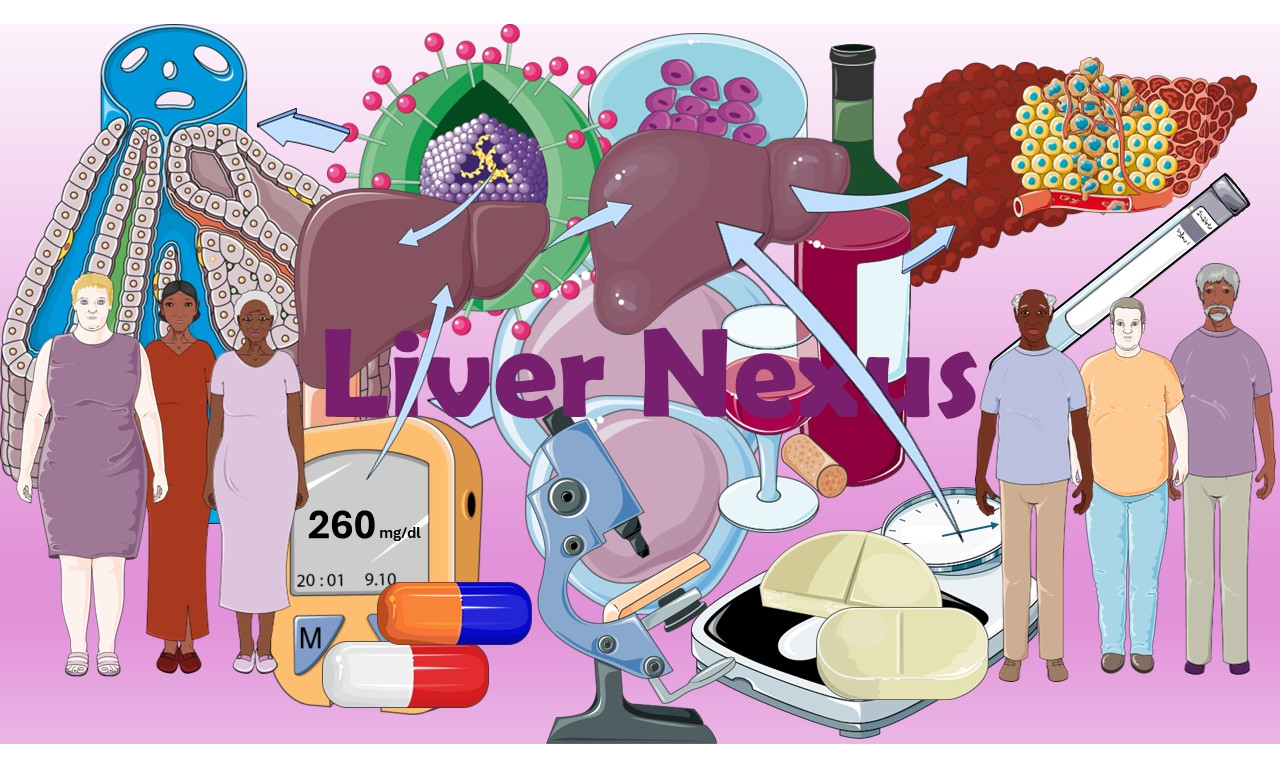
This Graphical abstract original illustration was created using Servier Medical ART (SMART) (https://smart.servier.com) and is licensed under the Creative Commons Attribution 4.0 International License (CC BY 4.0)(https://creativecommons.org/licenses/by/4.0/).
Authors’ contributions
The author contributed solely to the article.
Availability of data and materials
Not applicable.
Financial support and sponsorship
None.
Conflicts of interest
The author is the Editor-in-Chief of Liver Nexus. This Editorial was not externally peer reviewed and was accepted directly by the publisher. The Editor-in-Chief was not involved in the handling or decision-making for this manuscript.
Ethical approval and consent to participate
Not applicable.
Consent for publication
Not applicable.
Copyright
© The Author(s) 2025.
REFERENCES
1. Kalra A, Yetiskul E, Wehrle CJ, et al. Physiology, Liver. [Updated 2023 May 1]. In: StatPearls [Internet]. Treasure Island (FL): StatPearls Publishing; 2025 Jan. Available from: https://www.ncbi.nlm.nih.gov/books/NBK535438/. (accessed 2025-12-25).
2. Devarbhavi H, Asrani SK, Arab JP, Nartey YA, Pose E, Kamath PS. Global burden of liver disease: 2023 update. J Hepatol. 2023;79:516-37.
3. Silva ML, Prado R. Systematic mapping of worldwide research on metabolic dysfunction-associated steatotic liver disease (MASLD) and metabolic dysfunction-associated steatohepatitis (MASH). Dig Dis Sci. 2025.
4. Gan PL, Huang S, Pan X, et al. Global research trends in the field of liver cirrhosis from 2011 to 2020: A visualised and bibliometric study. World J Gastroenterol. 2022;28:4909-19.
Cite This Article
 Open Access
How to Cite
Download Citation
Export Citation File:
Type of Import
Tips on Downloading Citation
Citation Manager File Format
Type of Import
Direct Import: When the Direct Import option is selected (the default state), a dialogue box will give you the option to Save or Open the downloaded citation data. Choosing Open will either launch your citation manager or give you a choice of applications with which to use the metadata. The Save option saves the file locally for later use.
Indirect Import: When the Indirect Import option is selected, the metadata is displayed and may be copied and pasted as needed.
About This Article
Copyright

Data & Comments
Data
0







Comments
Comments must be written in English. Spam, offensive content, impersonation, and private information will not be permitted. If any comment is reported and identified as inappropriate content by OAE staff, the comment will be removed without notice. If you have any queries or need any help, please contact us at [email protected].