
fig3
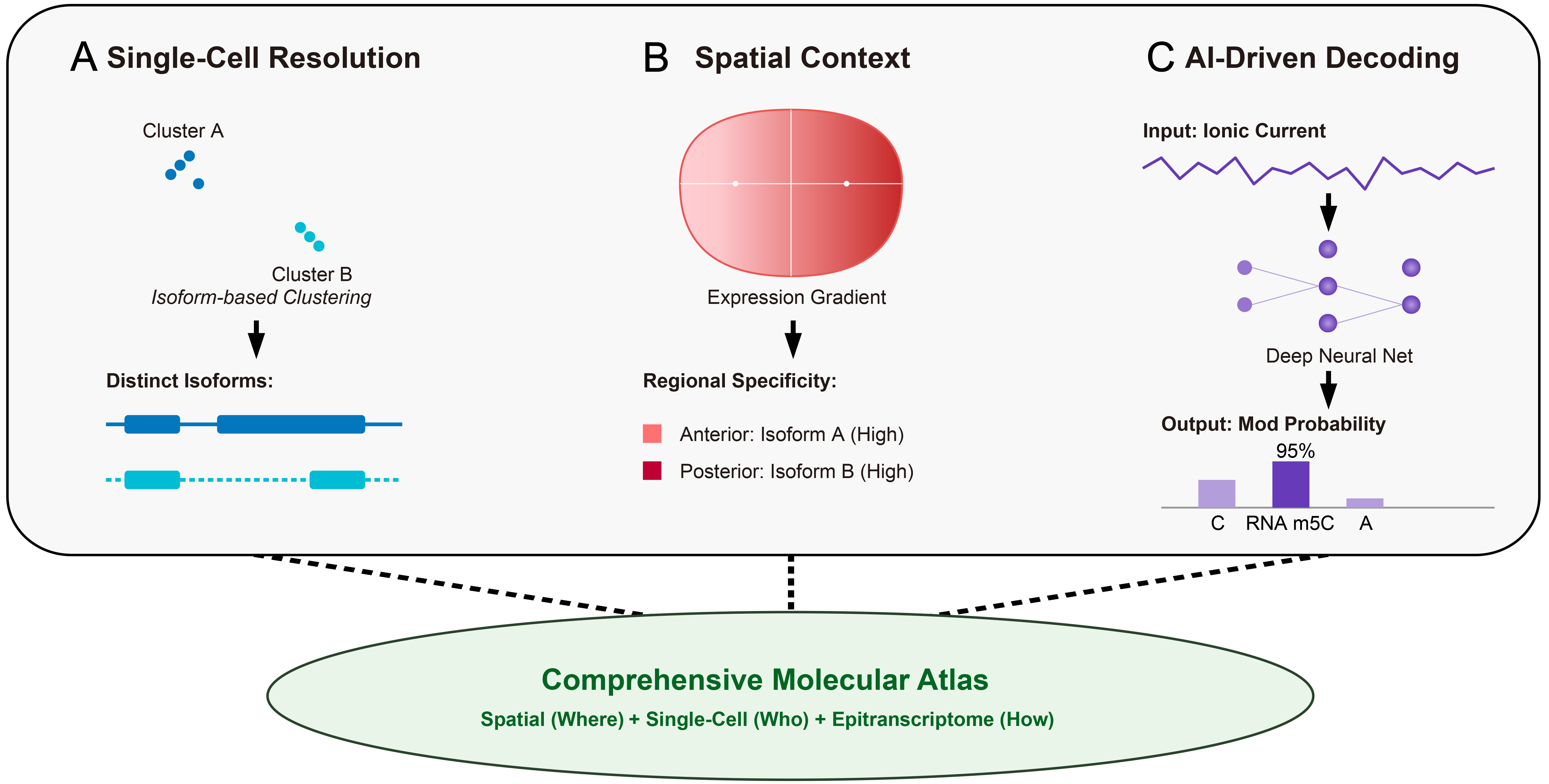
Figure 3. The future ecosystem of developmental genomics: converging frontiers. The next generation of LRS applications will be defined by three emerging pillars; (A) Single-cell resolution: moving from bulk to single-cell long-read sequencing (scLRS) to resolve isoform diversity at cellular granularity. Isoform-based clustering separates cell subpopulations (for example, Cluster A and Cluster B) that gene-level clustering merges; (B) Spatial context: spatial barcoding maps full-length isoforms to anatomical coordinates within developing tissue, so that expression gradients can be assigned to defined regions (for example, anterior versus posterior) and to specific cell types; (C) AI-driven decoding: deep neural networks interpret raw ionic current signal to estimate modification probabilities at individual positions, distinguishing, for example, RNA 5-methylcytosine (m5C) from unmodified cytosine without chemical conversion. The three pillars converge to produce a comprehensive molecular atlas that combines the spatial (where), single-cell (who), and epitranscriptomic (how) dimensions of development. The individual examples shown in the panel are illustrative of each pillar rather than observations from a single study. AI: Artificial intelligence.