
fig2
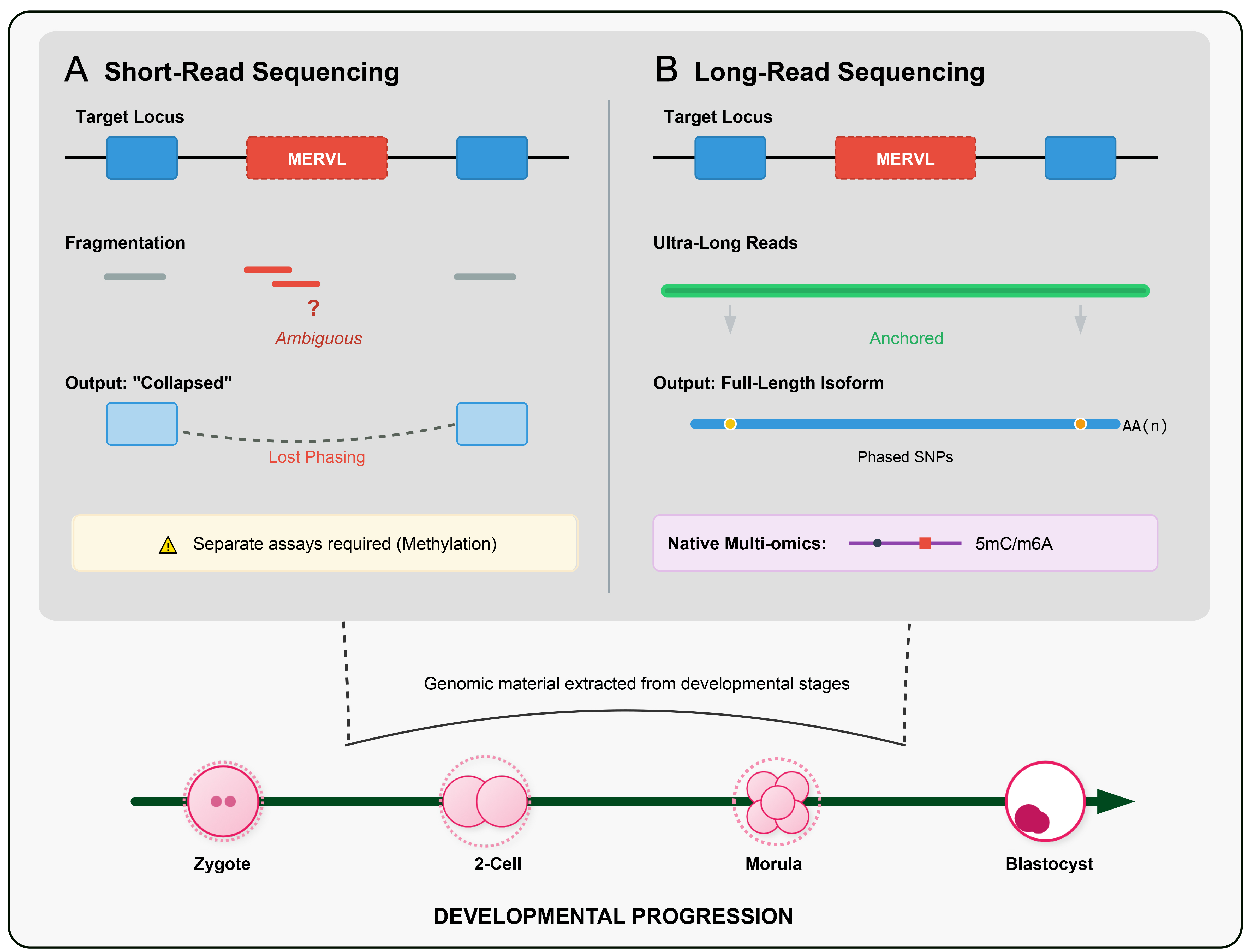
Figure 2. The resolution revolution: from fragmented snapshots to native holistic views. (A) Short-read sequencing requires fragmentation of the target molecule before sequencing. Reads derived from a repetitive target locus such as MERVL cannot be assigned unambiguously to their genomic origin, and the resulting output is a collapsed representation in which haplotype phasing is lost; DNA methylation, RNA modification, and poly(A) tail information must be obtained from separate assays; (B) Long-read sequencing sequences the whole molecule without fragmentation. Ultra-long reads span repetitive elements together with their unique flanking sequences, so that the transcript can be anchored to a single locus, single-nucleotide polymorphisms within the same molecule can be phased, and native modifications such as 5mC and m6A are read from the same molecule that provides the sequence. Both panels are set against the same developmental continuum, from zygote to blastocyst, to emphasize that LRS preserves the molecular continuity of material extracted from these stages rather than sampling it in fragments. 5mC: DNA 5-methylcytosine; m6A: N6-methyladenosine in RNA; LRS: long-read sequencing; MERVL: murine endogenous retrovirus-L.