



A federated learning–driven data fusion strategy for the hardenability prediction of gear steel
 0
0 Abstract
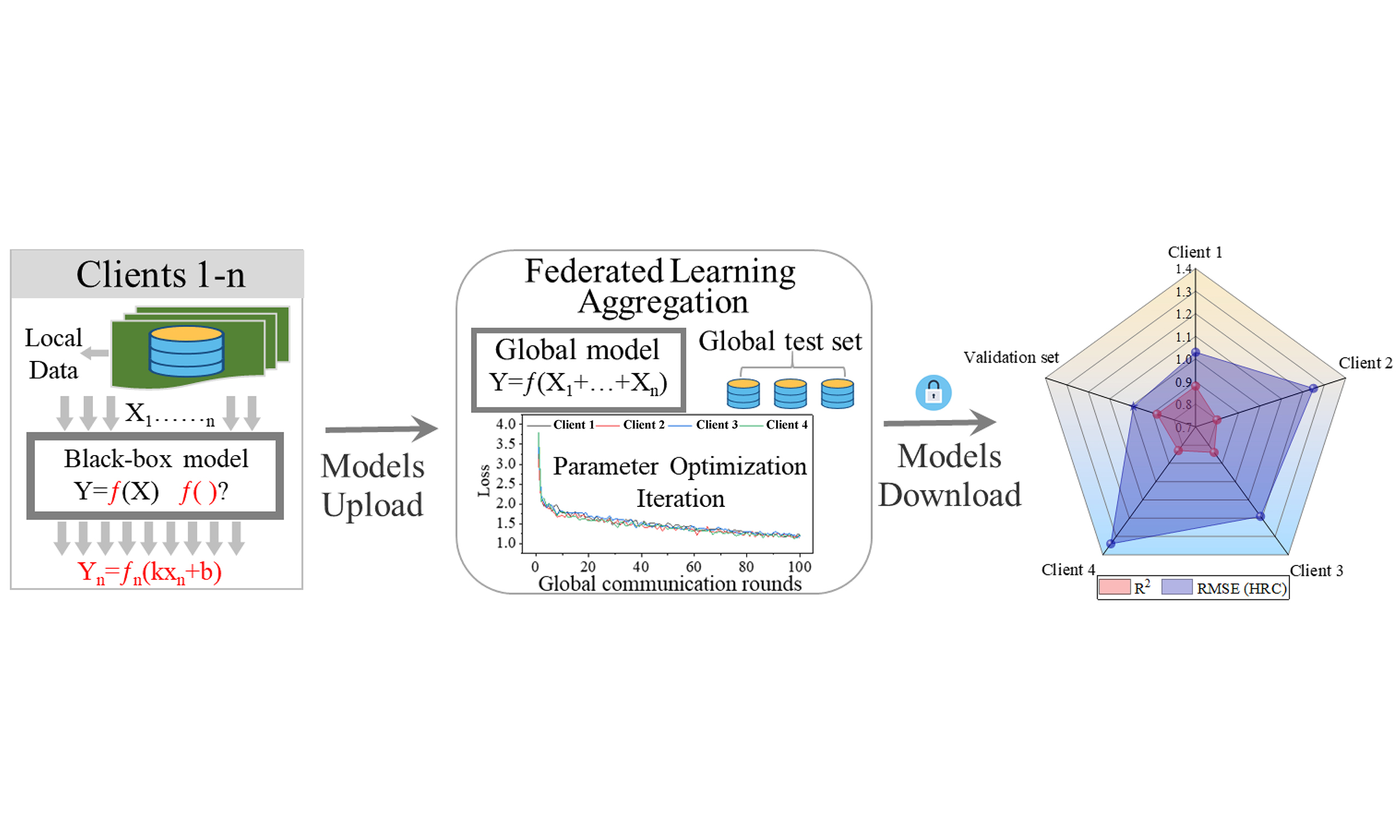
Hardenability is a critical indicator for evaluating the mechanical performance and service reliability of gear steel. However, conventional Jominy end-quench testing is labor-intensive and time-consuming, and data sharing among different companies is often restricted, which further complicates hardenability assessment. To address these challenges, a federated learning–driven data fusion strategy incorporating a multi-regularized attention residual network model for hardenability prediction (MRAN-J9) is proposed. In this strategy, collaborative models are trained on heterogeneous data from multiple sources, improving predictive accuracy while preserving the privacy of each participant’s raw data. Additionally, stable predictive performance is evaluated on a completely independent external validation dataset containing 755 samples [the coefficient of determination (R2) = 0.88, root mean square error (RMSE) = 0.99, Rockwell hardness (HRC)], demonstrating the generalization capability and predictive stability. The results confirm the feasibility and effectiveness of federated learning for privacy-preserving multi-party collaborative modeling. Furthermore, integrating the MRAN-J9 model facilitates the effective exploitation of distributed multi-source data, providing a practical and reliable solution for hardenability prediction in complex industrial application scenarios.
Keywords
INTRODUCTION
Hardenability is a critical parameter for evaluating the service performance of high-strength steel components such as gears and shafts[1]. It reflects the ability of steel to develop uniform hardness and microstructural characteristics throughout the cross-section during quenching heat treatment, thereby directly influencing the mechanical properties and service life of the components[2,3]. At present, steel hardenability is most commonly assessed using the Jominy end-quench test. Originally proposed by Jominy and Boegehold[4], this standardized method characterizes hardenability by measuring the hardness distribution along the length of a cylindrical specimen subjected to water cooling at one end, yielding the corresponding end-quench curve[5,6]. Despite its widespread adoption and high degree of standardization, the Jominy test is prone to experimental uncertainties arising from oxide scale formation, microstructural inhomogeneity, and operator-dependent variability. Moreover, the testing procedure is relatively labor-intensive and time-consuming, limiting its suitability for rapid and cost-effective evaluation of steel hardenability in practical applications[7,8].
To enable rapid evaluation of the hardenability of steel materials, the literature has proposed a wide range of empirical and semi-empirical models, along with various predictive equations[9-11]. However, these approaches generally depend on restrictive assumptions and simplified parameter relationships, which limit their ability to capture the complex, nonlinear interactions inherent in multi-component steel systems. In recent years, the rapid advancement of machine learning techniques has led to significant progress in data-driven prediction and design of materials properties[12-14]. Among these approaches, federated learning has emerged as a promising distributed learning strategy that effectively balances predictive performance and data privacy, making it particularly attractive for industrial applications[15,16]. To enable accurate prediction of defects in sheet metal forming processes, da Silveira Dib et al. proposed a federated learning-based framework integrated with digital envelopes, which effectively predicted defects in sheet metal forming[17]. To accurately predict the welding quality of friction stir welding, Chakraborty et al. developed a federated learning-based monitoring system that effectively predicted weld quality[18]. Similarly, Wu et al. proposed a three-layer federated learning framework for the collaborative training of deep learning models, which was successfully applied to quality defect detection in construction projects[19]. These findings demonstrate that federated learning enables collaborative modeling across companies and production lines while preserving data security, and that its range of applications in industrial environments is steadily expanding.
In this work, experimental hardenability data of gear steel from four steel companies are collected, and the J9 value is used as the target performance indicator for modeling and prediction. The methodological advance of this work does not lie in introducing a new elementary neural-network operator. Instead, it develops a federated regression strategy for hardenability, in which the network architecture, regularization strategy, and server aggregation rule are jointly designed for gear steel data from multiple sources. Specifically, efficient channel attention (ECA) is used to reweight coupled alloying element channels, preactivation residual blocks are employed to stabilize learning from moderately sized tabular datasets, dual-noise regularization is calibrated to composition measurement fluctuations and optimization uncertainty, and hierarchical feature aggregation is introduced to combine element-wise sensitivity with nonlinear alloying interactions. In addition, an adaptive sample loss aggregation rule is designed to mitigate non-independent and identically distributed (non-IID) client drift, extending beyond conventional aggregation relying on sample size. This strategy protects clients’ raw data and improves the robustness of J9 hardenability prediction under heterogeneous industrial data distributions.
MATERIALS AND METHODS
Data source and processing
The data utilized in this work are collected from the actual industrial production lines of four major steelmaking enterprises, resulting in a final dataset of 4,244 gear steel samples. Specifically, these four enterprises contributed 1,058, 1,016, 1,100, and 1,070 samples, respectively. Each sample comprises 25 chemical composition variables and the J9. In the standard Jominy end-quench test, J9 represents the Rockwell hardness (HRC) measured at a specific distance of 9 mm from the quenched end of the specimen. All experiments are conducted under uniform testing conditions and parameter settings, including a sample diameter of 25 mm, a length of 100 mm, a boss diameter of 30 mm with a length of 3 mm, and an austenitizing treatment at 950 °C for 1 h prior to end quenching. The experimental parameters are consistent across all samples; therefore, heat treatment process variables are not included as input features in the machine learning models. The analysis instead focused exclusively on the intrinsic relationship between chemical composition and hardenability.
Machine learning modeling and validation
This study employs a range of machine learning regression algorithms to predict J9 hardness values, including the K-nearest neighbors regressor (KNN), linear regression (LR), ridge regression (RR), support vector machine regressor (SVM), gradient boosting decision tree (GBDT), extreme gradient boosting (XGB), random forest (RF), and light gradient boosting machine (LGBM). The predictive performance of these models is systematically evaluated using the coefficient of determination (R2) and the root mean square error (RMSE). The R2 metric quantifies the goodness of fit between predicted and experimental values, providing a quantitative measure of the model’s ability to explain data variability[20,21]. In contrast, RMSE reflects the overall magnitude of prediction errors, with smaller values indicating higher predictive accuracy. The mathematical definitions of R2 and RMSE are provided to ensure a consistent, standardized, and comparable evaluation of model performance in predicting J9 hardness values.
where yi,
To address composition-based hardenability prediction using industrial data, a multi-regularized attention residual network, termed MRAN-J9, is developed in this work. The model is designed not to introduce new elementary neural network operators, but to construct a regression architecture tailored to this specific task. Specifically, this architecture aims to capture interactions among alloying elements, improve robustness to industrial measurement fluctuations, and stabilize learning under non-IID data distributions across multiple clients. The MRAN-J9 architecture consists of four functional stages: input regularization, attention-enhanced residual feature extraction, hierarchical feature aggregation, and regression output.
In the input and feature-extraction stages, the normalized chemical-composition vector is first processed by Gaussian error linear unit (GELU)-based nonlinear transformations and an ECA layer. GELU provides smooth nonlinear mapping and preserves weak but informative composition responses. The GELU function is defined as follows:
where GELU(x) denotes the output of the Gaussian error linear unit activation function, x represents the input feature of the neuron, and erf(·) is the Gaussian error function. The coefficient 0.5 and the normalization term
To further improve generalization, dual-noise regularization is introduced. This dual-noise design is functionally complementary and dataset-tailored: the Gaussian noise imposes input-space robustness against actual spectrometer errors (σ = 0.003, indicating ~0.3% perturbation of the standardized feature scale), while the gradient noise acts on optimization dynamics to prevent convergence to sharp minima, a critical safeguard for small-sample industrial data (~103 per client).
Federated learning strategy
Federated learning is a privacy-preserving distributed machine learning paradigm developed to address the data silo challenge arising from the difficulty of centrally sharing data across multiple sources. The concept is first introduced by Google in 2016 to enable on-device model training and updates on Android systems without transmitting raw data, thereby safeguarding user privacy[22,23]. In this work, the goal is for four clients to collaboratively train a global regression model without sharing data, achieving an accurate prediction of the target variable J9. The core modules of the federated learning strategy include data preprocessing and federated standardization, FedProx local training, adaptive global aggregation, and model evaluation and early stopping. Specifically, for each client, local training is terminated early if the local validation loss does not decrease for 10 consecutive local epochs. At the server side, the global aggregation process is terminated if the global validation loss showed no improvement for 20 consecutive global communication rounds. The maximum number of global communication rounds is uniformly set to 100 as the hard upper bound. During execution, the global early stopping criterion is not activated, so the model training proceeded through the entire 100 rounds. The detailed training configurations and hyperparameter settings, including federated training schemes, optimization parameters, FedProx coefficient, adaptive aggregation coefficient, loss function settings, and regularization strategies, are summarized in Supplementary Table 1. The total loss in FedProx training consists of two parts: regression loss (Huber Loss) and a proximal term penalty. The formula is as follows:
where ϑlocal denotes the total local loss of an individual client; ϑhubert(y,
where y denotes the ground-truth label of the sample,
In conventional FedAvg, the contribution of each client is usually determined only by its local sample size. This strategy may be insufficient for gear steel data from multiple plants because different companies may have distinct composition ranges, hardness distributions, and measurement fluctuations. A client with a larger dataset may dominate the global update even when its local distribution is biased, whereas a client with fewer samples but more stable local optimization may be underrepresented. Therefore, this work introduces an adaptive sample-loss aggregation strategy. The sample-size term reflects the statistical contribution of each client, while the loss-based term reflects the reliability of the current local update. By jointly considering these two factors, the proposed aggregation strategy dynamically adjusts client contributions during federated training and helps mitigate client drift under non-IID industrial data distributions.
To replace the traditional weighting method based solely on the number of samples, an adaptive weighting strategy is designed by jointly considering the number of samples and the loss. The combined weight calculation formula is as follows:
where ωk denotes the final adaptive weight of the K-th client; α is the weight allocation coefficient used to balance the relative contributions of the sample size and the loss value, with α ∈ (0,1); ωksample denotes the normalized weight based on the sample size; and ωkloss denotes the normalized weight based on the local loss.
The formula for calculating the sample size normalized weight is as follows:
where Nk denotes the number of samples held by the K-th client; K denotes the total number of clients participating in federated training (in this study, K = 4); and Σm=1KNm denotes the total number of samples across all clients.
The formula for calculating the normalized loss weight is:
where ϑmax denotes the maximum local training loss among all clients in the current round; ϑk denotes the local training loss of the K-th client; and Σm=1K(ϑmax - ϑm) denotes the sum of the differences between the maximum loss and the losses of all clients.
Based on adaptive weights, the local model parameters of each client are weighted and summed to obtain the updated global model parameters. The formula is as follows:
where pglobalnew denotes the p_th parameter of the updated global model; pk denotes the p_th parameter of the local model of the K-th client; and Σk=1Kωk·pk represents the weighted sum of the local parameters of all clients using the adaptive weights.
RESULTS AND DISCUSSION
The overall workflow of the proposed federated learning strategy is illustrated in Figure 1. In the traditional approach, models are trained independently by each client using only local datasets; however, predictive performance is frequently hindered by limited data volumes and heterogeneous sample distributions. To overcome these constraints, the federated learning strategy is employed, where local models are uploaded to a central server for parameter aggregation. This process updates the global model, which is subsequently redistributed to the clients to achieve significantly enhanced predictive accuracy. Crucially, this strategy precludes direct data exchange between clients, thereby ensuring the security of the clients’ raw data.
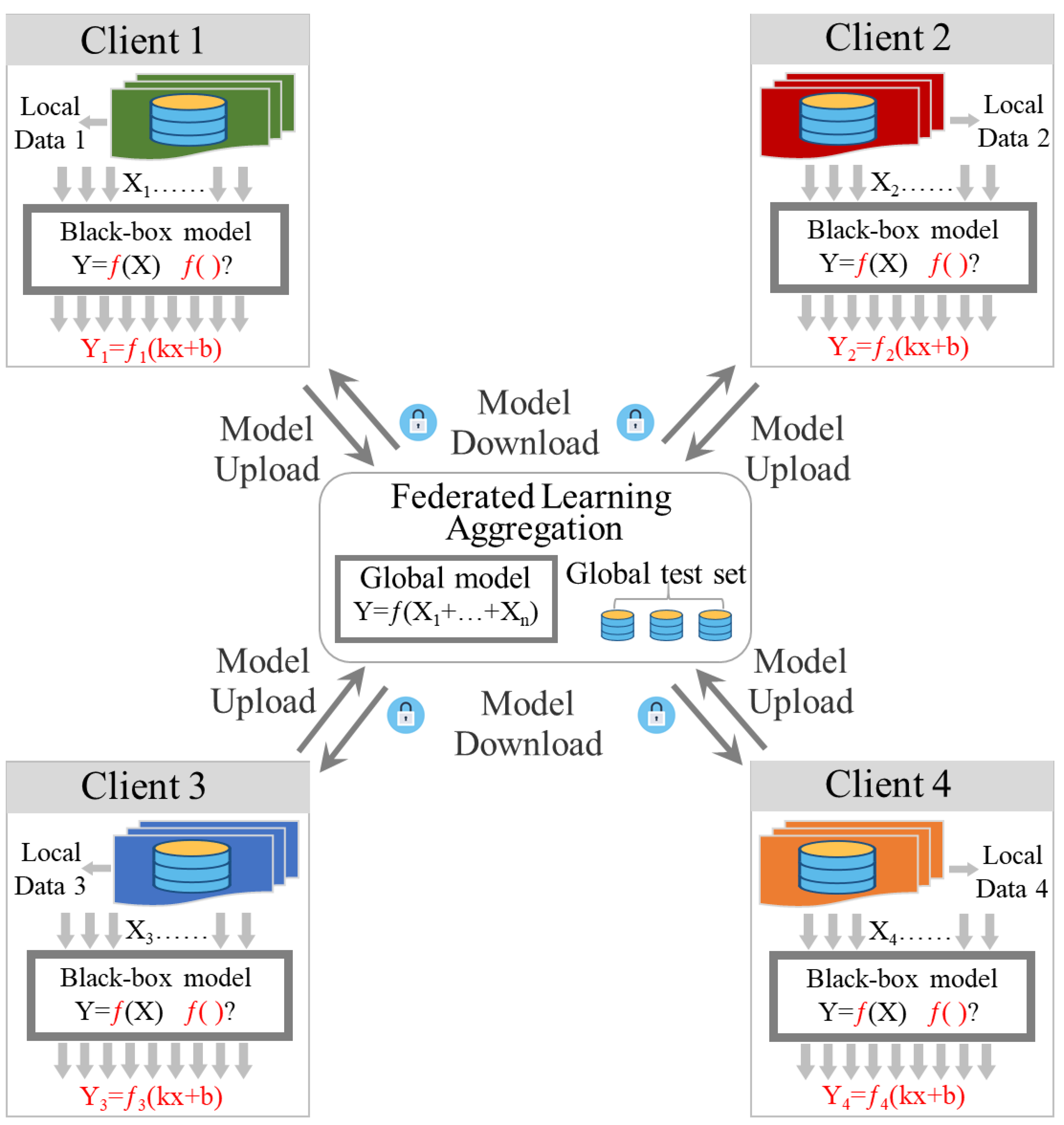
Figure 1. Server-client federated learning strategy and its training procedure.
The dataset is divided into training and testing sets at an 8:2 ratio, and the data distributions of the four clients are illustrated in Figure 2. The results indicated that for each client, both the training and testing sets generally follow an approximately normal distribution. This suggests that the data-splitting process preserves good statistical consistency, which is conducive to stable model training and reliable performance evaluation. Nevertheless, notable differences remain among the four clients in terms of data range and distribution characteristics. Specifically, the J9 hardness values are primarily distributed within the range of 28-44 HRC; however, substantial variations are observed across clients with respect to mean values, distribution widths, and sample densities. These discrepancies reflect the typical characteristics of multi-source heterogeneous data. The detailed statistical evaluation of each dataset is presented in Supplementary Table 2.
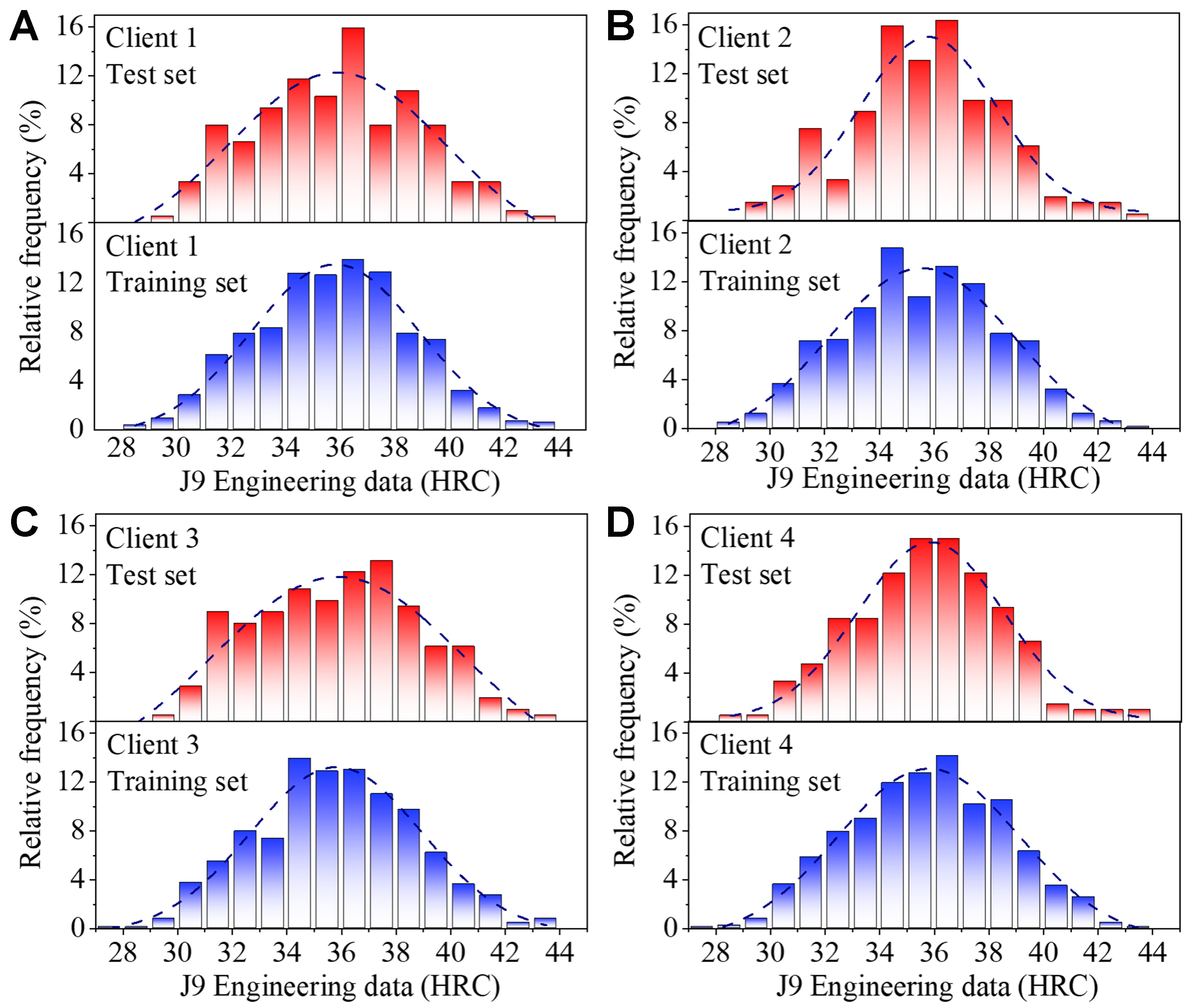
Figure 2. Data distribution of training and testing sets for machine learning from four clients. (A), (B), (C), and (D) correspond to clients 1, 2, 3, and 4, respectively. HRC: Rockwell hardness.
To better accommodate the modeling requirements of multi-source heterogeneous data within a federated learning strategy, this study proposed a novel MRAN-J9 model. The overall network architecture is illustrated in Figure 3A. The model is composed of four principal components: the Input Layer, the Residual Block Area, the Feature Aggregation Layer, and the Output Layer. In the Input Layer, multi-dimensional feature data are received and normalized. Within the Residual Block Area, residual connections are introduced to mitigate gradient vanishing during deep network training, thereby enhancing the model’s ability to capture complex nonlinear feature representations. The Feature Aggregation Layer fuses features extracted from different network layers, further strengthening the comprehensive modeling of salient information. Finally, the Output Layer generates the prediction of the target variable. Compared with conventional machine learning models, the MRAN-J9 model demonstrates clear advantages in feature representation capacity and generalization performance, making it more suitable for meeting the accuracy and stability requirements of practical production-line applications.
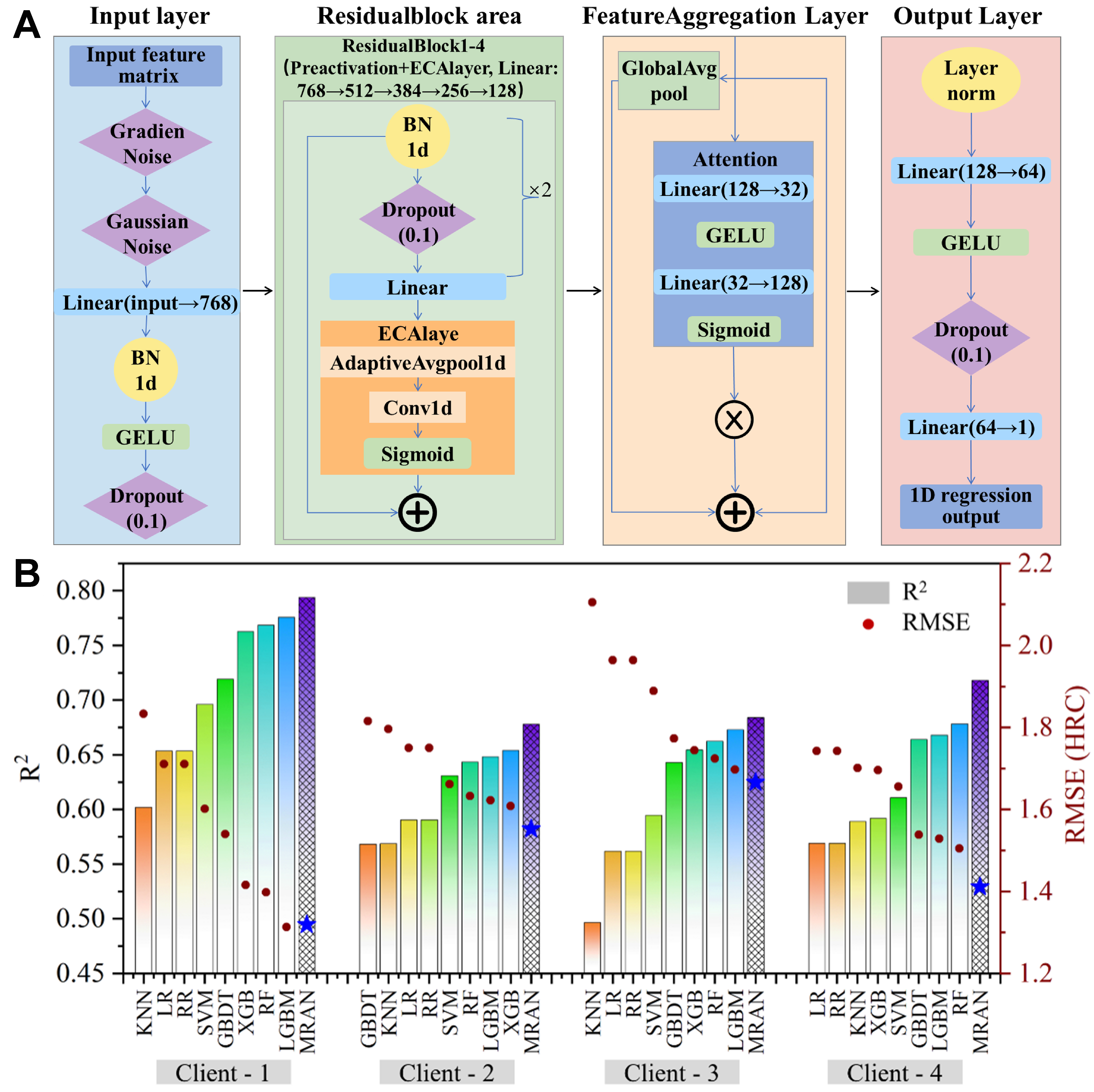
Figure 3. Model architecture and model prediction results. (A) MRAN-J9 architecture; (B) Model prediction results from multiple machine learning models across four clients. The blue five-pointed star indicates the lowest RMSE result. GELU: Gaussian error linear unit; ECA: efficient channel attention; R2: the coefficient of determination; RMSE: root mean square error; KNN: K-nearest neighbors regressor; LR: linear regression; RR: ridge regression; SVM: support vector machine regressor; GBDT: gradient boosting decision tree; XGB: extreme gradient boosting; RF: random forest; LGBM: light gradient boosting machine.
During the model evaluation phase, 20% of the data from each client is reserved as a testing set to assess predictive performance. A comparison of the prediction performance of the MRAN-J9 model and eight conventional machine learning models across datasets from four clients is presented in Figure 3B. The eight traditional machine learning models are trained independently using local data. The results indicate that MRAN-J9 consistently achieves superior predictive performance across all clients, which outperforms the remaining eight machine learning models, as reflected by the highest R2 and the lowest RMSE, the blue five-pointed star indicates the lowest RMSE result. These results demonstrate enhanced fitting capability and more stable predictive behavior (Client 1: R2 = 0.79, RMSE = 1.32 HRC; Client 2: R2 = 0.68, RMSE = 1.55 HRC; Client 3: R2 = 0.68, RMSE = 1.67 HRC; Client 4: R2 = 0.72, RMSE = 1.41 HRC). The detailed predictive results for the other eight machine learning models are summarized in Supplementary Table 3. Collectively, the results indicate that the MRAN-J9 model exhibits significant advantages in multi-client, multi-distribution data environments and effectively improves overall prediction performance. In addition to traditional machine learning, representative deep learning backbones [1-dimensional convolutional neural network (1D-CNN), multilayer perceptron (MLP), and squeeze-and-excitation multilayer perceptron (SE-MLP)] trained solely on local data are also evaluated. As detailed in Supplementary Table 4, the MRAN-J9 model consistently surpasses these modern deep learning baselines even before federated aggregation, and the gap widens when the federated strategy is applied, confirming the necessity of both the customized architecture and the collaborative training paradigm.
The parameter optimization process of the MRAN-J9 model for four clients within the federated learning strategy, together with the predictive performance of the corresponding optimal-parameter models, is presented in Figure 4. In each global communication round, the central server aggregates client-updated model parameters to update a global model, which is subsequently broadcast back to the clients to enable collaborative training while keeping raw data local. Each client then performs iterative local updates of the MRAN-J9 parameters on its own dataset, progressively converging to a client-specific optimum. For client 1, Figure 4A1 shows the optimization results over 100 global communication rounds, Figure 4A2 reports the prediction performance of the optimal model (R2 = 0.88, RMSE = 1.03 HRC), and Figure 4A3 depicts the frequency distribution of the predicted values. Figure 4B-D present the parameter optimization process and the corresponding prediction performance for clients 2-4 (Client 2: R2 = 0.80, RMSE = 1.25 HRC; Client 3: R2 = 0.84, RMSE = 1.19 HRC; Client 4: R2 = 0.83, RMSE = 1.34 HRC), respectively. Furthermore, the proportions of prediction errors falling within the ± 2 HRC range for the four clients are 94.39%, 92.99%, 89.72%, and 94.85%, respectively. Across all clients, predictions agree closely with the ground truth, with most points clustering around the 1:1 line, indicating that MRAN-J9 delivers consistent and robust predictive performance under the federated learning strategy. Beyond predictive accuracy, a SHAP feature-importance analysis is conducted on the datasets of all four clients. The results reveal that the top six most influential features (Mn, Cr, C, Ti, Si, and B) are identical across all clients. Notably, these elements are widely recognized in physical metallurgy for their significant influence on steel hardenability. This consistency effectively validates the model’s physical reliability. The detailed results are presented in Supplementary Figure 1.
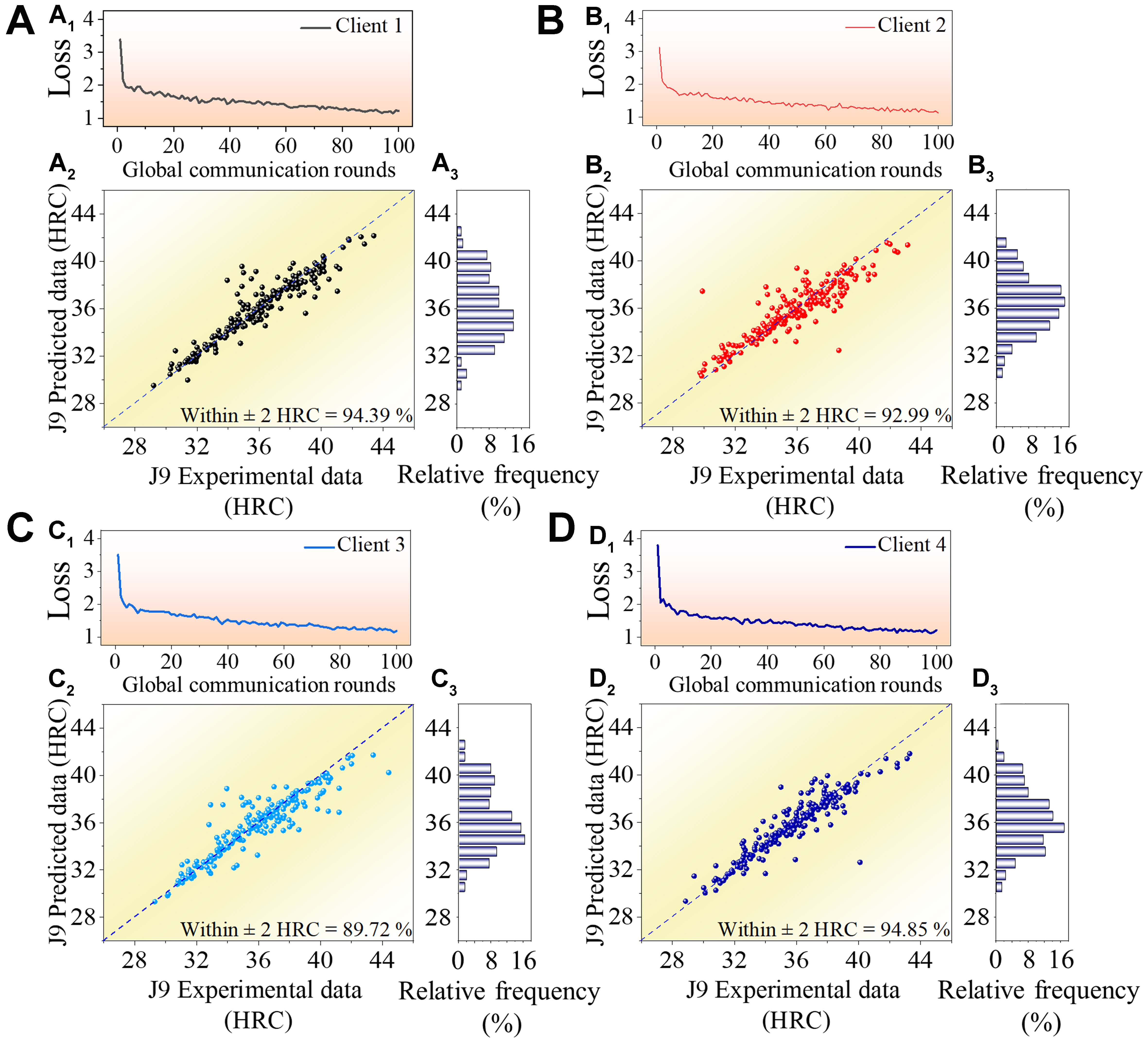
Figure 4. Parameter optimization of the federated learning strategy and prediction performance of the model with optimal parameters. (A1) Optimization results over 100 global communication rounds for Client 1; (A2) prediction performance of the optimal-parameter model; (A3) histogram of the frequency distribution of predicted values; (B-D) Optimization and prediction results for Clients 2, 3, and 4, respectively. HRC: Rockwell hardness.
To further clarify the source of the performance improvement, two levels of controlled comparisons are conducted. First, architectural ablation methods are performed under a purely local setting. The residual connection, ECA attention, noise regularization, and feature aggregation layer are removed individually while the remaining training settings are kept unchanged. As summarized in Supplementary Table 5, the full MRAN-J9 model achieved an average R2 of 0.72 across the four clients. After removing the residual connection, ECA attention, noise regularization, and feature aggregation layer, the average R2 decreased to 0.66, 0.67, 0.67, and 0.66, respectively. These results indicate that each architectural module contributes to the predictive capability of MRAN-J9 under the purely local setting.
To further distinguish the contribution of the federated aggregation strategy from the backbone architecture, benchmarks for both FedAvg and FedProx are additionally established under the identical MRAN-J9 network. The detailed ablation comparison is summarized in Supplementary Table 6. The results indicate that the adaptive weighting and robust preprocessing, rather than the proximal term alone, are the primary drivers of the performance enhancement, confirming the rationality of the federated learning design.
The results presented in Figure 4 demonstrate that the MRAN-J9 model trained under the federated learning strategy can effectively predict the test-set data of all four clients, as illustrated in Figure 5A. High predictive accuracy and good stability are maintained across different client data distributions. To further evaluate the generalization capability of the MRAN-J9 model, an additional validation dataset containing 755 samples is constructed. This validation dataset is derived from a different source than the original datasets of the four clients. The prediction results on the validation dataset are shown in Figure 5B, where an R2 of 0.88 and an RMSE of 0.99 HRC are achieved. Additionally, the model demonstrates excellent practical accuracy, with 93.38% of the errors strictly confined within the ± 2 HRC tolerance. These results indicate that the MRAN-J9 model can maintain robust predictive performance when applied to new data not used during training. Moreover, the findings demonstrate that the federated learning strategy effectively mitigates overfitting while fully leveraging multi-source data information, thereby significantly enhancing the model’s generalization capability and practical applicability.
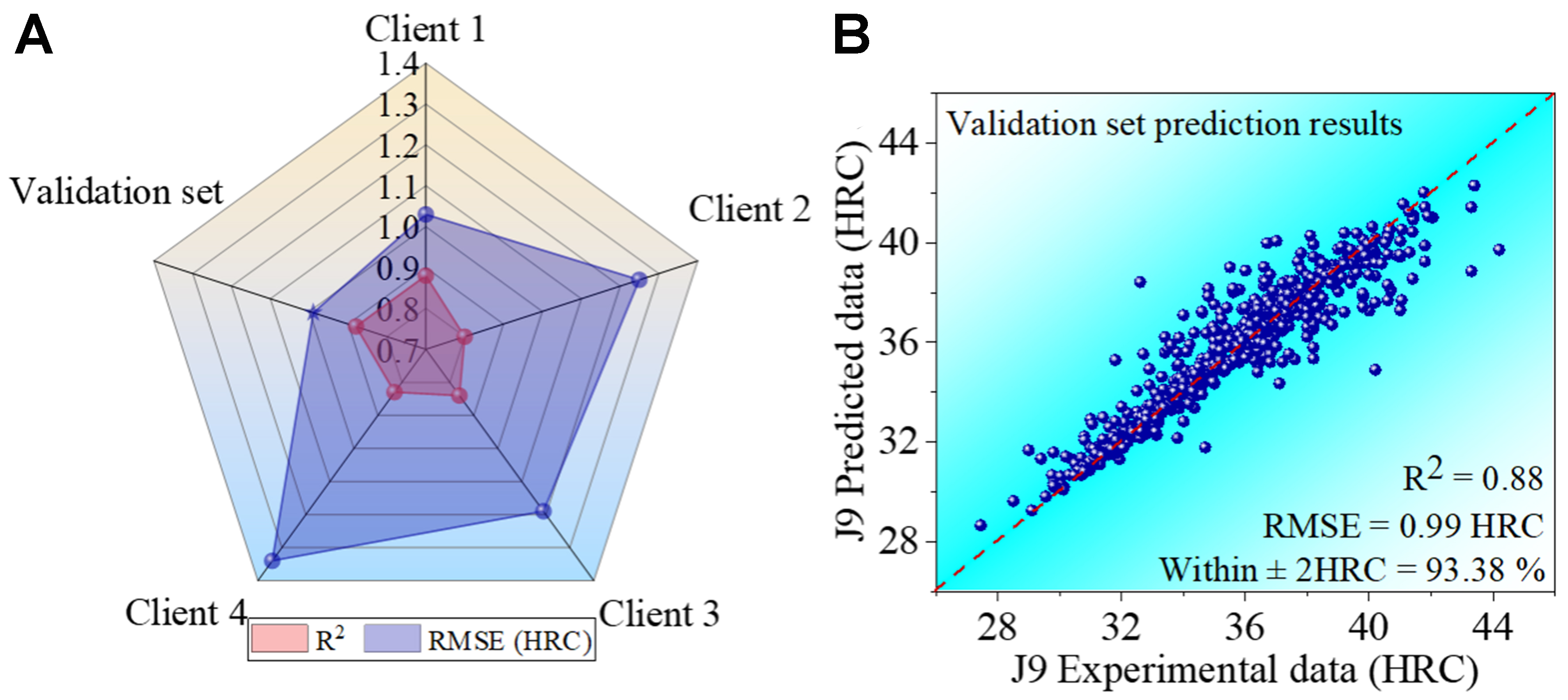
Figure 5. Federated learning validation set results. (A) The model prediction results for four clients and the validation set results; (B) Comparison of experimental and predicted values in the validation set. R2: The coefficient of determination; RMSE: root mean square error; HRC: Rockwell hardness.
In traditional centralized machine learning, distributed data are aggregated at a central server for model training[24-26]. In contrast, federated learning enables the construction of shared models among multiple participants in a secure, efficient, and regulation-compliant manner without requiring data to leave their respective domains[27,28]. As demonstrated by the results in Figures 4 and 5, the MRAN-J9 model trained under the federated learning strategy effectively adapts to heterogeneous data distributions across different clients while exhibiting strong generalization performance on an external independent validation dataset. These findings further validate the advantages of federated learning for collaborative modeling involving multi-source heterogeneous data.
With the continued advancement of federated learning theory and techniques, its application scope has been progressively extended to a wide range of domains, including intelligent healthcare[29], recommendation systems, smart cities[30], finance and insurance, and edge computing[31]. In response to the increasing complexity of application requirements, federated learning algorithms and system architectures are being actively investigated to achieve improved trade-offs among data security, communication efficiency, and model performance. By facilitating cross-institutional collaboration via secure connection platforms, federated learning is driving data collaboration paradigms toward more legal, compliant, and sustainable practices. In this context, the MRAN-J9 model proposed in this study provides effective technical support for deploying federated learning in industrial application scenarios.
CONCLUSIONS
In this work, an MRAN-J9 model suitable for federated learning strategy is proposed and systematically validated using data from four clients. The results demonstrate that the MRAN-J9 model trained under the federated learning strategy effectively adapts to the heterogeneous data distribution characteristics of different clients, achieving superior predictive performance on each client’s test set when compared with non-federated learning modeling approaches. Furthermore, high predictive accuracy is maintained on a completely independent external validation dataset (R2 = 0.88, RMSE = 0.99 HRC), thereby demonstrating the model’s strong generalization capability and stability. These findings further confirm the feasibility and effectiveness of federated learning in enabling collaborative modeling across multiple data owners while protecting client raw data and complying with regulatory requirements. By integrating MRAN-J9 into the federated learning strategy, latent feature information from multi-source data is more fully exploited, and the limitations of single-source modeling are alleviated. This integrated approach offers a new paradigm for researching the properties of gear steel, facilitating broader application deployment across environments involving multiple enterprises and production lines.
DECLARATIONS
Acknowledgment
The computing work is supported by USTB MatCom of Beijing Advanced Innovation Center for Materials Genome Engineering.
Authors’ contributions
Writing - original draft, software, methodology, formal analysis, data curation: Shang, C.; Jiang, T.
Writing - review and editing, supervision, project administration, investigation: Wu, H. H.; Wang, B.
Validation, investigation, data collection: Wang, S.; Gao, J.
Visualization, resources, formal analysis, conceptualization: Zhao, H.; Zhang, C.; Zhang, L.
Supervision, conceptualization, revised and finalized the manuscript: Mao, X.
Availability of data and materials
The data that support the findings of this study are available from the corresponding author upon reasonable request.
AI and AI-assisted tools statement
Not applicable.
Financial support and sponsorship
This work is financially supported by the Advanced Materials-National Science and Technology Major Project (2025ZD0619601). Wu, H. H. also thanks the financial support from the Xiaomi Young Scholars Program.
Conflicts of interest
Wu, H. H. is a Youth Editorial Board Member of the journal Journal of Materials Informatics, but was not involved in any steps of editorial processing, including reviewer selection, manuscript handling, and decision-making, while the other authors have declared that they have no conflicts of interest.
Ethical approval and consent to participate
Not applicable.
Consent for publication
Not applicable.
Copyright
© The Author(s) 2026.
Supplementary Materials
REFERENCES
1. Erden, M. A.; Aydın, F. Wear and mechanical properties of carburized AISI 8620 steel produced by powder metallurgy. Int. J. Miner. Metall. Mater. 2021, 28, 430-9.
2. Xue, H.; Peng, W.; Yu, L.; et al. Effect of hardenability on microstructure and property of low alloy abrasion-resistant steel. Mater. Sci. Eng. A. 2020, 793, 139901.
3. Di Schino, A.; Emilio Di Nunzio, P.; Maria Cabrera, J. Effect of quenching & partitioning process on a low carbon steel. Adv. Mater. Lett. 2017, 8, 641-4.
4. Jominy, W.; Boegehold, A. L. A hardenability test for carburizing steel. Trans. ASM. 1938, 26, 574-606.
5. Tenaglia, N. E.; Boeri, R. E.; Massone, J. M.; Basso, A. D. Assessment of the austemperability of high-silicon cast steels through Jominy hardenability tests. Mater. Sci. Technol. 2018, 34, 1990-2000.
6. Çakir, M.; Özsoy, A. Investigation of the correlation between thermal properties and hardenability of Jominy bars quenched with air–water mixture for AISI 1050 steel. Mater. Design. 2011, 32, 3099-105.
7. Newkirk, J.; Mackenzie, D. The Jominy end quench for light-weight alloy development. J. Mater. Eng. Perform. 2000, 9, 408-15.
8. Hömberg, D. A numerical simulation of the Jominy end-quench test. Acta. Mater. 1996, 44, 4375-85.
9. Zhu, D.; Wang, B.; Zhao, H.; et al. Enhanced hardenability prediction in 20CrMo special steel via XGBoost model. J. Iron Steel Res. Int. 2025, 32, 1023-33.
10. Jin, M.; Lian, J.; Jiang, Z. New method for prediction of Jominy curve of structural steel. Acta. Metall. Sin. 2006, 42, 405-10. https://www.ams.org.cn/EN/Y2006/V42/I4/405. (accessed on 6 Aug 2026).
11. Geng, X.; Cheng, Z.; Wang, S.; et al. A data-driven machine learning approach to predict the hardenability curve of boron steels and assist alloy design. J. Mater. Sci. 2022, 57, 10755-68.
12. Shang, C.; Zhu, D.; Wu, H.; et al. A quantitative relation for the ductile-brittle transition temperature in pipeline steel. Scr. Mater. 2024, 244, 116023.
13. Fu, Y.; Zhu, D.; Wu, H.; et al. Predicting the yield strength ratio of spring steels via machine learning with experimental validation. cScience 2026, 2, e70024.
14. Song, L.; Wang, C.; Li, Y.; Wei, X. Predicting stacking fault energy in austenitic stainless steels via physical metallurgy-based machine learning approaches. J. Mater. Inf. 2025, 5, 2.
15. Jiang, J.; Hu, L.; Hu, C.; Liu, J.; Wang, Z. BACombo - bandwidth-aware decentralized federated learning. Electronics 2020, 9, 440.
16. Hao, M.; Li, H.; Luo, X.; Xu, G.; Yang, H.; Liu, S. Efficient and privacy-enhanced federated learning for industrial artificial intelligence. IEEE. Trans. Ind. Inf. 2020, 16, 6532-42.
17. da Silveira Dib, M. A.; Prates, P.; Ribeiro, B. SecFL - secure federated learning framework for predicting defects in sheet metal forming under variability. Expert. Syst. Appl. 2024, 235, 121139.
18. Chakraborty, S.; Guha, S.; Mishra, D.; Pal, S. K. Federated learning for weld quality prediction. J. Dyn. Monit. Diagn. 2024, 3, 237-45.
19. Wu, H.; Li, H.; Chi, H.; Kou, W.; Wu, Y.; Wang, S. A hierarchical federated learning framework for collaborative quality defect inspection in construction. Eng. Appl. Artif. Intell. 2024, 133, 108218.
20. Shang, C.; Jiang, T.; Wu, H.; et al. Efficient design of hydrogen-resistant ultra-high-strength steels via active learning and multiscale characterization. Corros. Commun. 2026, 21, 60-72.
21. Xu, M.; Xing, S.; Hong, J.; et al. A hybrid deep learning model for robust and data-efficient lithium-ion battery remaining useful life prediction. J. Mater. Inf. 2026, 6, 26.
22. McMahan, H. B.; Moore, E.; Ramage, D.; Hampson, S.; Arcas, B. A. Communication-efficient learning of deep networks from decentralized data. arXiv 2016, arXiv:1602.05629. Available online: https://doi.org/10.48550/arXiv.1602.05629. (accessed on 6 Aug 2026).
23. Yang, Q.; Liu, Y.; Chen, T.; Tong, Y. Federated machine learning: concept and applications. ACM. Trans. Intell. Syst. Technol. 2019, 10, 1-19.
24. Hao, C.; Kuai, P.; Duan, J.; et al. Machine-learning-enabled composition–process co-design of heat-resistant cast aluminum alloys with superior elevated-temperature strength. J. Mater. Inf. 2026, 6, 38.
25. Guo, S.; Yu, J.; Liu, X.; Wang, C.; Jiang, Q. A predicting model for properties of steel using the industrial big data based on machine learning. Comput. Mater. Sci. 2019, 160, 95-104.
26. Shen, C.; Wang, C.; Wei, X.; Li, Y.; van der Zwaag, S.; Xu, W. Physical metallurgy-guided machine learning and artificial intelligent design of ultrahigh-strength stainless steel. Acta. Mater. 2019, 179, 201-14.
27. Li, A.; Zhang, L.; Wang, J.; Han, F.; Li, X. Privacy-preserving efficient federated-learning model debugging. IEEE. Trans. Parallel. Distrib. Syst. 2022, 33, 2291-303.
28. Li, T.; Sahu, A. K.; Talwalkar, A.; Smith, V. Federated learning: challenges, methods, and future directions. IEEE. Signal. Process. Mag. 2020, 37, 50-60.
29. Rieke, N.; Hancox, J.; Li, W.; et al. The future of digital health with federated learning. NPJ. Digit. Med. 2020, 3, 119.
30. Zheng, Z.; Zhou, Y.; Sun, Y.; Wang, Z.; Liu, B.; Li, K. Applications of federated learning in smart cities: recent advances, taxonomy, and open challenges. arXiv 2021, arXiv:2102.01375. Available online: https://doi.org/10.48550/arXiv.2102.01375. (accessed on 6 Aug 2026).
Cite This Article
 Open Access
How to Cite
Download Citation
Export Citation File:
Type of Import
Tips on Downloading Citation
Citation Manager File Format
Type of Import
Direct Import: When the Direct Import option is selected (the default state), a dialogue box will give you the option to Save or Open the downloaded citation data. Choosing Open will either launch your citation manager or give you a choice of applications with which to use the metadata. The Save option saves the file locally for later use.
Indirect Import: When the Indirect Import option is selected, the metadata is displayed and may be copied and pasted as needed.
About This Article
Copyright

Data & Comments
Data
0










Comments
Comments must be written in English. Spam, offensive content, impersonation, and private information will not be permitted. If any comment is reported and identified as inappropriate content by OAE staff, the comment will be removed without notice. If you have any queries or need any help, please contact us at [email protected].