

Mitochondrial homeostasis in heart failure with preserved ejection fraction: from metabolic remodeling to multi-organ crosstalk
 0
0 Graphical Abstract
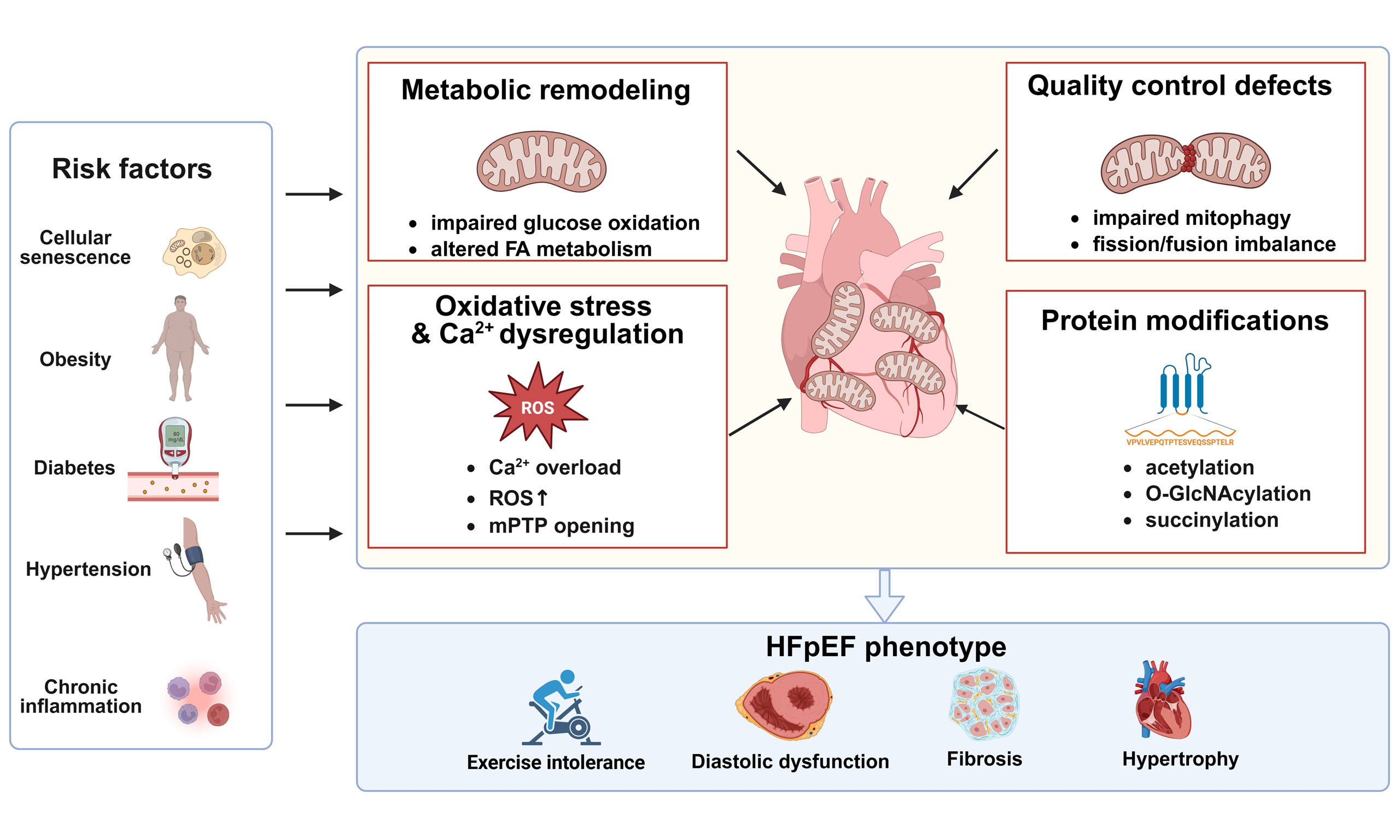
Abstract
Heart failure with preserved ejection fraction (HFpEF) represents a predominant heart failure phenotype characterized by intricate pathophysiology and an escalating global prevalence. Beyond classical hemodynamic disturbances, emerging evidence identifies mitochondrial dysfunction as a central mechanism in HFpEF pathogenesis. This review synthesizes the pivotal mitochondrial aberrations driving HFpEF, including impaired bioenergetics, disrupted mitochondrial quality control, oxidative stress, and Ca2+ dyshomeostasis, particularly under the burden of cardiometabolic stressors. Importantly, we highlight that HFpEF represents a multisystem disorder wherein the mitochondria of adipose tissue, the vasculature, the immune system, and skeletal muscle actively contribute to the pathological process. By reclassifying HFpEF as a bioenergetic failure, we hope to provide a conceptual framework for the development of integrated, mitochondria-targeted therapeutic strategies.
Keywords


 Download PDF
REFERENCES
1. Cho DH, Yoo BS. Current prevalence, incidence, and outcomes of heart failure with preserved ejection fraction. Heart Fail Clin. 2021;17:315-26.
2. Borlaug BA. Evaluation and management of heart failure with preserved ejection fraction. Nat Rev Cardiol. 2020;17:559-73.
3. Gharagozloo K, Mehdizadeh M, Heckman G, et al. Heart failure with preserved ejection fraction in the elderly population: basic mechanisms and clinical considerations. Can J Cardiol. 2024;40:1424-44.
4. Dunlay SM, Roger VL, Redfield MM. Epidemiology of heart failure with preserved ejection fraction. Nat Rev Cardiol. 2017;14:591-602.
5. Campbell P, Rutten FH, Lee MM, Hawkins NM, Petrie MC. Heart failure with preserved ejection fraction: everything the clinician needs to know. Lancet. 2024;403:1083-92.
6. Omote K, Verbrugge FH, Borlaug BA. Heart failure with preserved ejection fraction: mechanisms and treatment strategies. Annu Rev Med. 2022;73:321-37.
7. Kumar AA, Kelly DP, Chirinos JA. Mitochondrial dysfunction in heart failure with preserved ejection fraction. Circulation. 2019;139:1435-50.
8. Abudureyimu M, Luo X, Wang X, et al. Heart failure with preserved ejection fraction (HFpEF) in type 2 diabetes mellitus: from pathophysiology to therapeutics. J Mol Cell Biol. 2022:14.
9. Pieske B, Tschöpe C, de Boer RA, et al. How to diagnose heart failure with preserved ejection fraction: the HFA-PEFF diagnostic algorithm: a consensus recommendation from the Heart Failure Association (HFA) of the European Society of Cardiology (ESC). Eur Heart J. 2019;40:3297-317.
10. Chaanine AH, Joyce LD, Stulak JM, et al. Mitochondrial morphology, dynamics, and function in human pressure overload or ischemic heart disease with preserved or reduced ejection fraction. Circ Heart Fail. 2019;12:e005131.
11. De Jong KA, Lopaschuk GD. Complex energy metabolic changes in heart failure with preserved ejection fraction and heart failure with reduced ejection fraction. Can J Cardiol. 2017;33:860-71.
12. Ferro F, Spelat R, Valente C, Contessotto P. Understanding how heart metabolic derangement shows differential stage specificity for heart failure with preserved and reduced ejection fraction. Biomolecules. 2022;12:969.
13. Leri AS, Franco A, Zacheo A, et al. Ablation of telomerase and telomere loss leads to cardiac dilatation and heart failure associated with p53 upregulation. EMBO J. 2003;22:131-9.
14. Zhang A, Tang Z, Chang ACY, et al. Leukocyte telomere length and risk of heart failure with preserved ejection fraction in high-risk Chinese patients with hypertension under 65 years. Geroscience. 2025.
15. Chen X, Lin H, Xiong W, et al. p53-dependent mitochondrial compensation in heart failure with preserved ejection fraction. J Am Heart Assoc. 2022;11:e024582.
16. Li X, Tan W, Zheng S, et al. Differential mRNA Expression and circular RNA-based competitive endogenous RNA networks in the three stages of heart failure in transverse aortic constriction mice. Front Physiol. 2022;13:777284.
17. Guo Y, Wen J, He A, et al. iNOS contributes to heart failure with preserved ejection fraction through mitochondrial dysfunction and Akt S-nitrosylation. J Adv Res. 2023;43:175-86.
18. LaPenna KB, Li Z, Doiron JE, et al. Combination sodium nitrite and hydralazine therapy attenuates heart failure with preserved ejection fraction severity in a “2-Hit” murine model. J Am Heart Assoc. 2023;12:e028480.
19. Slotabec L, Wang H, Seale B, Wen C, Filho F, Li J. Cardiac diastolic dysfunction by cigarette smoking is associated with mitochondrial integrity in the heart. FASEB J. 2024;38:e23826.
20. Ren J, Pulakat L, Whaley-Connell A, Sowers JR. Mitochondrial biogenesis in the metabolic syndrome and cardiovascular disease. J Mol Med. 2010;88:993-1001.
21. Vázquez-Abuín X, Moraña-Fernández S, Aragón-Herrera A, et al. Soluble guanylate cyclase stimulation improves cardiac function and mitochondrial activity in a rat model of early-stage heart failure with preserved ejection fraction. Biomed Pharmacother. 2025;191:118439.
22. Müller M, Schubert T, Welke C, et al. Nitro-oleic acid enhances mitochondrial metabolism and ameliorates heart failure with preserved ejection fraction in mice. Nat Commun. 2025;16:3933.
23. Hu Y, Chen X, Zhao Q, et al. Berberine improves cardiac insufficiency through AMPK/PGC-1α signaling-mediated mitochondrial homeostasis and apoptosis in HFpEF mice. Int Immunopharmacol. 2025;155:114613.
24. Inácio JM, Cristo F, Pinheiro M, et al. Myocardial RNA sequencing reveals new potential therapeutic targets in heart failure with preserved ejection fraction. Biomedicines. 2023;11:2131.
25. Gibb AA, Murray EK, Eaton DM, et al. Molecular signature of HFpEF: systems biology in a cardiac-centric large animal model. JACC Basic Transl Sci. 2021;6:650-72.
26. Hahn VS, Knutsdottir H, Luo X, et al. Myocardial gene expression signatures in human heart failure with preserved ejection fraction. Circulation. 2021;143:120-34.
27. Cao Y, Vergnes L, Wang YC, et al. Sex differences in heart mitochondria regulate diastolic dysfunction. Nat Commun. 2022;13:3850.
28. Meddeb M, Koleini N, Binek A, et al. Myocardial ultrastructure of human heart failure with preserved ejection fraction. Nat Cardiovasc Res. 2024;3:907-14.
29. Abudureyimu M, Luo X, Jiang L, et al. FBXL4 protects against HFpEF through Drp1-Mediated regulation of mitochondrial dynamics and the downstream SERCA2a. Redox Biol. 2024;70:103081.
30. Shou J, Huo Y. PINK1 Phosphorylates Drp1(S616) to improve mitochondrial fission and inhibit the progression of hypertension-induced HFpEF. Int J Mol Sci. 2022;23:11934.
31. Wu D, Hu Q, Li H, Yin Y, Wang P, Wang W. Drp1 knockdown aggravates obesity-induced cardiac dysfunction and remodeling. Mitochondrion. 2025;83:102023.
32. Wang M, Ren B, Wu X, et al. S100A9 inhibition ameliorates HFpEF by modulating mitochondrial fission and oxidative stress. Int Immunopharmacol. 2025;163:115280.
33. Dou Z, Sun D, Huang Q, et al. Genistein improves heart failure with preserved ejection fraction through BNIP3L-mediated mitophagy. Biochem Pharmacol. 2026;245:117680.
34. Zhang H, Xu T, Mei X, et al. PINK1 modulates Prdx2 to reduce lipotoxicity-induced apoptosis and attenuate cardiac dysfunction in heart failure mice with a preserved ejection fraction. Clin Transl Med. 2025;15:e70166.
35. Bu X, Sha S, Zhang Z, et al. Thrombospondin 1 aggravates cardiac remodeling in heart failure with preserved ejection fraction by inhibiting mitophagy. iScience. 2026;29:114639.
36. Miura S, Misaka T, Sekine T, et al. Detyrosinated α-tubulin mediates mitochondrial dysfunction and diastolic impairment in heart failure with preserved ejection fraction. FEBS Lett. 2025;599:2474-90.
37. Yoshii A, McMillen TS, Wang Y, et al. Blunted cardiac mitophagy in response to metabolic stress contributes to HFpEF. Circ Res. 2024;135:1004-17.
38. Lozhkin A, Vendrov AE, Ramos-Mondragón R, et al. Mitochondrial oxidative stress contributes to diastolic dysfunction through impaired mitochondrial dynamics. Redox Biol. 2022;57:102474.
39. Vujic A, Koo A, Bidault G, et al. Loss of RET-ROS at complex I induces diastolic dysfunction in mice that is reversed by aerobic exercise. Am J Physiol Heart Circ Physiol. 2025;329:H154-68.
40. Pepin ME, Konrad PJM, Nazir S, et al. Mitochondrial NNT promotes diastolic dysfunction in cardiometabolic HFpEF. Circ Res. 2025;136:1564-78.
41. Wu T, Tong M, Chu A, Wu K, Niu X, Zhang Z. PM2.5-induced programmed myocardial cell death via mPTP opening results in deteriorated cardiac function in HFpEF mice. Cardiovasc Toxicol. 2022;22:746-62.
42. Miranda-Silva D, Wüst RCI, Conceição G, et al. Disturbed cardiac mitochondrial and cytosolic calcium handling in a metabolic risk-related rat model of heart failure with preserved ejection fraction. Acta Physiol. 2020;228:e13378.
43. Bode D, Semmler L, Wakula P, et al. Dual SGLT-1 and SGLT-2 inhibition improves left atrial dysfunction in HFpEF. Cardiovasc Diabetol. 2021;20:7.
44. Li X, Fu Y, Dai X, et al. TRPC6 deficiency attenuates mitochondrial and cardiac dysfunction in heart failure with preserved ejection fraction induced by high-fat diet plus L-NAME. Int J Mol Sci. 2025;26:9383.
45. Li Z, Sun X, Wang Y, et al. Renal denervation attenuates cardiac dysfunction in HFpEF by inhibiting the ATP-P2X7-NLRP3 inflammasome axis. Basic Res Cardiol. 2025;120:1225-47.
46. Chaanine AH, Kohlbrenner E, Gamb SI, et al. FOXO3a regulates BNIP3 and modulates mitochondrial calcium, dynamics, and function in cardiac stress. Am J Physiol Heart Circ Physiol. 2016;311:H1540-59.
47. Zhang LL, Chen GH, Tang RJ, et al. Levosimendan reverses cardiac malfunction and cardiomyocyte ferroptosis during heart failure with preserved ejection fraction via connexin 43 signaling activation. Cardiovasc Drugs Ther. 2024;38:705-18.
48. Ma S, Zuo QJ, He LL, et al. Canagliflozin ameliorates ferritinophagy in HFpEF rats. J Geriatr Cardiol. 2025;22:178-89.
49. Paulus WJ, Tschöpe C. A novel paradigm for heart failure with preserved ejection fraction: comorbidities drive myocardial dysfunction and remodeling through coronary microvascular endothelial inflammation. J Am Coll Cardiol. 2013;62:263-71.
50. Sun Q, Güven B, Wagg CS, et al. Mitochondrial fatty acid oxidation is the major source of cardiac adenosine triphosphate production in heart failure with preserved ejection fraction. Cardiovasc Res. 2024;120:360-71.
51. Koleini N, Meddeb M, Zhao L, et al. Landscape of glycolytic metabolites and their regulating proteins in myocardium from human heart failure with preserved ejection fraction. Eur J Heart Fail. 2024;26:1941-51.
52. Fillmore N, Levasseur JL, Fukushima A, et al. Uncoupling of glycolysis from glucose oxidation accompanies the development of heart failure with preserved ejection fraction. Mol Med. 2018;24:3.
53. Thapa D, Bugga P, Mushala BAS, et al. GCN5L1 impairs diastolic function in mice exposed to a high fat diet by restricting cardiac pyruvate oxidation. Physiol Rep. 2022;10:e15415.
54. Zhang W, Zhang H, Yao W, et al. Morphometric, hemodynamic, and multi-omics analyses in heart failure rats with preserved ejection fraction. Int J Mol Sci. 2020;21:3362.
55. Wang Y, Guo D, Zhu J, et al. Pyruvate metabolism enzyme Dlat induces mitochondria protein hyperacetylation to limit fatty acid oxidation in the HFpEF heart. Nat Commun. 2026:17.
56. Liu X, Zhang Y, Deng Y, et al. Mitochondrial protein hyperacetylation underpins heart failure with preserved ejection fraction in mice. J Mol Cell Cardiol. 2022;165:76-85.
57. Da Dalt L, Castiglioni L, Baragetti A, et al. PCSK9 deficiency rewires heart metabolism and drives heart failure with preserved ejection fraction. Eur Heart J. 2021;42:3078-90.
58. Gibb AA, LaPenna K, Gaspar RB, et al. Integrated systems biology identifies disruptions in mitochondrial function and metabolism as key contributors to HFpEF. JACC Basic Transl Sci. 2025;10:101334.
59. Jani VP, Yoo EJ, Binek A, et al. Myocardial proteome in human heart failure with preserved ejection fraction. J Am Heart Assoc. 2025;14:e038945.
60. Yousefi K, Irion CI, Takeuchi LM, et al. Osteopontin promotes left ventricular diastolic dysfunction through a mitochondrial pathway. J Am Coll Cardiol. 2019;73:2705-18.
61. Caravia XM, Fanjul V, Oliver E, et al. The microRNA-29/PGC1α regulatory axis is critical for metabolic control of cardiac function. PLoS Biol. 2018;16:e2006247.
62. Ranjbarvaziri S, Zeng A, Wu I, et al. Targeting HDAC6 to treat heart failure with preserved ejection fraction in mice. Nat Commun. 2024;15:1352.
63. Alves PKN, Schauer A, Augstein A, et al. Leucine supplementation improves diastolic function in HFpEF by HDAC4 inhibition. Cells. 2023;12:2561.
64. Tatekoshi Y, Mahmoodzadeh A, Shapiro JS, et al. Protein O-GlcNAcylation and hexokinase mitochondrial dissociation drive heart failure with preserved ejection fraction. Cell Metab. 2025;37:1584-1600.e10.
65. Schauer A, Adams V, Kämmerer S, et al. Empagliflozin improves diastolic function in HFpEF by restabilizing the mitochondrial respiratory chain. Circ Heart Fail. 2024;17:e011107.
66. Xu G, Xiao W, Sun P, et al. Lysophosphatidylethanolamine improves diastolic dysfunction by alleviating mitochondrial injury in the aging heart. J Lipid Res. 2025;66:100713.
67. Herwig M, Sieme M, Kovács A, et al. Diabetes mellitus aggravates myocardial inflammation and oxidative stress in aortic stenosis: a mechanistic link to HFpEF features. Cardiovasc Diabetol. 2025;24:203.
68. McCandless MG, Altara R, Booz GW, Kurdi M. What role do mitochondria have in diastolic dysfunction? Implications for diabetic cardiomyopathy and heart failure with preserved ejection function. J Cardiovasc Pharmacol. 2022;79:399-406.
69. MacIver DH. Is remodeling the dominant compensatory mechanism in both chronic heart failure with preserved and reduced left ventricular ejection fraction? Basic Res Cardiol. 2010;105:227-34.
70. Morris DA, Ma XX, Belyavskiy E, et al. Left ventricular longitudinal systolic function analysed by 2D speckle-tracking echocardiography in heart failure with preserved ejection fraction: a meta-analysis. Open Heart. 2017;4:e000630.
71. You H, Fan X, Diao J, Wu F. Integrative transcriptomic and single-cell analysis reveals mitochondrial-related gene biomarkers in heart failure with preserved ejection fraction. Sci Rep. 2025;15:44241.
72. Yoshihisa A, Watanabe S, Yokokawa T, et al. Associations between acylcarnitine to free carnitine ratio and adverse prognosis in heart failure patients with reduced or preserved ejection fraction. ESC Heart Fail. 2017;4:360-4.
73. Anguita E, Chaparro A, Candel FJ, et al. Biomarkers of stable and decompensated phases of heart failure with preserved ejection fraction. Int J Cardiol. 2022;361:91-100.
74. Ji H, Cao T, Tan Z, et al. Adipocyte extracellular vesicle mitochondrial cargo is linked to cardiomyocyte dysfunction in type 2 diabetes-related heart failure with preserved ejection fraction. Free Radic Biol Med. 2026;244:435-51.
75. Pan G, Roy B, Yeboah EO, et al. Targeted overexpression of mitochondrial ALDH2 in coronary endothelial cells mitigates HFpEF in a diabetic mouse model. Biomolecules. 2025;15:1029.
76. Otto M, Brabenec L, Müller M, et al. Development of heart failure with preserved ejection fraction in type 2 diabetic mice is ameliorated by preserving vascular function. Life Sci. 2021;284:119925.
77. Kneuer JM, Müller M, Erbe S, et al. Circulating immune cell signature analysis in HFpEF across species. Circ Res. 2025;137:682-98.
78. Liu H, Huang Y, Zhao Y, et al. Inflammatory macrophage interleukin-1β mediates high-fat diet-induced heart failure with preserved ejection fraction. JACC Basic Transl Sci. 2023;8:174-85.
79. Raman J, Simmonds S, Caluwé E, et al. CCR2+ monocyte-derived macrophages drive cardiac hypertrophy in early HFpEF. Am J Physiol Heart Circ Physiol. 2025;329:H109-23.
80. Filipp M, Ge ZD, DeBerge M, et al. Myeloid fatty acid metabolism activates neighboring hematopoietic stem cells to promote heart failure with preserved ejection fraction. Circulation. 2025;151:1451-66.
81. Adams V, Wunderlich S, Mangner N, et al. Ubiquitin-proteasome-system and enzymes of energy metabolism in skeletal muscle of patients with HFpEF and HFrEF. ESC Heart Fail. 2021;8:2556-68.
82. Vahle B, Schauer A, Augstein A, et al. MyoMed205 counteracts titin hyperphosphorylation and the expression of contraction-regulating proteins in a rat model of HFpEF. J Cachexia Sarcopenia Muscle. 2025;16:e13843.
83. Adams V, Schauer A, Augstein A, et al. Targeting MuRF1 by small molecules in a HFpEF rat model improves myocardial diastolic function and skeletal muscle contractility. J Cachexia Sarcopenia Muscle. 2022;13:1565-81.
84. Winzer EB, Schauer A, Langner E, et al. Empagliflozin preserves skeletal muscle function in a HFpEF rat model. Int J Mol Sci. 2022;23:10989.
85. Quiriarte H, Noland RC, Stampley JE, et al. Exercise therapy rescues skeletal muscle dysfunction and exercise intolerance in cardiometabolic HFpEF. JACC Basic Transl Sci. 2024;9:1409-25.
86. Zhang K, Gan J, Wang B, et al. FGF21 protects against HFpEF by improving cardiac mitochondrial bioenergetics in mice. Nat Commun. 2025;16:1661.
87. Wang X, Chen X, Wang Y, et al. Astragaloside IV alleviates inflammation and improves myocardial metabolism in heart failure mice with preserved ejection fraction. Front Pharmacol. 2024;15:1467132.
88. Winzer EB, Augstein A, Schauer A, et al. Impact of different training modalities on molecular alterations in skeletal muscle of patients with heart failure with preserved ejection fraction: a substudy of the OptimEx trial. Circ Heart Fail. 2022;15:e009124.
89. Dong J, Wang H, Feng Y, et al. Exercise training alleviates myocardial injury in mice with heart failure with preserved ejection fraction via the TLR4-mediated necroptosis pathway. Int Immunopharmacol. 2026;176:116513.
90. Kolijn D, Pabel S, Tian Y, et al. Empagliflozin improves endothelial and cardiomyocyte function in human heart failure with preserved ejection fraction via reduced pro-inflammatory-oxidative pathways and protein kinase Gα oxidation. Cardiovasc Res. 2021;117:495-507.
91. Qiu Z, Fan Y, Wang Z, et al. Catestatin protects against diastolic dysfunction by attenuating mitochondrial reactive oxygen species generation. J Am Heart Assoc. 2023;12:e029470.
92. Deng Y, Xie M, Li Q, et al. Targeting mitochondria-inflammation circuit by β-hydroxybutyrate mitigates HFpEF. Circ Res. 2021;128:232-45.
93. Koay YC, McIntosh B, Ng YH, et al. The heart has intrinsic ketogenic capacity that mediates NAD+ therapy in HFpEF. Circ Res. 2025;136:1113-30.
94. Zhang X, Wang N, Fu P, et al. Dapagliflozin attenuates heart failure with preserved ejection fraction remodeling and dysfunction by elevating β-hydroxybutyrate-activated citrate synthase. J Cardiovasc Pharmacol. 2023;82:375-88.
95. Quan J, Jia Z, Liu L, Tian J. The effect of long-term administration of green tea catechins on aging-related cardiac diastolic dysfunction and decline of troponin I. Genes Dis. 2025;12:101284.
96. Kitzman DW, Lewis GD, Pandey A, et al. A novel controlled metabolic accelerator for the treatment of obesity-related heart failure with preserved ejection fraction: rationale and design of the phase 2a HuMAIN trial. Eur J Heart Fail. 2024;26:2013-24.
97. Pandey A, Lewis GD, Borlaug BA, et al. Novel controlled metabolic accelerator for obesity-related HFpEF: the HuMAIN-HFpEF randomized clinical trial. JAMA Cardiol. 2025;10:609-16.
Cite This Article
 Open Access
How to Cite
Download Citation
If you have the appropriate software installed, you can download article citation data to the citation manager of your choice. Simply select your manager software from the list below and click on download.
Export Citation File
Type of Import
Tips on Downloading Citation
Citation Manager File Format
Type of Import
Direct Import: When the Direct Import option is selected (the default state), a dialogue box will give you the option to Save or Open the downloaded citation data. Choosing Open will either launch your citation manager or give you a choice of applications with which to use the metadata. The Save option saves the file locally for later use.
Indirect Import: When the Indirect Import option is selected, the metadata is displayed and may be copied and pasted as needed.
About This Article
Special Topic
Copyright

Data & Comments
Data
0











Comments
Comments must be written in English. Spam, offensive content, impersonation, and private information will not be permitted. If any comment is reported and identified as inappropriate content by OAE staff, the comment will be removed without notice. If you have any queries or need any help, please contact us at [email protected].